Yearly Archives: 2020

News: NowThis partners with Calm to offer a soothing Election Day livestream

Mobile news organization NowThis is announcing a bit of counter-programming for next week’s presidential election — it’s partnering with meditation app Calm to create a livestream for anyone who needs relief from stress of Election Day news. Not that NowThis is exactly avoiding that news, but this livestream (combining breathing exercises and other meditative activities

Mobile news organization NowThis is announcing a bit of counter-programming for next week’s presidential election — it’s partnering with meditation app Calm to create a livestream for anyone who needs relief from stress of Election Day news.

Not that NowThis is exactly avoiding that news, but this livestream (combining breathing exercises and other meditative activities with peaceful nature footage from all 50 states) should offer a brief respite from obsessively checking results.

It will go live at 5:30pm Eastern on Election Day on NowThis’ Facebook and YouTube pages, and it will run through the following day.

“As the leading news brand for young people, NowThis often covers important news of the day with hope and optimism,” said NowThis Chief Content Officer Tina Exarhos in a statement. “With voters across the country experiencing a uniquely stressful election, NowThis is excited to partner with Calm to add counter-programming to our coverage, providing a respite for audiences as Election Day comes to a close.”

NowThis is part of Group Nine Media, which also includes Thrillist, TheDodo and Seeker.

Calm, meanwhile, is reportedly looking to raise more funding to take advantage to take advantage of growing interest in meditation and mindfulness apps. Plus, it’s already been moving beyond apps with a celebrity-filled show for HBO Max.

News: Smartphone shipments dip in China for Q3, led by Huawei decline

China was the first major global smartphone markets to rebound from the early days of the COVID-19 pandemic. Stringent lockdown measures were able to help the country recover from the virus relatively quickly during the first wave, as sales started to return well ahead of other areas. In Q3, however, things have taken begun to

China was the first major global smartphone markets to rebound from the early days of the COVID-19 pandemic. Stringent lockdown measures were able to help the country recover from the virus relatively quickly during the first wave, as sales started to return well ahead of other areas.

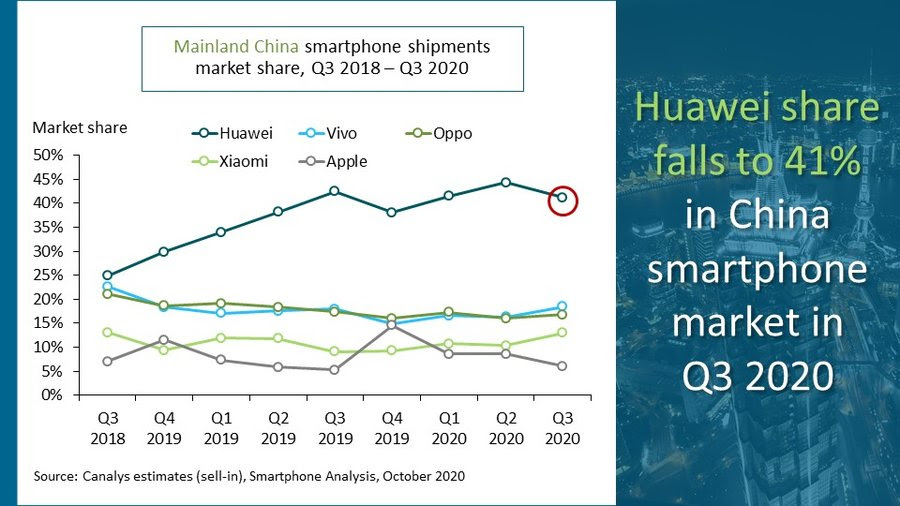
In Q3, however, things have taken begun to decline again. New numbers from Canalys point to an 8% drop between quarters — and a 15% drop, year-over-year. The firm chalks much of the slow down to longtime market leader Huawei’s on-going issues with the U.S. government. The problems had a kind of cascading effect that served to impact the number two companies, Vivo and Oppo.

Image Credits: Canalys

“Huawei was forced to restrict its smartphone shipments following the August 17 US sanctions which caused a void in channels in Q3 that its peers were not equipped to fill. Huawei is facing its most serious challenge since taking the lead in 2016,” analyst Mo Jia said in a release. “If the position of the US administration does not change, Huawei will attempt to pivot its business strategy, to focus on building the [Harmony] OS and software ecosystem, as the Chinese government is eager to nurture home-grown alternatives to global platforms.”

Huawei dropped 18% in Mainland China, year-over-year. Vivo and Oppo posted similar declines at 13 and 18%, respectively. Xiaomi was able to make up ground at third place, gaining 19% y-o-y per the figures. Apple, meanwhile, remained relatively stead, in spite of the delated launch of the iPhone 12. Huawei’s continued struggles could provide a vacuum for the competition to fill.

Analyst Nicole Peng notes that the arrival of the 5G handset put the U.S. company in a strong position, looking forward, “iPhone 12 series will be a game changer for Apple in Mainland China. As most smartphones in China are now 5G-capable, Apple is closing a critical gap, and pent-up demand for its new 5G-enabled family will be strong.”

News: Illinois is taking a data-driven approach to its mask-wearing ad campaign

Here’s an example of ad targeting that’s actually good for public health: In a campaign encouraging people to wear masks, the Illinois state government has been focusing its digital ad dollars on the counties with highest COVID risk. To achieve this, the government’s been working with Civis Analytics, the data science company founded by Dan

Here’s an example of ad targeting that’s actually good for public health: In a campaign encouraging people to wear masks, the Illinois state government has been focusing its digital ad dollars on the counties with highest COVID risk.

To achieve this, the government’s been working with Civis Analytics, the data science company founded by Dan Wagner, who was previously chief analytics officer for Barack Obama’s 2012 reelection campaign. The campaign kicked off in August, but the state is now sharing more details about its work, including a map that shows the week-by-week risk assessment that it used for targeting.

Crystal Son, Civis’ director of healthcare analytics, explained that every week, her team pulls together the latest county-level COVID data for Governor J.B. Pritzker’s team, who then use that data to determine where ad dollars for the It Only Works If You Wear It ad campaign should be spent.

Cameron Mock, chief of staff at the Governor’s Office of Management and Budget, said in a statement that the government is using “a one-of-a-kind formula to concentrate media dollars in the areas with the most risk.”

Mock continued, “The risk-based formula uses trends of cases and mobility on the county level to designate higher, medium and lower risk counties. It then uses a pro rata share to dedicate the most dollars to the highest risk areas.”

All In Illinois

Image Credits: State of Illinois

This formula divides counties into five tiers, with Tier 1 being the highest risk and Tier 5 being the lowest. Tiers 4 and 5 will still receive a baseline level of ad spend, but Tier 3 counties will see more spending and Tiers 1 and 2 receive the maximum amount.

While the mask campaign isn’t limited to online advertising, the formula is only being used on the digital side because it’s more difficult to adjust funding for more traditional ad channels on a week-by-week basis.

“Each county has unique and changing circumstances due to the virus, so we designed this campaign to respond to the on-the-ground situation in all 102 counties in Illinois,” said Alex Hann, deputy press secretary to Governor Pritzker, in a statement. “As an area’s risk increases, so too will its concentration of public health messaging. As the pandemic continues and another wave of coronavirus looms, the state of Illinois will continue to listen to scientists and follow the data to keep our residents safe.”

Son said she’s not aware of any other campaign responding to COVID-19 that uses a similar model to prioritize spending in the highest-risk geographies. Is it working? While this data doesn’t show the effects of a specific campaign, according to Carnegie Mellon University, 89% of Illinois residents wear masks — currently the 15th-highest usage rate in the U.S.

In the future, Son said she’s hopeful that we’ll see other organizations adopt “a much more customized communications approach” for healthcare.

“We still have the habit in healthcare of treating groups of people as if they are homogenous, as if they all act the same think the same,” she said. “There are widespread applications beyond mask-wearing for more tailored approaches.”

News: UK watchdog reduces Marriott data breach fine to $23.8M, down from $123M

The UK’s ICO has reduced the size of a data breach penalty for hotel business Marriott — dropping it to £14.4 million (~$23.8M) in a final penalty notice down from the £99M ($123M) figure that the watchdog initially said it would levy in July 2019. The fine relates to a data breach suffered by the

The UK’s ICO has reduced the size of a data breach penalty for hotel business Marriott — dropping it to £14.4 million (~$23.8M) in a final penalty notice down from the £99M ($123M) figure that the watchdog initially said it would levy in July 2019.

The fine relates to a data breach suffered by the hotel giant that dates back to 2014 (involving the network of Starwood hotels, which it had acquired in 2015) — but which wasn’t discovered until November 2018.

The personal data involved in the breach differed between individuals but the ICO said it may have included names, email addresses, phone numbers, unencrypted passport numbers, arrival/departure information, guests’ VIP status and loyalty programme membership number.

Globally, some 339 million guest records were affected but fewer individuals are thought to have been compromised owing to some of the records being duplicates. The breach is thought to have affected around 30 million users across the EU, per an earlier ICO estimate.

Its investigation found there were failures by Marriott to put “appropriate technical or organisational measures in place to protect people’s data” — as required by the pan-EU General Data Protection Regulation (GDPR) . (The penalty only covers the portion of the breach that dates from 25 May 2018 — when the GDPR came into effect.)

Commenting in a statement, the UK’s information commissioner Elizabeth Denham said: “Millions of people’s data was affected by Marriott’s failure; thousands contacted a helpline and others may have had to take action to protect their personal data because the company they trusted it with had not. When a business fails to look after customers’ data, the impact is not just a possible fine, what matters most is the public whose data they had a duty to protect.”

A Marriott spokesperson told us the company “deeply regrets” the incident, adding in a statement: “Marriott remains committed to the privacy and security of its guests’ information and continues to make significant investments in security measures for its systems. The ICO recognises the steps taken by Marriott following discovery of the incident to promptly inform and protect the interests of its guests.”

The hotel giant also confirmed it does not intend to appeal the ICO’s decision (while not making any admission of liability).

The penalty had to be signed off by other EU data protection authorities, under the GDPR’s one-stop-shop mechanism for cross-border cases. And the ICO confirmed it completed the Article 60 process prior to the issuing of the penalty.

One interesting element here is the difference between the initial penalty proposed by the ICO and the final fine.

The GDPR framework greatly increased the potential size of penalties for data breaches, up to a maximum of £20M or 4% of an entity’s global annual turnover (whichever is greater). Prior to that data protection rules existed in the region but could be easily ignored, given puny penalties. The GDPR was supposed to change that.

However, almost 2.5 years since the framework begun being applied, large fines remain rare — with a backlog of major cross-border cases still awaiting decisions.

Regulations may also be concerned about being able to make large sums stick if companies appeal.

The ICO’s initial penalty for the Marriott breach would have been one of the largest fines issued under the GDPR. Today’s haircut revises that. The first figure proposed represented around 3% of the company’s 2018 revenue (circa $3.6BN) — but that’s now shrunk to around 0.6%.

It follows a very similar episode at the ICO over a BA data breach. In July 2019 the regulator said it intended to fine the airliner £183.39M ($230M) for a 2018 data breach that affected some 500,000 customers. But earlier this month it issued a final penalty to BA of just £20M ($25.8M).

In both cases the impact of the coronavirus appears to be playing some part in explaining why the ICO has reduced the size of the penalties. Although the pandemic might be something of a useful scapegoat given the substantial size of the reductions involved. (The regulator has also used it to ‘pause’ any action over major adtech complaints, for example.)

All the ICO has to say vis-a-vis Marriott’s penalty haircut is that it “considered representations from Marriott, the steps Marriott took to mitigate the effects of the incident and the economic impact of COVID-19 on their business before setting a final penalty”.

On the reduction in the size of the penalty Marriott told us it reflects “extensive mitigating measures” it put in place following the security incident — noting that it established a dedicated website to provide information to concerned guests; opened a dedicated helpline; and sent “millions” of email notifications to individuals whose information was involved in the breach. It also said it offered guests the opportunity to sign up for a personal information monitoring service where it was available.

The ICO similarly took representations from BA after issuing its initial intention to fine — and ended up making a small discount as a result, per our report, though we reported that the lion’s share of the BA reduction was due to revising how much blame it had placed on the airline for the breach.

Asked for a view on the ICO’s penalty haircuts, Tim Turner, a UK based data protection trainer and consultant, agreed that the coronavirus looks like a handy scapegoat.

“I’m not accusing the ICO of feeding misunderstanding but the impression that these reduced fines are down to the pandemic is very helpful to them,” he told TechCrunch. “They plainly miscalculated both the BA and Marriott fines by a huge margin, and they don’t really deny it. The notices just skate over that on the basis that the original mistake has been rectified so it doesn’t matter.

“The ICO were proposing fines way beyond anything in the EU on the basis of a draft, unpublished procedure. They ought to account for that rather than letting everyone think this is a big COVID-19 discount.”


News: Under Armour to sell MyFitnessPal for $345 million, after acquiring it in 2015 for $475 million

Global fitness giant Under Armour announced this morning that it will be selling MyFitnessPal to investment firm Francisco Partners for $345 million, five and a half years after acquiring it for $475 million. The company also announced that it will be winding down the Endomondo platform which it also acquired at the same time for

Global fitness giant Under Armour announced this morning that it will be selling MyFitnessPal to investment firm Francisco Partners for $345 million, five and a half years after acquiring it for $475 million. The company also announced that it will be winding down the Endomondo platform which it also acquired at the same time for $85 million.

In a press release announcing the news, Under Armour said the reason for this decision was to simplify and focus its brand, keeping it aimed at its “target consumer – the Focused Performer” in the interest of building “a singular, cohesive UA ecosystem.” The fact that Under Armour is selling MyFitnessPal at a discount (not even including five years of inflation and stated MyFitnessPal user growth) indicates there’s more to this than just maintaining focus.

It’s definitely true that both MyFitnessPal (which claimed 80 million users in 2015 at time of acquisition, and has over 200 million users according to today’s press release) and Endomondo were aimed at more casual and entry-level fitness users, who might be working out for the first time, or looking to improve their daily health, but aren’t likely training for endurance sport competitions. Under Armour’s overall brand image is more associated with professional athletics, and with an enthusiast/semi-pro clientele (or those aspiring to that designation).

What’s more likely going on here is that Under Armour sees diminishing value in this segment over the long term, and there a number of possible reasons about why that might be. One is that Apple has been more aggressive about targeting entry-level fitness users, through both its expanded Apple Watch hardware and Apple Health software offerings, and through its forthcoming Apple Fitness+ service, which launches later this year.

While you’d expect the self-guided fitness segment to be a significant growth opportunity in light of the ongoing pandemic and restrictions on shared workout spots including gyms, Apple’s aggressive moves provide a fairly comprehensive default that users essentially get for free, or for a very low cost subscription, with the hardware they’re buying anyways. And the growth of Peloton, through both its dedicated home workout gear and its subscription platform, is also likely sucking up a lot of oxygen in the beginner to casual/habitual fitness user category.

Under Armour did note that it’s going to continue to own and operate the MapMyFitness platform, which includes MapMyRun and MapMyRide. It acquired that company in 2013, and the Under Armour line of connected footwear integrates with those apps for connected tracking of workouts.

News: AOL founder Steve Case, involved early in Section 230, says it’s time to change it

AOL founder Steve Case was there in Dulles, Virginia, just outside of Washington, D.C., when in 1996 the Communications Decency Act was passed as part of a major overhaul of U.S. telecommunications laws that President Bill Clinton signed into law. Soon after, in its first test, a provision of that act which states that, “[n]o

AOL founder Steve Case was there in Dulles, Virginia, just outside of Washington, D.C., when in 1996 the Communications Decency Act was passed as part of a major overhaul of U.S. telecommunications laws that President Bill Clinton signed into law. Soon after, in its first test, a provision of that act which states that, “[n]o provider or user of an interactive computer service shall be treated as the publisher or speaker of any information provided by another information content provider,” would famously save AOL’s bacon, too.

That wasn’t coincidental. In a wide-ranging call earlier today with Case — who has become an influential investor over the last 15 years through his Washington, D.C.-based firm Revolution and its early-stage, growth-stage, and seed-stage funds — he talked about his involvement in Section 230’s creation, and why the thinks it’s time to change it.

We’ll have more from our interview with Case tomorrow. In the meantime, here he talks about the related legal protections for online platforms that took center stage yesterday or, at least, were supposed to during the Senate’s latest Big Tech hearing.

In that early birthing stage of the internet, [we were all] figuring out what the rules of the road were, and the 230 provision was something I was involved in. I do think the first lawsuit related to it was related to AOL. But 25 years later, it’s fair to take a fresh look at it — [it’s] appropriate to take a fresh look at it. I’ve not recently spent enough time digging in to really have a strong point of view in terms of exactly what to change, but I think it’s fair to say that what made sense in those early days when very few people were online maybe doesn’t make as much sense now when when the entire world is online and the impact these platforms have is so significant.

At the same time, I think you have to be super careful. I think that’s what what the CEOs testifying [yesterday] were trying to emphasize. [It was] ‘We get that there’s a desire to relook at it. We also get that because of the election season, it’s become a highly politicized issue. Let’s engage in this discussion, and perhaps there are some things that need to be modified to reflect the current reality . . .let’s don’t do it just in the heat of a political moment.’

When we started AOL 35 years ago, only 3% of people are connected. They were only online about an hour a week, and it was still illegal, actually, for consumers or businesses to be on the internet [so] I spent a lot of time on commercializing the internet, opening up consumers and businesses, figuring out what the right rules of the road were in terms of things like taxes on e-commerce. And generally, we were able to convince regulators and government leaders that a light touch for the internet made sense, because it was a new idea, and it wasn’t clear exactly how it was going to develop.

But now, it’s not a new idea. And now it has a profound impact on people’s lives and our communities and countries. And so I’m not surprised that there’s more more focus on it, [though] it’s a little too bad that there’s so much attention right this moment because in an election season, things tend to get a little bit hot on both sides.

Putting that aside, I think there are legitimate issues that the policymakers need to be looking at and are starting to look at, not just in Washington, DC, but more broadly in Brussels. And I think having more of a dialogue between the innovators and the policymakers is actually going to be critical in this internet third wave, because the sectors up for grabs are most important aspects of our lives — things like health care and education and food and agriculture. And that’s really going to require not just innovation from a technology standpoint, but thoughtfulness from a a policy standpoint.

I understand entrepreneurs who get frustrated by regulations kind of slowing down the pace of information. I get that. Obviously, some of the businesses that we back have suffered from that. But at the same time, you can’t not expect the government — which is elected by the people — to serve the people, including protecting the people.”

News: Amazon pegs COVID-19 costs at an estimated $4 billion next quarter

Amazon expects to incur $4 billion in COVID-related costs next quarter, an estimate that provides a bellwether for other businesses, large and small, trying to stay operational and control expenses amid the pandemic. The upshot: Amazon is planning for COVID to remain an unwelcome companion through the end of the year with costs higher than

Amazon expects to incur $4 billion in COVID-related costs next quarter, an estimate that provides a bellwether for other businesses, large and small, trying to stay operational and control expenses amid the pandemic.

The upshot: Amazon is planning for COVID to remain an unwelcome companion through the end of the year with costs higher than the previous quarter.

The company said Thursday in its third-quarter earnings call that it logged $7.5 billion in COVID-related costs since the disease took root earlier this year. Amazon previously said its COVID costs were about $600 million in the first quarter and more than $4 billion in the second. The company’s COVID costs in the third quarter were about $2.5 billion, CFO Brian Olsavsky told an analyst during an earnings call. While Amazon was able to lower its costs in the third quarter due to efficiencies that number is on rise for next quarter.

Olsavsky said the majority of the increase in costs is due to the expansion of its operations. Amazon has hired 100,000 new workers in October.

COVID-19 along with other uncertainties related to the economy, holiday sales and even weather patterns weighed on its guidance for operating income in the fourth quarter. Amazon provided a wide-ranging guidance of between $1 billion and $4.5 billion in operating income in the fourth quarter compared with $3.9 billion in the same period last year.  This guidance assumes about $4 billion of costs related to COVID-19.

But what is most telling is that even after providing a lengthy list of possible uncertainties in the fourth quarter, Olsavsky noted that COVID still trumps them all.

“So there’s a whole host of issues that generally come to bear in Q4,” Olsavsky said. “I think the fact that COVID is dwarfing all of those is causing us a lot of uncertainty on our top line range.”

Olsavsky said costs were related to productivity losses caused by changing how it operates as well as expenses related to personal protective equipment and other upfront costs.

“The largest portion of these costs relate to continuing productivity headwinds in our facilities, including process revisions to allow for social distancing and incremental costs to ramp up new facilities, and the large influx of new employees hired to support strong customer demand also includes investments in PPE for employees and enhanced cleaning of our facilities,” Olsavsky said during Thursday’s earnings call.

Amazon said Thursday it also continues to ramp up its in-house COVID-19 testing program with capacity reaching 50,000 tests a day across 650 sites by November.

News: WhatsApp is now delivering roughly 100 billion messages a day

WhatsApp, the popular instant messaging app owned by Facebook, is now delivering roughly 100 billion messages a day, the company’s chief executive Mark Zuckerberg said at the quarterly earnings call Thursday. For some perspective, users exchanged 100 billion messages on WhatsApp last New Year’s Eve. That is the day when WhatsApp tops its engagement figures,

WhatsApp, the popular instant messaging app owned by Facebook, is now delivering roughly 100 billion messages a day, the company’s chief executive Mark Zuckerberg said at the quarterly earnings call Thursday.

For some perspective, users exchanged 100 billion messages on WhatsApp last New Year’s Eve. That is the day when WhatsApp tops its engagement figures, and as many of you may remember, also the time when the service customarily suffered glitches in the past years. (No outage on last New Year’s Eve!)

At this point, WhatsApp is just competing with itself. Facebook Messenger and WhatsApp together were used to exchange 60 billion messages a day as of early 2016. Apple chief executive Tim Cook said in May that iMessage and FaceTime were seeing record usage, but did not share specific figures. The last time Apple did share the figure, it was far behind WhatsApp’s then usage (podcast). WeChat, which has also amassed over 1 billion users, is behind in daily volume of messages, too.

In early 2014, WhatsApp was being used to exchange about 50 billion texts a day, its then chief executive Jan Koum revealed at an event.

At the time, WhatsApp had fewer than 500 million users. WhatsApp now has more than 2 billion users and at least in India, its largest market by users, its popularity surpasses those of every other smartphone app including the big blue app.

“This year we’ve all relied on messaging more than ever to keep up with our loved ones and get business done,” tweeted Will Cathcart, head of WhatsApp.

Sadly, that’s all the update the company shared on WhatsApp today. Mystery continues for when WhatsApp expects to resume its payments service in Brazil, and when it plans to launch its payments in India, where it began testing the service in 2018. (It has already shared big plans around financial services in India, though.)

“We are proud that WhatsApp is able to deliver roughly 100B messages every day and we’re excited about the road ahead,” said Cathcart.

News: PORTL Hologram raises $3M to put a hologram machine in every home

What does a hologram-obsessed entrepreneur do for a second act after setting up a virtual Ronald Reagan in the Reagan Memorial Library, or beaming Jimmy Kimmel all the way from Hollywood to the Country Music Awards in Nashville? If that entrepreneur is David Nussbaum, the founder of PORTL Hologram, the next logical step is to

What does a hologram-obsessed entrepreneur do for a second act after setting up a virtual Ronald Reagan in the Reagan Memorial Library, or beaming Jimmy Kimmel all the way from Hollywood to the Country Music Awards in Nashville?

If that entrepreneur is David Nussbaum, the founder of PORTL Hologram, the next logical step is to build a machine that can bring the joy of hologram-based communication to the masses.

That’s the goal thanks to a new $3 million round that Nussbaum’s company raised from famed venture investor Tim Draper, former Electronic Arts executive Doug Barry and longtime awards-show producer Joe Lewis.

Barry is not only backing the company, he’s also coming on board as its first chief operating officer.

Much of this interest can be traced back to the hologram performance given posthumously by Tupac Shakur back at Coachella about eight years ago.

Nussbaum turned the excitement generated by that event into a business. He bought the patents that powered Tupac’s beyond-the-grave performance, and used the technology to beam Julian Assange out of the Ecuadoran embassy he had been holed up in during his years in London and making dead stars live (and tour) again.

Those visual feats were basically just an updated version of the Pepper’s Ghost technique that stage illusionists and moviemakers have been using since it was invented by John Pepper in the 19th century.

The PORTL is a significant upgrade, according to Nussbaum.

The projector can transmit images any time of the day or night, and using PORTL’s capture studio-in-a-box means that anyone with $60,000 to spend and a white background can beam themselves into any portal anywhere in the world.

The company has sold a hundred devices and already delivered several dozen to shopping malls, airports and movie theater lobbies. “We’ve manufactured and delivered several dozen,” Nussbaum said.

Part of the selling point, beyond just the gimmick of the hologram’s next-level verisimilitude, is its interactivity. Through the studio rig and PORTL hardware, users can hear what people standing around the PORTL are saying and then respond.

For its next trick, PORTL is looking to build a miniaturized version of its system that would be about the size of a desktop computer and could be used to both record and distribute the holograms to anyone with a PORTL device.

“The minis will have all of the features to capture your content and rotoscope you out of our background and have the studio effects that is important in displaying your realistic volumetric like effect and they will beam you to any other device,” Nussbaum said.

To build out the business, the PORTL minis will have more than just communications capabilities, but recorded entertainment as well, Nussbaum said.

“The minis will be bundled with content like Peloton and Mirror bundled with very specific types of content. We are in conversations with a number of extremely well-known content creators where we would bundle a portal but will also have dedicated and exclusive content… [and] bundle that for $39 to $49 per month.”

It’s a vision that Nussbaum admits is far more expansive than his intentions — and the person he has to thank for the more ambitious vision of the business is none other than Draper.

“When I started this I thought it was going to be a novelty company,” he said. “When the pandemic hit he knew we needed to do much more than that.”

News: Tesla has increased the price of its “Full Self-Driving” option to $10,000

Tesla has made good on founder and CEO Elon Musk’s promise to boost the price of its “Full Self-Driving” (FSD) software upgrade option, increasing it to $10,000 following the start of the staged rollout of a beta version of the software update last week. This boosts the price of the package $2,000 from its price

Tesla has made good on founder and CEO Elon Musk’s promise to boost the price of its “Full Self-Driving” (FSD) software upgrade option, increasing it to $10,000 following the start of the staged rollout of a beta version of the software update last week. This boosts the price of the package $2,000 from its price before today, and it has steadily increased since last May.

The FSD option has been available as an optional add-on to complement Tesla’s Autopilot driver assistance technology, even though the features themselves haven’t been available to Tesla owners before the launch of the beta this month. Even still, it’s only in limited beta, but this is the closest Musk and Tesla have come to actually launching something under the FSD moniker – after having teased a fully autonomous mode in production Teslas for years now.

Despite its name, FSD isn’t what most in the industry would define as full, Level 4 or Level 5 autonomy per the standards defined by SAE International and accepted by most working on self-driving. Musk has designed it as vehicles having the ability “to be autonomous but requiring supervision and intervention at times,” whereas Levels 4 and 5 (often considered ‘true self-driving’) under SAE standards require no driver intervention.

Still, the technology does appear impressive in some ways according to early user feedback – though testing any kind of self-driving software unsupervised via the general public does seem an incredibly risky move. Musk has said that we should see a wide rollout of the FSD tech beyond the beta before year’s end, so he definitely seems confident in its performance.

The price increase might be another sign of his and the company’s confidence. Musk has always maintained that users were getting a discount by handing money over early to Tesla in order to help it develop technology that would come later, so in many ways it makes sense that the price increase comes now. This also obviously helps Tesla boost margins, though it’s already riding high on earning that beat both revenue and profit expectations from analysts.

WordPress Image Lightbox Plugin