Yearly Archives: 2020

News: E.ventures opens new office in Paris

VC firm e.ventures is expanding its footprint in Europe with a new office in Paris, as well as a new Paris-based partner. Jonathan Userovici, who previously worked for Idinvest Partners, is joining e.ventures as partner and head of the Paris office. Originally founded in the U.S. 20 years ago, e.ventures has been expanding to new

VC firm e.ventures is expanding its footprint in Europe with a new office in Paris, as well as a new Paris-based partner. Jonathan Userovici, who previously worked for Idinvest Partners, is joining e.ventures as partner and head of the Paris office.

Originally founded in the U.S. 20 years ago, e.ventures has been expanding to new geographies over the past few years. It has offices in San Francisco, Berlin, Beijing, Tokyo, São Paulo and now Paris.

Last year, the firm raised two new funds — the first was a $225 million U.S.-focused fund and the second was a $175 million fund based in Berlin and focused on Europe. The Paris team will deploy some capital in French startups with a sweet spot between €1 million and €10 million.

Over the past two decades, e.ventures has handled around 200 investments. Some of the most successful investments include funding rounds in Farfetch, Groupon, Sonos and Segment.

As for Jonathan Userovici, after five years at Idinvest Partners, he has been involved with some promising French startups. For instance, he is a board member at Swile and Ornikar.

Thanks to e.ventures’ distributed team, the VC firm hopes it can spot good investment opportunities in Europe and help them scale globally. The firm already has connections in the U.S., which should help French entrepreneurs when it comes to signing new deals and international expansion.

News: Daimler invests in lidar company Luminar in push to bring autonomous trucks to highways

Daimler’s trucks division has invested in lidar developer Luminar as part of a broader partnership to produce autonomous trucks capable of navigating highways without a human driver behind the wheel. The deal, which comes just days after Daimler and Waymo announced plans to work together to build an autonomous version of the Freightliner Cascadia truck,

Daimler’s trucks division has invested in lidar developer Luminar as part of a broader partnership to produce autonomous trucks capable of navigating highways without a human driver behind the wheel.

The deal, which comes just days after Daimler and Waymo announced plans to work together to build an autonomous version of the Freightliner Cascadia truck, is the latest action by the German manufacturer to move away from robotaxis and shared mobility and instead focus on how automated vehicle technology can be applied to freight.

The undisclosed investment by Daimler is in addition to the $170 million that Luminar raised as part of its merger with special purpose acquisition company Gores Metropoulos Inc. Luminar will become a publicly traded company through its merger with Gores, which is expected to close in late 2020.

Daimler is taking two tracks on its mission to commercialize autonomous trucks. The company has been working internally to develop a truck capable of Level 4 automation — an industry term that means the system can handle all aspects of driving without human intervention in certain conditions and environments such as highways. That work has accelerated since spring 2019 when Daimler took a majority stake in Torc Robotics, an autonomous trucking startup that had been working with Luminar the past two years. Lidar, the light detection and ranging radar that measures distance using laser light to generate a highly accurate 3D map of the world around the car, is considered a critical piece of hardware to deploy automated vehicle technology safely and at scale.

The plan is to integrate Torc’s self-driving system, along with Luminar’s sensors, into a Freightliner Cascadia truck as well as build out an operations and network center to run automated trucks. Daimler Trucks’ and Torc’s integrated self-driving product will be designed for on-highway hub-to-hub applications, especially for long-distance, monotonous transport between distribution centers, according to Daimler.

Meanwhile, Daimler Trucks is developing a customized Freightliner Cascadia truck chassis with redundant systems to allow Waymo to integrate its self-driving system. In this case, the software development stays in house at Waymo; Daimler is just concentrating on the chassis development.

This dual approach puts Daimler’s ambitions at center stage, which is to have series-production L4 trucks on highways globally. The deal also provides a clearer view of Luminar’s strategy of focusing on what its founder Austin Russell believes are the most likely and shortest paths to commercialized automated vehicles, and in turn, a profitable company.

“Our focus has really been always centered around highway autonomy use cases, which are specifically applicable to passenger vehicles as well as trucks,” Russell said in a recent interview, adding that the aim is to have a product that you can put into series production in a cost-effective capacity.

Luminar has already publicly announced one deal with an automaker to pursue the passenger vehicle use case. Volvo said in May it will start producing vehicles in 2022 that are equipped with lidar and a perception stack developed by Luminar that the automaker will use to deploy an automated driving system for highways. This deal with Daimler locks in the second use case.

“I absolutely do believe that autonomous trucking is an incredibly valuable business model that’s going to be larger than robotaxis and probably closer to being on par with consumer vehicles for the foreseeable future,” Russell said.

News: Uber Eats faces discrimination allegations over free delivery from Black-owned restaurants

Uber says it has received more than 8,500 demands for arbitration as a result of it ditching delivery fees for some Black-owned restaurants via Uber Eats. Uber Eats made this change in June, following racial justice protests around the police killing of George Floyd, an unarmed Black man. Uber Eats said it wanted to make

Uber says it has received more than 8,500 demands for arbitration as a result of it ditching delivery fees for some Black-owned restaurants via Uber Eats.

Uber Eats made this change in June, following racial justice protests around the police killing of George Floyd, an unarmed Black man. Uber Eats said it wanted to make it easier for customers to support Black-owned businesses in the U.S. and Canada. To qualify, the restaurant must be a small or medium-sized business and, therefore, not part of a franchise. In contrast, delivery fees are still in place for other restaurants.

In one of these claims, viewed by TechCrunch, a customer alleges Uber Eats violates the Unruh civil Rights Act by “charging discriminatory delivery fees based on race (of the business owner).” That claim seeks $12,000 as well as a permanent injunction that would prevent Uber from continuing to offer free delivery from Black-owned restaurants.

“We’re proud to support black-owned businesses with this initiative, as we know they’ve disproportionately been impacted by the health crisis,” Uber spokesperson Meghan Casserly said in a statement to TechCrunch. “We heard loud and clear from consumers this was a feature they wanted—and we’ll continue to make it a priority.”

The website soliciting customers says eligible people can make up to $4,000 in compensation if they have paid a delivery fee in California since June 4, 2020.

The arbitration demands are not super surprising, given that Sen. Ted Cruz said he expected Uber to face discrimination lawsuits from restaurants without Black ownership.

This will be an expensive exercise in virtue signaling. Because their explicit race-based discrimination is willfully in defiance of federal civil rights laws, Uber Eats will lose EVERY ONE of the lawsuits that are about to be filed. https://t.co/U1gR9fwANZ

— Ted Cruz (@tedcruz) June 10, 2020

It’s also worth noting that the representative for the customer listed in the complaint is Consovoy McCarthy, whose partners include President Donald Trump lawyer William Consovoy and others.

TechCrunch has reached out to Consovoy McCarthy and will update this story if we hear back.

These complaints are reminiscent of one Microsoft is facing, though not at as high of a level. Earlier this month, the U.S. Department of Labor essentially accused Microsoft of “reverse racism” (not a real thing) for committing to hire more Black people at its predominantly white company.

Meanwhile, this is just one of many legal battles Uber is facing these days. On the worker side of Uber’s business, a California appeals court judge recently upheld a ruling granting a preliminary injunction to force both Uber and Lyft to reclassify their workers as employees. However, that has yet to go into effect. That means all eyes are on Proposition 22, a California ballot measure backed by Uber, Lyft, DoorDash and Instacart that seeks to keep gig workers classified as independent contractors.

News: Teampay adds $5M to its Series A at higher valuation after growing ARR 320% growth since the round

What do you call the grey area between a Series A and a Series B? In 2020, when the money is taken on opportunistically, you call it a Series A-1 extension, according to Teampay. Even if the new capital was raised at a new, higher valuation. At least that’s what Teampay CEO Andrew Hoag has

What do you call the grey area between a Series A and a Series B? In 2020, when the money is taken on opportunistically, you call it a Series A-1 extension, according to Teampay. Even if the new capital was raised at a new, higher valuation.

At least that’s what Teampay CEO Andrew Hoag has done with his company’s new $5 million investment, adding it onto its September, 2019-era Series A. TechCrunch covered that round, and the company’s $4 million seed round in 2018, keeping tabs on the corporate spend-management company as it grows.

Indeed, Teampay has posted big growth since its Series A was announced, pushing its annual recurring revenue (ARR) up by 320% and its total spend managed up by 800%. The first number implies that it has managed to monetize well as its usage, the second number, has spiked.

Teampay, Hoag said in an interview, wants to help companies control their bank accounts. This has gotten harder in 2020, as companies went from having an office with many employees to many employees in home offices. The rising complexity of running companies in the aftermath of COVID-19 and its economic disruptions has been a boon for the startup, with Teampay seeing its sales cycle cut in half, the CEO said, and bigger companies coming to its door, looking for help.

The startup targets the midmarket with its spend software, helping companies control what Hoag views as a business process problem, not merely an ability-to-spend issue. Teampay doesn’t want to reinvent the corporate card, but instead provide a set of tools to help companies manage their outflows, no matter what format they take (ACH, virtual cards, etc.).

So unlike Divvy, say, or Brex, Teampay generates most of its income from software fees instead of interchange revenues, though the company did tell TechCrunch that it has room to derive more revenues from spend over time. On the topic of competition, Teampay has lots in various forms. Brex and Ramp and Divvy and Airbase, not to mention old-guard products like Concur and Expensify, are in the market.

But with a fresh $5 million led by Fin Venture Capital and participated in by prior investors like Crosscut, and Tribe, and the ubiquitous Precursor, Teampay has new ammunition with which to go hunting.

With this raise, Teampay has now raised $21 million in known equity financing to date. I asked Hoag why the new round is not simply called a Series B. He said that the letter-series round demarcations have lost some of their specificity in 2020 (true), undercutting the main thrust of my quibble, and that this round was too small to be called a Series B (also true).

Instead, he said, Teampay pulled forward a bit of its future Series B on the back of big growth, presumably to help the company do more today in anticipation of its later, more traditionally sized next round.

TechCrunch has covered aggressive extension rounds in recent months, putting Teampay in good company with firms that are doing well, leading to their taking on more capital to go even faster. Let’s see how much further it can amp its ARR before its real Series B.


News: Passion Capital backs UK fertility workplace benefits provider, Fertifa

UK-based Fertifa has bagged a £1 million (~$1.3M) seed to plug into a fertility-focused workplace benefits platform. Passion Capital is investing in the round, along with some unnamed strategic angel investors. The August 2019-founded startup sells bespoke reproductive health and fertility packages to UK employers to offer as workplace benefits to their staff — drawing

UK-based Fertifa has bagged a £1 million (~$1.3M) seed to plug into a fertility-focused workplace benefits platform. Passion Capital is investing in the round, along with some unnamed strategic angel investors.

The August 2019-founded startup sells bespoke reproductive health and fertility packages to UK employers to offer as workplace benefits to their staff — drawing on the use of technologies like telehealth to expand access to fertility support and cater to rising demand for reproductive health services.

Challenges conceiving can affect around one in seven couples, per the UK’s National Health Service (NHS).

In recent years fertility startups have been getting more investor attention as VC firms cotton on to growing market. Employers have also responded, with tech industry workplaces among those offering fertility ‘perks’ to staff. Although the access-to-services issue can be more acute in the US — given substantial costs involved in obtaining treatments like IVF.

In the UK the picture is a little different, given that the country’s taxpayer funded NHS does fund some fertility treatments — meaning IVF can be free for couples to access. Although how much support couples get can depend on where in the country they live, with some NHS trusts funding more rounds of IVF than others. There can also be access restrictions based on factors such as a woman’s age and the length of time trying to conceive.

This means UK couples can run out of free fertility support before they’ve been able to conceive — pushing them towards paying for private treatment. Hence Fertifa spotting an opportunity for a workplace benefits model around reproductive health services.

It signed up its first employers this spring and summer, and says it now has a portfolio of corporate clients with an employee pool from a few hundreds to >10,000 — although it isn’t breaking out customer numbers. Rather it says its services are available to around 700,000 UK employees at this point.

“At Fertifa we want to make fertility services more widely accessible to people,” says founder and CEO Tony Chen. “Some levels of fertility services can be provided by the NHS but every single NHS trust is different with eligibility, requirements and resources, and so unfortunately it can too often be reduced to a ‘postcode lottery’.

“We believe that everyone should have easy access to information, resources, education and services relating to fertility — and that working with workplaces is one way to start. With our efforts and partnerships we hope to normalise the conversations about fertility at work, just as other forms of health are openly discussed and provided for.”

Passion Capital partner Eileen Burbidge — who is joining Fertifa’s board (along with Passion’s Malin Posern) — has been public about her own use of IVF and takes a very personal interest in the fertility space.

“The unfortunate fact is that over recent years, even though success rates have increased and of course more and more patients are exploring the benefits of IVF, NHS funding has been declining and the number of patients using the NHS for their first cycle has also been decreasing,” she tells TechCrunch.

“This doesn’t take away from the fact that it’s brilliant what we get from the NHS here in the UK, but there’s clearly a lot more which can be done to further increase accessibility and affordability — given less and less funding for the NHS in the face of increasing demand of both the NHS and private routes.”

Fertifa says its model is to provide direct care and support to employees — rather than being a broker or acting as part of a referral system. So it has two in-house clinicians at this stage (out of a team of 10-15 people). Although it also says it “partners” with clinicians and clinics across the UK. So it’s not doing everything in-house.

It offers what it bills as a “full range” of fertility and gynaecology services — from assisted reproductive technology such as IVF, IUI and more; fertility planning such as egg, sperm and embryo freezing to donor-assisted and third-party reproduction such as donor eggs and sperm; as well as surrogacy and adoption.

Its doctors, nurses and “fertility advocates” are there to provide a one-to-one care service to support patients throughout the process.

“We use technology in a number of ways and are ambitious about how it will help us to maintain an advantage over others in the sector and provide the best customer experience,” says Chen, noting it’s developed “a full end-to-end” app for patients to guide them through the various stages of their fertility journey.

“On the employer side we have a full employer portal as well which provides educational resources, support options and access to services for HR/People teams to use and share with their workforces. Additionally, we use telehealth to enable more efficient, convenient (particularly in the age of COVID-19 restrictions) and immediate consultations with clinicians and nurses. Finally, we are refining our machine learning algorithms to help drive more informed decision making for patients and clinicians alike.”

It’s not currently applying AI but says that over time its in-house medical experts will use artificial intelligence to aid decision-making — with the aim of reducing clinic visits, enhancing the patient experience and yielding better clinical pregnancy rates.

Chen points to the UK’s Human Fertilisation and Embryology Authority having already made its data publicly available on more than 100,000 couples and their treatment and outcomes — suggesting such data-sets will underpin the development of new predictive models for fertility.

“With additional insight and data sources could more accurately predict probability of success for a patient — or the best type of treatment for them,” he adds.

While Fertifa’s current focus is UK expansion — targeting workplaces of all sizes and scale — it’s also got its eye on scaling overseas down the line. Although it will of course face more competition at that point, with the likes of Y Combinator backed Carrot already offering global fertility benefits packages for employers.

“Fertility and reproductive health is important to people all over the world,” says Chen. “Globally one in four women experience a miscarriage, every LGBT+ individual requires support to become a parent, and everyone needs to be increasingly empowered to take control of their reproductive health through fertility preservation treatment.”


News: Reliance Jio Platforms tops 400M subscribers, explores expanding services outside of India

Reliance Jio Platforms, the telecom venture run by India’s richest man (Mukesh Ambani), had 405.6 million subscribers in the quarter that ended in September, becoming the first operator outside of China to cross 400 million subscribers in a single country market. The Facebook and Google-backed telecom operator said its finances has improved, too, despite the

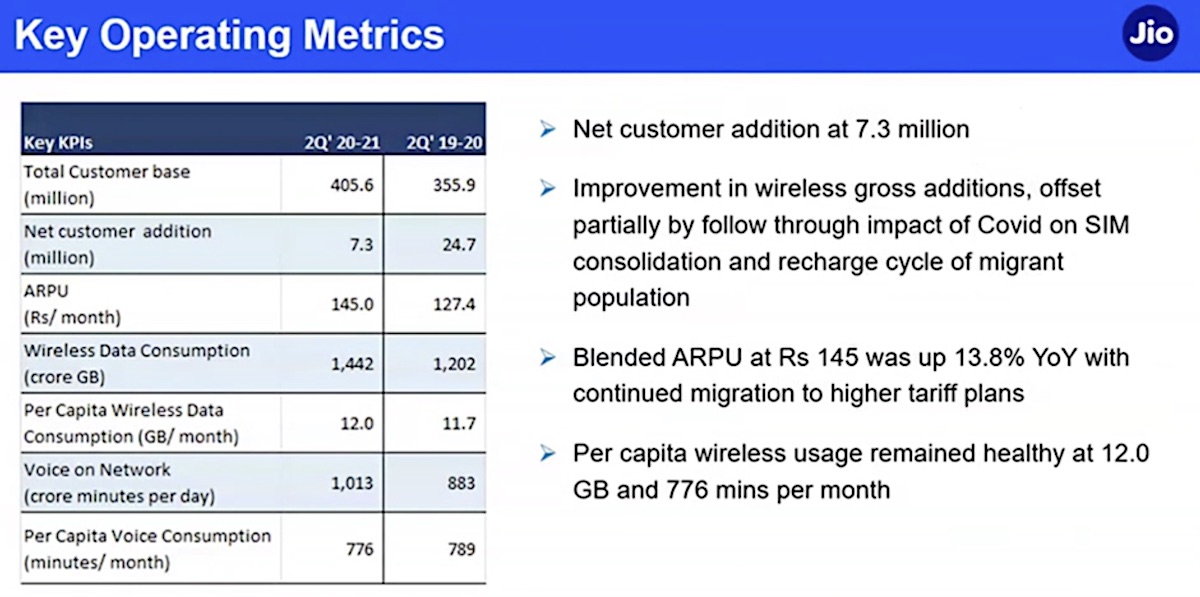
Reliance Jio Platforms, the telecom venture run by India’s richest man (Mukesh Ambani), had 405.6 million subscribers in the quarter that ended in September, becoming the first operator outside of China to cross 400 million subscribers in a single country market.

The Facebook and Google-backed telecom operator said its finances has improved, too, despite the pandemic. Its EBIDTA run-rate crossed $1 billion in the aforementioned quarter, while net profit jumped to $409 million. The average revenue it clocks per user now stands at Rs 145 ($1.94), up from $1.88 the quarter before. In the past two quarters, the company has expanded its workforce by 30,000 people, it added.

Jio Platforms also operates a range of services including JioTV (on-demand live TV service), music streamer JioMusic, and payments app JioMoney. Kiran Thomas, President of Reliance Industries (parent firm of Jio Platforms), said in an earnings call Friday that the company has proven that its services can be feasibly built in India, and the company plans to expand them outside of the country. However, he did not share a timeline for this expansion.

A slide from Reliance Industries’ quarterly earnings call (Reliance)

Reliance Industries, the most valuable firm in India, announced some more investments in its businesses, continuing its eye-catching funding spree at the height of a global pandemic.

The oil-to-retails giant announced that Abu Dhabi Investment Authority and Saudi Arabia’s Public Investment Fund will invest $1.01 billion in the company’s digital fibre business as the Indian firm makes further push in deploying its broadband line across the country.

Abu Dhabi Authority and Saudi Arabia’s PIF are also an investor in Jio Platforms, which this year has raised about $20 billion. A Reliance Jio spokesperson told TechCrunch that the investment announced today are separate and not part of the two firms’ previous deals.

News: Space investors will see into the future at TechCrunch Sessions: Space

If the projections are to be believed, the amount of money swirling around the space industry is poised to grow considerably over the next decade. Consider that the aviation giant Boeing estimates that the aerospace market will reach $3 trillion in market size between now and 2029. It’s most certainly in Boeing’s best interests to

If the projections are to be believed, the amount of money swirling around the space industry is poised to grow considerably over the next decade. Consider that the aviation giant Boeing estimates that the aerospace market will reach $3 trillion in market size between now and 2029.

It’s most certainly in Boeing’s best interests to produce a big number, but it’s also in line with other projections. Among the many areas of investment where Deloitte anticipates continued growth over the next decade, for example, is electric propulsion systems and aircraft, urban air mobility, and fully automated flight decks.

Some questions for investors center on how to make money off all this expected activity — and where. China has the fastest-growing aviation market globally. France and Germany have been boosting their defense budgets. Meanwhile, passenger traffic is rising in India, Japan, and the Middle East, which could create demand for all kinds of new aircraft.

Of course, many of these projects will require more time and money than make sense for some VCs, and even for those who lean in, there are challenges from supply-chain issues to profitability to potential capital constraints.

To dive into this vast space (ahem) and its promise, we’re thrilled to be talking with three savvy investors who think about little more and who will be sharing their researched perspectives on what’s coming — and what has been overhyped — at our TC Sessions: Space event coming up December 16-17.

If you want to understand which schools are producing some of the top talent, which regions of the world have the most advantages, and whether supersonic jets make any more sense this second time around (among many other things), you won’t want to miss this special conversation.

Joining us for this morning session on Wednesday, December 16, is Tess Hatch, a vice president at Bessemer Venture Partners who focuses largely on frontier technology and specifically on the commercialization of space, drones, autonomous vehicles, and the future of agriculture and food technology.

Hatch brings a lot of expertise to the table. She studied aerospace engineering at the University of Michigan before earning her Master’s degree in aeronautics and astronautics engineering from Stanford. She then continued on to Boeing, then SpaceX, where she worked with the government on integrating its payloads with the Falcon9 rocket.

We’ll also be joined by Mike Collett, the founder and managing partner of Promus Ventures, a venture firm with offices in Chicago, San Francisco and Luxembourg that invests in deep-tech software and hardware companies in the U.S., Europe and New Zealand.

Collett, a Vanderbilt grad, has been investing in software and hardware for more than 15 years, across areas such as artificial intelligence and machine learning, space, fintech, robotics, synthetic biology, computer vision and connected cars. Among Promus’s most recent investments is +Earth AI, a mineral exploration startup, and the spectrum mapping startup Aurora Insights.

Last but not least, Chris Boshuizen, an operating partner at the venture firm Data Collective (DCVC), will be joining us. Boshuizen previously co-founded and spent five years as the CTO of Planet Labs, a nearly 10-year-old company that was among the first of its kind to provide daily, global mapping of Earth from space. He was also once a Space Mission Architect at NASA Ames Research Center,  and he co-created Phonesat, a spacecraft built solely out of a regular smartphone.

A native of Australia, Boshuizen has a PhD in physics from the University of Sydney and strong thoughts about what’s interesting out there right now. But we’re thrilled to welcome all three, and we’re excited to see you, too.

We’ve launched early-bird pricing, and $125 gets you access to all live sessions, plus video on demand. Don’t procrastinate. Buy your pass now before the early-bird reenters Earth’s atmosphere (and prices go up) on November 13 at 11:59 p.m. (PT).

More ways to save: Go further together with early bird group tickets ($100) — bring four team members and get the fifth one free. We also offer discount passes for students ($50) and government, military and non-profits ($95). Looking for out-of-this-world exposure? An Early Stage Startup Exhibitor Package ($360) includes four tickets, digital exhibition space, a pitch session to attendees and the ability to generate leads. Bonus savings: Extra Crunch subscribers get an additional 20 percent discount.

News: Cloud infrastructure revenue grows 33% this quarter to almost $33B

The cloud infrastructure market kept growing at a brisk pace last quarter, as the pandemic continued to push more companies to the cloud with offices shut down in much of the world. This week the big three — Amazon, Microsoft and Google — all reported their numbers and as expected the news was good with

The cloud infrastructure market kept growing at a brisk pace last quarter, as the pandemic continued to push more companies to the cloud with offices shut down in much of the world. This week the big three — Amazon, Microsoft and Google — all reported their numbers and as expected the news was good with Synergy Research reporting revenue growth of 33% year over year, up to almost $33 billion for the quarter.

Still, John Dinsdale, chief analyst at Synergy was a bit taken aback that the market continued to grow as much as it did. “While we were fully expecting continued strong growth in the market, the scale of the growth in Q3 was a little surprising,” he said in a statement.

He added, “Total revenues were up by $2.5 billion from the previous quarter causing the year-on-year growth rate to nudge upwards, which is unusual for such a large market. It is quite clear that COVID-19 has provided an added boost to a market that was already developing rapidly.”

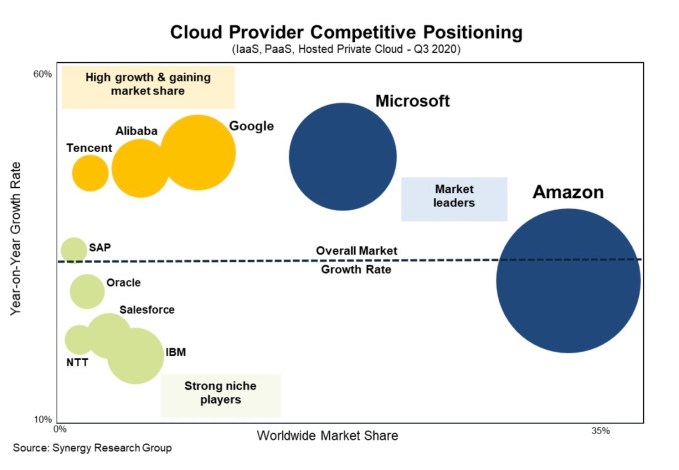
Per usual Amazon led the way with $11.6 billion in revenue, up from $10.8 billion last quarter. That’s up 29% year over year. Amazon continues to exhibit slowing growth in the cloud market, but because of its market share lead of 33%, a rate that has held fairly steady for some time, the growth is less important than the eye-popping revenue it continues to generate, almost double its closest rival Microsoft .

Speaking of Microsoft, Azure revenue was up 48% year over year, also slowing some, but good enough for a strong second place with 18% market share. Using Synergy’s total quarterly number of $33 billion, Microsoft came in at $5.9 billion in revenue for the quarter, up from $5.2 billion last quarter.

Finally Google announced cloud revenue of $3.4 billion, but that number includes all of its cloud revenue including G Suite and other software. Synergy reported that this was good for 9% or $2.98 billion, up from $2.7 billion last quarter, good for third place.

Alibaba and IBM were tied for fourth with 5% or around $1.65 billion each.

Synergy Research cloud infrastructure relative market positions. Amazon is the largest circle followed by Microsoft.

Image Credits: Synergy Research

It’s worth noting that Canalys had similar numbers to Synergy with growth of 33% to $36.5 billion. They had the same market order with slightly different numbers with Amazon at 32%, Microsoft at 19% and Google at 7% and Alibaba in 4th place at 6%.

Canalys sees continued growth ahead, especially as hybrid cloud begins to merge with newer technologies like 5G and edge computing. “All three [providers] are collaborating with mobile operators to deploy their cloud stacks at the edge in the operators’ data centers. These are part of holistic initiatives to profit from 5G services among business customers, as well as transform the mobile operators’ IT infrastructure,” Canalysis analyst Blake Murray said in a statement.

While the pure growth continues to move steadily downward over time, this is expected in a market that’s maturing like cloud infrastructure, but as companies continue to shift workloads more rapidly to the cloud during the pandemic, and find new use cases like 5G and edge computing, the market could continue to generate substantial revenue well into the future.

News: B8ta remains bullish on IRL shopping with new acquisition

Coronavirus cases in the United States are reaching new peaks. E-commerce is continuing to boom. And B8ta, a San Francisco startup which is betting on the future of physical retailers, is doubling down on its in-person footprint. B8ta offers shelf space to unique digital products, such as electric skateboards or a coffee alarm clock, on

Coronavirus cases in the United States are reaching new peaks. E-commerce is continuing to boom. And B8ta, a San Francisco startup which is betting on the future of physical retailers, is doubling down on its in-person footprint.

B8ta offers shelf space to unique digital products, such as electric skateboards or a coffee alarm clock, on behalf of brands that want a physical presence. Today, the company acquired a 1-year old company doing the same for direct to consumer businesses, Re:store.

Backed by Sequoia and SPC, Re:store has a three-story physical location in Maiden Lane in San Francisco and hosts products ranging from beauty, to consumer electronics to lifestyle products. It also has a community co-working space.

The Re:Store community hub.

“The pandemic has emphasized the need for brands to be flexible with their product mix and distribution,” says Selene Cruz, CEO of Re:store. “Some products do well in these times, and brands in a retail-as-a-service model can adapt their offering a lot faster than those in a traditional wholesale model that relies on buying cycles.”

It’s the high-touch startups that are expected to struggle during this time, as rising virus rates threaten the global economy. But, as today’s deal shows, both B8ta and Re:store are bullish on in-person shopping long term.

In fact, in March, B8ta CEO and co-founder Vibhu Nordy penned an extensive Twitter thread in favor of keeping his startups’ stores open, noting that closures would require the company to lose millions and send tens of thousands of employees home. B8ta’s entire value proposition is based on high-touch interactions, and a world in which consumers want to try and experience their products before they buy them.

At b8ta, we are in the business of physical retail stores. While we sell products online, our stores are the reason for our existence. We encourage our shoppers to touch and try all of the products at b8ta. We are truly in the business of touch and human-to-human relationships.

— Vibhu Norby (@vibhu) March 13, 2020

“I feel like we’ve lived through three lifetimes since I wrote that thread back in March,” Nordy said, noting that it’s been an “extremely difficult year” for the company. However, the Re:store acquisition comes off of new momentum he’s seen since B8ta was able to safely reopen its stores in May.

“We launched more brands last quarter than any other in our history,” Nordy said. “The traditional retail model and traditional real estate model has completely collapsed and brands are looking for something better.” To note, Macy’s, which has backed B8ta, narrowly dodged bankruptcy by securing a $4.5 billion lifeline in financing to temper down sales.

Image Credits: b8ta

B8ta’s Re:store acquisition is a response to a rebound among physical retailers, one that favors an experience instead of a catalog of aisles. A focus on creative in-person experiences versus department stores is an acceleration of a pre-pandemic trend. As direct-to-consumer investors told us in late March, companies can’t depend on a few channels for customer acquisition. As the field gets crowded, brands are looking to stand out, and stores like B8ta and Re:store could help them do that.

To balance out some of B8ta’s bullishness, Nordy did note that “on the shopping side, visitation is way down but sales have almost come back to where they were pre-pandemic.” In other words, people are buying B8ta products online without the physical presence, which means that online platforms are still a preference for consumers.

News: Is the Great 2020 Tech Rally slowing?

Yesterday’s earnings deluge made plain that tech shares are not rocketing higher as 2020 comes to a close. Indeed, in pre-market trading this morning, Microsoft, Apple, Facebook and Amazon are all down. Alphabet is the only member of the Big Five that is worth more today than yesterday. Strong advertising and cloud results helped the

Yesterday’s earnings deluge made plain that tech shares are not rocketing higher as 2020 comes to a close. Indeed, in pre-market trading this morning, Microsoft, Apple, Facebook and Amazon are all down.

Alphabet is the only member of the Big Five that is worth more today than yesterday. Strong advertising and cloud results helped the search giant post a return-to-form quarter. But in most other reports there were signs of weakness or underperformance compared to expectations that could undermine the relentlessly bullish attitude tech shares have enjoyed for several months.


The Exchange explores startups, markets and money. Read it every morning on Extra Crunch, or get The Exchange newsletter every Saturday.


The tailwinds that lifted much of tech this year remain. Every CEO I speak to still thinks that the COVID-19 bump to digital services demand has room to run, and that the digital transformation’s acceleration that has been a regular point of optimism for VCs, founders and public company leaders, will continue.

But that doesn’t mean all tech companies will benefit or post outsize results. Those facts don’t imply that pandemic-induced friction won’t add up.

It’s not only the biggest companies that are treading water. We’re seeing valuations pause in tech’s hottest category — SaaS and cloud — despite continued growth in its constituent companies. The combined sentiment-and-share change could dampen enthusiasm for startup shares, perhaps undercutting some of the hype and FOMO that we keep hearing is driving private valuations higher.

Are we seeing a change in tech’s temperature while the weather changes? Let’s take a look.

Good news, bad news

Starting with the biggest tech companies, Alphabet’s results were pretty good. The company’s YouTube and cloud segments outperformed expectations, helping the company best expectations.

From there, things get choppier. Apple beat expectations, but its shares fell after investors were less than impressed with its aggregate results. Microsoft posted good calendar Q3 earnings, including strong Azure performance, but its guidance left investors underwhelmed and its shares also fell. Facebook beat expectations in the quarter, but rising costs seemed to dampen investor sentiment. It lost a little ground after earnings. Amazon’s Q3 was hot, but its Q4 should reduce operating income due to COVID-19 costs. It also lost ground after reporting.

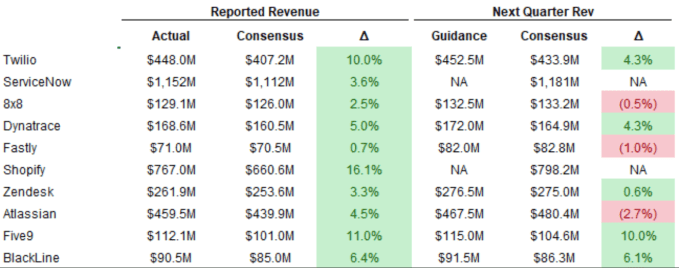
From that malaise we turn to the SaaS and cloud world. Redpoint’s Jamin Ball is doing his usual roundups, one of which we’re borrowing this morning. Here’s his digest of SaaS and cloud earnings thus far:

Takeaways? Every SaaS and cloud company crushed Q3, but Q4 is looking a bit more dicey. Beats look slim, some companies are declining to project and aside from an outlier or two, the numbers look slimmer overall.

WordPress Image Lightbox Plugin