
Yearly Archives: 2020

News: This Week in Apps: Facebook Gaming skips iOS, TikTok goes shopping, Apple One bundles arrive

Welcome back to This Week in Apps, the TechCrunch series that recaps the latest OS news, the applications they support and the money that flows through it all. The app industry is as hot as ever, with a record 204 billion downloads and $120 billion in consumer spending in 2019. People are now spending three hours and 40 minutes per day

Welcome back to This Week in Apps, the TechCrunch series that recaps the latest OS news, the applications they support and the money that flows through it all.

The app industry is as hot as ever, with a record 204 billion downloads and $120 billion in consumer spending in 2019. People are now spending three hours and 40 minutes per day using apps, rivaling TV. Apps aren’t just a way to pass idle hours — they’re a big business. In 2019, mobile-first companies had a combined $544 billion valuation, 6.5x higher than those without a mobile focus.

Top Stories

Here Comes Apple One

Thanks for all the market research, app developers.
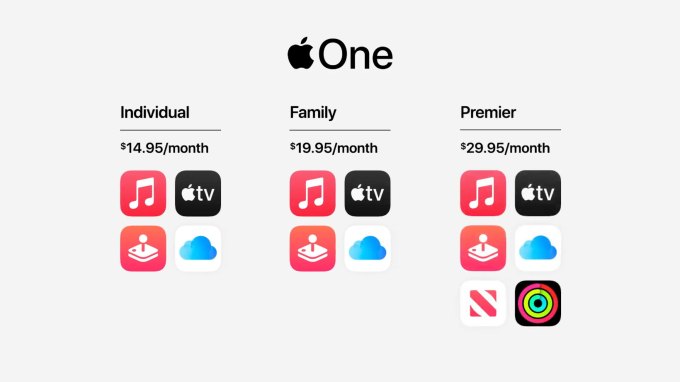
Image Credits: Apple

Apple issued a slight beat on earnings this week, despite the COVID pandemic and a 20% decline in iPhone sales year-over-year, including a drop in China.

But for app developers who already have a large install base to serve across Apple’s mobile devices, it’s Apple’s expansion into the services market that may draw more attention. Apple continues to edge its way into nearly every category that has proven popular on mobile devices. Streaming music? Apple Music. Streaming TV and movies? Apple TV+. Paid news and magazine subscriptions? Apple News+. Cloud storage? iCloud. Payments? Apple Card and Apple Pay. Gaming? Apple Arcade. And so on.

Its latest effort, launching on October 30, is Apple One — a way for users to pay for multiple Apple services in a single bundle.

At launch, the $14.95 per month Individual bundle includes Apple Music, Apple TV+, 50GB of iCloud storage and Apple Arcade. The same thing as a Family Plan (up to six people) is $19.95 per month and ups the iCloud storage to 200GB. And for $29.95 per month on the Premier plan, you get 2TB of iCloud storage, and add in Apple News+ and the new Fitness+, which arrives later this quarter.
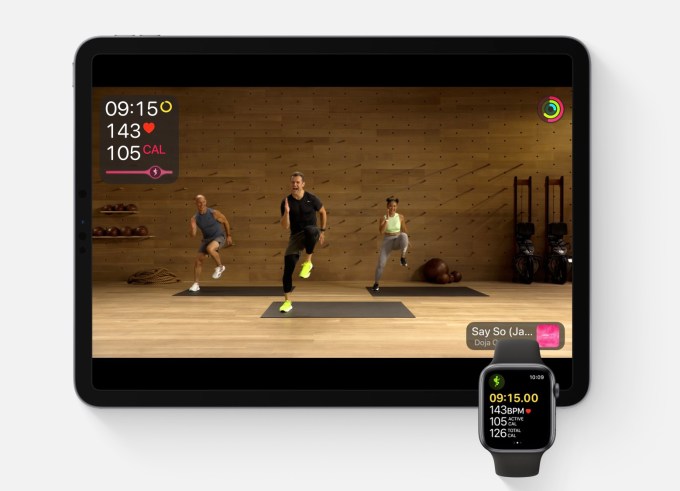
Image Credits: Apple

While each plan saves a little money than if paying individually, the most value can be found at the higher end. Which means Fitness+ could immediately gain an influx of new subscribers, even if the user primarily opted for the Premier plan because of its access to News+. That means Fitness+ doesn’t even have to try that hard to compete with third-party membership-based fitness apps. Instead, Fitness+ acquires users by its association with other known and valued Apple services.

As Apple stretches itself into new services markets — say, AirTags subscriptions, or something we haven’t thought of yet — like subscription medications (Health+?), financial news (Stocks+?), ridesharing (Car+?) social (FaceTime+?) — it will have a head start on user acquisition.

For app developers finding themselves having done the job of proving the market for a subscription-based business in their category, they’ll then be thrust into the role of trying to value add on top of a baseline product that offers a deeper integration with the iOS operating system than they’re allowed.

Cloud gaming’s unknown future on iOS

Image Credits: Facebook Gaming featuring Asphalt Legends

Speaking of services…this week Facebook launched its cloud gaming service that offers free-to-play games that Facebook users can play without leaving the social app.

The games are streamed from the cloud (meaning, Facebook’s servers), instead of requiring users download the titles locally.

This format for mobile gaming makes sense in mature markets that are now steadily moving to 5G. However, Facebook’s new service is only available on desktop and Android — not on iOS.

Facebook excluded Apple devices from the launch, citing Apple’s “arbitrary” policies around third-party apps. Though Apple recently updated its guidelines, it still doesn’t allow applications to act like third-party app stores where games are bought, used and streamed from within the main app directly. Instead, it’s permitting the model GameClub pioneered as a means of working around Apple’s rules last year. That is, there is a main app where users can subscribe and browse a catalog, but each individual game has to be listed on the App Store individually and be playable in some way — even if it’s just a demo.

There’s one school of thought (a point Facebook keeps pushing) that says Apple’s rules here are losing it money.

After all, Facebook says its avoidance of iOS is not about the 30% commission — it’s paying that on Android, in line with Google Play policies. Oh, why oh why doesn’t Apple want its 30%, too?, Facebook cries.

The answer is because Facebook’s iOS snub is part of its long-term strategy. To say it’s not about the money is disingenuous. Facebook at launch is already taking the 30% when in-app purchases are made on the web version of its cloud gaming services.

What’s really happening is that Facebook is making a calculated risk. It’s betting that regulators will ultimately force Apple to permit third-party app stores on iOS and maybe even end Apple’s requirements around in-app purchases, allowing alternative payments. If that comes to pass, the 30% goes back in Facebook’s own pocket.

Even if regulators only push Apple to allow third-party payment systems in addition to the Apple Pay requirement, Facebook could still make money when users picked the Facebook payment option. And it’s ready. Facebook has already built out Facebook Pay infrastructure and it’s now encouraging Facebook Pay usage by redesigning Facebook and Instagram as online shopping platforms.

You’ll just need the Facebook app on Android. iOS won’t work for now. Because, Apple (sigh).

And you’ll need to be in the U.S. for now. Because, data centers.

You can also play our cloud-streamed games on desktop at https://t.co/wbEyHZ1dB1. Because, internet.

— Facebook Gaming (@FacebookGaming) October 26, 2020

This all makes the near-term loss of cloud gaming users on iOS worth the risk. Instead of catering to the iOS base, Facebook is raising a stink about “Apple’s rules” to make it look like Apple is harming the market and stifling competition. In reality, Facebook could very easily list its handful of gaming titles separately, if it desired, as per Apple’s current rules — especially because many are more casual games than those found on xCloud or Stadia.

But that wouldn’t help its larger goal: to see Apple’s App Store regulated.

It’s not even like Facebook is being shy about its motives here. CEO Mark Zuckerberg has publicly stated that Apple’s control of the App Store “deserves scrutiny.”

“I do think that there are questions that people should be looking into about that control of the App store and whether that is enabling as robust of a competitive dynamic,” he said in an Axios interview. “…I think some of the behavior certainly raises questions. And I do think it’s something that deserves scrutiny.”

TikTok Goes Shopping

Image Credits: Shopify

Remember how Walmart angled in on that TikTok acquisition (whose status is still unknown) and everyone was wondering what the heck Walmart was doing? Well, it was thinking ahead.

TikTok this week partnered with Shopify on a social commerce initiative. The deal aims to make it easier for Shopify’s moer than 1 million merchants to reach TikTok’s younger audience and drive sales, by creating and optimizing TikTok campaigns from their Shopify dashboard.

The ad tools allow merchants to create native, shareable content that turns their products into In-Feed video ads that will resonate with the TikTok community. Merchants will be able to target their audiences across gender, age, user behavior and video category (see, TikTok does have SOME data on you!), and then track the campaign’s performance over time.

As a part of this effort, Shopify merchants can also install or connect their “TikTok Pixel” — a tool that helps them to more easily track conversions driven by their TikTok ad campaigns.

The campaigns’ costs will vary, based on the merchant’s own business objectives and how much they want to spend.

The partnership will eventually expand to include other in-app shopping features, as well.

The TikTok-Shopify partnership could help the video platform better compete against other sources of social commerce, including the growing number of live stream shopping apps as well as efforts from Facebook and its family of apps.

Weekly News Round-Up

Platforms

  • Epic says Apple has “no right to the fruits of Epic’s labor” in its latest court filing. “Consumers who choose to make in-app purchases in Fortnite pay for Epic’s creativity, innovation and effort—to enjoy an experience that Epic has designed,” the filing said. The company is making the point that it did the work to create an in-game marketplace for its players to use. The App Store and its payments system are not necessary — they’re forced upon Epic so Apple can ” maintain its monopoly,” Epic’s lawyers said.
  • Adoption of iOS 14 reaches 46.36% six weeks after launch, according to Mixpanel data.
  • Apple releases App Store server notifications into production. The notifications provide developers with real-time updates on a subscriber’s status, allowing app makers to create customized user experiences.
  • Facebook provides new guidance for partners on iOS 14 SKAdNetwork. The company said it will release an updated version of the Facebook SDK by early Q1 to support the upcoming iOS 14 privacy feature requirements, noting that “guidance from Apple remains limited.” The new version of the Facebook SDK will provide support for Apple’s SKAdNetwork API and conversion value management.
  • Google tests a new “app comparison” feature on Google Play that lets you analyze multiple apps across metrics, like ease of use, features, downloads and star rating. Google confirmed the test was live, but downplayed it saying it was “small” and the company had no plans for a broader rollout at this time.
  • Apple search crawler activity could be pointing to Apple’s plans to build its own search engine to rival Google. In iOS 14, Apple can now display its own search results when users type in queries from its home screen, bypassing Google.
  • ExxonMobile embraces Apple’s App Clips. The fuel company will bring the lightweight App Clips and Apple Pay to more than 11,500 Exxon and Mobil gas stations across the U.S., allowing consumers to scan a QR code on the pump to pay via an App Clip version of the ExxonMobil app.

Policies

  • Search engine app makers tell the European Commission that the Android choice screen isn’t working to remedy antitrust issues. Ecosia, DuckDuckGo, Lilo, Qwant and Seznam signed the letter to the Commission.
  • Big technology platforms asked the E.U. to protect them from legal liabilities over removing hate speech and illegal content, reports Bloomberg, citing a paper from Edima, an association representing Alphabet’s Google, Facebook, ByteDance and others.

Trends
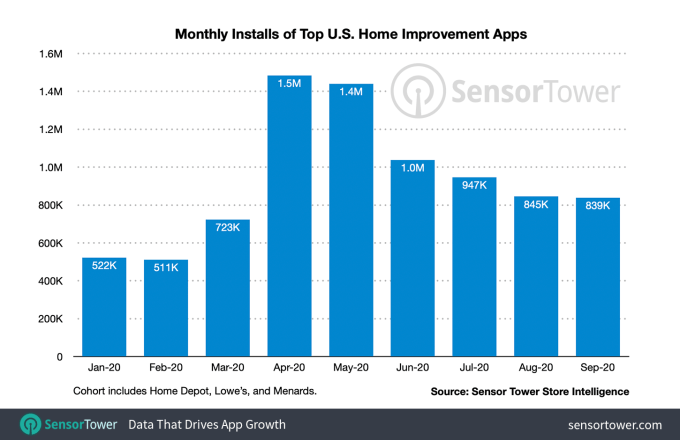
Image Credits: Sensor Tower

  • U.S. home improvement brand app adoption doubled over 2019 since March, per Sensor Tower. As COVID stuck people at home, first-time installs of top home improvement brand apps in the U.S. from March to September 2020 doubled year-over-year, climbing 103%. MAUs grew 35% during that time.
  • U.S. Adoption of Food & Drink apps climbed 30% during COVID-19, also per Sensor Tower. Worldwide, these apps saw a slowdown in download growth in Q3 with a +14% growth rate — slower than other previous third quarters.
  • Samsung reclaims the No. 1 spot in the Indian smartphone market, beating Xiaomi. The new data from marketing research firm Counterpoint conflicts with a report last week from Canalys, making it a close race.
  • Facebook is losing users in the U.S. and Canada. The company reported during its Q3 earnings that user growth in these key markets was slowing after the COVID surge. The company now has 196 million users in North America, down from 198 million in Q2, and it expects the decline to continue. DAUs and MAUs in these markets were also flat or down slightly in the quarter.

Services

Security/Privacy

  • True, a social networking app that promised to protect user privacy, found to be exposing private messages and user locations.
  • A massive analysis of the COVID-19 tracing app ecosystem tracks the permissions the apps require, SDKs in use, location-tracking abilities and more.
  • PUBG Mobile to terminate all service and access to users in India on October 30, after the country banned the game from the world’s second largest internet market over cybersecurity concerns due to its China ties. PUBG already tried cutting ties with its Chinese publishing partner, Tencent Games, but critics called this a Band-Aid if Tencent still had a hand in game development.

App News

  • Sony’s PlayStation app gets an upgrade before the PS5 launch on November 12. The updated app introduced a completely redesigned interface, with a home screen where you can see what friends are playing, voice chat support for up to 15 people, integrated messages and PS Store and news. When, the PS5 arrives, the app will allow users to remotely launch their games, manage storage and more.
  • Instagram extends time limits on live streams to four hours, the same as Facebook live streams on mobile. It will also soon support archiving of live video content.
  • YouTube revamps its mobile app with new gestures, video chapter lists and others changes. The video chapter lists expand the feature introduced in May, and now turn chapters into scrollable lists, each with their own video thumbnail.
  • Tinder roll outs Face To Face, its opt-in video chat feature, to users worldwide. The dating company was pushed to accelerate its virtual options due to the pandemic.
  • Microsoft Office apps add mouse and trackpad support for iPadOS, meaning you can now use Apple’s new Magic Keyboard with apps like Word, Excel and PowerPoint.
  • Cryptocurrency exchange Coinbase is launching a debit card in the U.S. later this year. The Visa debit will work with Visa-compatible payment terminals, online checkout interfaces and ATMs. A mobile app will allow you to control how you want to spend your cryptocurrencies.
  • Eko asks court to freeze Quibi assets related to its turnstyle tech. Even though Quibi is shutting down, Eko’s case against the mobile streaming service continues. Eko wants a payout of at least $96.5 million for infringing on its intellectual property.
  • Netflix engineers detail the studio apps shift to Kotlin Multiplatform in new blog post.
  • TikTok countersues Triller. The China-based, ByteDance-owned video app asks a U.S. judge to rule on Triller’s patent infringement allegations. Triller had filed a suit in late July,
  • TikTok parent ByteDance launches a smart lamp with a camera, display and virtual assistant. The device works with a mobile app and its aimed at helping kids with homework, in an education push.
  • TikTok expands its in-app Election Guide to include Election Day resources like information about polling locations and hours, services that can help people having voting difficulties and those offering other details how the voting process works, as well as live election results from the AP.

Funding and M&A

The best webcam is …. your iPhone!

Today we’re launching @elgato EpocCam – the easiest way to turn your phone into a super high quality webcam. Quick thread. pic.twitter.com/4bX4I3WblI

— Julian (@JFest) October 29, 2020

  • Corsair acquires EpocCam. Gaming peripheral maker bought smartphone app EpocCam, a top video app that lets users turn their iPhone or iPad into a high-def webcam for their Windows or Mac PC. The app grew in popularity due to the pandemic, and its wide support for major video apps includes Zoom, Skype, OBS Studio, Google Meet and Microsoft Teams. Under Corsair’s Elgato subsidiary, the app has been relaunched to fit into the company’s expanded ecosystem of content creation tools.
  • Digital health startup Nutrium raises $4.9 million led by Indico Capital for its service and app which links dietitians and their patients.
  • Bay Area-based Jiko raises $40 million Series A from Upfront Ventures and Wafra Inc. for its mobile banking startup.
  • Helsinki-headquartered app management startup AppFollow raises $5 million Series A led by Nauta Capital. The company now has 70,000 clients on its platform, including McDonald’s, Disney, Expedia, PicsArt, Flo, Jam City and Discord.
  • Mobile device management startup Kandji raises $21 million Series A in a round led by Greycroft. The startup’s MDM solution helps larger companies manage their fleet of Apple devices and keep them in compliance.
  • SimilarWeb raises $120 million for its AI-based market intelligence platform for websites and mobile apps. The company counts more than half of the Fortune 100 as customers, including Walmart, P&G, Adidas and Google.
  • Phone forensics company Grayshift, a startup that helps feds break into iPhones, raises $47 millionThe round was led by PeakEquity Partners, for the company that claims to have doubled adoption, revenues, and employees in the last year.
  • Intelligent visual assistance startup TechSee raises $30 million to automate field work with AR and computer vision.
  • Betty Labs, parent company to Locker Room, a new social audio app connecting sports fans for live conversations, raised $9.3 million in seed funding led by Google Ventures.
  • Mobile gaming company Scopely raises $340 million at a $3.3 billion valuation. Scopely had just raised $200 million last year. Unlike other gaming giants, Epic and Unity, the company doesn’t make tools for gaming, it focuses on keeping players engaged. Today, those users spend 80 minutes per day on games like its Star Trek Fleet Command, MARVEL Strike Force, Scrabble GO and YAHTZEE with Buddies.

Recommended Downloads

Filtertune
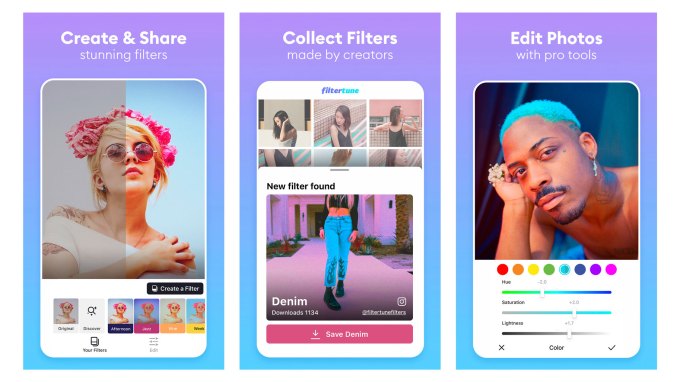
Image Credits: Lightricks

From the makers of Facetune, this new iOS app lets influencers create custom filters that can be shared across social media along with their photos, allowing fans to snap a screenshot of the photo — which includes a QR code on a banner — into order to import the custom preset photo filter into the app’s library. The filter can then be used to edit photos, and further personalized by the end user.

Clips 3.0 eyes TikTok with its biggest update ever

Image Credits: Apple

Apple rolled out an updated version of its casual video creation app, Clips. Before, the app only supported Instagram-like square video, but the new version, Clips 3.0, expands to include support for vertical and horizontal video, making it easier to export videos to apps like TikTok.

The new app also features a refreshed interface on iPhone and iPad, HDR recording with iPhone 12, support for a mouse, trackpad and keyboard cases on iPad, along with other smaller changes, like new stickers, sounds and posters. There are eight new social stickers (like “Sound On” for Instagram Stories), 24 new royalty-free soundtracks (bringing the total library to 100), and six new arrows and shapes, as well as a set of poster templates to use within videos.

Backbone

Image Credits: Backbone

The Backbone app works with the new $99 Backbone One mobile gaming controller for iPhone that lets you play games like Call of Duty: Mobile, Minecraft, Asphalt 9: Legends, hundreds of Apple Arcade titles and other iPhone games that support game controllers.

The controller also includes a Capture Button that lets you record gaming clips to share directly to social platforms like Instagram Stories and iMessage.

Read the TechCrunch review here.

New Releases in iOS 14 Widgets
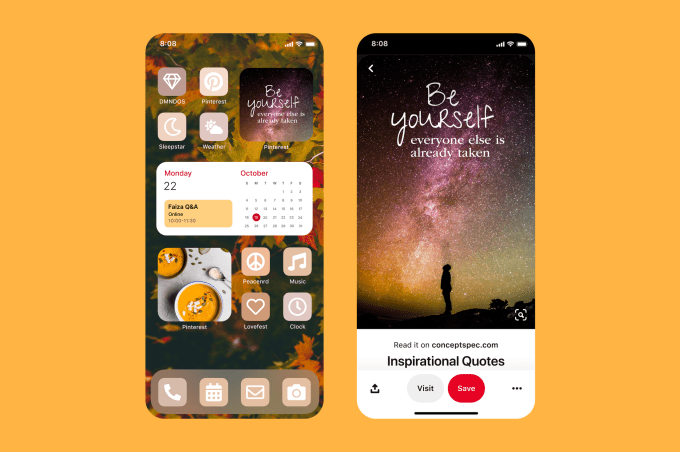
Image Credits: Pinterest

  • Pinterest: The pinboarding app jumps into widgets with an update that lets you put either a small or large widget on your home screen that pulls photos from a Pinterest board — either one you follow or one you created. This allows you to set up a widget that rotates through a set of photos from an online resource, instead of requiring you to keep an on-device photo gallery.
  • TikTok: The short form video app updated this week to include three different widgets from small to large that allow you to easily access trending videos and sounds right from your iOS home screen.
  • Widgit: This new widget lets you put GIF-like animated images on your iOS 14 home screen (in-app purchases).

News: Equity shot: Boo! It’s the Halloween earnings special!

Hello and welcome back to Equity, TechCrunch’s venture capital-focused podcast (now on Twitter!), where we unpack the numbers behind the headlines. As promised, the whole gang is back, this time to chew on the biggest, baddest, worstest, and most troubling earnings reports from the current cycle. This week saw Amazon and Alphabet and Microsoft and Apple

Hello and welcome back to Equity, TechCrunch’s venture capital-focused podcast (now on Twitter!), where we unpack the numbers behind the headlines.

As promised, the whole gang is back, this time to chew on the biggest, baddest, worstest, and most troubling earnings reports from the current cycle. This week saw Amazon and Alphabet and Microsoft and Apple and Facebook report, along with a host of smaller companies.

Spoiler alert: there were more tricks than treats.

  • Danny, Natasha and Alex wanted to get to the bottom of the big tech results, asking what really mattered from each of them?
  • Then it was time to dig into themes. We saw plan price increases coming from Netflix and Spotify, advertising getting a boo-st from politics and 2020’s overall meltdown, and boo-ming billions of consumer interest in…desktops.
  • After that, a dive into the results of smaller SaaS and cloud companies, picking out trends that might help us see around the corner a bit; is the tech boom slowing, or is corporate growth merely failing to keep up with inflated investor expectations?
  • This week felt like a shudder ran through the spine of our economy. The earnings paint a neutral picture, which isn’t exactly an exhale to rejoice over. The coronavirus continues to be a threat that poses a risk to public businesses. For startups, that could mean a less frothy exit market nad lower valuations. And for the public, it means that the uncertain is still ahead of us. So wear a mask.

And with that, the show is back Monday morning. Have a good weekend, everyone.

Equity drops every Monday at 7:00 a.m. PDT and Thursday afternoon as fast as we can get it out, so subscribe to us on Apple PodcastsOvercastSpotify and all the casts.

News: You can start a venture fund if you’re not rich; here’s how

For years — decades, even — there was little question about whether you could become a venture capitalist if you weren’t comfortable financially. You couldn’t. The people and institutions that invest in venture funds want to know that fund managers have their own “skin in the game,” so they’ve long required a sizable check from

For years — decades, even — there was little question about whether you could become a venture capitalist if you weren’t comfortable financially. You couldn’t. The people and institutions that invest in venture funds want to know that fund managers have their own “skin in the game,” so they’ve long required a sizable check from the investor’s own pocket before jumping aboard. Think 2% to 3% of the fund’s total assets, which often equates to millions of dollars.

In fact, five years ago, I wrote that the real obstacle to becoming a venture capitalist has less to do with gender than with financial inequality. I focused then on women, who are paid less (especially Black and Hispanic women), and who possess less wealth. But the same is true of anyone of lesser means.

Consider that one or two partners trying to raise a $50 million debut fund have to come up with $1.5 million. They’ll collect management fees off that $50 million fund — the standard is 2% annually for the fund’s investment period — but they have to use that $1 million per year to pay for everyone’s salaries, along with rent, auditing, legal costs and back-office administration fees. That doesn’t leave much, which is why having something to start with helps.

🤔LPs: The ≧1% of a fund capital commitment you expect from GPs makes it hard for POCs to raise funds.



Consider that “for a $20M fund, a 2% commitment with 2 GPs is still a $200K commitment for each partner.” This is out of reach for many of us. https://t.co/bguXpa3CiY

— lolitataub (@lolitataub) October 29, 2020

Thankfully, things are changing, with more ways to help aspiring VCs raise that initial capital commitment. None of these approaches can guarantee success in raising a fund, but they’re paths that other VCs have effectively used in the past when starting out.

1.) Find investors, i.e. limited partners, who are willing to take less than 3% and maybe even less than 1% of the overall fund size being targeted. You’ll likely find fewer investors as that “commit” shrinks. But for example Joanna Rupp, who runs the $1.1 billion private equity portfolio for the University of Chicago’s endowment, suggests that both she and other managers she knows are willing to be flexible based on the “specific situation of the GP.”

Says Rupp, “I think there are industry ‘norms,’ but we haven’t required a [general partner] commitment from younger GPs when we have felt that they don’t have the financial means.”

Bob Raynard, founder of the fund administration firm Standish Management, echoes the sentiment, saying that a smaller general partner commitment in exchange for special investor economics is also fairly common. “You might see a reduced management fee for the LP for helping them or reduced carry or both, and that has been done for years.”

2.) Learn more about what are called management fee offsets, which investors in venture funds often determine to be reasonable. These aren’t uncommon, says Michael Kim of Cendana Capital, a firm that has stakes in dozens of seed stage funds, because they also offer tax advantages (though the IRS has talked about doing away with these).

How do these work? Say your “commit” was $1 million over 10 years (the standard life of a fund). Instead of trying to come up with $1 million that you presumably don’t have, you can offset up to 80% of that, putting in $200,000 instead but reducing your management fees by that same amount over time so that it’s a wash and you’re still getting credit for the entire $1 million. You’re basically converting fee income into the investment you’re supposed to make.

3.) Use your existing portfolio companies as collateral. Kim had at least two highly regarded managers launch a fund not with a “commit” but rather by bringing to the table ownership stakes in startups they’d funded as angel investors.

In both of these cases, it was a great deal for Kim, who says the companies were quickly marked up. For the fund managers’ part, it meant not having to put more of their own money into the funds.

4.) Make a deal with wealthier friends if you can. When Kim launched his fund of funds to invest in venture managers after working for years as a VC himself, he raised $1 million in working capital from six friends to get it off the ground. The money gave Kim, who had a mortgage at the time and young children, enough runway for two years. Obviously, your friends have to be willing to gamble on you, but sweeteners certainly help, too. In Kim’s case, he gave his friends a percentage of Cendana’s economics in perpetuity.

5.) Get a bank loan. Rupp said she would be uncomfortable if a GP’s commit was being funded through a bank loan for several reasons, including that there’s no guarantee a fund manager will make money on his or her fund, a loan adds risk on top of risk, and because should a manager need liquidity related to that loan, he or she might sell a strongly performing position too early.

That said, loans aren’t uncommon, says Raynard. He says banks with venture capital relationships like Silicon Valley bank and First Republic are typically happy to lend a fund manager a line of credit to help him or her to make capital calls, though he says it does depend on who else is involved with the fund. “As long as it’s a diverse group of LPs,” the banks are comfortable moving forward in exchange for winning over a new fund’s business, he suggests.

6.) Consider the merits of so-called front loading. This is a technique with which “more creating LPs can sometimes get comfortable,” says Kim. It’s also how investor Chris Sacca, now a billionaire, got started when he first turned to fund management. How does it work? Say a fund manager is getting paid a 2.5% management fee over the life of a 10-year fund. Over that decade, that amounts to 25% of the fund. Typically, management fees decline over time, to 2% and even slightly lower because you are typically no longer actively managing it but rather managing out the bets you’ve made in the first few years.

Some beginning managers blend that management fee — say it’s 20% over the fund’s duration — and pay themselves a higher percentage — say 5% for each of its first three years — until by the end of the fund’s life, the manager is receiving no management fee for it at all.

Without carry, that could mean no income if you aren’t yet seeing profits from your investments. But presumably — especially given pacing in recent years — you, the general partner, have raised another fund by the time that happens so have resources coming in from that second fund.

These are just a few of the ways to get started. There are other paths to take, too, notes Lo Toney of Plexo Capital — which, like Cendana Capital — has stakes in many venture funds. Just one of these is to structure to use a self-directed IRA to finance that GP “commit.” Another is to sell a portion of the management company or to sell a greater percentage of future profits and to use those proceeds, though VCs Charles Hudson of Precursor Ventures and Eva Ho of Fika Ventures avoided that path and suggested that first-time managers do the same if they can.

Either way, suggests Toney, a former partner with the Alphabet’s venture arm, GV, it’s important to know  one’s options but keep in mind, too, that what you start with may ultimately prove irrelevant.

Said Toney via email this week: “I have not seen any data on the front end of a VC’s career that wealth indicates future success.”

News: TikTok stars got a judge to block Trump’s TikTok ban

TikTok has won another battle in its fight against the Trump administration’s ban of its video-sharing app in the U.S. — or, more accurately in this case, the TikTok community won a battle. On Friday, a federal judge in Pennsylvania issued an injunction that blocked the restrictions that would have otherwise blocked TikTok from operating

TikTok has won another battle in its fight against the Trump administration’s ban of its video-sharing app in the U.S. — or, more accurately in this case, the TikTok community won a battle. On Friday, a federal judge in Pennsylvania issued an injunction that blocked the restrictions that would have otherwise blocked TikTok from operating in the U.S. on November 12.

This particular lawsuit was not led by TikTok itself, but rather a group of TikTok creators who use the app to engage with their million-plus followers.

According to the court documents, plaintiff Douglas Marland has 2.7 million followers on the app; Alec Chambers has 1.8 million followers; and Cosette Rinab has 2.3 million followers. The creators argued — successfully as it turns out — that they would lose access to their followers in the event of a ban, as well as the “professional opportunities afforded by TikTok.” In other words, they’d lose their brand sponsorships — meaning, their income.

This is not the first time that the U.S. courts have sided with TikTok to block the Trump administration’s proposed ban over the Chinese-owned video sharing app. Last month, a D.C. judge blocked the ban that would have removed the app from being listed in U.S. app stores run by Apple and Google.

That ruling had not, however, stopped the November 12 ban that would have blocked companies from providing internet hosting services that would have allowed TikTok to continue to operate in the U.S.

The Trump administration had moved to block the TikTok app from operating in the U.S. due to its Chinese parent company, ByteDance, claiming it was a national security threat. The core argument from the judge in this ruling was the “Government’s own descriptions of the national security threat posed by the TikTok app are phrased in the hypothetical.”

That hypothetical risk was unable to be stated by the government, the judge argued, to be such a risk that it outweighed the public interest. The interest, in this case, was the more than 100 million users of TikTok and the creators like Marland, Chambers and Rinab that utilized it to spread “informational materials,” which allowed the judge to rule that the ban would shut down a platform for expressive activity.

“We are deeply moved by the outpouring of support from our creators, who have worked to protect their rights to expression, their careers, and to help small businesses, particularly during the pandemic,” said Vanessa Pappas, Interim Global Head of TikTok, in a statement. “We stand behind our community as they share their voices, and we are committed to continuing to provide a home for them to do so,” she added.

The TikTok community coming to the rescue on this one aspect of the overall TikTok picture just elevates this whole story. Though the company has been relatively quiet through this whole process, Pappas has thanked the community several times for its outpouring of support. Though there were some initial waves of “grief” on the app with creators frantically recommending people follow them on other platforms, that has morphed over time into more of a “let’s band together” vibe. This activity coalesced around a big swell in voting advocacy on the platform, where many creators are too young to actually participate but view voting messaging as their way to participate.

TikTok has remained active in the product department through the whole mess, shipping elections guides and trying to ban QAnon conspiracy spread, even as Pakistan banned and then un-banned the app.


News: Cough-scrutinizing AI shows major promise as an early warning system for COVID-19

Asymptomatic spread of COVID-19 is a huge contributor to the pandemic, but of course if there are no symptoms, how can anyone tell they should isolate or get a test? MIT research has found that hidden in the sound of coughs is a pattern that subtly, but reliably, marks a person as likely to be

Asymptomatic spread of COVID-19 is a huge contributor to the pandemic, but of course if there are no symptoms, how can anyone tell they should isolate or get a test? MIT research has found that hidden in the sound of coughs is a pattern that subtly, but reliably, marks a person as likely to be in the early stages of infection. It could make for a much-needed early warning system for the virus.

The sound of one’s cough can be very revealing, as doctors have known for many years. AI models have been built to detect conditions like pneumonia, asthma and even neuromuscular diseases, all of which alter how a person coughs in different ways.

Before the pandemic, researcher Brian Subirana had shown that coughs may even help predict Alzheimer’s — mirroring results from IBM research published just a week ago. More recently, Subirana thought if the AI was capable of telling so much from so little, perhaps COVID-19 might be something it could suss out as well. In fact, he isn’t the first to think so.

He and his team set up a site where people could contribute coughs, and ended up assembling “the largest research cough dataset that we know of.” Thousands of samples were used to train up the AI model, which they document in an open access IEEE journal.

The model seems to have detected subtle patterns in vocal strength, sentiment, lung and respiratory performance, and muscular degradation, to the point where it was able to identify 100% of coughs by asymptomatic COVID-19 carriers and 98.5% of symptomatic ones, with a specificity of 83% and 94% respectively, meaning it doesn’t have large numbers of false positives or negatives.

“We think this shows that the way you produce sound, changes when you have COVID, even if you’re asymptomatic,” said Subirana of the surprising finding. However, he cautioned that although the system was good at detecting non-healthy coughs, it should not be used as a diagnosis tool for people with symptoms but unsure of the underlying cause.

I asked Subirana for a bit more clarity on this point.

“The tool is detecting features that allow it to discriminate the subjects that have COVID from the ones that don’t,” he wrote in an email. “Previous research has shown you can pick up other conditions too. One could design a system that would discriminate between many conditions but our focus was on picking out COVID from the rest.”

For the statistics-minded out there, the incredibly high success rate may raise some red flags. Machine learning models are great at a lot of things, but 100% isn’t a number you see a lot, and when you do you start thinking of other ways it might have been produced by accident. No doubt the findings will need to be proven on other data sets and verified by other researchers, but it’s also possible that there’s simply a reliable tell in COVID-induced coughs that a computer listening system can hear quite easily.

The team is collaborating with several hospitals to build a more diverse data set, but is also working with a private company to put together an app to distribute the tool for wider use, if it can get FDA approval.

News: Apple acknowledges AirPods Pro issues, will replace those that crackle and rattle

Are your AirPods Pro earbuds making weird noises? You’re not imagining it — and you’re not the only one. Just a few months after Apple started shipping AirPods Pro, some users started noticing that one or both of their earbuds were rattling or crackling. The noises would reportedly get worse whenever the user moved, and

Are your AirPods Pro earbuds making weird noises? You’re not imagining it — and you’re not the only one.

Just a few months after Apple started shipping AirPods Pro, some users started noticing that one or both of their earbuds were rattling or crackling. The noises would reportedly get worse whenever the user moved, and would sometimes only develop after months of use.

Apple didn’t say too much about it at first, but would usually replace crackling earbuds if you took the time to hit up support. A few folks here at TechCrunch have had the rattle rear its head on our own AirPods Pro buds… only to have it pop up again in the replacements.

It seems the problem has become widespread enough for an official acknowledgement: today Apple launched an “AirPods Pro Service Program” (as first pointed out by Mark Gurman) specifically for swapping out crackling buds.

A newly published support page outlines the potential symptoms, both of which suggest the issue has to do with the noise cancellation system:

  • Crackling or static sounds that increase in loud environments, with exercise or while talking on the phone
  • Active Noise Cancellation not working as expected, such as a loss of bass sound, or an increase in background sounds, such as street or airplane noise

Apple notes that only units made before October 2020 are affected, suggesting they’ve fixed the issue in units now coming off the line. The support page repeatedly says faulty units will be “replaced” rather than “repaired” — so for the most part, it sounds like turnaround should be pretty quick.

News: Daily Crunch: Under Armour is selling MyFitnessPal

Under Armour gives up on one of its big acquisitions, Uber Eats faces complaints over its free delivery policy for Black restaurants and Facebook takes another step to limit QAnon-related content. This is your Daily Crunch for October 30, 2020. The big story: Under Armour is selling MyFitnessPal Five years after Under Armour acquired MyFitnessPal

Under Armour gives up on one of its big acquisitions, Uber Eats faces complaints over its free delivery policy for Black restaurants and Facebook takes another step to limit QAnon-related content. This is your Daily Crunch for October 30, 2020.

The big story: Under Armour is selling MyFitnessPal

Five years after Under Armour acquired MyFitnessPal for $475 million, it’s selling the diet- and exercise-tracking app to investment firm Francisco Partners for $345 million. It’s also shutting down the Endomondo platform, which it acquired at the same time.

Under Armour says it’s making these moves so that it can focus its brand on its “target consumer – the Focused Performer.” However, the diminished price suggested there may be more going on here, perhaps the business likely suffering as companies like Peloton and Apple (with its upcoming Fitness+ service) hog the spotlight in the casual fitness category.

It’s also worth noting that Under Armour isn’t completely giving up on digital products — it will continue operating the MapMyFitness platform, including MapMyRun and MapMyRide.

The tech giants

Uber Eats faces discrimination allegations over free delivery from Black-owned restaurants — Uber says it has received more than 8,500 demands for arbitration as a result of it ditching delivery fees for some Black-owned restaurants via Uber Eats.

Facebook is limiting distribution of ‘save our children’ hashtag over QAnon ties — Over the past several months, these terms have provided a kind of innocuous cover for the popular online conspiracy theory.

Reliance Jio Platforms tops 400M subscribers, explores expanding services outside of India — The Facebook- and Google-backed telecom operator said its finances have improved, despite the pandemic.

Startups, funding and venture capital

Daimler invests in lidar company Luminar in push to bring autonomous trucks to highways — Luminar will also become a publicly traded company through its merger with special purpose acquisition company Gores Metropoulos.

Nestlé acquires healthy meal startup Freshly for up to $1.5B — Founded in 2015, Freshly is a New York City-based startup that delivers healthy meals to your home in weekly orders, which can then be prepared in a few minutes via microwave or oven.

B8ta remains bullish on IRL shopping with new acquisition — B8ta offers shelf space to unique digital products.

Advice and analysis from Extra Crunch

New GV partner Terri Burns has a simple investment thesis: Gen Z — Burns is the firm’s youngest partner and the first Black woman to hold the role.

Is the Great 2020 Tech Rally slowing? — What happens if COVID-19, unrest and hyped valuations collide?

(Reminder: Extra Crunch is our membership program, which aims to democratize information about startups. You can sign up here.)

Everything else

Teachers are leaving schools. Will they come to startups next? — Teacher departures are a loss for public schools, but an opportunity for startups racing to win a share of the changing teacher economy.

Big tech’s ‘blackbox’ algorithms face regulatory oversight under EU plan — Major internet platforms will be required to open up their algorithms to regulatory oversight under proposals European lawmakers are set to introduce next month.

AOL founder Steve Case, involved early in Section 230, says it’s time to change it — “Having more of a dialogue between the innovators and the policymakers is actually going to be critical in this internet third wave,” Case told us.

The Daily Crunch is TechCrunch’s roundup of our biggest and most important stories. If you’d like to get this delivered to your inbox every day at around 3pm Pacific, you can subscribe here.

News: iPhones can now tell blind users where and how far away people are

Apple has packed an interesting new accessibility feature into the latest beta of iOS: a system that detects the presence of and distance to people in the view of the iPhone’s camera, so blind users can social distance effectively, among many other things. The feature emerged from Apple’s ARKit, for which the company developed “people

Apple has packed an interesting new accessibility feature into the latest beta of iOS: a system that detects the presence of and distance to people in the view of the iPhone’s camera, so blind users can social distance effectively, among many other things.

The feature emerged from Apple’s ARKit, for which the company developed “people occlusion,” which detects people’s shapes and lets virtual items pass in front of and behind them. The accessibility team realized that this, combined with the accurate distance measurements provided by the lidar units on the iPhone 12 Pro and Pro Max, could be an extremely useful tool for anyone with a visual impairment.

Of course during the pandemic one immediately thinks of the idea of keeping six feet away from other people. But knowing where others are and how far away is a basic visual task that we use all the time to plan where we walk, which line we get in at the store, whether to cross the street, and so on.

The new feature, which will be part of the Magnifier app, uses the lidar and wide-angle camera of the Pro and Pro Max, giving feedback to the user in a variety of ways.

The lidar in the iPhone 12 Pro shows up in this infrared video. Each dot reports back the precise distance of what it reflects off of.

First, it tells the user whether there are people in view at all. If someone is there, it will then say how far away the closest person is in feet or meters, updating regularly as they approach or move further away. The sound corresponds in stereo to the direction the person is in the camera’s view.

Second, it allows the user to set tones corresponding to certain distances. For example, if they set the distance at six feet, they’ll hear one tone if a person is more than six feet away, another if they’re inside that range. After all, not everyone wants a constant feed of exact distances if all they care about is staying two paces away.

The third feature, perhaps extra useful for folks who have both visual and hearing impairments, is a haptic pulse that goes faster as a person gets closer.

Last is a visual feature for people who need a little help discerning the world around them, an arrow that points to the detected person on the screen. Blindness is a spectrum, after all, and any number of vision problems could make a person want a bit of help in that regard.

The system requires a decent image on the wide-angle camera, so it won’t work in pitch darkness. And while the restriction of the feature to the high end of the iPhone line reduces the reach somewhat, the constantly increasing utility of such a device as a sort of vision prosthetic likely makes the investment in the hardware more palatable to people who need it.

This is far from the first tool like this — many phones and dedicated devices have features for finding objects and people, but it’s not often that it comes baked in as a standard feature.

People detection should be available to iPhone 12 Pro and Pro Max running the iOS 14.2 release candidate that was just made available today. Details will presumably appear soon on Apple’s dedicated iPhone accessibility site.

News: Q3 earnings find Apple and Google looking to the future for hardware rebounds

“5G is a once-in-a-decade kind of opportunity,” Tim Cook told the media during the Q&A portion of Apple’s Q3 earnings call. “And we could not be more excited to hit the market exactly when we did.” The truth of the matter is its timing was a mixed bag. Apple was, by some accounts, late to

“5G is a once-in-a-decade kind of opportunity,” Tim Cook told the media during the Q&A portion of Apple’s Q3 earnings call. “And we could not be more excited to hit the market exactly when we did.”

The truth of the matter is its timing was a mixed bag. Apple was, by some accounts, late to 5G. By the time the company finally announced that it was adding the technology across its lineup of iPhone 12 variants, much of its competition had already beat the company to the punch. Of course, that’s not a huge surprise. Apple’s strategy is rarely a rush to be first.

5G networks are only really starting to come into their own now. Even today, there are still wide swaths of users who will have to default to an LTE connection the majority of the time they use their handsets. The arrival of 5G on the iPhone was really as much about future-proofing this year’s models as anything. Consumers are holding onto phones longer, and in the three or four years before it’s time for another upgrade, the 5G maps will look very different.

Clearly, the new iPhone didn’t hit the market exactly when Apple had hoped; the pandemic saw to that. Manufacturing bottlenecks in Asia delayed the iPhone 12’s launch by a month. That’s going to have an impact on the bottom line of your quarterly earnings. The company saw a 20% drop for the quarter, year-over-year. That’s hugely significant, causing the company’s stock to drop more than 4% in extended trading.

Apple’s diverse portfolio helped curb some of those revenue slides. While the pandemic has generally had a profound impact on consumer spending on “non-essentials,” changing where and how we work has helped bolster Mac and iPad sales, which were up 28% and 46%, respectively, year-over-year. It wasn’t enough to completely stop the iPhone stumble, but it certainly brings the importance of a diverse hardware portfolio into sharp relief.

China was a big issue for the company this time around — and the lack of a new, 5G-enabled iPhone was a big contributor. In greater China (including Taiwan and Hong Kong), the company saw a 28% drop in sales. There are a number of reasons to be hopeful about iPhone sales in Q4, however.

As I noted this morning, smartphone shipments were down almost across the board in China for Q3, per new figures from Canalys. Much of that can be chalked up to Huawei’s ongoing issues with the U.S. government. Long the dominant manufacturer in mainland China, the company has been hamstrung by, among other things, a ban on access to Android and other U.S.-made technologies. Apple’s numbers remained relatively steady compared to the competition and Huawei’s issues could present a big hole in the market. With 5G on its side, this next quarter could prove a banner year for the company.

News: Google reveals a new Windows zero-day bug it says is under active attack

Google has dropped details of a previously undisclosed vulnerability in Windows, which it says hackers are actively exploiting. As a result, Google gave Microsoft just a week to fix the vulnerability. That deadline came and went, and Google published details of the vulnerability this afternoon. The vulnerability has no name but is labeled CVE-2020-17087, and

Google has dropped details of a previously undisclosed vulnerability in Windows, which it says hackers are actively exploiting. As a result, Google gave Microsoft just a week to fix the vulnerability. That deadline came and went, and Google published details of the vulnerability this afternoon.

The vulnerability has no name but is labeled CVE-2020-17087, and affects at least Windows 7 and Windows 10.

Google’s Project Zero, the elite group of security bug hunters which made the discovery, said the bug allows an attacker to escalate their level of user access in Windows. Attackers are using the Windows vulnerability in conjunction with a separate bug in Chrome, which Google disclosed and fixed last week. This new bug allows an attacker to escape Chrome’s sandbox, normally isolated from other apps, and run malware on the operating system.

In a tweet, Project Zero’s technical lead Ben Hawkes said Microsoft plans to issue a patch on November 10.

Microsoft didn’t independently confirm this date when asked, but said in a statement: “Microsoft has a customer commitment to investigate reported security issues and update impacted devices to protect customers. While we work to meet all researchers’ deadlines for disclosures, including short-term deadlines like in this scenario, developing a security update is a balance between timeliness and quality, and our ultimate goal is to help ensure maximum customer protection with minimal customer disruption.”

In addition to last week’s Chrome/freetype 0day (CVE-2020-15999), Project Zero also detected and reported the Windows kernel bug (CVE-2020-17087) that was used for a sandbox escape. The technical details of CVE-2020-17087 are now available here: https://t.co/bO451188Mk

— Ben Hawkes (@benhawkes) October 30, 2020

But it’s unclear who the attackers are or their motives. Google’s director of threat intelligence Shane Huntley said that the attacks were “targeted” and not related to the U.S. election.

A Microsoft spokesperson also added that the reported attack is “very limited and targeted in nature, and we have seen no evidence to indicate widespread usage.”

It’s the latest in a list of major flaws affecting Windows this year. Microsoft said in January that the National Security Agency helped find a cryptographic bug in Windows 10, though there was no evidence of exploitation. But in June and September, Homeland Security issued alerts over two “critical” Windows bugs — one which had the ability to spread across the internet, and the other could have gained complete access to an entire Windows network.

Updated with comment from Microsoft.

WordPress Image Lightbox Plugin