Yearly Archives: 2020

News: Alphabet’s X details Project Amber, a quest for a single biomarker for depression that fell short of its goal

Alphabet’s X (the Google-owner’s so-called ‘Moonshot Factory’) published a new blog post today about Project Amber, a project it’s been working on over the past three years – the results of which it’s now making available open source for the rest of the mental health research community to learn from, and hopefully build upon. The

Alphabet’s X (the Google-owner’s so-called ‘Moonshot Factory’) published a new blog post today about Project Amber, a project it’s been working on over the past three years – the results of which it’s now making available open source for the rest of the mental health research community to learn from, and hopefully build upon. The X project sought to identify a specific biomarker for depression – it did not accomplish that (and the researchers now believe that a single biomarker for depression and anxiety likely didn’t exist), but X is still hoping that its work on using electroencephalography (EEG) combined with machine learning to try to find one will be of benefit to others.

X’s researchers were hoping that depression, like other ailments and disorders, might have a clear biomarker that would help healthcare professionals more easily and objectively diagnose depression, which would also then hopefully make it more easily and consistency treatable. With EEG, there was some precedent, via studies done in labs using games designed specifically for the purpose, in which people with depression seemed to consistently demonstrate a lower measure of EEG activity in response to effectively ‘winning’ the games.

These studies seemed to offer a path to a potential biomarker, but in order to make them actually useful in real-world diagnostic settings, like a clinic or a public health lab, the team at X set about improving the process of EEG collection and interpretation to make it more accessible, both to users and to technicians.

What is perhaps most notable about this pursuit, and the post today that Alphabet released detailing its efforts, is that it’s essentially a story of a years-long investigation that didn’t work out – not the side of the moonshot story you typically hear from big tech companies.

In fact, this is perhaps one of the best examples yet of what critics of many of the approaches of large tech companies fail to understand – that some problems are not solvable by solutions with analogs in the world of software and engineering. The team at X sums its learning’s from the years-long research project up in three main bullet point about its user research, and each of them touch in some way on the insufficiency of a pure objective biomarker detection method (even if it had worked) particularly when it comes to mental illness. From the researchers:

  1. Mental health measurement remains an unsolved problem. Despite the availability of many mental health surveys and scales, they are not widely used, especially in primary care and counseling settings. Reasons range from burden (“I don’t have time for this”) to skepticism (“Using a scale is no better than using my clinical judgement”) to lack of trust (“I don’t think my client is filling this in truthfully” and ”I don’t want to reveal this much to my counsellor”). These findings were in line with the literature on measurement-based mental health care. Any new measurement tool would have to overcome these barriers by creating clear value for both the person with lived experience and the clinician.
  2. There is value in combining subjective and objective data. People with lived experience and clinicians both welcomed the introduction of objective metrics, but not as a replacement for subjective assessment and asking people about their experience and feelings. The combination of subjective and objective metrics was seen as especially powerful. Objective metrics might validate the subjective experience; or if the two diverge, that in itself is an interesting insight which provides the starting point for a conversation.
  3. There are multiple use cases for new measurement technology. Our initial hypothesis was that clinicians might use a “brainwave test” as a diagnostic aid. However, this concept got a lukewarm reception. Mental health experts such as psychiatrists and clinical psychologists felt confident in their ability to diagnose via clinical interview. Primary care physicians thought an EEG test could be useful, but only if it was conducted by a medical assistant before their consultation with the patient, similar to a blood pressure test. Counsellors and social workers don’t do diagnosis in their practice, so it was irrelevant to them. Some people with lived experience did not like the idea of being labelled as depressed by a machine. By contrast, there was a notably strong interest in using technology as a tool for ongoing monitoring — capturing changes in mental health state over time — to learn what happens between visits. Many clinicians asked if they could send the EEG system home so their patients and clients could repeat the test on their own. They were also very interested in EEG’s potential predictive qualities, e.g. predicting who is likely to get more depressed in future. More research is needed to determine how a tool such as EEG would be best deployed in clinical and counseling settings, including how it could be combined with other measurement technologies such as digital phenotyping.

X is making Amber’ hardware and software open-source on Github, and also issuing a ‘patent pledge’ that ensures X will not bring any legal action against users of the EEG Patents related to Amber through use of the open-sourced material. It’s unclear (though unlikely) that this would’ve been the result had Amber succeeded at finding a single biomarker for depression, but perhaps in the hands of the broader community the work the team did on rendering EEG more accessible beyond specialized testing facilities will lead to other interesting discoveries.


News: NerdWallet acquires small business loan marketplace Fundera

Financial guidance company NerdWallet announced at the end of last week that it has acquired Fundera. New York City-based Fundera was co-founded in 2013 by Jared Hecht, who previously co-founded GroupMe. It created a marketplace where small businesses could find loans, subsequently expanding into other areas like legal services, while also (like NerdWallet) offering free

Financial guidance company NerdWallet announced at the end of last week that it has acquired Fundera. New York City-based Fundera was co-founded in 2013 by Jared Hecht, who previously co-founded GroupMe. It created a marketplace where small businesses could find loans, subsequently expanding into other areas like legal services, while also (like NerdWallet) offering free financial content.

“It can be the wild wild west out there for small business owners,” Hecht said in a statement. “Finding the financial products and the guidance needed to start, grow and fund their businesses can be very challenging, and most small business owners don’t have a resource or partner to support them along their journey. Bringing transparency to this process and educating, empowering and advocating for business owners is so similar to what we see NerdWallet doing in the consumer space.”

And of course, small businesses may be in particularly dire need of assistance now, given the impact of the pandemic.

According to the announcement, Fundera will operate as a subsidiary of NerdWallet, with the entire team making the transition. The goal is to help NerdWallet expand into the small- and medium-business market with both content and actual financing.

“Although we offer free tools and content, we’ve never been able to fully support small business owners — that changes today,” said NerdWallet co-founder and CEO Tim Chen. “Fundera has been one of our partners for several years and their deep understanding of the SMB market, the long-standing, trusted relationships they’ve built with both lenders and business owners, and their commitment to putting the needs of small business owners first is really unique and impressive.”

The financial terms of the acquisition were not disclosed. Fundera had raised $18.9 million in funding from investors including QED Investors, Khosla Ventures, First Round Capital and Susquehanna Growth Equity, according to Crunchbase.

This is NerdWallet’s second acquisition of 2020, having previously acquired U.K.-based Know Your Money. The company says it’s been growing and profitable for the past several years.

News: Rocket Lab’s next launch will deliver 30 satellites to orbit – and a 3D-printed gnome from Gabe Newell

Rocket Lab’s next mission will put dozens of satellites into orbit using the launch company’s Kick Stage “space tug,” as well as a 3D-printed garden gnome from Valve Software’s Gabe Newell. The latter is a test of a new manufacturing technique, but also a philanthropic endeavor from the gaming industry legend. Scheduled for no earlier

Rocket Lab’s next mission will put dozens of satellites into orbit using the launch company’s Kick Stage “space tug,” as well as a 3D-printed garden gnome from Valve Software’s Gabe Newell. The latter is a test of a new manufacturing technique, but also a philanthropic endeavor from the gaming industry legend.

Scheduled for no earlier than November 15 (or 16 at the New Zealand launch site), the as-yet-unnamed launch — Rocket Lab gives all of their missions cheeky names — will be the company’s “most diverse ever,” it said in a press release.

A total of 30 satellites will be deployed using Rocket Lab’s own Kick Stage deployment platform, which like other “space tugs” detaches from the second stage once a certain preliminary orbit is reached and then delivers its payloads each at their own unique trajectory. That’s the most individual satellites every taken up at once by Rocket Lab.

24 of them are Swarm Technologies’ tiny SpaceBEEs, the sandwich-sized communications satellites it will be using to power a low-cost, low-bandwidth global network for Internet of Things devices.

The most unusual payload, however, is certainly “Gnome Chompski,” whose passage was paid by Valve president Newell: a 3D-printed figure that will remain attached to the Kick Stage until it burns up on reentry. The figure, a replica of an item from the popular Half-Life series of PC games, was made by Weta Workshop, the effects studio behind Lord of the Rings and many other films. It’s both a test of a potentially useful new component printing technique and “an homage to the innovation and creativity of gamers worldwide.”

More importantly, Newell will donate a dollar to Starship Children’s Hospital for every viewer of the launch, so you’ll definitely want to tune in for this one. (I’m waiting to find out more from Newell, if possible.)

The launch will also deliver satellites for TriSept, Unseenlabs, and the Auckland Space Institute — the last will be New Zealand’s first student-built spacecraft.

Rocket Lab has worked hard to make its launch platform all-in-one, so prospective customers don’t have to shop around for various services or components. Ideally, the company’s CEO has said, anyone should be able to come to the company with the barebones payload and the rest is taken care of.

Image Credits: Rocket Lab

“Small satellite operators shouldn’t have to compromise on orbits when flying on a rideshare mission, and we’re excited to provide tailored access to space for 30 satellites on this mission. It’s why we created the Kick Stage to enable custom orbits on every mission, and eliminate the added complexity, time, and cost of having to develop your own spacecraft propulsion or using a third-party space tug,” Beck said in the press release.

Rocket Lab recently launched its own home-grown satellite, First Light, to show that getting to orbit doesn’t have be such a “pain in the butt,” as Beck put it then.

News: Scaleway launches cloud instances that cost $2.10 per month

French cloud hosting company Scaleway originally started with very cheap cloud instances. Over the years, the company has expanded its offering and added more premium services, such as managed Kubernetes, object storage, block storage, managed databases, load balancers and GPU instances. But Scaleway is now launching another cheap cloud instance that costs €0.0025 per hour

French cloud hosting company Scaleway originally started with very cheap cloud instances. Over the years, the company has expanded its offering and added more premium services, such as managed Kubernetes, object storage, block storage, managed databases, load balancers and GPU instances. But Scaleway is now launching another cheap cloud instance that costs €0.0025 per hour — around $0.0039 per hour.

Obviously, you’re not getting incredible performance for that price. But it’s a good way to try out new things and build an application just for you. If you’re the only user, those specifications might be enough.

Called Stardust, the virtual compute instance comes with 1 vCPU, 1GB of RAM, an IP address (IPv4), 10GB of local storage and up to 100Mbps of bandwidth. There’s no restriction on bandwidth usage.

Billed by the hour, you end up paying €1.80 per month ($2.10). The company isn’t going to generate a ton of revenue from such a cheap product. That’s why supply is limited. Scaleway will release a limited batch of cloud instances every month — first come, first served.

There are also some limits as you can’t spin up a ton of Stardust and build your own infrastructure. Each account can have up to one Stardust instance in Paris and another one in Amsterdam.

Scaleway lists some potential use cases for its new product, such as an internal wiki, a code repository backup, an always-on instance to set up daemons, triggers and workers, a VPN server, etc. The instance supports Ubuntu, Debian, CentOS and Fedora.

News: YC-backed nonprofit VotingWorks wants to rebuild trust in election systems through open source

I know it will come as a shock to you as a reader of the news, but there is an election this week. Well, tomorrow actually. It’s the rare election where the logistics of the election itself seem to be increasingly dominating the discussion. Not since the Florida recount of 2000 have pollsters, analysts and

I know it will come as a shock to you as a reader of the news, but there is an election this week. Well, tomorrow actually.

It’s the rare election where the logistics of the election itself seem to be increasingly dominating the discussion. Not since the Florida recount of 2000 have pollsters, analysts and party lawyers been so fixated on the mechanics of ballots. What ballots will be counted? Will the Post Office deliver mail in time? How many drop-off boxes are authorized by county? Will the voting machines leave an auditable paper trail?

Voting in America is a complex affair — while presidential elections are national in scope, the actual logistics of ballots and votes are decided locally: not just state by state, but often also county by county. That can create huge variation in the systems at play — but it also means that a small county in rural Mississippi can be a test case for the rest of the nation in how to get voting done right.

That’s at least what VotingWorks is banking on.

VotingWorks is a non-partisan, nonprofit startup that graduated from YC in its winter batch last year with the twin goals of improving the technology that underpins elections through more affordable and secure voting systems as well as using modern statistical science to improve the quality and efficiency of voter audits. The nonprofit scoured the country looking for a testbed, and eventually found Choctaw County in Mississippi, a rural jurisdiction just shy of 10,000 residents who were willing to try VotingWorks’ system out in their election.

Matt Pasternack, who along with Ben Adida co-founded the organization, said that the existing voting machines there were “ancient” and didn’t have a paper audit trail. “We found one county that was so eager to get rid of these ancient machines that they said, ‘Yes, we want to, we want to use this new thing you guys are building,’” Pasternack said.

What VotingWorks built is quite competitive. First, the company used existing hardware like iPads rather than designing custom-built hardware that can be extraordinarily costly given that the machines are rarely used in the U.S., which has quadrennial elections for many offices. Second, the organization’s software is posted as open source on GitHub. That made the machines more open and verifiable than competitors, and also available at a lower price point.

Pasternack and Adida first met while working together at Clever, the API middleware platform that today could be dubbed the “Plaid of education,” designed to help app developers connect to the data stored in hundreds of student information systems. Pasternack noted that he was employee number one, and the two talked about politics and elections over the years and eventually saw an opportunity to enter the market with the 2018 midterms.

The team went through YC in early 2019. With Choctaw County’s push to replace their machines, VotingWorks managed to get its machines in their hands by August for the upcoming November 2019 election, when statewide offices including the governor and attorney general were up for election. The machines were used in 13 precincts.

Adida said that the company moved very fast, but the in-field experience was crucial for improving their machines. He noted that one thing the crew learned is that on election day, poll workers have to setup each machine in the morning before the first rush of voters. The speed of setup is crucial for getting poll places ready, and so VotingWorks optimized how many steps were involved in setting up each ballot machine. “With our machines, you put it on a table, you pop open the case, and you run the checklist. It takes about two-to-three minutes, compared to 30 [minutes] … and so the poll workers were raving about it,” he said.

Pasternack also added that in a rural county like Choctaw, power constraints added their own complexity. Precincts could be remarkably underpowered, and too many voting machines on one electrical circuit could blow out the entire precinct — preventing anyone from voting.

Since then, the organization’s technology has expanded to about 10% of Mississippi counties, partly driven by the need this year for color printing technology. The state is voting on changing its state flag to remove the imprint of the Confederate Flag, and voters have to see the new flags in color on the ballot. Pasternack said that their on-demand printing technology is both efficient and much more affordable per ballot.

Mississippi’s Existing Flag and proposed new flag that will be on the state’s ballot tomorrow. Images via Wikipedia. New flag credited on Wikipedia to Rocky Vaughn, Sue Anna Joe, and Kara Giles.

Outside of the machines itself, the organization is building up its audit software to make audits more statistically accurate and cheaper to conduct, and also developing systems for processing absentee ballots better. Each of these technologies work independently of one another — Adida stressed that “An important trait of a modern voting system is that it’s modular. You can use our auditing system with any standard tabulator. You absolutely don’t need to be using VotingWorks.” Its tech is now used in several additional states in addition to Mississippi, including crucial swing states Michigan and Pennsylvania.

The non-profit has a critical day tomorrow, but then the future beckons. With so much focus on election logistics this year, the hope is that more counties and states will begin to think through better, more robust systems to operate their elections. “We want a world where the foundation of democracy is publicly owned, so having open source software shepherded by a nonprofit organization — it feels like a better democracy to me,” Adida said.

News: Maze, a notorious ransomware group, says it’s shutting down

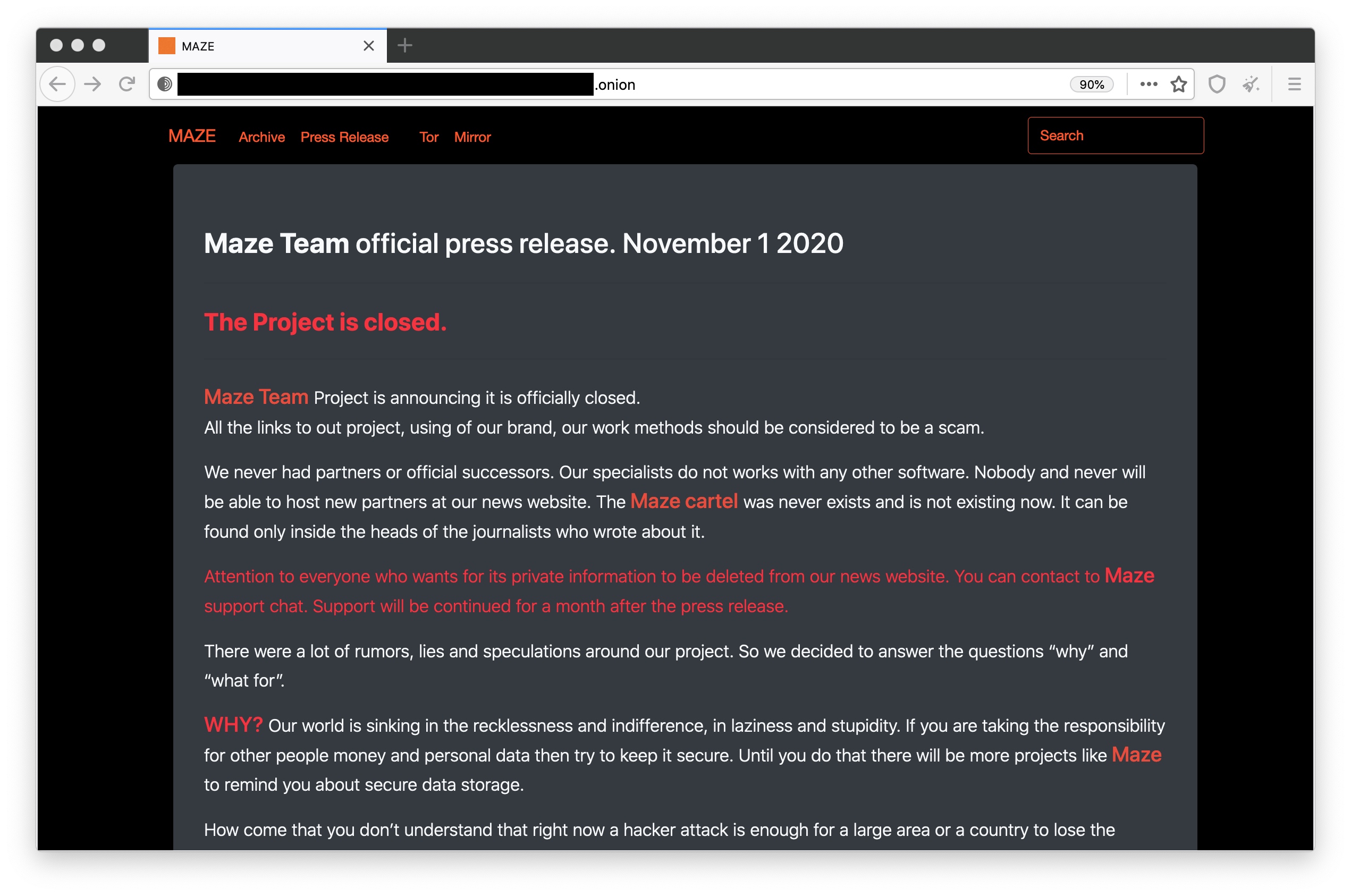
One of the most active and notorious data-stealing ransomware groups, Maze, says it is “officially closed.” The announcement came as a waffling statement, riddled with spelling mistakes, and published on its website on the dark web, which for the past year has published vast troves of stolen internal documents and files from the companies it

One of the most active and notorious data-stealing ransomware groups, Maze, says it is “officially closed.”

The announcement came as a waffling statement, riddled with spelling mistakes, and published on its website on the dark web, which for the past year has published vast troves of stolen internal documents and files from the companies it targeted, including Cognizant, cybersecurity insurance firm Chubb, pharmaceutical giant ExecuPharm, Tesla and SpaceX parts supplier Visser, and defense contractor Kimchuk.

Where typical ransomware groups would infect a victim with file-encrypting malware and hold the files for a ransom, Maze gained its notoriety for first exfiltrating a victim’s data and threatening to publish the stolen files unless the ransom was paid.

It quickly became the preferred tactic of ransomware groups, which set up websites — often on the dark web — to leak the files it stole if the victim refused to pay up.

Maze initially used exploit kits and spam campaigns to infect its victims, but later began using known security vulnerabilities to specifically target big name companies. Maze was known to use vulnerable virtual private network (VPN) and remote desktop (RDP) servers to launch targeted attacks against its victim’s network.

Some of the demanded ransoms reached into the millions of dollars. Maze reportedly demanded $6 million from one Georgia-based wire and cable manufacturer, and $15 million from one unnamed organization after the group encrypted its network. But after COVID-19 was declared a pandemic in March, Maze — as well as other ransomware groups — promised to not target hospitals and medical facilities.

But security experts aren’t celebrating just yet. After all, ransomware gangs are still criminal enterprises, many of which are driven by profits.

A statement by the Maze ransomware group, claiming it has shut down. Screenshot: TechCrunch

“Obviously, Maze’s claims should be taken with a very, very small pinch of salt,” said Brett Callow, a ransomware expert and threat analyst at security firm Emsisoft . “It’s certainly possible that the group feels they have made enough money to be able to close shop and sail off into the sunset. However, it’s also possible — and probably more likely — that they’ve decided to rebrand.”

Callow said the group’s apparent disbanding leaves open questions about the Maze group’s connections and involvement with other groups. “As Maze was an affiliate operation, their partners in crime are unlikely to retire and will instead simply align themselves with another group,” he said.

Maze denied that it was a “cartel” of ransomware groups in its statement, but experts disagree. Steve Ragan, a security researcher at Akamai, said Maze was known to post data from other ransomware, like Ragnar Locker and the LockBit ransomware-for-hire, on its website.

“For them to pretend now that there was no team-up or cartel is just plain backwards. Clearly these groups were working together on many levels,” said Ragan.

“The downside to this, and the other significant element, is that nothing will change, Ransomware is still going to be out there,” said Ragan. “Criminals are still targeting open access, exposed RDP [remote desktop protocol] and VPN portals, and still sending malicious emails with malicious attachments in the hope of infecting unsuspecting victims on the internet,” he said.

Jeremy Kennelly at FireEye’s Mandiant threat intelligence unit said that while the Maze brand may be dead, its operators are likely not gone for good.

“We assess with high confidence that many of the individuals and groups that collaborated to enable the Maze ransomware service will likely to continue to engage in similar operations — either working to support existing ransomware services or supporting novel operations in the future,” said Kennelly.

News: Booming edtech M&A activity brings consolidation to a fragmented sector

As the COVID-19 pandemic continues to force teachers, students and parents to adopt new technologies, edtech’s total addressable market has massively grown in the last several months. The shift has urged venture capitalists to pour money into the sector accordingly, ushering a number of startups into the unicorn club. But maturation doesn’t just mean bigger

As the COVID-19 pandemic continues to force teachers, students and parents to adopt new technologies, edtech’s total addressable market has massively grown in the last several months. The shift has urged venture capitalists to pour money into the sector accordingly, ushering a number of startups into the unicorn club.

But maturation doesn’t just mean bigger checks and high-flying unicorns — it also brings exits.

Edtech M&A activity is buzzier than usual: In the last week, Course Hero, a startup that sells Netflix-like subscriptions to students looking for learning and teaching content, bought Symbolab, an artificial intelligence-powered calculator. Saga Education, a tutoring nonprofit backed by Comcast, the Bill & Melinda Gates Foundation and others, acquired math software platform Woot Math. We also saw PowerSchool, which sells a suite of software services to manage schools, scoop up Hoonuit, a data management and analytics tool for educators. Finally, K-12 curriculum company Discovery Education bought K-5 science and stem curriculum upstart Mystery Science.

It’s a lot of news in a short period of time. Luckily, these consolidations offer some directional guidance regarding where some edtech businesses think the future of their industry is headed.

Smart content as a competitive advantage

Content, to an extent, is commoditized. If you can find a free tutorial on Youtube or Khan Academy, buy a subscription to an edtech platform that offers the same solution? The commodification of education is good for end-users and is often why startups have a freemium model as a customer acquisition strategy. To convert free users into paying subscribers, edtech startups need to offer differentiated and targeted content.

The Course Hero and Mystery Science deals show us that edtech businesses are hungry for personalized, targeted content. Course Hero’s acquisition of Symbolab was essentially a deal for more than a decade’s worth of data that captured which math questions students found hardest.

Symbolab is a math calculator that is set to answer over 1 billion questions this year. With each answer, Symbolab adds information to its algorithm regarding students’ most common pain points and confusion. Course Hero, in contrast, is a broader service that focuses on Q&A from a variety of subjects. CEO Andrew Grauer says Symbolab’s algorithm isn’t something that Course Hero, which has been operating since 2006, can drum up overnight. That’s precisely why he “decided to buy, instead of build.”

“It made a lot of sense to move fast enough so it wouldn’t take up multiple years to get this technology,” Grauer said. The deal was made as big companies get in the Q&A game too, he noted. Google acquired homework helper app Socratic in 2019 and Microsoft built Microsoft Solver in the same year.

Discovery Education, a curriculum provider for K-12 classrooms, acquired San Francisco-based K-5 STEM curriculum provider, Mystery Science. Discovery Education has launched a series of other products focused on science education, including Discovery Education Experience, the Science Techbook series and STEM Connect.  However, Mystery Science is largely focused on offering a creative digital solution to science education. The programming, a mix of videos, prompts and projects, cover a range of questions such as, “Where do rivers flow?” and “Could a volcano pop up where you live?” for young students.

Mystery Science CEO and founder Keith Schact explained how his product focuses on kids and educators, while Discovery Education focuses on educators and districts, making the deal feel like a “natural marriage.” Even as edtech goes directly to consumers, Schact remains bullish on the role that institutions play in true adoption of technology.

“You can go straight to teachers and get a certain market share,” he said. “But the institutions still do have a big role.” The founder likened the dynamic to the state of media: With the rise of blogs, you can publish directly and reach an engaged audience, but writers who want a bigger positioning tend to join larger platforms to grow their overall reach. Edtech is the same, in that some startups need an official sign-off from schools before they can reach venture-scale returns.

According to a source familiar with the transaction, Mystery Science was sold for $175 million after only raising $4 million in venture financing.

Using data management and analytics to improve student outcomes

News: Spotify will now allow artists and labels promote tracks in your recommendations

Spotify announced today it will begin to test a new service that gives artists more of a say in how their music is discovered on the Spotify platform. At launch, the service will allow artists and labels to identify music that’s a priority to them and Spotify will then add a signal to help the

Spotify announced today it will begin to test a new service that gives artists more of a say in how their music is discovered on the Spotify platform. At launch, the service will allow artists and labels to identify music that’s a priority to them and Spotify will then add a signal to help the music get surfaced by its personalization algorithms.

While the new service is not a paid promotion and requires no upfront budget on artists’ or labels’ part, Spotify says that the artists, labels and rights holders will agree to be paid a “promotional recording royalty rate” for streams where the company provides the service. Streams that come from any other place in the app would not be impacted, however.

At launch, the promotional rate will apply only in select areas of Spotify’s app, including Spotify Radio and Autoplay. Promoted tracks won’t appear on other playlists, either algorithmic or editorial — though Spotify isn’t ruling out expansion to these areas in the future.

“We wanted to make the tools accessible and available to artists of any size, at any phase in their career,” explains Spotify Product Marketing Lead, Charleton Lamb, in describing the new service. That’s why the company won’t require an upfront payment from artists and labels, he says.

“We were looking for a model that was acceptable, more democratic and fair…The model is going to allow even really small artists to access promotions at the same terms of the biggest labels,” Lamb adds.

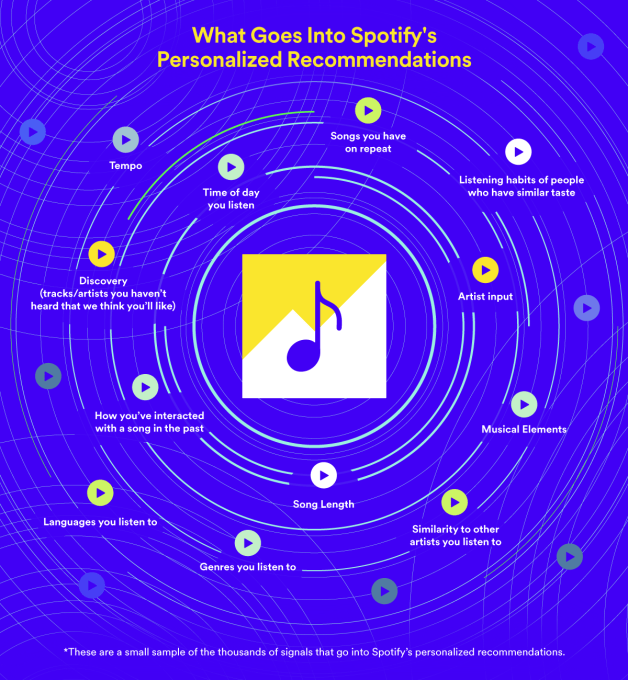
Image Credits: Spotify

The idea is that if a track does well due to the promotion, the rights holders would see an overall positive ROI as the music becomes more popular and sees increased plays outside of the areas where the lower, promotional rate applies. Artists can also turn off the promotions at any time if the tool is not having a positive financial benefit.

Spotify isn’t detailing the extent of the royalty rate change for promotions, saying that it may be adjusted as a result of the test.

The company also stresses it will take listener interest and enjoyment into consideration with this change. Spotify says if the music performs well, it will continue to promote it. But if it doesn’t, it will be pulled back.

“We won’t guarantee placement to labels or artists, and we only ever recommend music we think listeners will want to hear,” Spotify notes, in its public announcement.

Lamb clarifies this means users may hear a promoted track if they already listen to that genre or artist, but also if there are other signals that indicate a user may be receptive to the music. For example, users could come across the promoted track if the music was acoustically similar to what they already listen to. It could also be placed in front of the user if they listen to similar artists, or if people who have similar listening habits also listen to that music.

The reverse will also be true. If those who share a user’s listening habits are negatively responding to a promoted track — perhaps by skipping it in a session or choosing to stream less frequently from Radio, for instance — the music could be pulled back.

“If any kind of recommendation was causing a listener to respond negatively or show less interest in radio systems, then we would adjust how we’re recommending,” Lamb says.

This user feedback loop can quickly impact the extent with which the track is promoted, he also notes, as the recommendation pools for listeners are updated every 24 hours.

There is currently no limit to how many tracks that an artist or label can promote at once, nor any limit on the time frame of the promotion.

While artists can promote tracks of any recency, Spotify believes the largest focus for this tool would be on catalog music. For example, if the artist is looking to celebrate an album anniversary or take advantage of a “cultural moment.”

In other words, if an artist sees sudden viral success for an older track, this service could help. That’s something that’s happening with much more frequency these days, thanks to TikTok, which is helping surface older tunes when they get featured as the background track in viral videos.

For example, when TikTok user Nathan Apodaca — better known as @420doggface208 — recorded a video of himself skateboarding and drinking Ocean Spray’s Cran-Raspberry juice to Fleetwood Mac’s “Dreams,” the 1977 classic found itself back on the top charts.

TikTok said that from the video’s release on Sept. 25th to mid-October, the average daily uses of “Dreams” in TikTok videos climbed 1,380%, which then translated to a 374% jump in sales and an 89% jump in streams. This allowed the song to re-enter the Billboard Hot 100 at #21 after a 43-year absence. It also climbed to the Top Ten of Spotify’s Global and U.S. charts and hit #1 on Apple Music.

That’s precisely the type of “cultural moment” Spotify now aims to profit from.

Though the service is not exactly a “pay for play” model, it is a financially-tied service for music promotion that effectively allows Spotify to make more money when streams are “promoted” with the new tool.

Spotify has been inching its way into the pay for play market for years. In 2019, the company introduced a new feature that allows artists to buy a full-screen recommendation to promote their new album to users Spotify has identified as fans. Rolling Stone said each ad click cost 55 cents, citing internal documents.

Though the feature was targeted towards users who would be more likely to welcome such a notification, it was criticized as being a new form of payola — meaning labels that had the most money to spend would get the most play.

In previous years, Spotify had also been criticized for allowing payola to infiltrate its playlists. And the company famously angered its users in 2018 with an over-the-top Drake album promotion that placed the album and Drake’s image in sections of the app like Browse and Playlists, and used Drake’s image on playlists that didn’t even contain his music — like those featuring dance hits, pop, and more.

This new service, on the other hand, aims to counter some of the issues with past promotions, as it would favor pushing tracks to already receptive users — and it would do so in a less over-the-top way than with pop-up ads or overboard global promotions.

Spotify has tested the technology before now with a small number of partners, but says it will now begin to roll out the test and the promoted rate in the U.S.

During the test period, it will work with a small handful of labels, including both indies and majors, to gain a variety of feedback. Spotify says the feature will expand globally in the future.

News: Coupa Software snags Llamasoft for $1.5B to bring together spending and supply chain data

Coupa Software, a publicly traded company that helps large corporations manage spending, announced that it was buying Llamasoft, an 18 year old Michigan company that helps large companies manage their supply chain. The deal was pegged at $1.5 billion. This year Llamasoft released its latest tool, an AI-driven platform for managing supply chains intelligently. This

Coupa Software, a publicly traded company that helps large corporations manage spending, announced that it was buying Llamasoft, an 18 year old Michigan company that helps large companies manage their supply chain. The deal was pegged at $1.5 billion.

This year Llamasoft released its latest tool, an AI-driven platform for managing supply chains intelligently. This capability in particular seemed to attract Coupa’s attention, as it was looking for a supply chain application to compliment its spend management capabilities.

Coupa CEO and chairman Rob Bernshteyn says when you combine that supply chain data with Coupa’s spending data, it can produce a powerful combination.

“Lamasoft’s deep supply chain expertise and sophisticated data science and modeling capabilities, combined with the roughly $2 trillion of cumulative transactional spend data we have in Coupa, will empower businesses with the intelligence needed to pivot on a dime,” Bernshteyn said in a statement.

The purchase comes at a time when companies are focusing more and more on digitizing processes across enterprise, and when supply chains can be uncertain, depending on the location of COVID hotspots at any particular time.

“With demand uncertainty on one hand, and supply volatility on the other, companies are in need of supply chain technology that can help them assess alternatives and balance trade-offs to achieve desired business results. LLamasoft provides these capabilities with an AI-powered cloud platform that empowers companies to make smarter supply chain decisions, faster,” the company wrote in a statement.

Llamasoft was founded in 2002 in Ann Arbor, Michigan and has raised over $56 million, according to Crunchbase data. Its largest raise was a $50 million Series B in 2015 led by Goldman Sachs.

The company generated more than $100 million in revenue and has 650 big customers including Boeing, DHL, Kimberly-Clark and GM, according to company data.

Coupa has been extremely acquisitive over the years, buying 17 companies, according to Crunchbase data. This deal represents the fourth acquisition this year for the company. So far the stock market is not enamored with the acquisition with the company’s stock price down 5.20% at publication.

News: Apple’s next big event is November 10

Apple just sent out invites for its latest — and last — big event of 2020. Set for 10 a.m. PST on November 10, the “One More Thing” event will almost certainly focus on the long-awaited arrival of Apple silicon Macs. The big event will, naturally, be online-only — as it seems all big tech

Apple just sent out invites for its latest — and last — big event of 2020. Set for 10 a.m. PST on November 10, the “One More Thing” event will almost certainly focus on the long-awaited arrival of Apple silicon Macs. The big event will, naturally, be online-only — as it seems all big tech shows will be for the foreseeable future.

The move toward virtual events amid the COVID-19 shutdown has afforded companies the ability to break these spotlight events up more than in past years. After all, simply asking reporters and analysts to tune into a livestream is a much smaller lift. As such, the company has taken advantage, with three events in quick succession. The first focused on the new Apple Watch and iPads, the second iPhones and now it seems inevitable that Apple is going to turn its attention to the Mac.

The show will likely see the long-awaited release date for macOS Big Sur, along with the unveiling of Macs built around the company’s priority ARM-based processors. Back at WWDC in late-June, the company took the unusual step of announcing the technology’s arrival well-ahead of its launch date, in order to get developers on board with the shift, prior to retail availability. Until now, however, the technology has been limited to the realm of development kits.

“From the beginning, the Mac has always embraced big changes to stay at the forefront of personal computing. Today we’re announcing our transition to Apple silicon, making this a historic day for the Mac,” Tim Cook said during the announcement. “With its powerful features and industry-leading performance, Apple silicon will make the Mac stronger and more capable than ever.” It seems we’ll finally see what all of that means next week.

Recent rumors have pointed to a new version of the MacBook Air set for a Q4 2020 arrival. Redesigned versions of the MacBook Pro and iMac are also reportedly in the works. The early November event is also, notably, Apple’s last chance to get products announced ahead of the holiday season. As such, it certainly seems possible we could see some other long-rumored products arrive, including its Tile-like AirTags tracking device and over-ear AirPods Studio headphones.

As always, we’ll be following along with you and bringing you the news as it breaks.

WordPress Image Lightbox Plugin