Yearly Archives: 2020

News: Aveine’s Smart Wine Aerator is a huge upgrade for wine lovers – and could create some new ones, too

You might have very good reason to be on a wine kick right now – along with plenty of the rest of the country – so it’s perhaps timely to take a look at the Aveine Smart Aerator, a gadget from a French startup that offers variable, instant aeration and a connected app platform for

You might have very good reason to be on a wine kick right now – along with plenty of the rest of the country – so it’s perhaps timely to take a look at the Aveine Smart Aerator, a gadget from a French startup that offers variable, instant aeration and a connected app platform for determining just the right amount of aeration that any particular wine you happen to be drinking requires. The Aveine Smart Wine Aerator is premium-priced, but you might be surprised at just how much of a difference it can make.

The basics

The Aveine Smart Wine Aerator began life as did many other startup devices – as a crowdfunding project. The France-based team ended their campaign in 2018, having surpassed their funding goal, and spend the next couple of years working on finalizing, producing and shipping their design. The Aveine is now available to order, in both the original, full-performance version at $449, and an ‘Essential’ edition introduced this year that offers half the maximum aeration time (12 hours vs. 24) for $299 (reviewed here).

Both work the same way: You place them on top of the bottle you want to aerate once it’s opened, and they connect via Bluetooth to your phone and the Aveine app, which is available for iOS and Android . Through the app, you can take a photo of your wine’s label and it will try to match it from its growing database to automatically set the Aveine to the optimal aeration time.

Image Credits: Aveine

In practice, I found that most of the wines I was testing with weren’t in the database – which Aveine expects, and that’s why it provides a simple survey that you can fill out to get an approximate best aeration time, by supplying information like vintage, grapes used, region and whether the wine is organic or biodynamic. You can also manually set the aeration, and taste test small amounts to find your preferred amount.

Aveine includes a soft carrying case for the Smart Aerator in the box, as well as a charging base that connects to any standard USB wall plug for via micro USB. The built-in battery is rated for around 12-hours of standby, with occasional aeration use while pouring, when it’s actively injecting air into the flow using a built-in motor.

Design and performance

The Aveine feels quite heavy, and it’s clear that a lot of care went into ensuring that all of its smart internals fit comfortably inside the relatively small device. It fits easily over the vast majority of wine bottle tops, and grips while pouring without any special attachment process required. The touchscreen activates when you swipe it, showing you the adjustable aeration screen in simple black and white.

Getting started with the Aveine is simple, and doesn’t require the app at all in fact. Just adjust the scale to your desired aeration level, and pour. The aeration automatically begins when you tip the bottle, and you can hear it working as the motor works to inject air while the wine flows through. If you do use the app, it’ll ask you to connect the Aerator (if you’ve woken up the device by activating the display, it should instantly show up in the app’s device list when it’s within Bluetooth range of your phone).

If you have a wine that’s in Aveine’s database, taking a picture of the label will return a recommended aeration time, and if you’re connected to the aerator, it’ll also automatically set the aerator’s aeration time to that level. As mentioned, you can also answer a few questions about the wine if it’s not in the database to return an estimated aeration time, which will also be automatically set if you’re connected to the device.

Image Credits: Aveine

Now let’s talk performance: Let me say that I understand sticker shock when you see the asking price of the Aveine – I had the same thing. But actually using the Smart Aerator goes a long way to proving its worth. The effect is immediate and non-ambiguous: It makes just about any bottle of wine taste a whole lot better, without you having to decant it and let it sit for hours in advance.

My testing is admittedly non-scientific, but I did poll a wide swath of friends and families who enjoyed bottles aerated via the Aveine during socially distanced visits, and to a one they all noted a vast improvement between before and after aeration tastings. At least one even went out and immediately purchased an Aveine of their own based on the experience.

Sometimes you have to do a bit of experimentation to get the aeration right, adjusting the levels and doing contrasting taste tests – but that’s actually also part of the fun.

Bottom line

Aerator gadgets are plentiful, and often cheaply acquired in the checkout line at the local wine shop for well under $100. But the Aveine is the first one I’ve tried that makes such a clear and demonstrable difference it can convince novices and pros alike about its efficacy. It’s a high price to pay, yes, but what you get in return is a device that consistently makes life better for wine lovers – and that make some new wine lovers out of skeptics, too.

News: Apple, Microsoft and other tech stocks roar as the Presidential election narrows to several states

On the back of sizable gains posted yesterday, tech stocks are once again rising sharply in pre-market trading today. Futures concerning the tech-heavy Nasdaq Composite index are indicating a 3.4% gain this morning, far above a 1.7% gain that the broader S&P 500 index is currently anticipating. The market capitalization of some of the world’s

On the back of sizable gains posted yesterday, tech stocks are once again rising sharply in pre-market trading today. Futures concerning the tech-heavy Nasdaq Composite index are indicating a 3.4% gain this morning, far above a 1.7% gain that the broader S&P 500 index is currently anticipating.

The market capitalization of some of the world’s most valuable companies have added tens of billions of dollars in value this morning, with Apple rising 3.9% in pre-market trading, and Microsoft gaining an even-richer 4.4%.

Smaller key players in the tech market are also rising, with Salesforce gaining 2.9% ahead of the bell, and Twilio adding 3.3% to its own value.

The price of heavily-traded assets have whipsawed during the last 24 hours, with yield on American government debt falling last night — indicating that investors were bullish on the economy as a whole — before rising again when it became clear that no so-called Blue Wave was forming. The prospect of a divided Congress could stifle future economic stimulus, the possibility of which has been a key narrative driver for market trading in recent months.

Precisely why tech stocks are racing higher this morning is not entirely clear. One obvious possibility is that investors are returning to their summer trade, when they bid shares of software-heavy companies higher in hopes of parking their wealth in the firms with the best chance of posting regular growth during a period of intense economic uncertainty.

If a divided Congress means a drag on more stimulus, why not return to the play that worked before?

For tech, and tech-enabled companies hoping to go public before the year ends, or in early 2021, the rally is welcome news. But, as with everything in this election, things could still change.

News: Shares of Uber, Lyft soar on expected passage of California gig-labor ballot measure

Shares of American ride-hailing giants Uber and Lyft are sharply higher in pre-market trading this morning on the expected passage of Proposition 22, a California ballot measure that allow tech-enabled, on-demand companies to continue classifying gig-workers as independent contractors. Shares of Uber are up 11.88% in pre-market trading, while shares of Lyft — which is

Shares of American ride-hailing giants Uber and Lyft are sharply higher in pre-market trading this morning on the expected passage of Proposition 22, a California ballot measure that allow tech-enabled, on-demand companies to continue classifying gig-workers as independent contractors.

Shares of Uber are up 11.88% in pre-market trading, while shares of Lyft — which is more heavily dependant on the U.S. market, and thus California — is up a staggering 14.9% before the market open today.

TechCrunch noted that the ballot measure looked set to pass around 3 am Eastern Time last night. The vote has continued to come in, with Google’s election data giving Proposition 22 a 58.4% positive tally with 71% of expected votes reporting.

We’re only seeing the value of public on-demand companies, but the value of DoorDash also rose this morning. DoorDash, a food-delivery giant backed by SoftBank and others, has confidentially filed to go public but has yet to release its S-1 filing.

Still, investors in the company are picking up the same boon that Uber and Lyft shareholders are enjoying today, both in terms of continued operational capability in California without radical price changes or shaking up their business practices as well as a perceived value increase.

Perhaps with Proposition 22 behind it, DoorDash will move with more alacrity towards the public markets.

The three companies along with Postmates spent heavily to help Proposition 22 pass, as TechCrunch reported last night:

Prop 22 was primarily backed by Uber, Lyft,  DoorDash and Postmates . Last week, DoorDash put in an additional $3.75 million into the Yes on 22 campaign, according to a late contribution filing. Then, on Monday, Uber put in an additional $1 million. That influx of cash brought Yes on 22’s total contributions to around $205 million. All that funding makes Proposition 22 the most expensive ballot measure in California since 1999.

That money now appears to be cash well spent, from a business perspective. For labor-advocates, the result is a disappointment.

News: CA ballot measure that keeps gig workers as independent contractors is projected to pass

Uber, Lyft, Instacart, DoorDash — the major backers of California’s Proposition 22 — are getting their way. The proposition, which will keep gig workers classified as independent contractors, is projected to pass. The Associated Press called the race with 67% of precincts partially reporting. At the time of publication, 58.2% of voters (more than 6.3

Uber, Lyft, Instacart, DoorDash — the major backers of California’s Proposition 22 — are getting their way. The proposition, which will keep gig workers classified as independent contractors, is projected to pass. The Associated Press called the race with 67% of precincts partially reporting.

At the time of publication, 58.2% of voters (more than 6.3 million people) voted for Prop 22, while 41.5% of voters (about 4.5 million people) voted against it.

The ballot measure will implement an earnings guarantee of at least 120% of minimum wage while on the job, 30 cents per engaged miles for expenses, a healthcare stipend, occupational accident insurance for on-the-job injuries, protection against discrimination and sexual harassment, and automobile accident and liability insurance. It’s worth noting that those earnings guarantees and reimbursement for expenses only reflect a driver’s engaged time, and does not account for the time spent in between rides or deliveries.

Proponents of Prop 22 claimed their win late Tuesday night when about 57% of the votes were accounted for. In an email to drivers tonight, Uber CEO Dara Khosrowshahi notified them of the news.

“With this vote, drivers and delivery people will get what so many of you have been asking for: access to benefits and protections, while maintaining the flexibility and independence you want and deserve,” Khosrowshahi wrote. “The future of independent work is more secure because so many drivers like you spoke up and made your voice heard—and voters across the state listened.”

Uber said it will be in touch over the next few weeks with additional details regarding how to enroll in the new offerings like occupational accident insurance and healthcare subsidies. Meanwhile, some opponents of the measure conceded.

“We’re disappointed in tonight’s outcome, especially because this campaign’s success is based on lies and fear-mongering,” Gig Workers Collective wrote in a blog post. “Companies shouldn’t be able to buy elections. But we’re still dedicated to our cause and ready to continue our fight.”

The folks over at Gig Workers Rising also said the fight is far from over.

“This battle is but a stepping stone towards our continued fight to get gig workers the rights, benefits, and dignified working conditions they deserve,” Gig Workers Rising said in a statement.

Prop 22 was primarily backed by Uber, Lyft, DoorDash and Postmates . Last week, DoorDash put in an additional $3.75 million into the Yes on 22 campaign, according to a late contribution filing. Then, on Monday, Uber put in an additional $1 million. That influx of cash brought Yes on 22’s total contributions to around $205 million. All that funding makes Proposition 22 the most expensive ballot measure in California since 1999.

On the other side, major donors in opposition of Prop 22 included Service Employees International Union, United Food & Commercial Workers and International Brotherhood of Teamsters.

“The reality is that, you know, it establishes a dangerous precedent to allow companies to write their own labor laws,” Vanessa Bain, a gig worker and organizer at Gig Workers Collective, recently told TechCrunch. “This policy was created to unilaterally benefit companies at the detriment of workers.”

The creation of Prop 22 was a direct response to the legalization of AB-5, the gig worker bill that makes it harder for the likes of Uber, Lyft, DoorDash and other gig economy companies to classify their workers as 1099 independent contractors.

AB-5 helps to ensure gig economy workers are entitled to minimum wage, workers’ compensation and other benefits by requiring employers to apply the ABC test. According to the ABC test, in order for a hiring entity to legally classify a worker as an independent contractor, it must prove the worker is free from the control and direction of the hiring entity, performs work outside the scope of the entity’s business and is regularly engaged in work of some independently established trade or other similar business.

Currently, Uber and Lyft are in the midst of a lawsuit regarding AB-5 brought forth in May by California Attorney General Xavier Becerra, along with city attorneys from Los Angeles, San Diego and San Francisco. They argued Uber and Lyft gain an unfair and unlawful competitive advantage by misclassifying workers as independent contractors. Then, in June, the plaintiffs filed a preliminary injunction seeking the court to force Uber and Lyft to reclassify their drivers.

In August, a judge granted the preliminary injunction. Uber and Lyft appealed the decision, but the appeals court last month affirmed the decision from the lower court. However, the decision will be stayed for 30 days after the court issues the remittitur, which the court has yet to do. Meanwhile, both Uber and Lyft previously said they were looking at their appeal options.

Throughout the case, Uber and Lyft have argued that reclassifying their drivers as employees would cause irreparable harm to the companies. In the ruling last month, the judge said neither company would suffer any “grave or irreparable harm by being prohibited from violating the law” and that their respective financial burdens “do not rise to the level of irreparable harm.”

But now that Prop 22 is projected to pass, this lawsuit has far less legal ground to stand on. It’s also worth noting that Uber has previously said it may pursue similar legislation in other states.

The California Secretary of State began releasing partial election results from the state’s 58 counties at 8 p.m. PT. However, do not expect a final count tonight, or even tomorrow. That’s partly due to the fact that California accepts absentee ballots postmarked no later than Nov. 3, 2020. Meanwhile, county elections officials have until Dec. 1, 2020 to report final results.

News: Twitter restricts Trump’s tweet claiming that foes would ‘steal’ the election

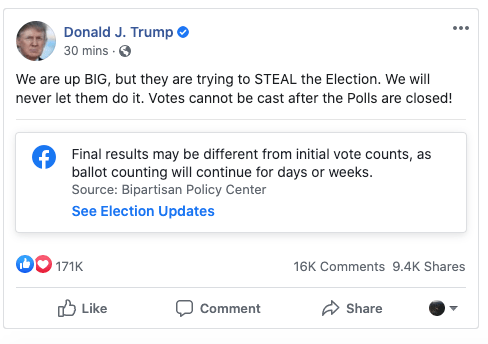
With key wins notched in a few states, Trump didn’t declare victory prematurely on election night as social media companies feared — but he did baselessly raise the specter of voter fraud. “We are up BIG, but they are trying to STEAL the Election,” Trump tweeted. “We will never let them do it. Votes cannot

With key wins notched in a few states, Trump didn’t declare victory prematurely on election night as social media companies feared — but he did baselessly raise the specter of voter fraud.

“We are up BIG, but they are trying to STEAL the Election,” Trump tweeted. “We will never let them do it. Votes cannot be cast after the Polls are closed!”

We are up BIG, but they are trying to STEAL the Election. We will never let them do it. Votes cannot be cast after the Polls are closed!

Donald J. Trump (@realDonaldTrump) November 4, 2020

Twitter took action against the tweet quickly, placing it behind a warning and adding a misinformation label. The company explained its actions in a tweet, stating that the president’s message contained a “potentially misleading claim about an election.”

We placed a warning on a Tweet from @realDonaldTrump for making a potentially misleading claim about an election. This action is in line with our Civic Integrity Policy. More here: https://t.co/k6OkjNXEAm

— Twitter Safety (@TwitterSafety) November 4, 2020

While Trump’s wording is left a bit ambiguous, the president again appears to be attacking the integrity of vote-by-mail ballots. With mail-in ballots expected to come in slowly in some states, lagging votes may play a big part in the election outcome. That scenario was expected and does not raise any concerns over the integrity of vote tallying.

Due to a huge spike in mail-in voting related to the pandemic, results were expected to be more ambiguous on election night in 2020 than in past years and so far that’s proven true. Social media companies began crafting new policies for the unusual circumstances of the 2020 election and its worrisome misinformation ecosystem in the months leading up to November.

Twitter also said in a September policy announcement that it would remove or label any tweets that incite unlawful activity and threaten a “peaceful transfer of power or orderly succession.” While tweets that Twitter restricts remain online, they’re placed behind a warning message that users must first click through in order to view their content. Restricted tweets also have their retweets, likes and comments disabled, reducing their reach.

On Facebook, where much of Trump’s Twitter content is reposted, his message earned a label reminding users that election night results and final results may differ but the post was not otherwise restricted. In an email, Facebook spokesperson Tom Reynolds said that Facebook labeled the post shortly after it went up “in accordance with the policies we shared ahead of Election Day.”

The company attached a similar label to another late night Trump post declaring “I will be making a statement tonight. A big WIN!” Facebook previously said it planned to label any posts claiming premature victory with an informational message pointing users to official election results.

News: A QAnon supporter is headed to Congress

Marjorie Taylor Greene’s win in a Georgia House race means that QAnon is headed to Capitol Hill. Greene openly supports the complex, outlandish conspiracy theory, which posits that President Trump is waging a secret war against a shadowy group of elites who engage in child sex trafficking, among other far-fetched claims. The FBI identified QAnon

Marjorie Taylor Greene’s win in a Georgia House race means that QAnon is headed to Capitol Hill.

Greene openly supports the complex, outlandish conspiracy theory, which posits that President Trump is waging a secret war against a shadowy group of elites who engage in child sex trafficking, among other far-fetched claims. The FBI identified QAnon as a potential inspiration for “conspiracy theory-driven domestic extremists” last year.

Greene’s win is a startling moment of legitimacy for the dangerous conspiracy, though it wasn’t unexpected: her Democratic opponent dropped out of the race for personal reasons in September, clearing her path to the House seat.

Greene’s support for the constellation of conspiracy theories isn’t particularly quiet — nor are her other beliefs. Called a “future Republican star” by President Trump, Greene has been vocal in expressing racist and Islamophobic views. Greene has also espoused September 11 “truther” theories and criticized the use of masks, a scientifically-supported measure that reduces transmission of the novel coronavirus.

QAnon, once a belief only at the far-right fringes of the internet, has inspired followers to engage in real-world criminal acts, including fatally shooting a mob boss in Staten Island and blocking the Hoover Dam bridge in an armed standoff.

The conspiracy’s adherents have also hijacked the hashtag #savethechildren, interfering with legitimate child safety efforts and exporting their extreme ideas into mainstream conversation under the guise of helping children. Facebook, which previously banned QAnon, limited the hashtag’s reach last month in light of the phenomenon.

Other QAnon believers are on the ballot in 2020, including in Oregon, where Jo Rae Perkins is projected to lose her race against incumbent Senate Democrat Jeff Merkley. Perkins was very open about her beliefs and in June tweeted a video pledging her allegiance as a “digital soldier” for QAnon along with a popular hashtag associated with the conspiracy movement.

News: Intel has acquired Cnvrg.io, a platform to manage, build and automate machine learning

Intel continues to snap up startups to build out its machine learning and AI operations. In the latest move, TechCrunch has learned that the chip giant has acquired Cnvrg.io, an Israeli company that has built and operates a platform for data scientists to build and run machine learning models, which can be used to train

Intel continues to snap up startups to build out its machine learning and AI operations. In the latest move, TechCrunch has learned that the chip giant has acquired Cnvrg.io, an Israeli company that has built and operates a platform for data scientists to build and run machine learning models, which can be used to train and track multiple models and run comparisons on them, build recommendations and more.

Intel confirmed the acquisition to us with a short note. “We can confirm that we have acquired Cnvrg,” a spokesperson said. “Cnvrg will be an independent Intel company and will continue to serve its existing and future customers.” Those customers include Lightricks, ST Unitas and Playtika.

Intel is not disclosing any financial terms of the deal, nor who from the startup will join Intel. Cnvrg, co-founded by Yochay Ettun (CEO) and Leah Forkosh Kolben, had raised $8 million from investors that include Hanaco Venture Capital and Jerusalem Venture Partners and PitchBook estimates that it was valued at around $17 million in its last round. 

It was only a week ago that Intel made another acquisition to boost its AI business, also in the area of machine learning modeling: it picked up SigOpt, which had developed an optimization platform to run machine learning modeling and simulations.

While SigOpt is based out of the Bay Area, Cnvrg is in Israel and joins an extensive footprint that Intel has built in the country specifically in the area of artificial intelligence research and development, banked around its Mobileye autonomous vehicle business (which it acquired for more than $15 billion in 2017) and its acquisition of AI chipmaker Habana (which it acquired for $2 billion at the end of 2019).

Cnvrg.io’s platform works across on-premise, cloud and hybrid environments and it comes in paid and free tiers (we covered the launch of the free service, branded Core, last year). It competes with the likes of Databricks, Sagemaker and Dataiku as well as smaller operations like H2O.ai that are built on open source frameworks.

While Intel is not saying much about the deal, it seems that some of the same logic behind last week’s SigOpt acquisition applies here as well: Intel has been refocusing its business around next-generation chips to better compete against the likes of Nvidia and smaller players like GraphCore. So it makes sense to also provide/invest in AI tools for customers, specifically services to help with the compute loads that they will be running on those chips.

It’s notable that in our article about the Core free tier last year, Frederic noted that those using the platform in the cloud can do so with Nvidia-optimized containers that run on a Kubernetes cluster. It’s not clear if that will continue to be the case, or if containers will be optimized instead for Intel architecture, or both. Cnvrg’s other partners include Red Hat and NetApp.

Intel’s focus on the next generation of computing aims to offset declines in its legacy operations. In the last quarter, Intel reported a 3% decline in its revenues, led by a drop in its data center business. It said that it’s projecting the AI silicon market to be bigger than $25 billion by 2024, with AI silicon in the data center to be greater than $10 billion in that period.

In 2019, Intel reported some $3.8 billion in AI-driven revenue, but it hopes that tools like SigOpt’s will help drive more activity in that business, dovetailing with the push for more AI applications in a wider range of businesses.

News: Report: US visas granted to students from mainland China have plummeted 99% since April

It’s no secret that the Trump administration has pursued a variety of avenues to keep foreigners out of the U.S., including through a recent overhaul of the H-1B visa program for high-skilled foreign workers that will require employers to pay H-1B workers higher wages and narrow the types of degrees that would qualify an applicant

It’s no secret that the Trump administration has pursued a variety of avenues to keep foreigners out of the U.S., including through a recent overhaul of the H-1B visa program for high-skilled foreign workers that will require employers to pay H-1B workers higher wages and narrow the types of degrees that would qualify an applicant — a move which has ready triggered numerous lawsuits.

Still, it may surprise some to learn that U.S. visas issued to students around the world have fallen as dramatically as they have this year. According to a new report in Nikkei Asia, citing U.S. State Department data, just 808 F-1 student visas were granted to applicants in mainland China between April and September’s end, which is 99% fewer than the 90,410 F-1 student visas granted during the same period last year. The story is much the same for students of other countries: with 88% fewer F-1 visas granted to students in India, 87% fewer for students in Japan, 75% fewer for students in South Korea and 60% fewer for students from Mexico.

What’s going on? A confluence of factors, seemingly.

Coronavirus is most certainly among them, as families grow more hesitant to send their children to the U.S., which reported 93,581 new cases on Sunday alone, compared with 24 in China, 38,000 in India, 468 in Japan, 97 in South Korea and 3,762 in Mexico.

So is racism, with many Asians and Asian-Americans noting that Donald Trump’s rhetoric around the coronavirus has sharpened the racism they’ve faced throughout their lives, with terms like “kung flu” and “China virus” common in responses, per a recent survey by Washington State University researchers who say that increasing reports of racial discrimination since the start of the COVID-19 pandemic coincide with an increase in reported negative health symptoms. (The Nikkei notes that students already studying in the U.S. have been targets, too, citing a 23-year-old Chinese woman who was yelled at to leave the U.S.)

Yet an aggressive focus on Chinese espionage in Washington has played a bigger role, suggests the outlet, which speculates that the difficulty in obtaining American visas is likely to drive some Chinese students to other countries, including Canada.

Secretary of State Mike Pompeo, for example, said in remarks at the Richard Nixon Presidential Library in July that, “We opened our arms to Chinese citizens, only to see the Chinese Communist Party exploit our free and open society. China sent propagandists into our press conferences, our research centers, our high schools, our colleges and even into our PTA meetings.”

A backlash against Chinese students in particular is not a new one for the Trump administration, even while it’s been accelerated greatly in recent months. In 2018, the State Department began restricting to one year visas for Chinese graduate students studying in certain research fields, after which they need to reapply. The move rolled back a policy established during the Obama administration that allowed Chinese citizens to secure five-year student visas.

News: Insight Partners, Precursor Ventures join Hustle Fund in raising new fund money

Even as the country is in the final days of a polarizing election, the cogs of VC never stop turning. On this ever-so-quiet, non-election-news Tuesday, venture firms still managed to file paperwork with the SEC indicating newly raised funds. Precursor Ventures and Insight Partners will join Hustle Fund in closing new capital. The filings are

Even as the country is in the final days of a polarizing election, the cogs of VC never stop turning. On this ever-so-quiet, non-election-news Tuesday, venture firms still managed to file paperwork with the SEC indicating newly raised funds. Precursor Ventures and Insight Partners will join Hustle Fund in closing new capital.

The filings are noteworthy because they signal new capital coming into the startup world, which could look dramatically different in the coming weeks. Still, Precursor Ventures and Hustle Fund are both still fundraising, so expect them to (hopefully) add more capital in the coming months.

Precursor Ventures, led by Charles Hudson, has raised a new tranche of capital to invest in pre-seed companies. The firm first filed in March 2020 that it had plans to raise a $40 million fund, and today it appears that it has closed $29 million of that goal. Recent investments from Precursor include The Juggernaut, mmhmm and TeamPay. The fund made headlines recently because it promoted Sydney Thomas, its first hire, to principal. Hudson was unable to comment due to fundraising activity.

We also saw a filing from Insight Partners, which closed a $9.5 billion fund in April for startups and growth-stage investments, indicating that it has raised money for its first-ever Opportunity Fund. The SEC filing shows that Insight Partners has raised $413 million for the opportunity fund. Insight did not return a request for comment.

Earlier today, SEC filings also showed that Hustle Fund has raised $30 million for a second fund, surpassing its previous fund of $11.5 million. Interestingly, paperwork for this new fund was first filed in May 2019 with the intention to raise $50 million. Today’s news, thus, is its first close. While the firm is still fundraising, it’s a long gap between filing and first close. The fund was launched in 2018 by ex-500 Startup partners Eric Bahn and Elizabeth Yin to, similar to Precursor, invest in pre-seed startups. Hustle Fund invests $25,000 checks into 50 startups per year.

Yin declined to comment due to ongoing fundraising activity.

While the spree of funds on Election Day was noteworthy, it was somewhat expected. Generally speaking, funds want to get their paperwork cleared and closed before a potentially chaotic event or time of unrest. We saw closes from OpenView, Canaan, True Ventures and more, while firms including First Round and Khosla filed paperwork for new funds. Time will tell if this is a final exhale of news until January 1, or if the VC world will continue pushing droves of capital, holidays be damned.

News: ‘Stay home’ robocalls on Election Day prompt warnings, investigation

A scourge of robocalls that urges Americans to “stay safe and stay home” has gotten the attention of the FBI and the New York Attorney General over concerns of voter suppression. The brief message, which doesn’t specifically mention Election Day, has prompted New York Attorney General Letitia James to launch an investigation into the matter. James

A scourge of robocalls that urges Americans to “stay safe and stay home” has gotten the attention of the FBI and the New York Attorney General over concerns of voter suppression.

The brief message, which doesn’t specifically mention Election Day, has prompted New York Attorney General Letitia James to launch an investigation into the matter. James announced Tuesday that her office is actively investigating allegations that voters are receiving the robocalls.

“Voting is a cornerstone of our democracy,” James said in a statement Tuesday. “Attempts to hinder voters from exercising their right to cast their ballots are disheartening, disturbing and wrong.”

James added that such calls are illegal and will not be tolerated.

The FBI told TechCrunch that the agency is aware of reports of robocalls. The agency wouldn’t say if it is investigating the robocalls; however, a senior official at the Department of Homeland Security told reporters Tuesday that the FBI was investigating calls that seek to discourage people from voting, according to the AP.

“As a reminder, the FBI encourages the American public to verify any election and voting information they may receive through their local election officials,” the FBI said in a statement sent to TechCrunch.

The announcement from James follows subpoenas issued earlier this week by the New York AG office to investigate the source of these robocalls allegedly spreading disinformation. New York voters who receive concerning disinformation, or face issues at the polls can contact her office’s Election Protection Hotline at 1-800-771-7755.

“Every voter must be able to exercise their fundamental right to vote without being harassed, coerced, or intimidated. Our nation has a legacy of free and fair elections, and this election will be no different,” James added. “Voters should rest assured that voting is safe and secure, and they should exercise their fundamental right to vote in confidence. We, along with state leaders across the nation, are working hard to protecting your right to vote, and anyone who tries to hinder that right will be held accountable to the fullest extent of the law.”

Last month, the U.S. Department of Justice announced that an interagency working group convened by Attorney General William P. Barr released a report to Congress on efforts to stop illegal robocalls. The report described efforts by the DOJ, including two civil actions filed in January 2020 against U.S.-based Voice over Internet Protocol (VoIP) companies, the Federal Trade Commission and the Federal Communications Commission to combat illegal robocalls. Despite those efforts, and even evidence of some declines in robocalls for a time, the presidential election and the COVID-19 pandemic has fueled a spike in calls. 

WordPress Image Lightbox Plugin