Yearly Archives: 2020

News: MSCHF’s Push Party raises an unconventional seed round at a $200 million valuation

As part of its latest stunt, MSCHF, a venture-backed creative studio that’s smarter and more audacious than most, is poking a little fun at the venture industry itself and perhaps publications like TechCrunch too. The startup has spun out a rather simplistic app into a separate company and raised an undisclosed amount of seed funding

As part of its latest stunt, MSCHF, a venture-backed creative studio that’s smarter and more audacious than most, is poking a little fun at the venture industry itself and perhaps publications like TechCrunch too. The startup has spun out a rather simplistic app into a separate company and raised an undisclosed amount of seed funding from a very real venture capital firm at an eye-popping $200 million valuation.

For the time being, the actual completion of the legal paperwork to cement this valuation seems like a more complex hurdle than the technical challenges of building the app itself. Push Party is by all means a Gen-Z Yo, it does one thing and one thing only, allows people to push a button which sends a push notification to every user of the app. There are no friends, no groups, no influencers. It’s a big button that fires off an awful lot of notifications.

Image via MSCHF

Like everything else MSCHF does, the app is designed with virality in mind. The startup’s last application they shipped, “Finger on the App” launched a huge online contest that ended after multiple winners who spent several days with their finger sitting on their phone screen. The fun with this rollout is that there’s no telling who pushed the button especially when users can set their own user names and unsurprisingly seem keen to pick celebrity names.

If the app Push Party takes some heavy inspiration from Yo, it’s also taking a page from what helped make it famous, namely a quizzically high early valuation for a product that did almost nothing. Back in simpler times, 2014, Yo raised $1.5 million on $10 million. But fast forward to 2020 and earning a $10 million valuation for a half-baked conceptual take doesn’t mean quite as much, it’s been normalized to a degree. As a result, MSCHF upped the ante and banked a $200 million valuation for Push Party in this raise.

It used to be that a $200 million valuation was a sign of late-stage traction rather than early-stage hype, but high valuations have grown increasingly common for investors racing to win the most competitive deals. Earlier this summer, audio startup Clubhouse raised eyebrows when it banked a $100 million early valuation, and just a few months ago, Roam, a note-taking app with a cult following raised a seed round on $200 million.

Push Party’s round was financed by Founders Fund with Principal Trae Stephens driving the deal. If you’re puzzled how the MSCHF team bagged a real investor from a real firm for a dubiously real project, the mystery fades when you find Stephens is unsurprisingly a backer of MSCHF itself. Stephens is by all means, in on the joke.

In a tongue-in-cheek press release, Stephens notes that, “We were a bit concerned by the valuation at first, but I told my people to run toward gunfire for anything less than $250 million.”

Is any of this real? Well, MSCHF insists that they went through all of the legal steps of incorporating Push Party and raising this round. How much the startup actually raised is perhaps more suspect, it’s unclear whether this was a $10 million investment or $1 million or $10,000, the team wasn’t too keen to go into details there, though I did ask someone from MSCHF whether the round was more than $100, and they confirmed that it was definitely more than $100.

Though the company refused to dissect what exactly it’s trying to communicate here, I think a good part of it is just poking at the idea that in today’s climate of ridiculous valuations there’s a tendency for some fairly nebulous numbers to signal value or innovation where this isn’t quite as much. And that often times a high valuation from a prestigious firm is a vote of confidence that drives Silicon Valley watchers to drive downloads while other investors toss in checks, engineers send in job applications and, yes, journalists write stories.
News: YouTube copies Spotify’s ‘Daily Mixes’ with its new ‘My Mix’ feature

YouTube Music is taking another cue from Spotify with today’s launch of a set of personalized playlists that are essentially YouTube Music’s own take on Spotify’s “Daily Mixes.” Each of these new “My Mix” playlists will feature a different aspect of a user’s tastes and interests, allowing users to dive in to a particular vibe

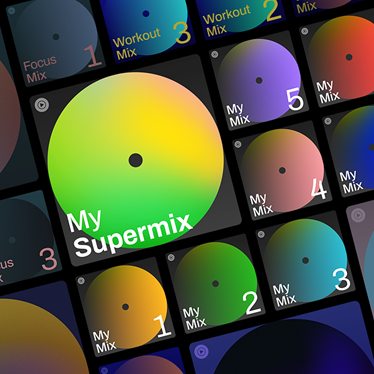
YouTube Music is taking another cue from Spotify with today’s launch of a set of personalized playlists that are essentially YouTube Music’s own take on Spotify’s “Daily Mixes.” Each of these new “My Mix” playlists will feature a different aspect of a user’s tastes and interests, allowing users to dive in to a particular vibe or music genre.

Up to seven of these new “My Mix” playlists will be featured on the Home tab, the company says, and will include a combination of favorite tunes as well as potential new favorites for discovery purposes.

With the launch, YouTube is also rebranding its personalized playlist previously called “Your Mix.” To better clarify its purpose and eliminate possible confusion with the new “My Mix” playlists, this playlist will now be called “My Supermix,” and will combine all of a user’s music tastes into one playlist, like Spotify’s “Discover Weekly.”

YouTube is making other changes to its Home tab and personalized selections, too, it says.

Image Credits: YouTube

Now, the Home tab will feature an activity bar offering easy access to four activity types, including Workout, Focus, Relax, and Commute. These will take the user to a dedicated personalized homepage with a variety of playlists suited to the activity in question. The Workout tab, in particular, has been updated to include up to four new personalized mixes that feature music you already like as well as new recommendations. These tabs will also include a “Supermix” of the different playlists.

Personalization has become a key battleground for music streaming services, which aim to use technology to better cater to users by creating unique mixes and delivering more targeted recommendations. YouTube and Apple have both mimicked Spotify’s features on this front, offering their own variations on personalized playlists like Spotify’s flagship playlist, “Discover Weekly,” and others.

YouTube Music, though, has not had as much success in gaining a following, perhaps due to Google’s confusing and overlapping music strategy over the past several years, where it offered two different music apps.

Google has finally begun to correct his, and has started the transition that will shift users off its older service, Google Play Music, and over to YouTube Music. The latter, to date, has struggled with gaining a sizable share in the competitive music market, where Spotify and Apple dominate.

According to a MIDiA report in June, Google is in fifth place with a 6% share, behind Spotify, Apple, Amazon, and Tencent. However, the report suggested that YouTube Music’s appeal to a younger demographic could help Google turn things around, as its share had grown from just 3% in Q1 2018 to Q1 2019.

YouTube says the new changes to its playlists will arrive today.

News: Spora Health launches primary care network for Black people and people of color

A number of healthcare disparities exist for Black people in America, but they can oftentimes go unaddressed due to the lack of education and understanding among medical professionals. Spora Health, which launches today for patients in Virginia, Tennessee, Pennsylvania and Florida, aims to fix that. “An equitable healthcare system has never existed in America, especially

A number of healthcare disparities exist for Black people in America, but they can oftentimes go unaddressed due to the lack of education and understanding among medical professionals. Spora Health, which launches today for patients in Virginia, Tennessee, Pennsylvania and Florida, aims to fix that.

“An equitable healthcare system has never existed in America, especially for Black folks and that is the goal,” Spora Health founder and CEO Dan Miller told TechCrunch.

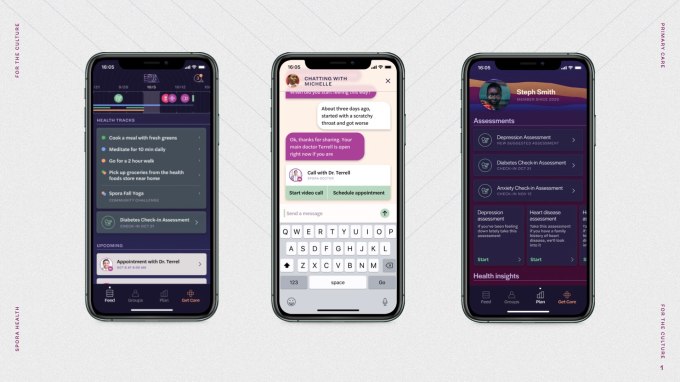
Spora Health is a primary care provider for Black people and people of color. Initially, Spora Health is taking a telemedicine approach but eventually plans to open physical locations.

Spora Health patients get access to its care delivery platform and care team that consists of doctors, nurse practitioners, nutritionists and more. Its machine learning-driven technology also can predict risk profiles for patients and look for chronic conditions like pre-diabetes, hypertension, emphysema and more.

Image Credits: Spora Health

Spora Health costs $9.99 per month. On the first visit, patients pay their normal co-pay. For those without insurance, they pay a one-time $99 fee on their first visit. You can think of it almost as a One Medical, which charges $199 per year, but with the specific needs of Black people and people of color in mind.

“Being a young startup, we can compete on price,” Miller said. “For us, we can make the offering more affordable because we have less overhead as well as tech that allows us to be more thoughtful.”

While the goal is to better serve Black people and people of color, not all of Spora Health’s providers fall into those demographics.

“We want to overindex on providers of color but supply and demand doesn’t match up,” Miller said. “There’s a shortage of providers of color becoming physicians. So we need to invest in the reeducation of providers.”

In order to become a provider on Spora Health, medical professionals must go through an interview process and participate in the Spora Institute. The Spora Institute serves to reeducate providers and help them understand their implicit biases.

“Within med school, there is a curriculum around health equity but that only happens in the first year of the program,” Miller said. “What tends to happen by the end of residency is that a lot of these implicit biases tend to surface again because the training curriculum and environment does not incorporate equity and doesn’t think about disparities in certain populations.”

Spora Health is actively raising a $1.2 million seed round. So far, the company has closed $1 million of that round.

News: Autonomous delivery startup Nuro hits $5 billion valuation on fresh funding of $500 million

Nuro, the autonomous delivery startup founded by two former Google engineers, has raised $500 million, suggesting that investors still have an appetite for long-term pursuits such as robotics and automated vehicle technology. Nuro now has a post-money valuation of $5 billion. The Series C round was led by funds and accounts advised by T. Rowe Price

Nuro, the autonomous delivery startup founded by two former Google engineers, has raised $500 million, suggesting that investors still have an appetite for long-term pursuits such as robotics and automated vehicle technology. Nuro now has a post-money valuation of $5 billion.

The Series C round was led by funds and accounts advised by T. Rowe Price Associates, Inc., with participation from new investors including Fidelity Management & Research Company and Baillie Gifford. The round also includes existing investors such as SoftBank Vision Fund 1 and Greylock.

Nuro was founded in June 2016 by former Google engineers Dave Ferguson and Jiajun Zhu. While the startup was initially bootstrapped by Ferguson and Zhu, it has never struggled to attract investors. Nuro completed its first Series A funding round in China in 2016, a deal that gave NetEase founder Ding Lei (aka William Ding) a seat on Nuro’s board. A second, U.S.-based round in June 2017 raised Nuro’s total Series A funding to $92 million. But it was the monster $940 million investment made by the SoftBank Vision Fund in February 2019 that catapulted Nuro ahead of numerous other startups attempting to commercialize autonomous vehicle technology. Nuro had a $2.7 billion valuation following the Softbank investment, meaning its value doubled in about 18 months. That money has helped it grow to more than 650 employees.

Unlike many other startups in the AV industry, Nuro has focused its effort designing a low-speed electric self-driving vehicle that transports packages, not people. Some of Nuro’s first tests and pilots were with Toyota Prius vehicles equipped with its self-driving system. Nuro partnered in 2018 with with Kroger to pilot a delivery service in Arizona. The pilot, which initially used Toyota Prius vehicles, transitioned to its R1 delivery bot. Nuro has also partnered with companies like CVS, Domino’s and Walmart.

The company has since developed a second generation vehicle, known as the R2. This delivery bot, which is designed for local delivery service for restaurants, grocery stores and other businesses, received an exemption from the federal government earlier this year that allows it to operate as a driverless vehicle.

“We are witnessing an unprecedented shift in consumer demand for safe and affordable local delivery services,” said Zhu, CEO and co-founder of Nuro said in a statement. “This funding, which brings us together with many of the world’s top investors, positions Nuro confidently toward a future where our world-class technology is adopted into people’s everyday lives.”

The company, which is testing and operating R2 on public roads in Arizona, California and Texas, told TechCrunch that the new funding will allow it to “confidently grow for years to come, with multi-year runway to build in multiple cities and scale across multiple markets.” Nuro’s near-term focus is on scaling its service in Houston and implementing R2 into commercial service.

News: Cookware startup Great Jones raises $1.75M as it expands into bakeware

Great Jones is expanding into a new area of the kitchen, with what co-founder and CEO Sierra Tishgart described as the startup’s biggest launch since it released its first products two years ago. Ahead of launching the new bakeware line tomorrow, Great Jones is announcing that it has raised $1.75 million in new funding. The money

Great Jones is expanding into a new area of the kitchen, with what co-founder and CEO Sierra Tishgart described as the startup’s biggest launch since it released its first products two years ago.

Ahead of launching the new bakeware line tomorrow, Great Jones is announcing that it has raised $1.75 million in new funding.

The money comes from notable figures in the e-commerce world — Fellow founder Jake Miller and Very Great founders Eric Prum and Josh Williams — along with restauranteurs including Mimi Cheng’s co-founder Hannah Cheng, Lilia founder Sean Feeny, Kopitiam co-owner Moonlyn Tsai and Konbi co-owner Akira Akuto.

NEA partner Liza Landsman invested as well, and Tishgart said that Sweetgreen’s Nic Jammet and Parachute’s Ariel Kaye have joined the startup’s board of directors. Tishgart noted that Great Jones has worked on collaborations and product partnerships with many of these investors, and she also pointed to Kaye and Parachute as providing a model for how Great Jones can grow.

“To me, starting with sheets, [Kaye] has taken a product which people loved and thoughtfully expanded to a broad selection,” Tishgart said.

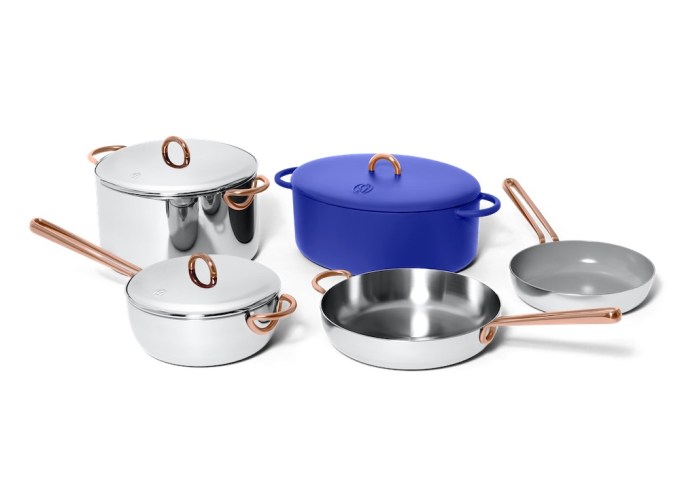
She sees a similar path for Great Jones — just as Parachute has become a “one-stop shop” for bedding, Tishgart wants her startup to do the same for your kitchen. Great Jones launched with pots, pans, and a Dutch oven, then added a baking sheet and is now expanding into a whole line of bakeware.

Great Jones

Image Credits: Great Jones

The new bakeware products (many of them inspired by classic Pyrex designs) include the Sweetie Pie ceramic pie dish, the Hot Dish ceramic casserole dish, the Breadwinner loaf pan, the Patty Cake cake pan and a new broccoli-colored version of the Holy Sheet baking sheet. You can buy the pieces a la carte (the Holy Sheet is $35, the pie pans are $45 and the bread pans are $65 for a pair) or purchase the whole set for $245.

Tishgart added that that the company has had a “really, really busy year” with lockdowns and social distancing.

“People are cooking more than ever,” she said. “This is a category and an industry that have really been able to thrive on this.”

At the same time, Tishgart emphasized that the growing interest from millennials and younger consumers is a long-term trend that won’t go away when the pandemic is over — with the rise of celebrity chefs, high-profile restaurants and more food content than ever, “food has been a cultural force from 2004 on, in a major way.”

There have been challenges as well, particularly as the pandemic has affected supply chains. Tishgart said the company has spent much of the year “chasing product,” but it benefited from using a variety of materials and working with a variety of manufacturers.

“This is one thing that upfront made for a more complicated supply chain,” she said. “But it’s a strong saving grace now, because we’re not reliant on one factory or one part of the world.”

The funding, Tishgart said, will allow Great Jones to invest in further product development and production. And while there are plenty of other cookware startups raising funding, she said that “it’s motivating, it’s exciting to see how other people interpret it” and that the different brands “all speak to different customers.”

News: What we expect from Apple’s ‘One More Thing’ Mac event

Macs. Okay, great. We’re done here.

Macs.

Okay, great. We’re done here.

Okay, fine. Yes, Apple has all but loudly declared that, five months after making a big silicon Mac reveal back at WWDC, the first models will finally be arriving at this week’s big event. Which models and precisely what kind of upgrades are coming is still up in the air, after months of rumors.

It’s also worth noting here that, in spite of the fact that Apple has had a LOT of smaller events in recent months, this is the company’s last event before the holiday season is in full force — as the name implies. That means we may finally be seeing some long-awaited products arriving in time to make their way into stockings and under trees.

But let’s start with the obvious: new Macs. Apple confirmed back in June that the first models sporting the ARM-based chips would arrive this year, so this event is do or die on that front. There have been a number of a rumors floating around on this front, well ahead of even the official Apple silicon unveiling. While iMacs and other models have been suggested, we seem to be looking specifically at two new 13-inch laptops at this week’s event, namely a new MacBook Pro and MacBook Air.

A report from Bloomberg that appeared last week details a chip based on the same A14 chip found in this year’s iPhone 12 models and the iPad Air. The company touted that the new chips would “deliver industry-leading performance and powerful new technologies.” Among the other stated benefits are increased power efficiency/battery life and other features developed for mobile devices, including security and machine learning.

An upgraded version of the company’s high-end 16-inch MacBook Pro could also be on the slate for the event, but the company appears to be kicking the can down the road on a long-rumored redesign for both this and the iMac. Keep in mind, the company has a stated two-year plan to make the full transition to the first-party silicon. That means we’re not likely to see big updates to the iMac (which received one fairly recently), Mac mini or the Mac Pro.

And, of course, what’s new hardware without the software to match? Apple’s been holding off on announcing the Big Sur release date since its June event. It seems all but a certainty that we’ll be getting a date for macOS 11.0. As one of the biggest updates to the desktop operating system in a number of years, Big Sur brings some key aesthetic redesigns and the new features to the Mac line.

Again, given that this is Apple’s last big event before the holidays, it seems likely we’ll see one or two non-Mac launches. The clearest candidates are the same ones we’ve been discussing in the lead up to every Apple event (and there have been plenty) over the last few months: namely, AirTags and AirPods Studio.

The recent iPhone event seemed like as good a time as any to launch the latter, alongside the arrival of the HomePod mini, but the over-ear headphones have reportedly run into production issues. That’s something of a surprise, given the fact the company owns Beats — the brand behind some of the best-selling over-ear headphones on the market. But better to have them late than early and malfunctioning.

AirTags, meanwhile, are the company’s long-rumored product-tracking Tile competitor. This one has been on top of the rumor list for even longer than AirPods Studio — and now would veritably be a good time to announce the potential stocking stuffer.

That’s pretty much it for the rumor list at this point. These things used to be longer, but Apple’s COVID-19-era schedule of practically monthly press events has largely meant portioning out announcements. The event kicks off tomorrow at 10 a.m. PST, 1 p.m. EST. As usual, we’ll be breaking news live as it happens.

News: What happens to high-flying startups if the pandemic trade flips?

So much can change in a day. This morning, news that a trial COVID-19 vaccine candidate had an effective rate of more than 90% shook the financial world. The Pfizer vaccine is reportedl;y so effective, the company “will have manufactured enough doses to immunize 15 to 20 million people” by the end of the year,

So much can change in a day.

This morning, news that a trial COVID-19 vaccine candidate had an effective rate of more than 90% shook the financial world. The Pfizer vaccine is reportedl;y so effective, the company “will have manufactured enough doses to immunize 15 to 20 million people” by the end of the year, according to the New York Times, appears to have given investors the green light to pile back into companies harmed by the pandemic.


The Exchange explores startups, markets and money. Read it every morning on Extra Crunch, or get The Exchange newsletter every Saturday.


The shift of money from shares that proved popular during the summer is massive and abrupt. Zoom and Peloton are down sharply this morning, while Uber and Lyft are soaring. Indeed, the Dow Jones Industrial Average and S&P 500 indices are up around 4.8% and 3.3% respectively, while SaaS and cloud share are off 3.5%.

Investors are taking money out of companies that were expected to do well thanks to the pandemic and moving that capital into firms that were weakened by the pandemic.

Our question for this morning: what do these changes mean for the economic forces that have broadly favored venture-backed startups? What happens to high-flying startups if the pandemic trade flips? What’s next for insurtech, edtech, fintech and SaaS? Let’s discuss.

Hot sectors, warm futures?

Short-term market movements do not always predict the future accurately, so we should not treat today’s trading as gospel.

That said, it’s not hard to draw some basic conclusions from the trading activity. Here’s what I think we can deduce from today’s stock market activity:

  • Corporate software spend growth will slow: The broad decline in the value of software companies today appears to indicate that investors expect slower growth in the future. This is especially sharp in companies boosted by the pandemic itself, and, it appears, less acute in companies that were less helped by the COVID-19 economy. Our read? Investors are betting that growth amongst the companies that most benefited from a switch to remote work, for example, will see the greatest deceleration from recent forecasts. For startups, the lesson here is plain. Go look at your public comps and consider your own valuation likely trading along similar lines.

News: Zoom settles with FTC after making ‘deceptive’ security claims

The Federal Trade Commission has announced a settlement with Zoom, after it accused the video calling giant of engaging in “a series of deceptive and unfair practices that undermined the security of its users,” in part by claiming the encryption was stronger than it actually was. Cast your mind back earlier this year at the

The Federal Trade Commission has announced a settlement with Zoom, after it accused the video calling giant of engaging in “a series of deceptive and unfair practices that undermined the security of its users,” in part by claiming the encryption was stronger than it actually was.

Cast your mind back earlier this year at the height of the pandemic lockdown, which forced millions to work from home and rely on Zoom for work meetings and remote learning. At the time, Zoom claimed video calls were protected by “end-to-end” encryption, a way of scrambling calls that makes it near-impossible for anyone — even Zoom — to listen in.

But those claims were false.

“In reality, the FTC alleges, Zoom maintained the cryptographic keys that could allow Zoom to access the content of its customers’ meetings, and secured its Zoom Meetings, in part, with a lower level of encryption than promised,” said the FTC in a statement Monday. “Zoom’s misleading claims gave users a false sense of security, according to the FTC’s complaint, especially for those who used the company’s platform to discuss sensitive topics such as health and financial information.”

Zoom quickly admitted it was wrong, prompting the company to launch a 90-day turnaround effort, which included the rollout of end-to-end encryption to its users. That eventually months later in late October — but not without another backtrack after Zoom initially said free users could not use end-to-end encryption.

The FTC also alleged in its complaint that Zoom stored some meeting recordings unencrypted on its servers for up to two months, and compromised the security of its users by covertly installing a web server on its users’ computers in order for users to jump into meetings faster. This, the FTC said, “was unfair and violated the FTC Act.” Zoom pushed out an update which removed the web server, but Apple also intervened to remove the vulnerable component from its customers’ computers.

In its statement, the FTC said it has prohibited Zoom from misrepresenting its security and privacy practices going forward, and has agreed to start a vulnerability management program and implement stronger security across its internal network.

Zoom did not immediately respond to a request for comment.

News: Uzabase sells Quartz to the site’s CEO and staff

Quartz is going private, with co-founder and CEO Zach Seward buying the business news site from its current owner Uzabase. In his post announcing the deal, Seward described the move as a management buyout that will also see Editor in Chief Katherine Bell and the rest of the Quartz staff taking equity in the new

Quartz is going private, with co-founder and CEO Zach Seward buying the business news site from its current owner Uzabase.

In his post announcing the deal, Seward described the move as a management buyout that will also see Editor in Chief Katherine Bell and the rest of the Quartz staff taking equity in the new company.

“Most of the time, I hope, Quartz’s finances and our corporate parentage are irrelevant, as long as we’re doing our job well,” he wrote. “But this is an important moment in the life of our company, and we want to share it with all of you, whose readership and enthusiasm for Quartz have carried us successfully through the past eight years.”

Seward suggested that while Uzabase’s ownership was “helpful,” the company is “better off right now as a startup, freer to chart our own path.” And as a startup, it’s looking to raise outside funding.

The Wall Street Journal, which broke the news that Uzabase wanted to sell the property, also reported that Uzabase CEO Yusuke Umeda (pictured above) has made a personal loan to support the site.

Quartz was founded in 2012 by Atlantic Media, then acquired by Uzabase (a Japanese financial data and media company) for $86 million in 2018.

The company has struggled to make the business side work in recent years, reporting a loss of $18.4 million on revenue of $26.4 million in 2019, and cutting about 80 staff positions earlier this year.

In an assessment of the site’s troubles published in June, Digiday’s Steven Perlberg noted Quartz has been restructuring around its subscription business, but he suggested that it’s been caught in digital media’s “mushy middle”: “Not quite niche enough to be essential to a small group of readers, but not quite big enough to compete at scale.”

News: McDonald’s to launch a McPlant vegetarian option

McDonalds is developing what it calls a plant-based platform called the McPlant that will debut in markets around the world early next year, according to a report in USA Today. In an investor meeting McDonald’s announced that it had worked to develop its McPlant formulation exclusively. “McPlant is crafted exclusively for McDonald’s, by McDonald’s,” Ian

McDonalds is developing what it calls a plant-based platform called the McPlant that will debut in markets around the world early next year, according to a report in USA Today.

In an investor meeting McDonald’s announced that it had worked to develop its McPlant formulation exclusively. “McPlant is crafted exclusively for McDonald’s, by McDonald’s,” Ian Borden, McDonald’s international president, said at an investor meeting, quoted by USA Today.

The company’s special formulation could extend across plant-based products including burgers, chicken-substitutes and breakfast sandwiches, according to Borden.

To date, McDonald’s has been a laggard in the corporate fight over plant-based burgers and chicken — at least in the U.S.

In McDonald’s around the world — including locations in Germany, the UK, Hong Kong, Israel, Canada, and Finland — diners under the golden arches can find a vegetarian sandwich option.

Indeed, in Canada, McDonald’s launched a pilot last year with Beyond Meat for the PLT sandwich (a play off of the company’s previous sandwich the McDLT, I’m assuming).

Compared to some other fast food chains in the US, McDonald’s has been something of a laggard. Burger King has worked with Impossible Foods to launch the Impossible Whopper and Beyond Meat has partnered with KFC on a plant-based nugget.

The two leading alternative protein makers have done a fairly good job of carving up the fast food market to date — but McDonald’s entry with its exclusive formulation must come as a blow to the companies (and the other startups that were hoping for a bite of McDonald’s food empire).

That includes startups like Chile’s the Not Company and Hong Kong’s Green Monday Holdings, which have both been vying for McDonald’s plant-based patty business.

WordPress Image Lightbox Plugin