Yearly Archives: 2020

News: T-minus 24 hours left to save on tickets to TC Sessions: Space 2020

We’ve initiated the final countdown, and we’re just hours away from the deadline for early bird savings to TC Sessions: Space 2020 (December 16-17). It’s your last chance to grab the first of many opportunities this two-day conference provides. Purchase your early-bird ticket today before the offer expires tonight at 11:59 p.m. (PT). Let’s talk about

We’ve initiated the final countdown, and we’re just hours away from the deadline for early bird savings to TC Sessions: Space 2020 (December 16-17). It’s your last chance to grab the first of many opportunities this two-day conference provides.

Purchase your early-bird ticket today before the offer expires tonight at 11:59 p.m. (PT).

Let’s talk about the opportunities at TC Sessions: Space. You’ll learn from and engage with the top leaders and officials across private, public and military sectors. These are the people currently driving and funding the future of space technology — founders, CEOs, generals, NASA officials, scientists and investors. Peruse the event agenda for all the presentations, fireside chats interviews, breakout sessions and interactive Q&As.

Fresh from the “Thank you, Captain Obvious” file, building a space startup ain’t cheap. Don’t miss your opportunity to meet some of the leading space funding programs and learn how you can access grant money to fuel your startup for the long haul. Representatives from each program will present and explain its grant process for 30 minutes. Then you can schedule individual appointments — using CrunchMatch — to discuss the specifics of your proposal.

We’ll add even more programs in the coming days, but here are four of the programs available (read more about them here).

  • The Space Force Accelerators
  • Advancing Space Technology with NASA SBIR
  • NAVWAR SBIR/STTR Primer 
  • Introduction to In-Q-Tel

You’ll go further with a strong network, and you won’t find a better opportunity to expand yours. Connect with people who share your business goals and can help you achieve startup success. CrunchMatch, our free, AI-powered platform makes it much easier to find and connect with people across a virtual environment. Schedule 1:1 video calls, find partners, potential customers, investors or the perfect engineer to advance your business.

Explore the early-stage startups exhibiting in the expo area and see what your peers are working on. All exhibitors will get five minutes to pitch live to global attendees. If you want in on that action, grab an Early-Stage Startup Exhibitor Package ($360 gets you three tickets, digital exhibition space and the ability to generate leads).

TC Sessions: Space 2020 offers almost infinite opportunity, but your first opportunity — to save $100 — disappears tonight at 11:59 p.m. (PT). Take flight with the early bird and buy your ticket right now.

Is your company interested in sponsoring TC Sessions: Space 2020? Click here to talk with us about available opportunities.

News: Springtide, an autism treatment center network, raises $15.6 million

With one in 54 children diagnosed with autism spectrum disorder in the US, the issue of how to treat patients diagnosed with the condition has become almost as acute as the prevalence of the condition itself. That’s one reason why Jia Jia Ye and the team at the healthcare startup studio Redesign Health, were able

With one in 54 children diagnosed with autism spectrum disorder in the US, the issue of how to treat patients diagnosed with the condition has become almost as acute as the prevalence of the condition itself.

That’s one reason why Jia Jia Ye and the team at the healthcare startup studio Redesign Health, were able to raise $15.6 million in a recent round of funding for the new startup, Springtide Child Development.

A longtime executive in the healthcare industry with previous stints at OneMedical and Oscar, Ye and Redesign Health’s team began talking two years ago about potential business ideas. The group settled on autism care because of what they saw as the clear need in the market, Ye said.

“Why this immediately clicked is that the supply and demand imbalance was super clear,” Ye said. 

Simply put, Springtide combines the concierge medical business model with early childcare and education businesses like Sylvan Learning to offer autism care through specialists and a team of registered behavioral technicians.

To ensure that as many people as possible can use Springtide’s services the company takes both private insurance and Medicaid.

So far, the company has one clinic set up in Connecticut providing both remote and in-person services, and it plans to launch several sites throughout the Northeast on the back of its $15.6 million in financing.

Joining Ye in designing the company’s facilities and treatment services is Dr. Tiva Pierce, who previously worked at Constellation Health Services, which provides behavioral and physical healthcare through schools.

Like many companies which had an in-person services model, Springtide had to pivot to delivering remote care as soon as the pandemic lockdowns hit the Northeast.

Image Credit: Thetaree Sarmkasat iStock / Getty Images Plus

The company charges Medicaid $46 per hour and commercial payers will be charged between $50 and $60 per hour, but the company’s services will only cost families their typical co-pay and deductible.

Taking Medicaid was a priority, Ye said, to increase access for more people who need it.

Already, the families in the US spend about $17 billion on ABA therapy, according to Ye. And the overall spending on autism related issues is $68 billion, she said.

The financing, which came from Deerfield Management and Optum Ventures, will be used to expand the company’s footprint and staff, which currently numbers roughly 30 employees.

“The rapidly growing autism care market is highly fragmented and uncoordinated, which creates significant challenges for children and their families who deserve to have access to care that is consistently of exceptional quality,” said Julian Harris, M.D., Partner at Deerfield. “Springtide offers an interdisciplinary, in-center care experience with a tech-enabled wrap-around for families who want their children to get all of their care in one setting.  With an emphasis on outcomes measurement, we hope that Springtide can serve as a platform for care and research, ultimately establishing the gold standard in this field.

News: NASA’s head of human spaceflight, Kathryn Lueders, will join us at TC Sessions: Space

NASA’s human spaceflight program took big strides in 2020 with the official kick-off of the commercial crew program with SpaceX, and on plans to return humans to the surface of the Moon via the Artemis program. NASA Associate Administrator of the Human Exploration and Operations (HEO) Mission Directorate Kathryn Lueders has been there for it

NASA’s human spaceflight program took big strides in 2020 with the official kick-off of the commercial crew program with SpaceX, and on plans to return humans to the surface of the Moon via the Artemis program. NASA Associate Administrator of the Human Exploration and Operations (HEO) Mission Directorate Kathryn Lueders has been there for it all, and actually rose to her current position from previously serving as Commercial Crew Program Manager, so there’s no one better to speak to the agency’s achievements and goals around putting humans in space.

Lueders will join us at TC Sessions: Space this year, which is happening December 16 and 17. It’s a fully virtual event, featuring all-star programming from across the space industry, public sector, and of course the startup scene. Associate Administrator Lueders will be joined on stage by moderator Emily Calandrelli, scientist, engineer, and host of the hit Netflix show Emily’s Wonder Lab.

We’ll be talking to Lueders about NASA’s historic certification of SpaceX’s Falcon 9 and Dragon human launch system, which ends the U.S. reliance on Russia’s Soyuz for transportation to and from the International Space Station – and becomes the first commercial spacecraft certified for human flight ever.

Dragon will make history yet again with its first-ever operational crew mission, set to take three NASA astronauts and one JAXA astronaut to the ISS this weekend.

Associate Administrator Lueders will also be able to talk us through the ongoing effort to gain a second commercial crew mission provider with Boeing, which is still in the process of certifying their Starliner spacecraft, and NASA’s work toward putting the next American man and the first American woman on the surface of the Moon with Artemis. She’s also the perfect person to talk about the agency’s future with commercial and startup partners when it comes to human spaceflight.

You can get an Early Bird Ticket for just $125 until 11:59pm tonight, Friday, November 13. And we have discounts available for groupsstudentsactive military/government employees and for early-stage space startup founders who want to pitch and give their startup some extra visibility.


News: Fintech VC keeps getting later, larger and more expensive

The venture capital market appears to be getting later, larger and more expensive. As a result, fintech — one of its hottest and most-funded sectors — is evolving in a similar manner. For late-stage fintech companies, it’s great news. But for smaller players, is the shift towards bigger, more mature rounds undercutting their ability to

The venture capital market appears to be getting later, larger and more expensive. As a result, fintech — one of its hottest and most-funded sectors — is evolving in a similar manner.

For late-stage fintech companies, it’s great news. But for smaller players, is the shift towards bigger, more mature rounds undercutting their ability to attract capital and reach scale?


The Exchange explores startups, markets and money. Read it every morning on Extra Crunch, or get The Exchange newsletter every Saturday.


Venture capital getting later and larger was something we saw repeatedly in our examinations of what happened in Q3 2020 more broadly. For example, during our look into United States’ results during the period, we noted that “54% of all venture capital money invested in the United States in the third quarter was part of rounds that were $100 million or more,” with those 88 rounds — a record — totaling $19.8 billion.

The other 1,373 rounds in the quarter had to split the rest of the money. And the percentage of rounds that are late-stage is rising, along with their average deal size, to add to the trend.

Fintech appears to be in a very similar boat.

The Exchange previously dug into the fintech VC market, focusing our examination on the payments, insurtech, wealth management and banking verticals.

This morning, leaning on a report from PitchBook covering fintech’s third quarter, I want to highlight how the vertical is also tilting later-stage — a trend to keep in mind as we care not only about which startups are gearing up to go public, but also which ones have a shot at raising the capital they need to make it to the growth stage.

More big, and more late

Top-line numbers from PitchBook concerning North American and European venture capital results for fintech in Q3 are as follows: $8.9 billion in total capital raised, +$1.3 billion or +17% from Q2 2020’s $7.6 billion haul.

But, as PitchBook notes, “only 414 deals closed during the quarter—the lowest count since Q3 2017.” More capital then, into fewer rounds. That sounds familiar.

Initially, when looking at the dataset, we were going to note that consumer fintech startups are having a great year, while it appears that certain B2B fintech categories were pulling back. Indeed, after raising $3.7 billion in 2019, consumer-facing fintechs in North America and Europe have already raised $5.9 billion in 2020.

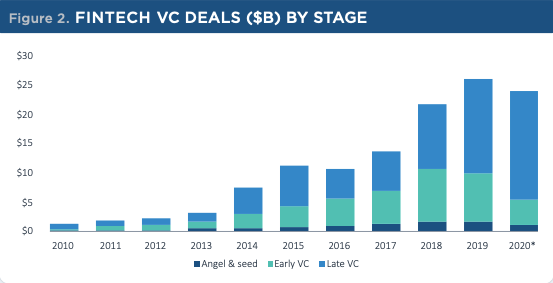
But that growth story was dwarfed by the figures on this chart:

Via PitchBook, shared with permission.

News: Kyklo raises $8.5M to bring electrical distributors online

Kyklo, a startup that helps wholesale distributors of electrical and automation products launch e-commerce stores, is announcing that it has raised $8.5 million in seed funding. The industry may sound a bit arcane, but it’s one that founders Remi Ducrocq (Kyklo’s CEO) and Fabien Legouic (CTO) know from having worked at Schneider Electric. Ducrocq said

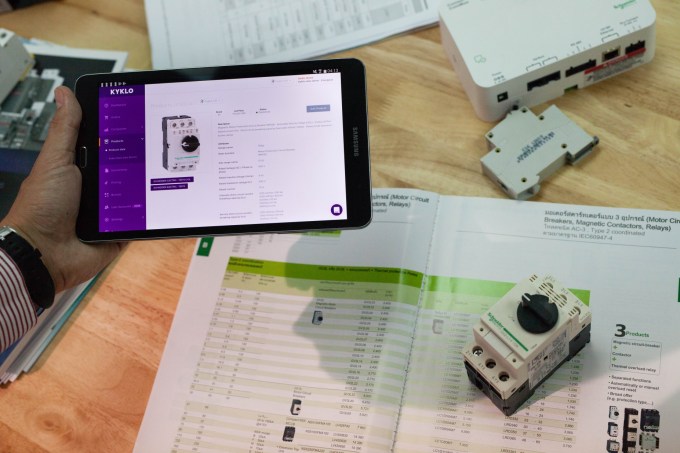
Kyklo, a startup that helps wholesale distributors of electrical and automation products launch e-commerce stores, is announcing that it has raised $8.5 million in seed funding.

The industry may sound a bit arcane, but it’s one that founders Remi Ducrocq (Kyklo’s CEO) and Fabien Legouic (CTO) know from having worked at Schneider Electric. Ducrocq said that the process of selling these products to manufacturers and electricians remains a cumbersome process that relies largely on PDF catalogs.

Shifting these businesses to digital is a much bigger challenge than creating your standard online store, both because of the number of products being sold and the needs for accurate listings.

“Even the small folks sell 100,000 SKUs [distinct products], up to 1 million SKUs,” Ducrocq told me. “If you choose the wrong product, your factory gets shut down. [It’s essential] to have accurate information present on the web store to have a transaction happen.”

Kyklo doesn’t automate the process completely, Ducrocq added, because “you can’t just create content or apply AI to something that is so unstructured.” Sreating these stores remains a manual process for the Kylo team, but the company has built “technology to make that manual process as easy as possible.”

That includes standardized data structures and a variety of scripts to create these product listings more quickly. Ultimately, Ducrocq said Kyklo can get distributors up and running with an online store within 30 days, and sometimes as quickly as two weeks.

In total, Kyklo has created a catalog of more than 2.5 million products for more than 35 distributors. It’s also been endorsed by manufacturers like Schneider Electric, Wago, Festo US and Mitsubishi Electric Automation as their preferred e-commerce partner.

Ducrocq suggested that creating going digital with Kyklo helps these businesses both by allowing them to reach new customers with improved SEO and by giving them tools to expand their sales with existing customers. For example, IEC Supply says that its online sales increased 600% for the first six months after launching with Kyklo, while new customer interactions tripled.

“Market maturity accelerated because of the pandemic,” he added. “These B2B traditional businesses were reluctant to go towards digitization, with only visionaries embarking on the journey. But during the pandemic, salespeople haven’t been able to see ther customers in person for six months, so many distributors are reassessing how they should effectively go to market.”

Kyklo has now raised a total of $10.2 million. The new funding was led by Felicis Ventures and IA Ventures, with participation from Jungle Ventures, partners at Wavemaker, Seedplus and strategic angel investors.

“With 80% of the $640 billion electrical, industrial and automation distribution industry still relying on PDF catalogs and phone and emails for its operations, distributors face a challenge in the market,” said Felicis Managing Director Sundeep Peechu in a statement. “KYKLO’s platform helps these companies keep pace with crucial industry needs and reassess how digital tools can transform their sales force.”

News: The VC and founder winners of DoorDash’s IPO

After years of rumors and high-flying headlines, we finally have the S-1 for DoorDash. Alex has covered the primary details, but I figured it would be good to dive in so we can see who is raking in the returns on the country’s delivery startup champion. DoorDash’s filing indicates that the company raised a combined

After years of rumors and high-flying headlines, we finally have the S-1 for DoorDash. Alex has covered the primary details, but I figured it would be good to dive in so we can see who is raking in the returns on the country’s delivery startup champion.

DoorDash’s filing indicates that the company raised a combined $2.485 billion in capital across a seed round and eight rounds Series A-H. The three VC firms with the largest holdings noted in the filing were the SoftBank Vision Fund, Sequoia and Singapore’s GIC investment fund, listed here as Greenview (no relation to the cannabis fund of the same name that was charged with fraud a few years ago).

DoorDash’s most recent per share valuation was $45.91 for the Series H back in June. Shares purchased by investors over the entire life of the company had an average value of $8.73.

We’ll dive into the VCs and who won here in a second, but first, I want to discuss the founders and their ownership stakes. Co-founder and CEO Tony Xu currently owns 5.2% of DoorDash, according to the filing, which doesn’t include any future performance incentives. Co-founders Andy Fang, who is CTO, and chief product officer Stanley Tang both own 4.7% of the company. A fourth co-founder, Evan Moore, formerly head of operations at DoorDash and now a partner at DoorDash’s seed investor Khosla, doesn’t have his ownership listed as he is no longer an active executive with the company.

News: Nintendo’s Switch dominates US console sales ahead of PlayStation/Xbox launches

Another banner month month for Nintendo hardware sales, per the latest figures from NPD. The firm puts Switch sales (including the standard and Lite models) at 735,000 units in the U.S., making the best October for a Nintendo console since the Wii sold 807,000 units in October 2008. It’s been a good couple of years

Another banner month month for Nintendo hardware sales, per the latest figures from NPD. The firm puts Switch sales (including the standard and Lite models) at 735,000 units in the U.S., making the best October for a Nintendo console since the Wii sold 807,000 units in October 2008.

It’s been a good couple of years for the Switch, which has marked 23 straight months as the best-selling console in the States. In its own reporting, Nintendo adds that the company has sold more than 63 million units worldwide, to date. 2020 has been particularly strong for the company, owing to both pandemic-related stay-at-home orders and the strength of titles like Animal Crossing: New Horizons, which was a downright powerhouse.

Of course, many Microsoft and Sony devotees were no doubt holding off on purchasing new hardware, with the arrival of the Xbox Series X/S and PlayStation 5 a month out. Per NPD, Nintendo offset its competitors’ declines in the meantime. Though an end to Nintendo’s console sales dominance could very well be in the cards for November, even with the Switch bundles the company has on offer for Black Friday.

FIFA 21 was the best-selling game for the month — the first time an entry in the soccer franchise hit the number one spot in the U.S. on launch. The hybrid title, Mario Kart Live: Home Circuit, was Nintendo’s best-selling game at number five overall, though Nintendo managed to claim nine of the top 20 spots for the month.

News: Onfido’s Husayn Kassai steps back, brings in new CEO ahead of a planned IPO

There are big changes today at Onfido, the global identity verification and authentication platform which has rocketed in adoption as so many services become digitized during the pandemic. The company, which has raised more than $200 million to date, is appointing a new CEO with the intention of moving towards an IPO “at some point”

There are big changes today at Onfido, the global identity verification and authentication platform which has rocketed in adoption as so many services become digitized during the pandemic. The company, which has raised more than $200 million to date, is appointing a new CEO with the intention of moving towards an IPO “at some point” in the future, according to co-founder and current CEO Husayn Kassai.

Kassai has of this week handed over the reins to Mike Tuchen, the former CEO of Talend who successfully took the compay to the NASDAQ in 2016.

Kassai says he will remain with Onfido, working “2-3 days a week” to assist Tuchen as he leads the company through the next period of growth across sectors and geographies, and towards that IPO.

Prior to Talend, a leader in cloud data integration, Tuchen led Rapid7, a security software startup, and founded a marketing analytics startup in between senior management roles at Microsoft and Polycom.

Kassai co-founded Onfido with Eamon Jubbawy and Ruhul Amin in 2012 to make digital identity verification simpler and more accurate, and it now employs over 400 people globally.

Speaking exclusively to TechCrunch Kassai said: “Its kind’ve been non-stop for 10 years. I’ve taken us from zero to one. And in order to go from ‘one to 100’, specifically an IPO and listing in large part, that’s the stage where you have to meet with consulting firms, banks etc, which has a lot of fun in it, but it’s not what I’m interested in. So I’d rather step down, still work with the company and help an experienced CEO take this forward for the next stage.”

Asked if he was stepping down for any other reason Kassai told TechCrunch: “No this is predominantly about the IPO focus, plus I have I’ve been speaking internally for a year about taking a break after this ten year period. My personal life has been on hold for this whole time. Exercise, eating well, family birthdays, everything else that goes with it. On hold. This move, in part, helps me get back some of my personal life, while the company will be in good hands.”

Asked if he would be taking the title of Chairman or Co-CEO or some other title, Kassai said that was undecided that this point.

On the joint call between Tuchen and Kassai, Tuchen said: “My first company was a security company in Boston. It’s now public on the NASDAQ. We took Talends public in 2016. So, I’ve had a lot of experience working across Europe and the US.”

Tuchen said he would be based in California, now that the whole company has moved to remote working because of the pandemic: “I don’t expect to move a lot during COVID. We are a remote-first company right now and will be for the medium term at least, and still trying to work out what our longer-term plans are, as we get – post-vaccine – back in the office. I spent a lot of time on the road before, but we’ll be figuring out how to develop that same kind of relationship with people over Zoom, with all the stuff that, you know, we’re used to doing in the regular world. So we’re kind of experimenting and figuring that out. The entire process of me joining was done over Zoom. And now the whole onboarding and getting to know the company is all being done on top, so we’re all kind of breaking new ground here in this dynamic environment.”

Tuchen said no decision had been made about where the IPO would be placed, but “most likely on one of the US exchanges.”

News: DoorDash files to go public

After filing earlier this year, DoorDash dropped its public S-1 filing this morning, bringing clarity to its numbers and moving it closer to a public debut that should happen before the end of the year. The company is one of several startups that we expect to see IPOs from before the year ends, despite some

After filing earlier this year, DoorDash dropped its public S-1 filing this morning, bringing clarity to its numbers and moving it closer to a public debut that should happen before the end of the year.

The company is one of several startups that we expect to see IPOs from before the year ends, despite some recent market chop and election chaos in the United States.

DoorDash is a heavily-backed company, with Crunchbase reporting that the food-delivery giant has accessed around $2.5 billion in capital during its life, most recently in a $400 million round this June. At the time, DoorDash was valued at a towering $16 billion, post-money, giving the company big valuation shoes to fill when it prices its IPO, and begins to trade.

What follows is a brief rundown of its numbers. The TechCrunch crew will be digging through the IPO filing all morning, so expect more coverage on ownership, legal risks, and other details soon. Let’s go!

The numbers

DoorDash has grown incredibly rapidly, scaling its revenues from $291 million in 2018 to $885 million in 2019. And more recently, from $587 million in the first nine months of 2019 to $1.92 billion in the same period of 2020.

That is 226% growth in 2020 thus far, the sort of expansion that explains why DoorDash was able to attract so much capital at such high prices.

How high-quality is DoorDash’s revenue? In the first three quarters of 2019, the company had gross margins of 39.9%, and in the same period of 2020 the figure rose to 53.1%, a huge improvement for the consumer consumable delivery confab.

The result of DoorDash’s epic growth, and gross margin improvement has been radically improving profitability. The company’s operating loss fell from $479 million in the first nine months of 2019 to just $131 million in the same period of 2020. DoorDash’s net losses are slightly worse — $533 million and $149 million over the same timeframes, respectively — but, again, compared to the company’s topline growth and revenue quality improvements, are inconsequential.

DoorDash has around $1.6 billion in cash and equivalents heading into the fourth quarter, meaning that it has ample cash to fund itself, sans an IPO. The company is therefore going out because it thinks the time is ripe.

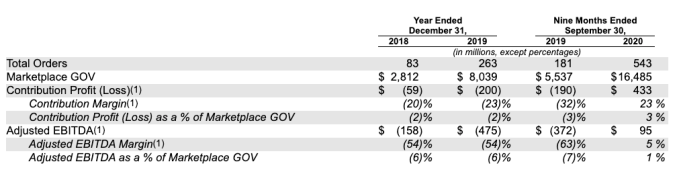
Driving DoorDash’s epic growth has been a huge boom in the company’s order volumes and gross order volumes, while its gross margins appear driven by an epic gain in the profitability of the company’s core activity. Observe the following dataset:

The 2019 to 2020 change in contribution margin at DoorDash, and its jump into positive-adjusted EBITDA, makes one wonder why Uber is struggling to accomplish the same task with its Uber Eats business. Regardless, the flip into adjusted profitability should be enough to allay Wall Street concerns about DoorDash’s path to eventual GAAP profits.

At that trajectory it can get the job done in a year or so.

And DoorDash’s operations have flipped into the cash-generating territory, with the company reporting operating cash flow of $315 million during the first three quarters of 2020, up from -$308 million in the same period of 2019.

Overall I am impressed at first blush. The company is bigger, growing more quickly, and losing less money than I expected. Throw in cash generation and adjusted EBTIDA positivity and improving gross margins, and DoorDash could be worth a pretty penny. Without recurring revenues akin to a software company, and the possibility of a vaccine slowing is future growth, DoorDash won’t get a SaaS multiple when it prices. But perhaps defending that $16 billion valuation won’t be as hard as we might have guessed before getting our hands on the numbers.

More to come. Stick with TechCrunch.

News: Microsoft says hackers backed by Russia and North Korea targeted COVID-19 vaccine makers

Microsoft has revealed that hackers backed by Russia and North Korea have targeted pharmaceutical companies involved in the COVID-19 vaccine development efforts. The technology giant said Friday that the attacks targeted seven companies in the U.S., Canada, France, India, and South Korea. But while it blocked the “majority” of the attacks, Microsoft acknowledged that some

Microsoft has revealed that hackers backed by Russia and North Korea have targeted pharmaceutical companies involved in the COVID-19 vaccine development efforts.

The technology giant said Friday that the attacks targeted seven companies in the U.S., Canada, France, India, and South Korea. But while it blocked the “majority” of the attacks, Microsoft acknowledged that some were successful.

Microsoft said it had notified the affected companies, but declined to name them.

“We think these attacks are unconscionable and should be condemned by all civilized society,” said Tom Burt, Microsoft’s customer security and trust chief, in a blog post.

The technology giant blamed the attacks on three distinct hacker groups. The Russian group, which Microsoft calls Strontium but is better known as APT28 or Fancy Bear, used password spraying attacks to target their victims, which often involves recycled or reused passwords. Fancy Bear may be best known for its disinformation and hacking operations in the run-up to the 2016 presidential election, but the group has also been blamed for a string of other high-profile attacks against media outlets and businesses.

The other two groups are backed by the North Korean regime, one of which Microsoft calls Zinc but is better known as the Lazarus Group, which used targeted spearphishing emails disguised as recruiters in an effort to steal passwords from their victims. Lazarus was blamed for the Sony hack in 2016 and the WannaCry ransomware attack in 2017, as well as other malware-driven attacks.

But little is known about the other North Korea-backed hacker group, which Microsoft calls Cerium. Microsoft said the group also used targeted spearphishing emails masquerading as representatives from the World Health Organization, charged with coordinating the effort to combat the COVID-19 pandemic.

A Microsoft spokesperson acknowledged it was the first time the company had referenced Cerium, but the company did not offer more.

This is the latest effort by hackers trying to exploit the COVID-19 pandemic for their own goals. Earlier this year, the FBI and Homeland Security warned that hackers would try to steal coronavirus vaccine research.

Today’s news coincides with the Paris Peace Forum, where Microsoft president Brad Smith will urge governments to do more to combat cyberattacks against the healthcare sector, particularly during the pandemic.

“Microsoft is calling on the world’s leaders to affirm that international law protects health care facilities and to take action to enforce the law,” Burt said. “We believe the law should be enforced not just when attacks originate from government agencies but also when they originate from criminal groups that governments enable to operate — or even facilitate — within their borders.”

WordPress Image Lightbox Plugin