Yearly Archives: 2020

News: NextView Ventures closes its fourth fund with $89 million

NextView Ventures, a Boston-based venture capital fund, has raised an $89.6 million fund, according to SEC filings. The firm’s fourth fund, its largest to date, is oversubscribed, with early documents indicating a $70 million goal. The NextView Ventures team did not immediately respond to request for comment. NextView Ventures was launched in 2010 by Rob

NextView Ventures, a Boston-based venture capital fund, has raised an $89.6 million fund, according to SEC filings. The firm’s fourth fund, its largest to date, is oversubscribed, with early documents indicating a $70 million goal. The NextView Ventures team did not immediately respond to request for comment.

NextView Ventures was launched in 2010 by Rob Go, a former partner at Spark Capital; Dave Beisel, who clocked time at Venrock and Masthead Venture Partners; and Lee Hower, a former investor at Point Judith Capital. Melody Koh joined as a partner three years ago, and most recently, the fund brought on former journalist Leah Fessler as an investor.

The fund, which has offices in New York as well as Boston, invests in consumer and software-as-a-service enterprise startups at the pre-seed and seed stage. Its portfolio includes Ellevest, an investing platform for women; Grove Collaborative, a sustainable goods subscription platform; and ThredUp, which has confidentially filed for IPO. In April, NextView launched a virtual accelerator for startups to build a more robust pipeline for deal flow. The firm invested $200,000 for an 8% equity stake in a number of pre-seed and seed startups focused on “the everyday economy.

Despite the pandemic, Boston’s startup scene has continued to attract record numbers in venture capital volume. In fact, according to PitchBook data, Boston-area startups raised more private capital during summer 2020 than they did in summer 2019, suggesting that the pandemic has been a boon to startups in aggregate.

More recently, my colleague Alex Wilhelm and I wrote about how the Boston area is growing its demographic footprint in venture capital. In Q3 2019, New England drove 9.3% of U.S. venture deals, and 10.3% of U.S. venture dollars. In Q3 2020, those numbers were 9.3% of U.S. venture deals, and 12.7% of U.S. venture dollars. The percentage change is notable, especially amid volatile times.

NextView’s new fund is yet another signal of the city’s ability to attract institutional investment. Its previous fund was raised in 2017 at a $50 million close.

News: Google pulls the plug on Expeditions VR app, migrates tours to Arts & Culture

Google today announced that it is ending support for Expeditions. The VR app will also be pulled from its own Play Store and Apple’s App Store in June of next year. In a blogpost somewhat confusingly titled, “Expanding Google Arts and Culture with Expeditions,” the company notes the 360-degree tours captured for the project will

Google today announced that it is ending support for Expeditions. The VR app will also be pulled from its own Play Store and Apple’s App Store in June of next year. In a blogpost somewhat confusingly titled, “Expanding Google Arts and Culture with Expeditions,” the company notes the 360-degree tours captured for the project will survive — but will be moved to Google Arts & Culture.

Director of Program Management, Education, Jennifer Holland, says the decision was made to make the content more accessible to students and educators.

“Engaging students in the classroom has taken on an entirely different meaning this year. As schools around the world reimagine education from the ground up for a hybrid world, we’ve also been thinking deeply about how to adjust our tools to meet the moment and simultaneously build for the future,” she writes. “We’ve heard and recognize that immersive experiences with VR headsets are not always accessible to all learners and even more so this year, as the transition to hybrid learning has presented challenges for schools to effectively use Expeditions.”

The content will be included alongside Arts & Culture’s museum tours and other content, available for free to all users. That, at least, is a small win for teachers and parents who have struggled to keep up kids’ education in the face of a pandemic that has contributed to major school closures.

Notably, the news comes a little over a month after Google announced it would be ending support for the ill-fated Daydream VR platform. Launched four years ago, the project was an effort to bring low-cost virtual reality that failed to reach its potential.

News: Uber in talks to sell ATG self-driving unit to Aurora

Eighteen months ago, Uber’s self-driving car unit, Uber Advanced Technologies Group, was valued at $7.25 billion following a $1 billion investment from Toyota, DENSO and Softbank’s Vision Fund. Now, it’s up for sale and a competing autonomous vehicle technology startup is in talks with Uber to buy it, according to three sources familiar with the

Eighteen months ago, Uber’s self-driving car unit, Uber Advanced Technologies Group, was valued at $7.25 billion following a $1 billion investment from Toyota, DENSO and Softbank’s Vision Fund. Now, it’s up for sale and a competing autonomous vehicle technology startup is in talks with Uber to buy it, according to three sources familiar with the deal.

Aurora Innovation, the startup founded by three veterans of the autonomous vehicle industry who led programs at Google, Tesla and Uber, is in negotiations to buy Uber ATG. Terms of the deal are still unknown, but sources say the two companies have been in talks since October and it is far along in the process.

An Uber spokesperson declined to comment, citing that the company’s general policy is not to comment on these sorts of inquiries. An Aurora spokesperson said it doesn’t comment on speculation.

The talks could falter. But if successful, they have the potential to triple Aurora’s headcount and allow Uber to unload an expensive long-term play that has sustained several controversies in its short life.

Uber has ‘been shopping’

Shedding Uber ATG would follow a string of spin offs or other deals in recent months that has narrowed Uber’s focus and costs into core areas of ride-hailing and delivery. Two years ago, Uber’s business model could be described as an “all of the above approach,” a bet on generating revenue from all forms of transportation, including ride-hailing, micromobility, logistics, package and food delivery and someday even autonomous robotaxis.

That strategy has changed since Uber went public and has further accelerated as the COVID-19 pandemic has upended the economy and fundamentally changed how people live. In the past 11 months, Uber has dumped shared micromobility unit Jump, sold a stake in its growing but still unprofitable logistics arm, Uber Freight and acquired Postmates. (The Postmates acquisition is expected to close in the fourth quarter of 2020).

Uber ATG has been the company’s last big, expensive holding. Uber ATG holds a lot of long-term promise and high present-day costs; Uber reported in November that ATG and “other technologies” (which includes Uber Elevate) had a net loss of $303 million in the nine months that ended September 30, 2020. In its S-1 document, Uber said it incurred $457 million of research and development expenses for its ATG and “other Technology Programs” initiatives.

Four sources within the industry told TechCrunch that Uber “has been shopping” ATG to several companies, including automakers this year. Sources have also told TechCrunch that Uber ATG was facing a potential down round, which might have been an additional motivator behind the talks with Aurora.

Aurora, which was founded in 2017, is focused on building the full self-driving stack, the underlying technology that will allow vehicles to navigate highways and city streets without a human driver behind the wheel. Aurora has attracted attention and investment from high-profile venture firms, management firms and corporations such as Greylock Partners, Sequoia Capital, Amazon and T. Rowe Price, in part because of its founders Sterling Anderson, Drew Bagnell and Chris Urmson.

Urmson led the former Google self-driving project before it spun out to become the Alphabet business Waymo. Anderson is best known for leading the development and launch of the Tesla Model X and the automaker’s Autopilot program. Bagnell, an associate professor at Carnegie Mellon, helped launch Uber’s efforts in autonomy, ultimately heading the autonomy and perception team at the Advanced Technologies Center in Pittsburgh.

Aurora has grown from a small upstart to a company with 600 employees and operations in the San Francisco Bay Area, Pittsburgh, Texas and Bozeman, Montana, home of Blackmore, the lidar company it acquired in 2019. About 12% of Aurora’s current workforce previously worked at Uber, according to records on LinkedIn.

Despite that growth, Aurora is still dwarfed by Uber ATG, the self-driving subsidiary that is majority owned by Uber. Uber ATG has more than 1,200 employees with operations in several locations, including Pittsburgh, San Francisco and Toronto. Uber holds an 86.2% stake (on a fully diluted basis) in Uber ATG, according to filings with the U.S. Securities and Exchange Commission. Its investors hold a combined stake of 13.8% in Uber ATG.

Uber’s public leap into autonomous vehicle technology began in earnest in early 2015 when the company announced a strategic partnership with Carnegie Mellon University’s National Robotics Center. The agreement to work on developing driverless car technology resulted in Uber poaching dozens of NREC researchers and scientists. A year later, with the beginnings of an in-house AV development program, Uber, then led by co-founder Travis Kalanick, acquired a self-driving truck startup called Otto.

The acquisition was troubled almost from the start. Otto was founded earlier that year by one of Google’s star engineers Anthony Levandowski, along with three other Google veterans: Lior Ron, Claire Delaunay and Don Burnette. Uber acquired Otto less than eight months later.

Two months after the acquisition, Google made two arbitration demands against Levandowski and Ron. Uber wasn’t a party to either arbitration. While the arbitrations played out, Waymo separately filed a lawsuit against Uber in February 2017 for trade secret theft and patent infringement. Waymo alleged in the suit, which went to trial but ended in a settlement in 2018, that Levandowski stole trade secrets, which were then used by Uber.

Under the settlement, Uber agreed not to incorporate Waymo’s confidential information into their hardware and software. Uber also agreed to pay a financial settlement that included 0.34% of Uber equity, per its Series G-1 round $72 billion valuation. That was calculated at the time to be about $244.8 million in Uber equity.

In the early days of the Otto acquisition, Uber estimated it could have 75,000 autonomous vehicles on the roads by 2019 and be operating driverless taxi services in 13 cities by 2022, according to court documents unsealed and first reported on by TechCrunch. To reach those ambitious goals, the ride-hailing company was spending $20 million a month on developing self-driving technologies.

Uber never came close to hitting those targets, a mission that was derailed by technical hurdles as well as the lawsuit with Waymo, its troubled relationship with Lewandowski and the fatal crash in March 2018 involving one of its self-driving test vehicles in Tempe, Arizona.

Uber halted all testing following the crash and has been slowly ramping up its more public-facing operations over the past 18 months. The expensive undertaking of developing autonomous vehicles prompted Uber to spin out the company in spring 2019 after it closed $1 billion in funding from Toyota, auto parts maker Denso and Softbank’s Vision Fund.

The spin out, which occurred about one month before Uber’s debut as a publicly traded company, had been the subject of speculation for months. It was seen as a way for Uber to share the expensive load with other investors and allow it to focus on its core competencies and nearer term profit goals.

What Aurora gains

Troubles aside, Uber ATG has two important and critical features that make it attractive to Aurora: talent and Toyota.

The Japanese car giant had already invested $500 million into Uber prior to the 2019 injection of cash. At the time, the two companies announced their intention to bring pilot-scale deployments of automated Toyota Sienna-based ridesharing vehicles to the Uber ridesharing network in 2021, “leveraging the strengths of Uber ATG’s self-driving technology alongside the Toyota Guardian advanced safety support system.”

The 2019 investment into the Uber ATG unit deepened Toyota’s relationship with the company.

“While Uber was facing off against Waymo in the trade secrets lawsuit, Aurora launched with a bang. Within 18 months, Auora had secured several kinds of partnerships with Hyundai, Byton and VW Group. Some have fizzled, while there have been new gains, notably with Fiat Chrysler Automobiles. The musical chair-like changes underscores the sheer number of hopeful players in the self-driving business — a market that is still full of commercial and technical unknowns — and the fickleness of incumbent car makers in search of the best tech and deal.”

VW Group, which had touted its Aurora partnership in January 2018, confirmed to TechCrunch in June 2019 that “activities under our partnership have been concluded.” VW Group ultimately put its capital behind Argo AI, another autonomous vehicle technology developer that had locked up backing and a customer deal with Ford.

While Hyundai does have a minority stake in Aurora, it also went ahead and locked in a joint venture in fall 2019 with autonomous driving technology company Aptiv. Under the deal with Aptiv, both parties took a 50% ownership stake in the new joint company that is now called Motional. The combined investment in Motional from both companies will total $4 billion in aggregate value (including the value of combined engineering services, R&D and IP).

Still, Aurora has had its wins. The company raised $530 million last spring in a Series B round led by Sequoia with “significant investment” from Amazon and T. Rowe Price. Aurora’s post-money valuation at the time was $2.5 billion. More recently, sources in the industry say that Aurora is abuzz with activity, particularly around the office of David Maday, the company’s new vice president of business development who led General Motors’ corporate development and mergers and acquisitions team for 21 years.

Aurora has always stated that its full driving stack — the combined suite of software and hardware that provides the brains for an AV — would be vehicle agnostic, but some of its early testing and partnerships suggested it was focused on robotaxi applications, not logistics. Aurora started talking more openly last year about applying its technology to long-haul trucking and has become more bullish on that application, particularly following its Blackmore acquisition.

Aurora announced in July 2020 that it was expanding into Texas and planned to test commercial routes in the Dallas-Fort Worth Area with a mix of Fiat Chrysler Pacifica minivans and Class 8 trucks. A small fleet of Pacificas were expected to arrive first. The trucks will be on the road in Texas by the end of the year, according to the company.

The Jump precedent

What’s unclear is how an acquisition of Uber ATG might be structured; and more importantly, if it will retain any interest in the enterprise. Even with the expected depletion in Uber ATG’s valuation, it would be seemingly out-of-range for Aurora unless it was able to secure additional outside investment or structure the deal in a way that would allow Uber to keep some equity. 

There is precedent for the latter. Earlier this year, Uber led a $170 million investment round into Lime. As part of the complex arrangement, Uber offloaded Jump, the bike and scooter-sharing unit, to Lime.

Rumors that Uber CEO Dara Khosrowshahi was keen to get rid of Uber ATG have popped up from time to time in the past year. But as the COVID-19 pandemic took hold, Khosrowshahi and other executives began to focus on its core competency of ride-hailing and double down on delivery. In addition to its micromobility unit and the Uber Freight spinoff, it has divested itself internationally of a number of regional operations that were proving too costly to grow in competition with strong local rivals.

It was on the heels of the Jump deal that interest in selling off Uber ATG ramped up, according to two sources.

One investor in the industry described it as an interesting plan b for Uber, a deal that would allow the company to take ATG off the books, while potentially getting to benefit from a little of upside.


News: Extra Crunch roundup: Inside DoorDash’s IPO, first-person founder stories, the latest in fintech VC and more

One of my favorite series of Monty Python sketches is built around the concept of surprise: Chapman: I didn’t expect a kind of Spanish Inquisition. [JARRING CHORD] [Three cardinals burst in] Cardinal Ximénez: NOBODY expects the Spanish Inquisition! I was reminded of this today when I needed to reschedule a few stories so we could cover DoorDash’s S-1

One of my favorite series of Monty Python sketches is built around the concept of surprise:

Chapman: I didn’t expect a kind of Spanish Inquisition.

[JARRING CHORD]

[Three cardinals burst in]

Cardinal Ximénez: NOBODY expects the Spanish Inquisition!

I was reminded of this today when I needed to reschedule a few stories so we could cover DoorDash’s S-1 filing from multiple angles. First, Managing Editor Danny Crichton looked at how well the company’s co-founders and many investors stand to make out. Alex Wilhelm covered the IPO announcement in depth on TechCrunch before writing an Extra Crunch column that studied the role the COVID-19 pandemic played in the home-delivery platform’s recent growth.

Our all-hands-on-deck coverage of DoorDash’s S-1 is a good illustration of Extra Crunch’s mission: timely analysis of current and future technology trends that serves founders and investors. We have a talented team, and as today’s coverage shows, they’re just as good as they are fast.

The stories that follow are an overview of Extra Crunch from the last five days. The full articles are only available to members, but you can use discount code ECFriday to save 20% off a one or two-year subscription. Details here.

Thanks very much for reading Extra Crunch this week. I hope you have a great weekend!

Walter Thompson
Senior Editor, TechCrunch
@yourprotagonist


What I wish I’d known about venture capital when I was a founder

Why I left edtech and got into gaming

Image Credits: Klaus Vedfelt / Getty Images

We frequently run posts by guest contributors, but two stories we published this week were written in the first person, which is a bit of a departure.

In Why I left edtech and got into gaming, Darshan Somashekar brought us inside his decision to pivot away from a sector that’s been growing hotter in 2020.

His post is a unique take on two oft-discussed categories, but it also examines one founder/investor’s thought process when it comes to evaluating new opportunities.

Andy Areitio, a partner at early-stage fund TheVentureCity, wrote What I wish I’d known about venture capital when I was a founder, a reflection on the “classic mistakes” founders tend to make when it’s time to fundraise.

“Error number one (and two) is to raise the wrong amount of money and to do it at the wrong time,” he says. “They can also put all their eggs in one basket too early. I made that mistake.”

You can find business writing that explores best practices anywhere, which is why we hunt down stories that are firmly rooted in data or personal experience (which includes success and failure).

How COVID-19 accelerated DoorDash’s business

doordash dasher bicycle delivery person

Image Credits: DoorDash

The coronavirus pandemic looms large in DoorDash’s S-1 filing.

According to the food-delivery platform, “58% of all adults and 70% of millennials say that they are more likely to have restaurant food delivered than they were two years ago,” and “the COVID-19 pandemic has further accelerated these trends.”

As in other sectors, the pandemic didn’t wave a magic wand — instead, it hastened trends that were already in play: consumers love convenience, which means DoorDash’s gross order volume and revenue were tracking well before the virus started to shape our lives.

“It’s your call on how to balance the factors and decide whether or not to buy into the IPO, but this one is going to be big,” writes Alex Wilhelm in a supplemental edition of today’s The Exchange.


The VC and founder winners of DoorDash’s IPO

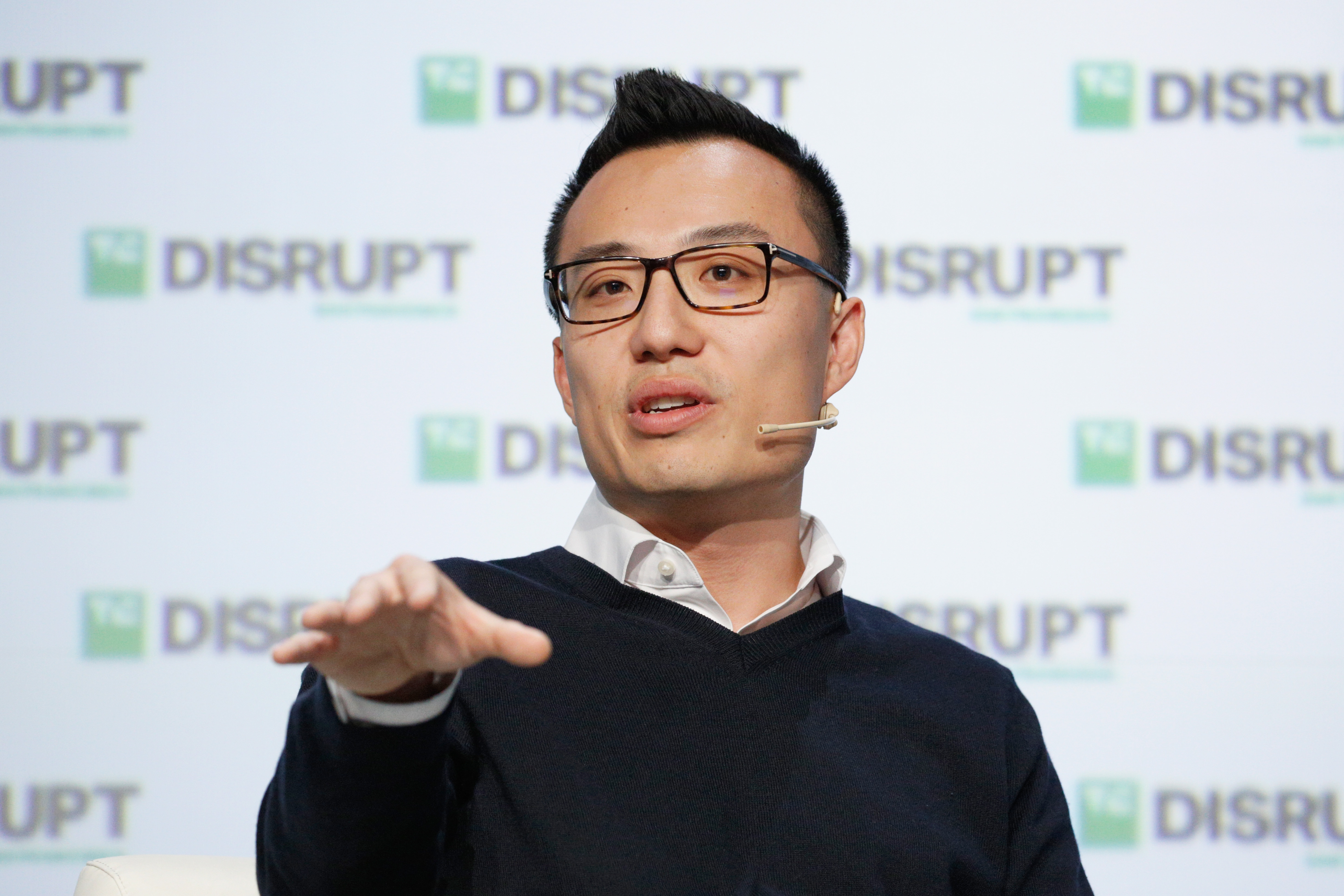
SAN FRANCISCO, CA – SEPTEMBER 05: DoorDash CEO Tony Xu speaks onstage during Day 1 of TechCrunch Disrupt SF 2018 at Moscone Center on September 5, 2018 in San Francisco, California. (Photo by Kimberly White/Getty Images for TechCrunch)

None of us knew DoorDash would release its S-1 filing today, but Danny Crichton jumped on the story “so we can see who is raking in the returns on the country’s delivery startup champion.”

After estimating the value of the respective ownership stakes held by DoorDash’s four co-founders, he turned to the investors who participated in rounds seed through Series H.

Some growth funds are about to look very good after this IPO, and each founder is looking at hundreds of millions, he found.

But even so, their diminished haul of about $1.3 billion is “a sign of just how much dilution the co-founders took given the sheer amount of capital the company fundraised over its life.”


Fintech VC keeps getting later, larger and more expensive

Investors sent stacks of cash to late-stage fintech companies in Q3 2020, but these sizable rounds may also point to shrinking opportunities for early-stage firms, reports Alex Wilhelm in this morning’s edition of The Exchange.

2020 could be a record year for fintech VC in Europe and North America, but are these “huge late-stage dollars” actually “a dampener for new fintech startups trying to get off the ground?”


Accelerators embrace change forced by pandemic

Devin Coldewey interviewed the leaders of three startup accelerators to learn more about the adaptations they’ve made in recent months:

  • David Brown, founder and CEO, Techstars
  • Cyril Ebersweiler, founder HAX, venture partner at SOSV
  • Daniela Fernandez, founder, Ocean Solutions Accelerator

Due to travel bans, shelter-in-place orders and other unknowns, they’ve all shifted to virtual. But accelerators are intensive programs designed to indoctrinate founders and elicit brutally honest feedback in real time.

Despite the sudden shift, that boot-camp mindset is still in effect, Devin reports.

“Cutting out the commute time in a busy city leaves founders with more time for workshops, mentor matchmaking, pitch practice and other important sessions,” said Fernandez. “Everybody just has more flexibility and tranquility.”

Said Ebersweiler: “People are for some reason more participative and have more feedback than physically — it’s pretty strange.”

Greylock’s Asheem Chandna on ‘shifting left’ in cybersecurity and the future of enterprise startups

Asheem Chandna

Image Credits: Greylock

In a recent interview with Greylock partner Asheem Chandna, Managing Editor Danny Crichton asked him about the buzz around no-code platforms and what’s happening in early-stage enterprise startups before segueing into a discussion about “shift left” security:

“Every organization today wants to bring software to market faster, but they also want to make software more secure,” said Chandna.

“There is a genuine interest today in making the software more secure, so there’s this concept of shift left — bake security into the software.”


Square and PayPal earnings bring good (and bad) news for fintech startups

If you missed Wednesday’s The Exchange, Alex scoured earnings reports from PayPal and Square to see what the near future might hold for several fintech startups currently waiting in the wings.

Using Square and PayPal’s recent numbers for stock purchases, card usage and consumer payment activity as a proxy, he attempts to “see what we can learn, and to which unicorns it might apply.”


Conflicts in California’s trade secret laws on customer lists create uncertainty

Concept of knowledge, data and protection. Paper human head with pad lock.

Image Credits: jayk7 (opens in a new window)/ Getty Images

In California, non-competition agreements can’t be enforced and a court has ruled that customer contact lists aren’t trade secrets.

That doesn’t mean salespeople who switch jobs can start soliciting their former customers on their first day at the new gig, however.

Before you jump ship — or hire a salesperson who already has — read this overview of California’s trade secret laws.

“Even without litigation, a former employer can significantly hamper a departing salesperson’s career,” says Nick Saenz, a partner at Lewis & Llewellyn LLP, who focuses on employment and trade secret issues.

As public investors reprice edtech bets, what’s ahead for the hot startup sector?

light bulb flickering on and off

Image: Bryce Durbin / TechCrunch

News of a highly effective COVID-19 vaccine appeared to drive down prices of the three best-known publicly traded edtech companies: 2U, Chegg and Kahoot saw declines of about 20%, 10% and 9%, respectively after the report.

Are COVID-19 tailwinds dissipating, or did the market make a correction because “edtech has been categorically overhyped in recent months?”


Dear Sophie: What does a Biden win for tech immigration?

Image Credits: Sophie Alcorn

What does President-elect Biden’s victory mean for U.S. immigration and immigration reform?

I’m in tech in SF and have a lot of friends who are immigrant founders, along with many international teammates at my tech company. What can we look forward to?

— Anticipation in Albany


News: Demon’s Souls: The first truly next-gen game is a lopsided but impressive showcase

The next generation of gaming is here with the PlayStation 5 and Xbox Series X — except it isn’t, because there are almost no next-generation games to play on them. Demon’s Souls is the first title that can truly be called next-gen, and it shows — even though it’s a remake of a PS3 game…

The next generation of gaming is here with the PlayStation 5 and Xbox Series X — except it isn’t, because there are almost no next-generation games to play on them. Demon’s Souls is the first title that can truly be called next-gen, and it shows — even though it’s a remake of a PS3 game… which also shows.

The original Demon’s Souls was an incredibly influential game. Its sequel, Dark Souls, was more popular and improved on the first quite a bit, but much of what made the now major series good had already been established. “Souls-like” is practically a genre now, though the originals are unsurprisingly still the nonpareil.

The comparative few who played Demon’s Souls were elated to hear that it was being remade, and by Bluepoint at that (who also remade the legendary Shadow of the Colossus), but worried that the game might not stand up by modern standards.

Can an old game, the essentials of which are a decade behind its descendants, be given a really, really, really, ridiculously good-looking coat of paint and still act as a blockbuster next-gen debut? Well, it kind of has to — there’s no other option! Fortunately the game really does hold up, and in fact makes for a harrowing, cinematic experience despite a few significant creaks.

I don’t want to give a full review of the game itself; let it suffice to say that, although it looks and runs much better, the core of the game is almost entirely unchanged. Any review from the last decade is still completely relevant, down to the “magic is overpowered” and “inventory burden is annoying.”

As a next-gen gaming experience, however, Demon’s Souls is as yet without comparison. It serves as a showcase not only for the PS5’s graphical prowess, but its sound design, haptics, speed, and OS.

Image Credits: Sony

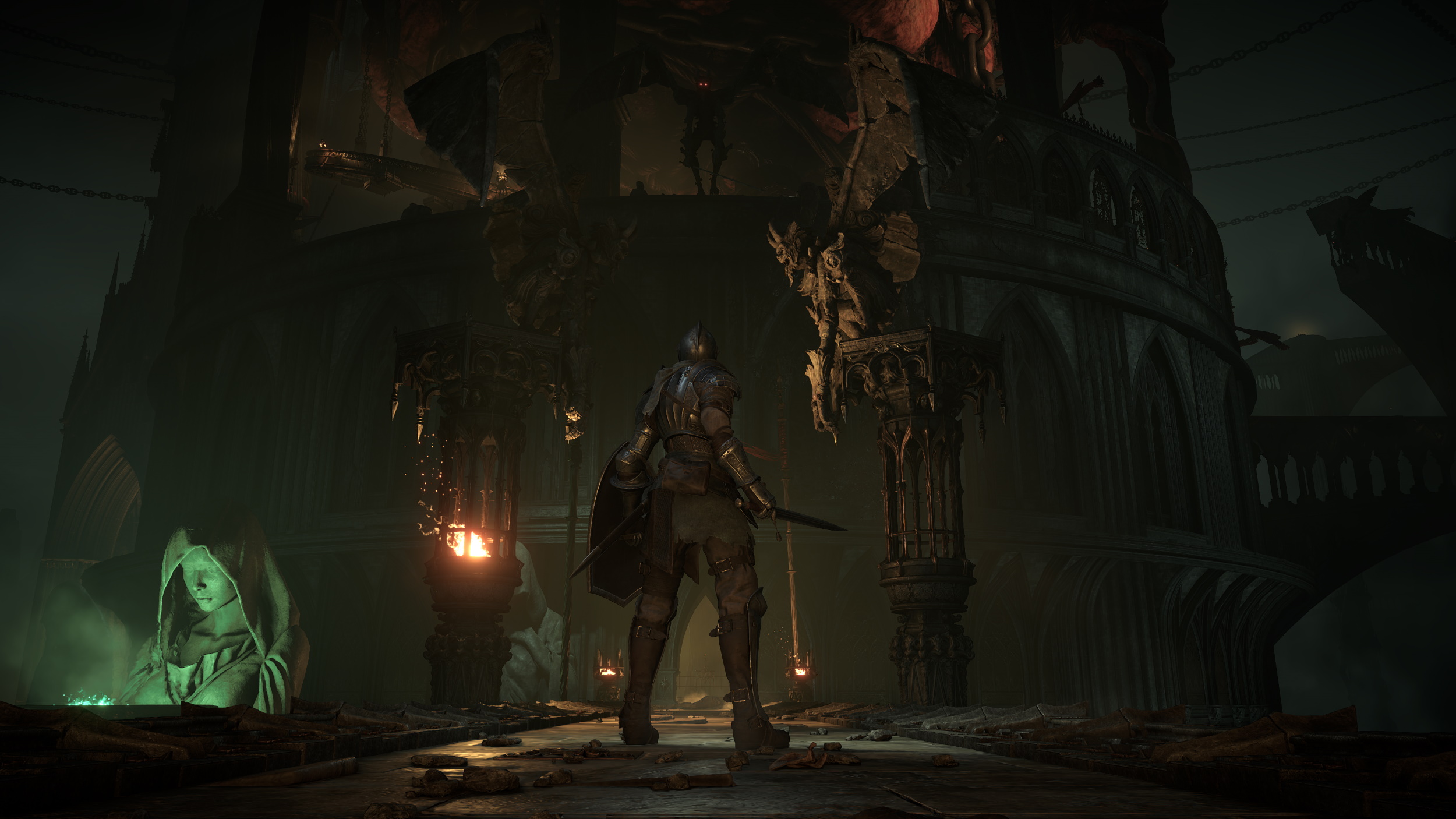
First, the graphics. It’s clear that Sony and Bluepoint intended this to be a truly lavish remake, and the game’s structure — essentially five long, mostly linear levels — provides an excellent platform for breathtaking visuals carefully tuned to the user’s experience.

The environments themselves are incredibly detailed, and the various enemies you fight very well realized, but what I kept being impressed by was the lighting. Realistic lighting is something that has proven difficult even for top-tier developers, and it’s only now that the hardware has enough headroom to start doing it properly.

Demon’s Souls doesn’t use ray-tracing, the computation-heavy lighting technique perennially on the cusp of being implemented, but the real-time lighting effects are nevertheless dramatic and extremely engaging. This is a dark, dark world and the player is very limited as far as personal light sources, meaning the way you experience the environment is carefully designed.

Although the detailed armor, props, and monsters are all very nice, it’s the realistic lighting that really sets them off in a way that seems truly new and beautiful. Dynamic range is used properly, to have actually dark areas illuminated dramatically, such as the still-terrifying Tower of Latria.

Image Credits: Sony

The game isn’t a huge leap over the best the PC has to offer right now, but it does make me excited for game designers who really want to use light and shadow as gameplay elements.

(Incidentally, don’t bother with the “cinematic” option versus “performance.” The latter keeps the game silky smooth, which for Souls games is a luxury, and the other setting didn’t improve the look much if at all, while severely affecting the framerate. Skip it unless you’re taking glamour shots.)

Similarly sound is extremely well done in the game, though I’m cautious about hyping Sony’s “3D audio” — really, games have had this sort of thing for years on many platforms. Having a decent pair of headphones is the important bit. But perhaps the PS5 offers improved workflows for spatializing sound; at all events in Demon’s Souls it was very good, with great separation, location, and clarity. I have reliably dodged an enemy attack from offscreen after recognizing the characteristic grunt of an attacking foe, and the screeches and roars of dragons and boss monsters (as well as the general milieu of Latria) were suitably chilling.

A Sony DualSense controller seen from above.

Image Credits: Sony

This combined well with the improved haptics of the DualSense controller, which seemed to have a different “sensation” for every event. A dragon flying overhead, a demon stomping the ground, a blocked attack, an elevator ride. Mostly these were good and only aided immersion, but some, like the elevators, felt to me more like an annoying buzz than a rumble, like holding a power tool. I hope that developers will be sensible about these things and identify vibration patterns that are irritating. Fortunately the intensity can be adjusted universally in the PS5’s controls.

Likewise the adaptive triggers were nice but not game-changing. It was helpful when using the bow to know when the arrow was ready to release, for instance, but beyond a few things like that it was not used to great advantage.

Something that had a more immediate effect on how I played was the incredibly short load times. The Souls series has always been plagued by long load times when traveling and dying, the latter of which you can expect to do a lot. But now it’s rare that I can count to three before I’m materializing at the bonfire again.

This significantly reduces (but far from eliminates) frustration in this infamously unforgiving game, and actually makes me play it differently. Where once I could not be bothered to briefly travel to another area or the hub in order to accomplish some small task, now I know I can return to the Nexus, fuss around a bit with my loadout, and be back in Boletaria in 30 seconds flat. If I die, I’m back in action in five seconds rather than twenty, and believe me, that adds up real fast. (Load times are improved across the board in PS4 games running on the PS5 as well.)

Aiding this, kind of, is the new fancy pause screen Sony has implemented on its new console. When hitting the (annoyingly PS-shaped) PS button, a set of “cards” appears showing recent achievements and screenshots, but also ongoing missions or game progress. Pausing in Latria to take a breath, the menu offered up the ability to instantly warp to one of the other worlds, losing my souls but skipping the ordinarily requisite Nexus stop. This will certainly change how speedruns are accomplished, and provides a useful, if somewhat immersion-breaking, option for the scatterbrained player.

The pause menu also provides a venue for tips and hints, in both text and video form. Again this is a funny game to debut these in (I don’t count Astro’s Playroom, the included game/tech demo, which is fun but slight), because one of the Souls series’s distinctive features is player-generated notes and ghosts that alternatively warn and deceive new players. In another game I might have relied on the PS5’s hints more, but for this specific title they seem somewhat redundant.

As arguably the only “real” PS5 launch title, Demon’s Souls is a curious but impressive creature. It definitely shows the new console to advantage in some ways, but the game itself (while still amazing) is dated in many ways, limiting the possibilities of what can be shown off in the first place.

Certainly the remake is the best (and for many, only) way to play a classic, and for that alone it is recommended — though the $70 price (more in Europe and elsewhere) is definitely a bit of a squinter. One would hope that for the new higher asking price, we could expect next-generation gameplay as well as next-generation trimmings. Well, for now we have to take what we can get.

News: Filing: Online learning marketplace Udemy is raising up to $100M at a $3.32B valuation

Online education has been one of the hotspots in the tech world this year, as people turn to e-learning tools to fill in the gaps variously arising from closed schools, closed offices, social distancing, and more time on our hands at home because of the Covid-19 pandemic. And that is giving a big bump to

Online education has been one of the hotspots in the tech world this year, as people turn to e-learning tools to fill in the gaps variously arising from closed schools, closed offices, social distancing, and more time on our hands at home because of the Covid-19 pandemic. And that is giving a big bump to education startups, which are raising money to capitalise on the growth opportunity.

In one of the latest developments, Udemy — which provides a marketplace currently numbering some 130,000 video-based courses across 65 languages, ranging from learning python or how to photograph better, through to mastering mindfulness and business analytics — is raising up to $100 million in a Series F round of funding that would value the company at up to $3.32 billion.

The company has filed paperwork for the fundraise in Delaware, first discovered by Justin Byers and the team at Prime Unicorn Index. It’s not clear if the round has closed, and whether the full amount was raised (or indeed, more).

Contacted for a response, Udemy didn’t deny the report but also declined to say anything for the moment. “We have a company policy where we don’t comment on speculations,” a spokesperson said to me via email. “We don’t have a comment at this time but I’ll reach out if anything changes.”

The fundraise would be a strong move for Udemy, which only closed its Series E earlier this year — a $50 million round that catapulted the company to a $2 billion+ post-money valuation.

But that was in February, before the novel coronavirus really took hold of the world. Since then, startups focused on education have been seeing a surge of business starting in the spring of this year, and as a result, also a surge of attention from investors who see a good moment to back rising stars.

Just looking at some of the most recent deals, last week, Udacity announced a $75 million debt round and said it was finally profitable. In October, Kahoot announced a $215 million round from SoftBank. And in September, Outschool raised $45 million (and is now profitable); Homer (raised $50 million from an impressive group of strategic backers); Unacademy (raised $150 million) and the juggernaut that is Byju’s picked up $500 million from Silver Lake.

And these are just some of the bigger deals; there have been many smaller fundraises, new edtech startup launches, and other signs of momentum alongside this. (And Prime Unicorn, incidentally, also noted that Duolingo is also raising money, up to $35 million at a valuation of $2.21 billion if all shares are issued. We’re still digging on that lead.)

When Udemy last raised money, earlier this year, the president of the business division told me it had clocked up 50 million students that purchase courses in an a la carte format, while enterprise customers — which include Adidas, General Mills, Toyota, Wipro, Pinterest and Lyft in a list of some 5,000 in all — use a subscription model.

It looks like its business users have grown and now number over 7,000, according to figures on its site, with total course enrollments now totalling 400 million to date. That could point to the opportunity that Udemy is now exploring with more capital.

But to be clear, the filing does not detail who is in this latest round, nor what the purpose of the fundraising is.

As we wrote at the time of the round in February, that fundraise came from a single, strategic investor, the Japanese educational publisher Benesse Holdings, which partners with Udemy in Japan. Benesse’s bigger business includes developing educational content for children and courses for adults, both online and in-person, and for other educational brands that it owns, such as Berlitz, and Udemy helps Benesse develop content for those various efforts.

Other investors in the company include Stripes, Naspers (now Prosus), Learn Capital, Insight Partners, and Norwest Venture Partners, among others.

Prime Unicorn Index notes that the terms surrounding this latest Series F include a “pari passu liquidation preference with all other preferred, and conventional convertible, meaning they will not participate with common stock if there are remaining proceeds.” It also noted that Udemy’s most recent price per share is $24.13, an upround from the Series E, which priced shares at $15.57.

We’ll update this post as we learn more.

News: How COVID-19 accelerated DoorDash’s business

DoorDash filed to go public today, publishing numbers that showed rapid growth, enhanced profitability and an improving cash flow record which helped explain how the company had grown to a $16 billion valuation while private. The unicorn’s impending liquidity event will enrich a host of venture capital firms that bet on its eventual maturity. Instead

DoorDash filed to go public today, publishing numbers that showed rapid growth, enhanced profitability and an improving cash flow record which helped explain how the company had grown to a $16 billion valuation while private. The unicorn’s impending liquidity event will enrich a host of venture capital firms that bet on its eventual maturity.


Instead of posting this entry of The Exchange on Monday, we’ve put it out today for your Friday and weekend reading. Enjoy! — Alex and Walter


But notable in DoorDash’s impressive results is the impact of COVID-19, accelerating secular trends already in place, and boosting the unicorn’s growth. Before we get into pricing this IPO and guessing what the company might be worth, let’s strive to understand what portion of its 2020 business gains could stem from the pandemic — and might not persist into the future.

We’re not being pessimistic; we merely want to better understand the company. And DoorDash agrees with our general thrust, writing in its S-1 filing that “58% of all adults and 70% of millennials say that they are more likely to have restaurant food delivered than they were two years ago,” adding that it believes “the COVID-19 pandemic has further accelerated these trends.”

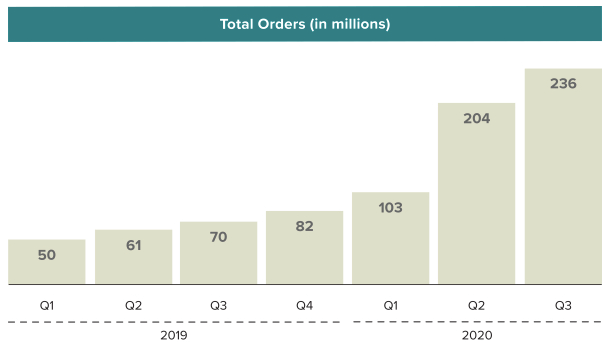
Even more, elsewhere in its filings DoorDash states plainly that COVD-19 led it to experience “a significant increase in revenue, Total Orders, and Marketplace [gross order volume] due to increased consumer demand for delivery, more merchants using our platform to facilitate both delivery and take-out, and improved efficiency of our local logistics platform.” The company then went on to warn investors that the “circumstances that have accelerated the growth of our business stemming from the effects of the COVID-19 pandemic may not continue in the future, and we expect the growth rates in revenue, Total Orders, and Marketplace [gross order volume] to decline in future periods.”

We’re not idly speculating.

Let’s observe how DoorDash’s growth accelerated from 2019 through 2020 and then peek at how the company’s economics improved during the same period, giving the company a shot at adjusted profitability for the full year, a nearly unheard of result in the on-demand market.

Growth

DoorDash generates revenue when a customer orders food via its service, splitting the total bill of food costs, taxes, fees and tips, distributing them to itself, the merchant creating the goods and the delivery person.

In an “illustrative” example that DoorDash notes its 2019 “approximate average per-order information,” the split works out as follows:

  • Bill: $32.90
  • Merchant: $20.10, or 61%
  • DoorDash: $4.90, or 15%
  • Delivery person: $7.90, or 24%

Given that the company is giving us old data and DoorDash’s performance has been stellar this year in terms of generating more gross profit, I wonder what has happened amidst 2020’s upheaval. But, the old numbers do for what we need, which is to understand the link between gross order volume (GOV) and DoorDash revenue. When the former goes up, the latter goes up.

So, as orders rise:

News: Getaround tops up $25M debt financing to its $140M Series E

Silicon Valley peer-to-peer car rental startup Getaround has secured a $25 million loan from Horizon Technology Finance Corporation. The financing announcement comes one month after Getaround raised $140 million from investors, including SoftBank Vision Fund, Menlo Ventures, Reid Hoffman and Mark Pincus’ Reinvent Capital. Getaround’s raise signals that the company is looking for new ways

Silicon Valley peer-to-peer car rental startup Getaround has secured a $25 million loan from Horizon Technology Finance Corporation. The financing announcement comes one month after Getaround raised $140 million from investors, including SoftBank Vision Fund, Menlo Ventures, Reid Hoffman and Mark Pincus’ Reinvent Capital.

Getaround’s raise signals that the company is looking for new ways to secure cash without further diluting executives or investors.

A Getaround spokesperson said “Horizon presented an opportunity that provides us with additional capital to accelerate our plans in the same way as our recent Series E fundraise.”

Dan Devorsetz, Horizon’s chief investment officer, told TechCrunch that venture debt has been a part of Getaround’s financing strategy for 2020.

“It diversifies funding sources and lowers their overall cost of capital, while also mitigating the dilution impact of incremental equity,” he said. While he wouldn’t clarify on where the debt capital was going, he said that the debt is allowing Getaround to accomplish both “working capital needs and long term strategic growth initiatives.”

Getaround, like many travel-related startups, struggled in the beginning of the pandemic as governments issued stay-at-home orders in an effort to keep the disease caused by coronavirus from spreading. Bookings dropped 75% in March, forcing Getaround to layoff 100 employees. The company also applied and received approval for a Paycheck Protection Program loan to help retain workers. Getaround previously told said TechCrunch that the program “helped reduce the otherwise severe impact on the health of our organization,” due to lockdowns and coronavirus restrictions.

Demand returned in May as travelers turned to cars instead of flights for short-distance trips. Getaround CEO Sam Zaid last told TechCrunch that worldwide revenue has more than doubled from pre-COVID baselines.

By July, Getaround said it had rehired all of its furloughed employees.

There have been scattered signs of a comeback throughout the mobility industry. This week, Uber had its highest close since IPO, and Lyft saw its ride revenues recover enough to give investors some calm.

The upshot: the green shoots have sprouted. But will another wave of COVID-19 nip those buds before they can establish roots?

Getaround’s decision to pursue debt financing so soon after raising a six-figure venture capital round could signal the company’s anticipation of another lockdown, and subsequent drop in bookings. Unlike other mobility companies, Getaround doesn’t own the cars, trucks and SUVs on its rental platform, a benefit that could help the company weather a short downturn.

News: Which emerging technologies are enterprise companies getting serious about in 2020?

Even within the same industry, not all big, established companies are the same when it comes to their readiness to start investing in new technology.

Scott Kirsner
Contributor

Scott Kirsner is CEO and co-founder of Innovation Leader, a research and events firm that focuses on innovation in Global 1000 companies, and a longtime business columnist for The Boston Globe.

Startups need to live in the future. They create roadmaps, build products and continually upgrade them with an eye on next year — or even a few years out.

Big companies, often the target customers for startups, live in a much more near-term world. They buy technologies that can solve problems they know about today, rather than those they may face a couple bends down the road. In other words, they’re driving a Dodge, and most tech entrepreneurs are driving a DeLorean equipped with a flux-capacitor.

That situation can lead to a huge waste of time for startups that want to sell to enterprise customers: a business development black hole. Startups are talking about technology shifts and customer demands that the executives inside the large company — even if they have “innovation,” “IT,” or “emerging technology” in their titles — just don’t see as an urgent priority yet, or can’t sell to their colleagues.

How do you avoid the aforementioned black hole? Some recent research that my company, Innovation Leader, conducted in collaboration with KPMG LLP, suggests a constructive approach.

Rather than asking large companies about which technologies they were experimenting with, we created four buckets, based on what you might call “commitment level.” (Our survey had 211 respondents, 62% of them in North America and 59% at companies with greater than $1 billion in annual revenue.) We asked survey respondents to assess a list of 16 technologies, from advanced analytics to quantum computing, and put each one into one of these four buckets. We conducted the survey at the tail end of Q3 2020.

Respondents in the first group were “not exploring or investing” — in other words, “we don’t care about this right now.” The top technology there was quantum computing.

Bucket #2 was the second-lowest commitment level: “learning and exploring.” At this stage, a startup gets to educate its prospective corporate customer about an emerging technology — but nabbing a purchase commitment is still quite a few exits down the highway. It can be constructive to begin building relationships when a company is at this stage, but your sales staff shouldn’t start calculating their commissions just yet.

Here are the top five things that fell into the “learning and exploring” cohort, in ranked order:

  1. Blockchain.
  2. Augmented reality/mixed reality.
  3. Virtual reality.
  4. AI/machine learning.
  5. Wearable devices.

Technologies in the third group, “investing or piloting,” may represent the sweet spot for startups. At this stage, the corporate customer has already discovered some internal problem or use case that the technology might address. They may have shaken loose some early funding. They may have departments internally, or test sites externally, where they know they can conduct pilots. Often, they’re assessing what established tech vendors like Microsoft, Oracle and Cisco can provide — and they may find their solutions wanting.

Here’s what our survey respondents put into the “investing or piloting” bucket, in ranked order:

  1. Advanced analytics.
  2. AI/machine learning.
  3. Collaboration tools and software.
  4. Cloud infrastructure and services.
  5. Internet of things/new sensors.

By the time a technology is placed into the fourth category, which we dubbed “in-market or accelerating investment,” it may be too late for a startup to find a foothold. There’s already a clear understanding of at least some of the use cases or problems that need solving, and return-on-investment metrics have been established. But some providers have already been chosen, based on successful pilots and you may need to dislodge someone that the enterprise is already working with. It can happen, but the headwinds are strong.

Here’s what the survey respondents placed into the “in-market or accelerating investment” bucket, in ranked order:

News: Nintendo’s Mario Game & Watch is a choice gaming stocking stuffer of 2020

Nintendo will never stop mining its past for new nostalgia-based products, but at least it tends to do so with aplomb and occasionally even generosity. The former at least is on display with the Super Mario Bros. Game & Watch, a standalone handheld that plays the first Mario game, its unbelievably hard “Lost Levels” sequel,

Nintendo will never stop mining its past for new nostalgia-based products, but at least it tends to do so with aplomb and occasionally even generosity. The former at least is on display with the Super Mario Bros. Game & Watch, a standalone handheld that plays the first Mario game, its unbelievably hard “Lost Levels” sequel, and acts as a totally impractical timepiece.

This tiny gaming system isn’t the most practical thing in the world, but it is a charming piece of hardware that does exactly what it says on the tin.

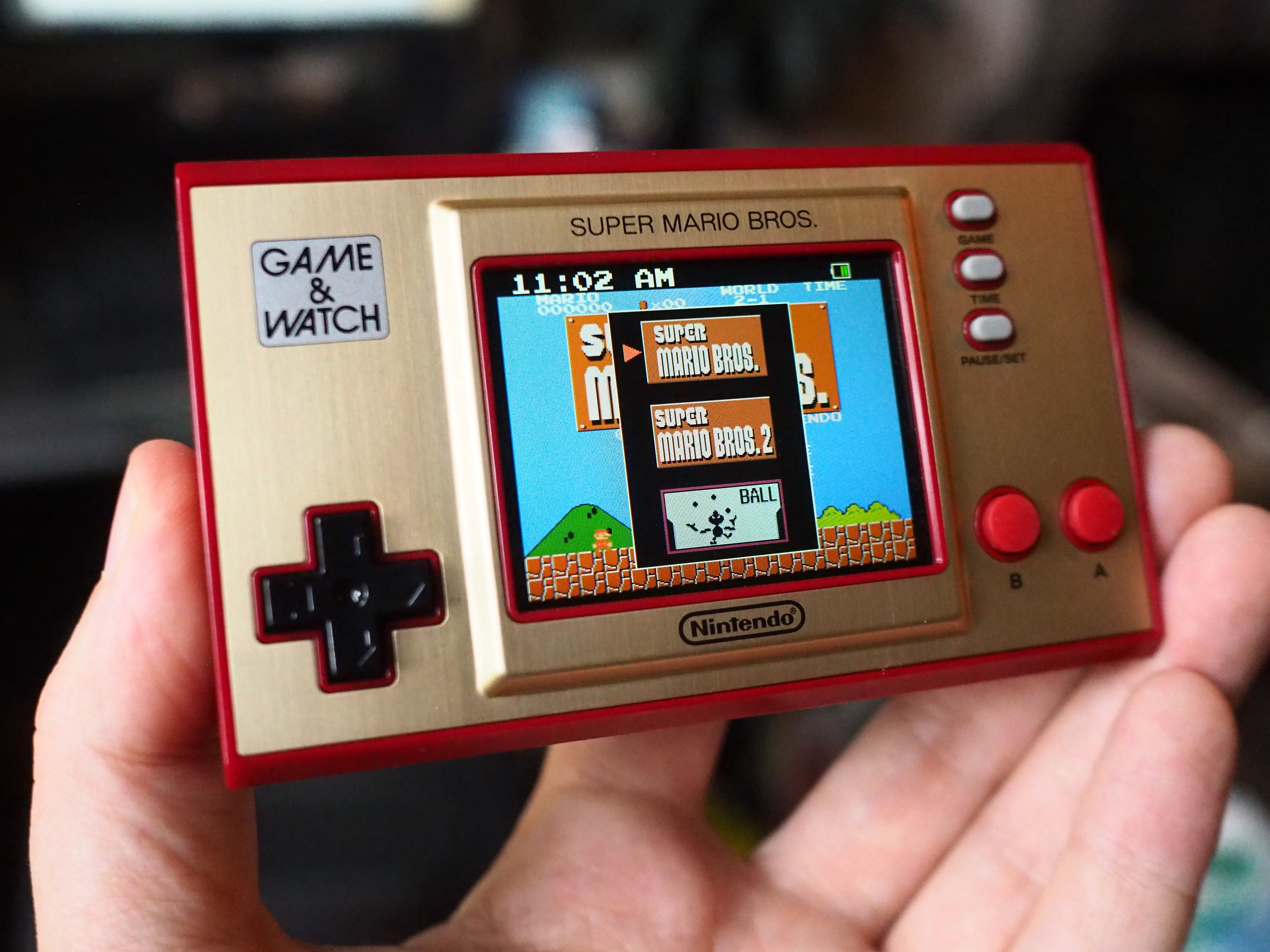
Turn on the Game & Watch with a button on the side and you can select between, naturally, the Game and Watch modes. In game mode, you can select between playing the original Super Mario Bros. for NES, the sequel we never got in the U.S., but was eventually released as “The Lost Levels,” and a recreation of an old-school LCD game where Mario juggles balls at ever-increasing speeds.

Nintendo's Super Mario Bros handheld system

Image Credits: Devin Coldewey / TechCrunch

The screen, while certainly small, is bright and sharp, apparently displaying the exact pixel dimensions of the original Nintendo game. It plays well, too — the controls are responsive, though it feels strange to play the game on anything other than an original NES controller. The buttons of the Game & Watch are a bit softer than I’d like — but they were good enough that I cleared the first set of levels without any real frustration other than my own lack of skill.

While there is no support for saving or rewinding the game — pretty much essential for the 99 percent of us who can’t beat it honestly — at least you don’t have to to try to beat it in one sitting. The game freezes its state when you turn if off or switch to any other game or mode, meaning you can play a couple levels between subway stops and not worry about losing progress.

Nintendo's Super Mario Bros handheld system, side view

Image Credits: Devin Coldewey / TechCrunch

You can hand it back and forth with a friend (after sanitizing it, of course) too, since player 2 uses the same controls.

The juggling game is a fun little diversion but, like most of those old LCD games, goes from really boring to nearly impossible in the course of about 60 seconds.

Nintendo's Super Mario Bros handheld system

Image Credits: Devin Coldewey / TechCrunch

The “Watch” mode has a charming little landscape with the current time made out of bricks, and Mario running across the screen below stomping goombas and avoiding bullet bills. If you watch for a while he’ll moonwalk, mount a pipe, and perform other hijinks. You can switch the background from normal to hills to mushroom platforms. I wouldn’t use it as a watch but if you don’t want to pull your phone out while you’re playing, there you go.

For $50 it may seem a little steep, and perhaps it is. If this had Marios 1 through 3 on it I would consider it a bargain, especially considering the ability to come back to the game time after time — I’d work my way through the epic-length third game with pleasure.

As it is, however, it’s hard to justify the price — except, of course, as a gift to a Nintendo-loving friend or loved one. That’s why I suspect these will sell like hotcakes this holiday season. With no new Switch hardware, no N64 mini, and no must-have games on Nintendo’s platforms, it’s looking a bit dry, but a Game & Watch is just silly enough — and decent enough — a device to sate the hunger of a retro-minded gamer for a few days.

WordPress Image Lightbox Plugin