Yearly Archives: 2020

News: Baidu to acquire Joyy’s Chinese live-streaming service YY for $3.6B

Baidu said on Monday it is acquiring Joyy’s live streaming service YY Live in China for $3.6 billion in an all-cash deal as the Chinese internet giant makes a further push to diversify beyond its core search business. The announcement, which Baidu shared on the sidelines of its quarterly earnings, is the Chinese firm’s biggest

Baidu said on Monday it is acquiring Joyy’s live streaming service YY Live in China for $3.6 billion in an all-cash deal as the Chinese internet giant makes a further push to diversify beyond its core search business.

The announcement, which Baidu shared on the sidelines of its quarterly earnings, is the Chinese firm’s biggest foray into the growing market of video streaming. It comes at a time when the company has been struggling to fight new comers such as ByteDance.

YY has amassed over 4 million paying subscribers who watch influencers perform and sell a range of items on the video app. The streaming service last year bought a stake worth $1.45 billion in Bigo, a Singapore-based startup that operates streaming apps Bigo Live and Like in a push to expand outside of China.

YY today is only selling its China business to Baidu. The closing of the transaction is subject to certain conditions and is currently expected to occur in the first half of 2021, Baidu said.

“This transaction will catapult Baidu into a leading platform for live streaming and diversify our revenue source.” said Robin Li, co-founder and chief executive of Baidu, in a statement.

“YY Live stands to benefit from Baidu’s large traffic and thriving mobile ecosystem, while Baidu will receive immediate operational experience and knowhow for large-scale video-based social media development, as well as an enviable creator network that will further strengthen Baidu’s massive content provider network. Together with the team from YY Live, Baidu hopes to explore the next-generation livestreaming and video-based social media that can expand beyond entertainment into the diversified verticals on Baidu platform.”

More to follow…


News: Airbnb files to go public

Airbnb filed to go public today, bringing the well-known unicorn one step closer to being a public company. The financial results show a company on the rebound, but smaller than it was. Its more granular financial results also make clear how hard the pandemic was on the travel-reliant unicorn. Regarding Airbnb’s worth, investors will have

Airbnb filed to go public today, bringing the well-known unicorn one step closer to being a public company.

The financial results show a company on the rebound, but smaller than it was. Its more granular financial results also make clear how hard the pandemic was on the travel-reliant unicorn. Regarding Airbnb’s worth, investors will have to balance how they value recovery and recent profits over the company’s disrupted historical growth arc.

How did we get here?

The home-sharing startup had a tumultuous year, with the COVID-19 pandemic harming its business in the first and second quarters of the year, and Airbnb later recovering on the strength of more local bookings.

Its filing comes mere days after fellow unicorns DoorDash and C3.ai themselves filed to go public in what could be a rush to the public markets by richly valued startups.

Airbnb’s S-1 filing was expected to come last week, but was delayed due to purported election concerns, a concept that TechCrunch staff did not find entirely convincing.

We’ve scraped together quite a lot about Airbnb’s recent financial performance, but its S-1 is the real treasure trove. What follows is a dive into the company’s high-level numbers. From there, TechCrunch will dig into the company’s financial nuances and ownership stakes.

Airbnb’s financial performance

What we want to know is how the pandemic impacted Airbnb’s business; its year-to-date results, and what we can suss out from its quarterly trends.

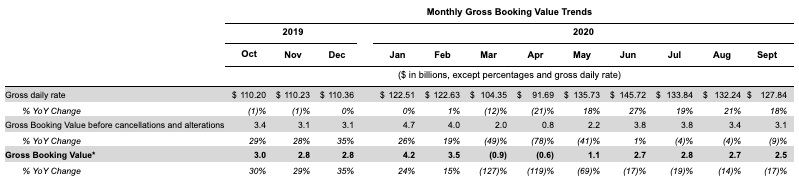
Up top in Airbnb’s S-1 is a chart that shows monthly bookings on its platform. The implication is somewhat simple; namely that Airbnb knows what we want to know and wanted to share. Here are those numbers:

As expected, Airbnb took a huge hit in March. But by May things were back to year-over-year growth, where they stayed.

Now, the company has seen precious little bookings growth since June — indeed it has seen bookings fall in the months since. And, worse, the company’s gross bookings after removing cancellations are down on a year-over-year basis. (Update: We misread this table at first, and have updated our notes on it.)

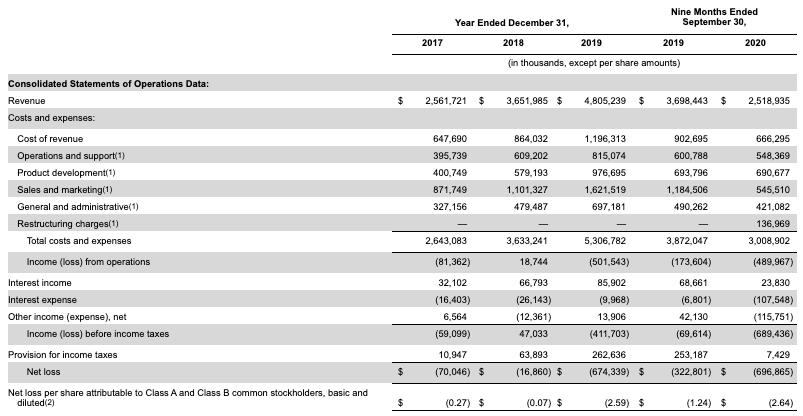
So, what does all of that look like in more traditional accounting figures? Here’s Airbnb’s reported income statement:

As expected, Airbnb’s year has not been tremendous. Indeed, the company is on track to match its 2018 size, if we have our math correct.

What changed from the first three quarters of 2019 to the first three quarters of 2020? The biggest thing, apart from expected lowers revenue costs — less revenue costs less — is the huge decline in sales and marketing spend at the company. Airbnb slashed S&M outlays from $1.18 billion in the first three quarters of 2019 to just $545.5 million in the same period of 2020.

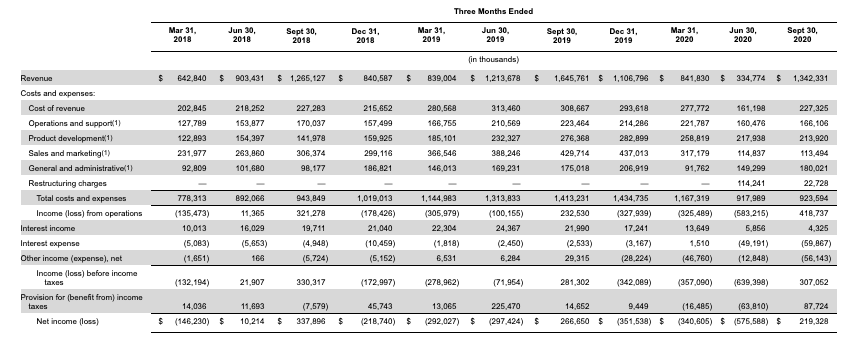
So, where will Airbnb wind up in 2020 once it’s all done? We’ll need to peek at its quarterly results for that. Here they are:

Airbnb’s growth continues in year-over-year terms right until the March 31, 2020 quarter, when it was effectively flat compared to Q1 2019. Or, the company would have grown sans COVID-19. In the June 30, 2020 quarter we see the real damage, with Airbnb’s revenue falling from $1.2 billion in the year-ago quarter to just $334.8 million. That’s a shocking decline.

But, looking ahead to Q3 2020 and we see a large return to form. Yes, Airbnb’s third quarter was smaller than its Q3 2019, with $1.34 billion in top line instead of $1.65 billion in 2019, but the company effectively quadrupled from its preceding quarter. If the company manages another Q3 worth of revenue in Q4, it would be larger than it was in 2018 by a few hundred million.

Critically, Airbnb managed to swing from a number of unprofitable quarters to a profit in Q3, akin to its 2019 Q3 when it was also in the black. Of course, Airbnb’s $219.3 million in GAAP net income during the third quarter pales compared to its losses tallied earlier in the year. The company will not break even in 2020.

Airbnb also reported adjusted profit metrics. Its adjusted EBITDA results are based on the following definition:

Adjusted EBITDA is defined as net income or loss adjusted for (i) provision for income taxes; (ii) interest income, interest expense, and other income (expense), net; (iii) depreciation and amortization; (iv) stock-based compensation expense; (v) net changes to the reserves for lodging taxes for which we may be held jointly liable with hosts for collecting and remitting such taxes; and (vi) restructuring charges.

The decision to remove restructuring costs raised eyebrows, with Amy Cheetham, an investor at Costanoa Ventures saying that “it feels like leaving out restructuring costs is a little aggressive?” We agree, as it gives the company too much flexibility to count the good in its results, like lower operating costs, while discounting what it took to get those results, like restructuring its business operations.

That’s having your cake and eating it as well and not counting the calories.

Still, who are we to withhold numbers from you? Here is the very adjusted EBITDA that Airbnb claims:

The numbers are still not good even after ripping out so very any costs. Worse, perhaps is the company’s cash burn in the year. That deficit helps explain why Airbnb took on more capital when it did earlier this year.

It’s hard to put a firm grade on this S-1. It contains what we expected, but how investors weigh the company’s year-over-year revenue declines in Q3 2020 against its rapid comeback from Q2 2020 should help decide its eventual value. On the whole Airbnb has managed something incredibly impressive — bouncing back from so low a low.

But, now that it’s going public we can’t merely say good job; it wants to price itself well and trade strongly. So, all eyes on its first IPO range as that should tell us what investors just might be willing to pay for the famous company’s equity.

News: Ride Vision raises $7M for its AI-based motorcycle safety system

Ride Vision, an Israeli startup that is building an AI-driven safety system to prevent motorcycle collisions, today announced that it has raised a $7 million Series A round led by crowdsourcing platform OurCrowd. YL Ventures, which typically specializes in cybersecurity startups but also led the company’s $2.5 million seed round in 2018, Mobilion VC and

Ride Vision, an Israeli startup that is building an AI-driven safety system to prevent motorcycle collisions, today announced that it has raised a $7 million Series A round led by crowdsourcing platform OurCrowd. YL Ventures, which typically specializes in cybersecurity startups but also led the company’s $2.5 million seed round in 2018, Mobilion VC and motorcycle mirror manufacturer Metagal also participated in this round. The company has now raised a total of $10 million.

In addition to this new funding round, Ride Vision also today announced a new partnership with automotive parts manufacturer Continental .

“As motorcycle enthusiasts, we at Ride Vision are excited at the prospect of our international launch and our partnership with Continental,” Uri Lavi, CEO and co-founder of Ride Vision, said in today’s announcement. “This moment is a major milestone, as we stride toward our dream of empowering bikers to feel truly safe while they enjoy the ride.”

The general idea here is pretty straightforward and comparable with the blind-spot monitoring system in your car. Using computer vision, Ride Vision’s system, the Ride Vision 1, analyzes the traffic around a rider in real time. It provides forward collision alerts and monitors your blind spot, but it can also tell you when you’re following another rider or car too closely. It can also simply record your ride and, coming soon, it’ll be able to make emergency calls on your behalf when things go awry.

As the company argues, the number of motorcycles (and other motorized two-wheeled vehicles) has only increased during the pandemic, as people started avoiding public transport and looked for relatively affordable alternatives. In Europe, sales of two-wheeled vehicles increased by 30% during the pandemic.

The hardware on the motorcycle itself is pretty straightforward. It includes two wide-angle cameras (one each at the front and rear), as well as alert indicators on the mirrors, as well as the main computing unit. Ride Vision has patents on its human-machine warning interface and vision algorithms.

It’s worth noting that there are some blind-spot monitoring solutions for motorcycles on the market already, including those from Innovv and Senzar. Honda also has patents on similar technologies. These do not provide the kind of 360-degree view that Ride Vision is aiming for.

Ride Vision says its products will be available in Italy, Germany, Austria, Spain, France, Greece, Israel and the U.K. in early 2021, with the U.S., Brazil, Canada, Australia, Japan, India, China and others following later.

News: Beyond Meat unveils two new versions of its Beyond Burgers

Beyond Meat has launched two new versions of its Beyond Burgers, the company announced today. The two new options will be available on store shelves in 2021, but will be on offer at a two-day pop up event in Los Angeles for folks to try. The new Beyond Burger patties are designed to mirror the

Beyond Meat has launched two new versions of its Beyond Burgers, the company announced today.

The two new options will be available on store shelves in 2021, but will be on offer at a two-day pop up event in Los Angeles for folks to try.

The new Beyond Burger patties are designed to mirror the options of beef in the market with the presentation of a lower fat patty option and a new version of its higher fat content option that the brand promises will be its “juiciest” patty for the “meatiest” Beyond Meat patty on the market.

The low fat option contains 50% less saturated fat and 35% less total fat than 80/20 beef, according to a statement and both burgers have fewer calories and added vitamins and minerals that are comparable to beef’s micronutrient profile, the company said in a statement.

News: How esports can save colleges

Colleges are diving into esports, with 115 different programs offering scholarships for esports and club programs are growing even faster. Certainly, it will help attract students, but monetization is really tricky.

Brandon Byrne
Contributor

Brandon Byrne is the CEO and co-founder of Opera Event, a technology platform that connects content creators, teams and sponsors to one another programmatically and at scale. He was previously the CFO of Team Liquid and VP of Finance and Administration at Curse.

A few months ago, I wrote a piece about esports and the Olympics after sitting on a panel discussing whether, as a result of the coronavirus pandemic, esports had an opportunity to work with the International Olympic Committee. After careful consideration and research, my conclusion was basically, “I think that the Olympics need esports a whole lot more than esports needs the Olympics.”

I was surprised by some of the data I uncovered in the course of researching the Olympics piece, specifically on audiences for international, professional and collegiate sports. I observed that while the esports model isn’t as mature as in traditional sports, esports actually garnered close to the same level of viewership, and the audience was growing astronomically. I couldn’t help but wonder how long this phenomenon would go unacknowledged by the institutions that might benefit most from it.

Enter colleges’ and universities’ flirtation with esports: There are currently more than 170 collegiate varsity gaming programs in NCAA Division I, and the number of clubs is even higher. So even as institutions investment in esports, there are still many misunderstood and overlooked aspects of the potential to drive value (and even revenue) in the collegiate esports space.

College in the 21st century

The college experience today is very different than it was 50 years ago. The pace of change outside of institutions is ever-accelerating, often leaving colleges struggling to keep up. Technology, students’ interests, evolving economies and workplaces, and changes in cultural norms have left colleges and universities in a place of less relevance than at many points in the past.

The same can be said of college sports: Outside forces have eroded a once-near-hegemonic source of collegiate pride, cultural power, recruitment, alumni engagement and, in some cases, revenue.

I did a quick review of the audience for the biggest NCAA events in the world; the Football Bowl Subdivision Bowl Championship and the NCAA Men’s Division I Basketball Tournament.

pre-championship viewers FBS bowls

Image Credits: Brandon Byrne

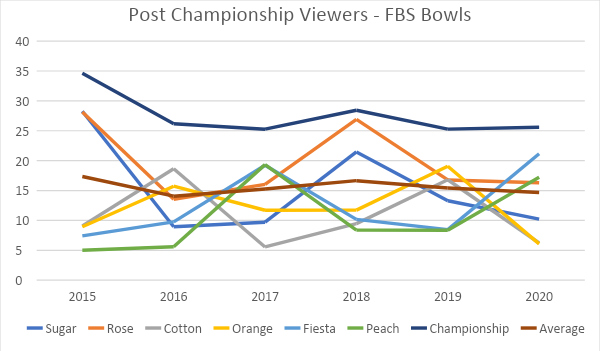
post-championship viewers

Image Credits: Brandon Byrne

Look at the average viewership of the big bowl games before the championship system went into effect in 2015, as well as after. Above, you see the trend line for viewership for the various big bowl viewership as well as an average. While there are certainly occasional spikes, the best case you could make here is that the product is flat — when you isolate the trend line for both, here is the result:

average viewership all bowls

Image Credits: Brandon Byrne

In the aggregate, the trend seems mostly downward.

Look at the same trends in viewership for the NCAA Final Four — the early semi-final, the late semi-final and finally the championship game.

final four viewership

Image Credits: Brandon Byrne

They look rather similar. So, while collegiate sports still have a massive following, there are two concerning issues here. First, the audience isn’t growing at all; in fact, it appears to be slightly contracting. Secondly, the audience is aging, making collegiate sports less relevant to younger people. While an older audience is still a valuable source of alumni donations and ancillary revenue, it doesn’t exactly align with another core target demographic: potential college students.

Now despite this, there is data that suggests that schools with elite academic departments do enjoy a phenomenon known as the “Flutie effect,” named after Doug Flutie, a quarterback for Boston College whose exciting performance on the gridiron was credited with boosting BC applications. An article in Forbes breaking down an HBS study goes into the phenomenon more deeply than we can here.

Granted, much of the data is from a few years ago, when college sports were perhaps more relevant, but the point is broadly the same: Having an elite program in an activity students enjoy benefits the institutions that sponsor and promote them. But what happens when enthusiasm for those activities among the student body is waning? One idea is to explore involvement in what the students of today are interested in.

As a comparison to FBS football (maxed out at 35 million viewers) and the NCAA Final Four (maxed out at 28 million), Riot Games’ Mid-Season Invitational event for League of Legends had a total viewership of 60 million people. In second place is the Intel Extreme Masters tournament in Katowice with 46 million people. While precise demographic data isn’t readily available, it stands to reason that the latter two events skew younger than the former two.

A few caveats, as these are not precisely apples-to-apples comparisons: These esports events are broken up over a number of days and encompass a significant number of matches — comparable to March Madness, perhaps — and the content is consumed in different ways. Much of the NCAA’s content is presented on television, some of which is on paid, premium channels. Esports events are broadcast on Twitch and YouTube via streams for free.

But the thing to understand is that esports audiences are growing at a 15%-16% year-over-year clip and it commands a worldwide audience, meaning its total addressable market (TAM) is MUCH bigger. The NCAA events are not likely to draw serious audiences outside of North America.

COVID-19

In the context of the pandemic, colleges are hamstrung by students’ inability to engage in a college experience in-person, which is one of the primary reasons one goes to college. Networking, developing new friends and having new experiences are all a part of the collegiate draw, none of which work as well from students’ parents’ living rooms. Similarly, collegiate sports as we know them have essentially ceased to exist, along with their functions of institutional pride, marketing and revenue. The NCAA Tournament was canceled in March of 2020 and there is no sign that it, or any other sport, will be back anytime soon.

Esports, on the other hand, are thriving in this context, thanks mostly to their ability to offer remote competition and viewing. Esports tournaments can isolate audiences, teams and even referees to allow for safe content creation and consumption.

Esports and college

Believe it or not, esports is a better fit for college than it is for the pros. I won’t go into all of the details here, but I actually wrote a separate article about why the pro sports model is NOT a good one for esports. In this article we talk about intellectual property, who owns the league in esports and how all of the entities make money. The biggest problem is, in pro sports, the teams own the league and can then act in the best interest of all of the teams. In esports, the league is usually owned or regulated by the publisher of the video game, meaning you have hands in the monetization pie in a way that pro sports doesn’t have.

The interesting thing about this is that college athletics actually has the same problem and has found a way to mitigate that. The athletes get their scholarships, and the schools, their athletic conference, and the NCAA itself all own a piece of the pie that gets packaged and sold for distribution to the ESPNs and Fox Sports of the world.

This is a much better model for esports. It’s unlikely that any group that “owned” football IP would tell the Dallas Cowboys how to market their team, what their cut is and how it will be distributed. This process happens all the time in college, though. In fact, in order for everyone to get their seat at the table, you HAVE to work all of this out so that the schools make some money (equivalent to a team), the conference makes their money (equivalent to the league) and the NCAA makes their money (equivalent to the publisher themselves). If the chain breaks down at any point, then the whole process grinds to a halt and nobody makes money.

I mention this in my article about the Olympics. The IOC is used to having full autonomy over how the Olympic Games are broadcast, which events are part of the games, who is eligible and who isn’t, etc. There is no chance this would be the case if the Olympics took on esports. The publisher would absolutely wield an incredible amount of influence over how the games are portrayed, broadcast, judged and the like. The IOC isn’t used to that. In college, that’s just a typical Saturday afternoon.

College admission is down and not just because of COVID-19. Even before the pandemic, colleges were trying to find their footing with potential students as people reevaluate the college experience. Forbes wrote back in 2019 that college enrollments were down two million students in that decade. Add onto that the preliminary data we are getting on the effect of COVID on colleges, we could see enrollment in 2020 down anywhere from 5%-20%.
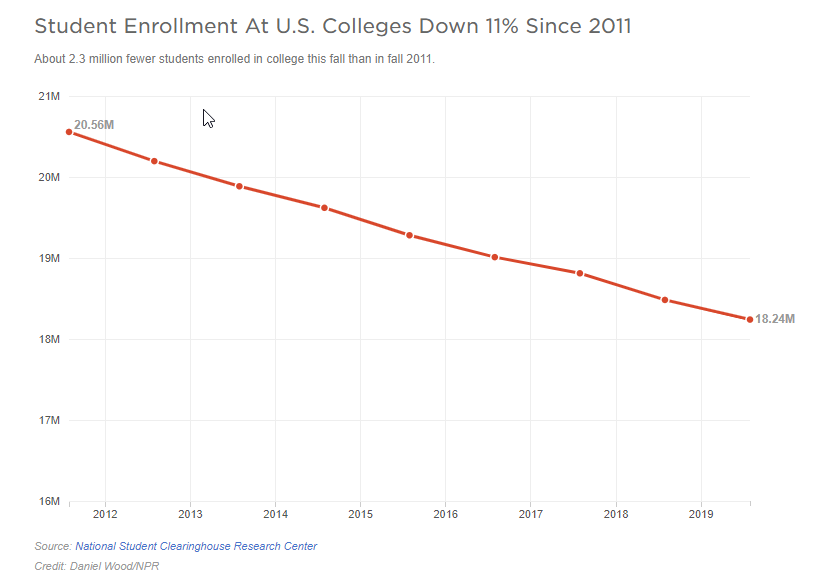
Student enrollment at US colleges has been declining since 2011

Image Credits: Brandon Byrne

The outlook

For colleges, it’s not great. Revenue is massively down, with even stalwarts like Harvard University hemorrhaging cash. With enrollment down before the pandemic, we have reached a point where colleges and universities have to adapt to survive.

The good news is, I believe that esports could be an opportunity to do just that. Colleges are diving into esports, with 115 different programs offering scholarships for esports and club programs are growing even faster. Certainly, it will help attract students, but monetization in esports is really tricky.

It’s critical that colleges and universities get expert advice on how to create an ecosystem that ultimately compensates all of the stakeholders, including the college themselves. It also will require universities to move quickly and get on board with a model that is still being formed in real time. The coronavirus pandemic isn’t going away anytime soon, but I think there will be many colleges that will. The time to move is now.


News: Deep Vision announces its low-latency AI processor for the edge

Deep Vision, a new AI startup that is building an AI inferencing chip for edge computing solutions, is coming out of stealth today. The six-year-old company’s new ARA-1 processors promise to strike the right balance between low latency, energy efficiency and compute power for use in anything from sensors to cameras and full-fledged edge servers.

Deep Vision, a new AI startup that is building an AI inferencing chip for edge computing solutions, is coming out of stealth today. The six-year-old company’s new ARA-1 processors promise to strike the right balance between low latency, energy efficiency and compute power for use in anything from sensors to cameras and full-fledged edge servers.

Because of its strength in real-time video analysis, the company is aiming its chip at solutions around smart retail, including cashier-less stores, smart cities and Industry 4.0/robotics. The company is also working with suppliers to the automotive industry, but less around autonomous driving than monitoring in-cabin activity to ensure that drivers are paying attention to the road and aren’t distracted or sleepy.

Image Credits: Deep Vision

The company was founded by its CTO Rehan Hameed and its Chief Architect Wajahat Qadeer​, who recruited Ravi Annavajjhala, who previously worked at Intel and SanDisk, as the company’s CEO. Hameed and Qadeer developed Deep Vision’s architecture as part of a Ph.D. thesis at Stanford.

“They came up with a very compelling architecture for AI that minimizes data movement within the chip,” Annavajjhala explained. “That gives you extraordinary efficiency — both in terms of performance per dollar and performance per watt — when looking at AI workloads.”

Long before the team had working hardware, though, the company focused on building its compiler to ensure that its solution could actually address its customers’ needs. Only then did they finalize the chip design.

Image Credits: Deep Vision

As Hameed told me, Deep Vision’s focus was always on reducing latency. While its competitors often emphasize throughput, the team believes that for edge solutions, latency is the more important metric. While architectures that focus on throughput make sense in the data center, Deep Vision CTO Hameed argues that this doesn’t necessarily make them a good fit at the edge.

“[Throughput architectures] require a large number of streams being processed by the accelerator at the same time to fully utilize the hardware, whether it’s through batching or pipeline execution,” he explained. “That’s the only way for them to get their big throughput. The result, of course, is high latency for individual tasks and that makes them a poor fit in our opinion for an edge use case where real-time performance is key.”

To enable this performance — and Deep Vision claims that its processor offers far lower latency than Google’s Edge TPUs and Movidius’ MyriadX, for example — the team is using an architecture that reduces data movement on the chip to a minimum. In addition, its software optimizes the overall data flow inside the architecture based on the specific workload.

Image Credits: Deep Vision

“In our design, instead of baking in a particular acceleration strategy into the hardware, we have instead built the right programmable primitives into our own processor, which allows the software to map any type of data flow or any execution flow that you might find in a neural network graph efficiently on top of the same set of basic primitives,” said Hameed.

With this, the compiler can then look at the model and figure out how to best map it on the hardware to optimize for data flow and minimize data movement. Thanks to this, the processor and compiler can also support virtually any neural network framework and optimize their models without the developers having to think about the specific hardware constraints that often make working with other chips hard.

“Every aspect of our hardware/software stack has been architected with the same two high-level goals in mind,” Hameed said. “One is to minimize the data movement to drive efficiency. And then also to keep every part of the design flexible in a way where the right execution plan can be used for every type of problem.”

Since its founding, the company raised about $19 million and has filed nine patents. The new chip has been sampling for a while and even though the company already has a couple of customers, it chose to remain under the radar until now. The company obviously hopes that its unique architecture can give it an edge in this market, which is getting increasingly competitive. Besides the likes of Intel’s Movidius chips (and custom chips from Google and AWS for their own clouds), there are also plenty of startups in this space, including the likes of Hailo, which raised a $60 million Series B round earlier this year and recently launched its new chips, too.

News: Hulu will increase the price of its live TV service again on December 18th

It’s price hike season! Just a few weeks after Netflix bumped up prices on a bunch of its plans, it looks like Hulu will soon be charging more for its Live TV service. The company has confirmed to us that it will be bumping the monthly cost of Hulu + Live from $54.99 to $64.99

It’s price hike season!

Just a few weeks after Netflix bumped up prices on a bunch of its plans, it looks like Hulu will soon be charging more for its Live TV service.

The company has confirmed to us that it will be bumping the monthly cost of Hulu + Live from $54.99 to $64.99 as of December 18th — an increase of around 18%. The price increase will go into effect for both existing and new subscribers.

To be clear, this price increase seemingly only impacts the plans that include live TV; there’s no word, currently, on any price changes for Hulu’s on-demand streaming offerings.

Hulu + Live originally launched in May of 2017, initially costing $40 per month.

News: 3 growth tactics that helped us surpass Noom and Weight Watchers

Here’s a closer look at the three growth marketing tactics I credit with helping us scale Lifesum over the last 36 months. It’s a strategy any startup can use, regardless of size or budget.

Henrik Torstensson
Contributor

Henrik Torstensson is CEO and co-founder of Lifesum. Previously, he was Head of Premium Sales at Spotify and SVP, Strategy at Stardoll.

Many consumers might think Noom or Weight Watchers are industry leaders with their nonstop commercials, but neither is the fastest-growing weight management program.

Over the past year, nutrition app Lifesum has acquired users at nearly twice the rate of both Noom and Weight Watchers, according to statistics from Sensor Tower, the independent market intelligence for the mobile app economy.

Over this past summer, we surpassed Noom on the global scale with 45 million users. More impressively, we accomplished this without any TV buys. That’s right — no multimillion dollar ad campaigns, allowing us to redistribute precious marketing dollars to other growth projects.

Here’s a closer look at the three growth marketing tactics I credit with helping us scale Lifesum over the last 36 months. It’s a strategy any startup can use, regardless of size or budget.

Understand the different generational lenses

Generations approach products differently. It’s important for startups to understand the different generational approaches of their customers. Startups that spend time thinking and strategizing about where generational trends are going will scale faster.

Here’s a closer look at the three growth marketing tactics I credit with helping us scale Lifesum over the last 36 months. It’s a strategy any startup can use, regardless of size or budget.

Millennials and Generation Z are now the largest consumer market in the world, so you can’t ignore them if you want to scale. With Lifesum these generations have helped our brand surpass the older and well-established competitors. We achieved this by intimately understanding how they view health and fitness.

Gen Z and millennials are all about empowerment. They grew up with Google and Facebook, having information at their fingertips. They are far less likely to be moved by a TV commercial since they desire to discover the world on their own.

In our industry, we’ve learned millennials and Gen Z don’t want a one-size-fits-all weight loss program or to count calories like their parents did 20 years ago. As millennials and Gen Z started embracing keto, intermittent fasting and pescatarian diets, our nutrition team had already created tailored programs to help them stick with it.

Bypass traditional marketing methods

As a brand, it’s important to look ahead and anticipate what is coming next. This also applies to marketing your product. If you get in early with emerging marketing platforms, you will save money and potentially reach more early adopters.

News: Arrikto raises $10M for its MLOps platform

Arrikto, a startup that wants to speed up the machine learning development lifecycle by allowing engineers and data scientists to treat data like code, is coming out of stealth today and announcing a $10 million Series A round. The round was led by Unusual Ventures, with Unusual’s John Vrionis joining the board. “Our technology at

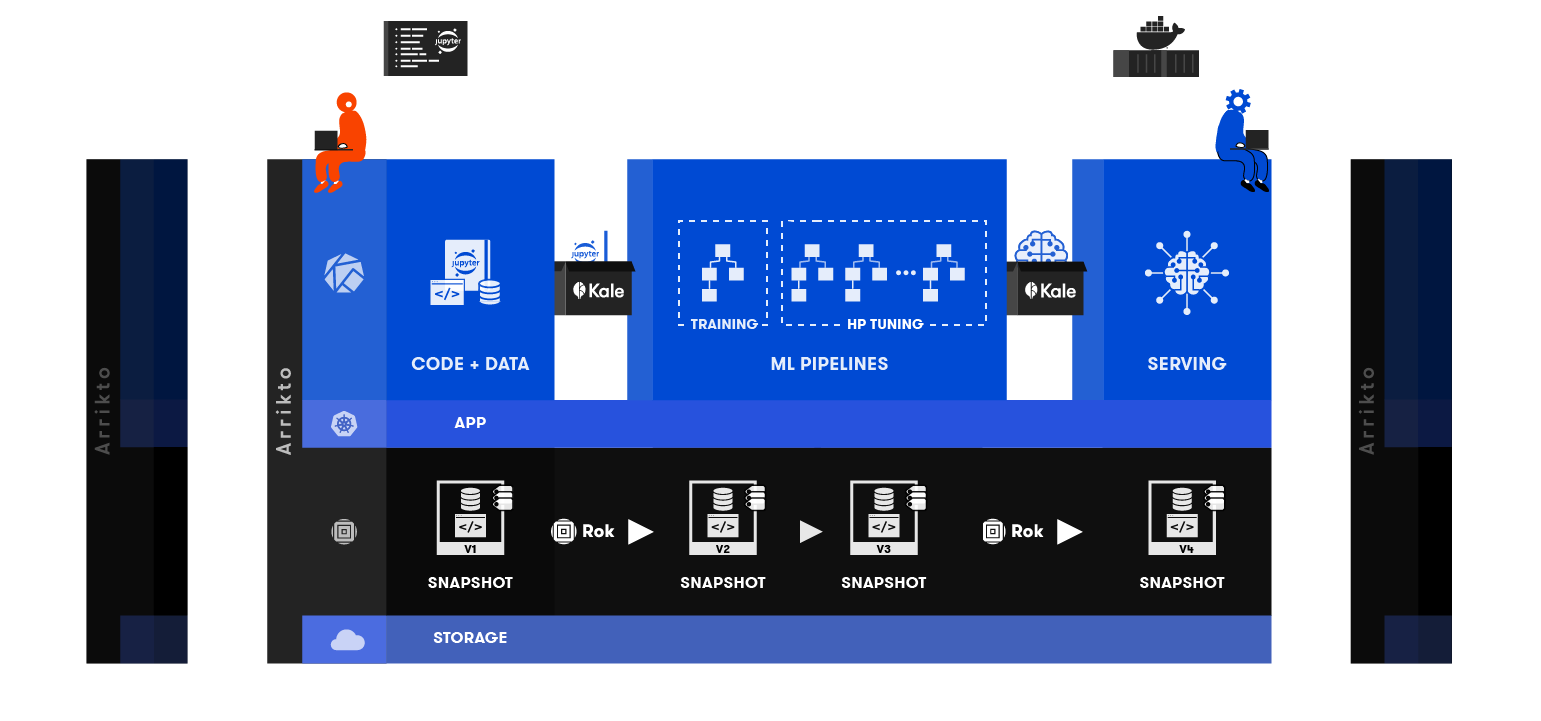
Arrikto, a startup that wants to speed up the machine learning development lifecycle by allowing engineers and data scientists to treat data like code, is coming out of stealth today and announcing a $10 million Series A round. The round was led by Unusual Ventures, with Unusual’s John Vrionis joining the board.

“Our technology at Arrikto helps companies overcome the complexities of implementing and managing machine learning applications,” Arrikto CEO and co-founder Constantinos Venetsanopoulos explained. “We make it super easy to set up end-to-end machine learning pipelines. More specifically, we make it easy to build, train, deploy ML models into production using Kubernetes and intelligent intelligently manage all the data around it.”

Like so many developer-centric platforms today, Arrikto is all about “shift left.” Currently, the team argues, machine learning teams and developer teams don’t speak the same language and use different tools to build models and to put them into production.

Image Credits: Arrikto

“Much like DevOps shifted deployment left, to developers in the software development life cycle, Arrikto shifts deployment left to data scientists in the machine learning life cycle,” Venetsanopoulos explained.

Arrikto also aims to reduce the technical barriers that still make implementing machine learning so difficult for most enterprises. Venetsanopoulos noted that just like Kubernetes showed businesses what a simple and scalable infrastructure could look like, Arrikto can show them what a simpler ML production pipeline can look like — and do so in a Kubernetes-native way.

Arrikto CEO Constantinos Venetsanopoulos. Image Credits: Arrikto

At the core of Arrikto is Kubeflow, the Google -incubated open-source machine learning toolkit for Kubernetes — and in many ways, you can think of Arrikto as offering an enterprise-ready version of Kubeflow. Among other projects, the team also built MiniKF to run Kubeflow on a laptop and uses Kale, which lets engineers build Kubeflow pipelines from their JupyterLab notebooks.

As Venetsanopoulos noted, Arrikto’s technology does three things: it simplifies deploying and managing Kubeflow, allows data scientists to manage it using the tools they already know, and it creates a portable environment for data science that enables data versioning and data sharing across teams and clouds.

While Arrikto has stayed off the radar since it launched out of Athens, Greece in 2015, the founding team of Venetsanopoulos and CTO Vangelis Koukis already managed to get a number of large enterprises to adopt its platform. Arrikto currently has more than 100 customers and, while the company isn’t allowed to name any of them just yet, Venetsanopoulos said they include one of the largest oil and gas companies, for example.

And while you may not think of Athens as a startup hub, Venetsanopoulos argues that this is changing and there is a lot of talent there (though the company is also using the funding to build out its sales and marketing team in Silicon Valley). “There’s top-notch talent from top-notch universities that’s still untapped. It’s like we have an unfair advantage,” he said.

“We see a strong market opportunity as enterprises seek to leverage cloud-native solutions to unlock the benefits of machine learning,” Unusual’s Vrionis said. “Arrikto has taken an innovative and holistic approach to MLOps across the entire data, model and code lifecycle. Data scientists will be empowered to accelerate time to market through increased automation and collaboration without requiring engineering teams.”

Image Credits: Arrikto

News: You can now embed Apple Podcasts on the web

Apple is making it easier to discover and listen to podcasts via the web. The company announced today an Apple Podcasts embed web player is now available, allowing anyone — including creators, listeners or marketers — to generate embed codes for the over 1.5 million shows available across the Apple Podcasts service. The codes can

Apple is making it easier to discover and listen to podcasts via the web. The company announced today an Apple Podcasts embed web player is now available, allowing anyone — including creators, listeners or marketers — to generate embed codes for the over 1.5 million shows available across the Apple Podcasts service.

The codes can be generated from the Apple Podcasts Preview pages on the web or from the Apple Podcasts Marketing Tools website.

For the former, you would first click the share icon on the Preview page for either a show or an individual episode. You’ll then see a new “embed” button on the left hand side.

And in the case of the latter, you would enter the URL for the podcast or episode you want to embed on the Marketing Tools website, then scroll down to the bottom of the page to see the options for the embed player.

Here, you can also adjust the options for the player’s height and width to your own specifications or leave it at the default setting of 450px x 660px. When you’re ready to grab the code, you just click the “Copy Embed” button which automatically copies the code to your clipboard for pasting elsewhere.

Here’s an example of what the embed looks like:


When visitors happen upon the embedded web player, they can interact with the podcast immediately by playing the episode and by opening the Apple Podcasts app for iOS, iPadOS or macOS to learn more about the program or to add it to their existing podcast subscriptions.

The new feature aims to help Apple retain and grow its audience of podcast listeners who use its own app for following their favorite audio programs. It arrives at a time when rivals, led by Spotify, are increasing their investments in podcasts. Spotify continues to acquire podcast studios and ad technology, while also rolling out more tools and features for podcast creators and listeners alike. Spotify, too, already offers an embed feature for its podcasts, which allows it to direct users to its own service.

Apple says its Apple Podcasts web embed is broadly available as of today.

WordPress Image Lightbox Plugin