Yearly Archives: 2020

News: Twentyeight Health partners with Healthify to expand its reproductive and sexual health services

Targeting the population that’s most underserved with new treatment options has been part of the mission fro Twentyeight Health since its launch. Now a new partnership with the venture-backed startup, Healthify, means that the company will be able to expand its reach.  Healthify works with managed care organizations and case workers to integrate social determinants

Targeting the population that’s most underserved with new treatment options has been part of the mission fro Twentyeight Health since its launch. Now a new partnership with the venture-backed startup, Healthify, means that the company will be able to expand its reach. 

Healthify works with managed care organizations and case workers to integrate social determinants of health into the healthcare system.

Social factors have a significant role to play in patient outcomes, according to new research, and both Twentyeight Health and Healthify are trying to do their part to ensure that access to care becomes less of an issue.

Twentyeight Health sells and delivers birth control pills, patches, rings, shots and emergency contraception prescriptions at a low-cost — or covered by insurance including Medicaid.

Through the Healthify integration, the company will be able to offer its services through health plans and providers that use Healthify to determine social factors that may influence treatment, the companies said.

“This partnership comes at a time when many women in vulnerable communities are in need of prescription delivery or virtual healthcare services due to COVID-19,” said Amy Fan, Co-Founder of Twentyeight Health. “By working with Healthify, we can strengthen our efforts to ensure that all women who want birth control are able to access it.”

Since its launch two years ago, Twentyeight Health is now operating in six states including Florida, Maryland, New Jersey, New York, North Carolina and Pennsylvania.

“Together, we can expand Twentyeight Health’s impact by offering their services to help individuals receive the low- or no- cost birth control that is right for them,” said Manik Bhat, Founder and Chief Executive Officer of Healthify.

To date, Healthify has raised $25.5 million from investors including Primary Venture Partners and BlueCross Blue Shield Venture Partners. Twentyeight Health recently announced a $5 million early stage round of funding and is backed by investors including Third Prime and Town Hall Ventures.

News: Extra Crunch Live: Join Bessemer’s Byron Deeter for a live Q&A today at 12pm PT/3pm ET

Byron Deeter’s portfolio includes Twilio, DocuSign, Box, Canva, Intercom, SendGrid and many more. He is one of the most knowledgeable and experienced SaaS and cloud investors in the biz, which is why Alex Wilhelm and I are more than thrilled to lead a live Q&A with Deeter on today’s forthcoming episode of Extra Crunch Live.

Byron Deeter’s portfolio includes Twilio, DocuSign, Box, Canva, Intercom, SendGrid and many more. He is one of the most knowledgeable and experienced SaaS and cloud investors in the biz, which is why Alex Wilhelm and I are more than thrilled to lead a live Q&A with Deeter on today’s forthcoming episode of Extra Crunch Live.

Deeter co-authors Bessemer Venture Partners’ 10 Laws of Cloud Computing and the annual State of the Cloud report, created the Bessemer Forbes Cloud 100 and is now the host of Bessemer’s new podcast Cloud Giants. To say this man has his head in the cloud would be an understatement.

The move over to the cloud had plenty of momentum behind it before the pandemic struck, which has only served to speed up that transition even more. With businesses across almost every industry moving to the cloud, and startups clamoring to get a piece of the pie, Deeter has a unique perspective on what it takes to win big in this market.

We’ll chat with Deeter about what he looks for in SaaS and cloud startups, both subjectively (founder qualities) and objectively (metrics), and which trends he foresees in the year ahead.

I’ll also Q Deeter about his investment in Team SoloMid as anyone who knows me knows I can’t resist a good discussion about esports, especially considering that investment is a bit of an outlier in Deeter’s portfolio.

Of course, Alex and I won’t be the only ones asking questions. Extra Crunch Members are more than encouraged to submit their own question (you can do that ahead of time using the link below), which we’ll pass on to Deeter during the conversation.

You can catch the chat live at 3pm ET/12pm PT today or watch it on demand right here. (Pro Tip: That link will also take you to the full library of all Extra Crunch Live episodes of the past, which include conversations with guests such as Mark Cuban, Roelof Botha, Aileen Lee, Charles Hudson, Max Levchin, Zack Perret and many, many more.)

If you’re not yet an Extra Crunch member, what the hell are you waiting for? You can sign up here (and you really should!).

Details:

Below are links to add the event to your calendar and to save the Zoom link. We’ll share the YouTube link shortly before the discussion:

News: OpenPhone rings up $14 million to put your work phone in an app

Communication tools are evolving quickly. We have all kinds of social media for our personal lives, Slack for chatting with our coworkers, Discord for gaming and other communities, and Zoom and FaceTime for when we want to look someone (almost) in the eyes. But the business phone has been mostly stuck in the past. OpenPhone

Communication tools are evolving quickly. We have all kinds of social media for our personal lives, Slack for chatting with our coworkers, Discord for gaming and other communities, and Zoom and FaceTime for when we want to look someone (almost) in the eyes.

But the business phone has been mostly stuck in the past. OpenPhone wants to change that.

The company, which today announced the close of a $14 million Series A financing, is looking to bring the same modern communications features that we use every day to our work phone. The round. was led by Craft Ventures’ David Sacks with participation from Slow Ventures, Kindred Ventures, Y Combinator, Garage Capital and Chapter One Ventures.

OpenPhone lets employees make calls, send texts, and add context to their business contacts all from an app on their phone or computer. Moreover, the app lets an organization work collaboratively across the platform. For example, a company or department can have a single shared number, as well as their own individual numbers, and can also share and sync information about contacts across the org.

Alongside the announcement of the funding, OpenPhone is also releasing a handful of new features on the platform, including new integrations with HubSpot and Zapier. The app is also introducing international calling, group messaging among teammates, search functionality, and analytics around OpenPhone usage.

The company claims that 77 percent of consumers use text for business communication and that upwards of 80 percent of small businesses use a personal cell phone for professional calls. That said, legacy solutions are often highly complicated phones with no messaging capabilities.

There are, however, several competitors looking to bring the work phone into the 21st century alongside OpenPhone. RingCentral and DialPad are just two that also put the work phone in the cloud, and they’ve raised $44 million and $220 million respectively with an impressive list of investors across the two of them (such as Sequoia and A16Z).

OpenPhone costs $10/month per user for the base tier, with more expensive options for more complicated use cases. The startup is happy to sell directly to individuals within an organization for a bottom-up approach.

“The biggest challenge so far is breaking out of the noise,” said cofounder and CEO Mahyar Raissi. “Our strategy is to build OpenPhone for startups because they’re small businesses that grow up and can become difficult to serve, and if we can build for that kind of company that means we’re the type of solution that can potentially be applied in most use cases.”

OpenPhone has a team of 11 employees, with just over 25 percent female team members and the same ratio of non-white employees. Four of the 11 employees are first-generation immigrants, including the cofounders.

The company says its tripled revenue since the beginning of the pandemic, in March 2020, and has powered more than 7.5 million calls and more than 17.3 million messages since launch.

News: Giraffe360, a robotic camera for real estate, raises $4.5M from LAUNCHub and Hoxton Ventures

Giraffe360 has a robotic camera, combined with a subscription service, which enables real estate agents and brokers to generate high-resolution photos of properties, floor plans and virtual tours easily. It’s now raised $4.5M in a funding round led by LAUNCHub Ventures and Hoxton Ventures. Also participating is HCVC (Hardware Club), alongside existing investor Change Ventures.

Giraffe360 has a robotic camera, combined with a subscription service, which enables real estate agents and brokers to generate high-resolution photos of properties, floor plans and virtual tours easily. It’s now raised $4.5M in a funding round led by LAUNCHub Ventures and Hoxton Ventures. Also participating is HCVC (Hardware Club), alongside existing investor Change Ventures.

The startup is leaning into the opportunity of 2020 qs property viewings have migrated from physical to virtual, in large part because of the pandemic.

Giraffe360 uses a high-specification sensor, LIDAR laser technology and robotics. The camera is sold as a service for £399 per month to real estate agents and brokers. It was founded in 2016 in Riga, Latvia by two brothers Mikus Opelts and Madars Opelts and is headquartered in London, UK.

The competition is obviously the older model of hiring a professional photographer or the agent taking their own pictures. The 3D rendering or virtual tour also usually requires professional help.

In the US, a similar company, Matterport, has raised $114M to date.

Mikus Opelts, founder and CEO of Giraffe360 said in a statement: “Our growth numbers speak for themselves. Subscriptions grew 800% in 2019 and will be even higher in 2020. More than ever this year, our clients and prospective buyers and tenants have started to see virtual viewing as the default way to look at a property.”

Todor Breshkov, partner at LAUNCHub Ventures said: “We’re always keeping an eye on proptech trends and we’re impressed with the potential their product has to modernize the real estate industry.”

Hussein Kanji, partner at Hoxton Ventures: “Giraffe360 has global potential with customers in 26 countries, including industry-leading brands such as RE/MAX, CBRE, and BNP Paribas Real Estate.”

News: Amazon launches Amazon Pharmacy, a delivery service for prescription medications

A little over two years after its $753 million acquisition of the prescription medicine delivery service Pillpack, Amazon has finally launched Amazon Pharmacy, its online and mobile prescription medication ordering and fulfillment service. Using a secure pharmacy profile, customers can add their insurance information, manage prescriptions and choose payment options all through Amazon’s service. And

A little over two years after its $753 million acquisition of the prescription medicine delivery service Pillpack, Amazon has finally launched Amazon Pharmacy, its online and mobile prescription medication ordering and fulfillment service.

Using a secure pharmacy profile, customers can add their insurance information, manage prescriptions and choose payment options all through Amazon’s service. And in another small push towards wider healthcare services, and not just selling items (although, yes, the outcome is to sell items), users are provided with “self-service help” tools on Amazon’s portal, and they also have the option to speak to pharmacists either via over the phone, for advice: “Friendly and knowledgeable pharmacists are available 24/7 to answer questions about medications.”

After launching its own line of over-the-counter drugs in 2019, this is arguably Amazon’s broadest push into the healthcare business to-date, one that could open up very large, new revenue opportunities for the company, especially as the ongoing COVID-19 pandemic pushes consumers both toward more remote care, and using online channels for all their shopping needs.

Indeed, this is also more than just Amazon’s continued expansion as a one-stop shop for medicine and wellness. For many consumers, shopping at the pharmacy and shopping for groceries goes hand-in-hand (and of course over decades, many standalone pharmacies have moved more into becoming like stores selling food, while those selling food also have pharmacy counters).

Having this alongside Amazon’s very aggressive and ambitious grocery and food play — which mirrors its drug strategy by spanning its own brands as well as those it has bought it, including Amazon Fresh, Whole Foods, Amazon’s own brand items, and physical Amazon grocery stores — gives the company a more complete experience, where shoppers can more fully replace their shopping needs using Amazon alone.

While Amazon Pharmacy looks to be a US-only launch for now, it’s a global opportunity. Online pharmacy services are projected to hit revenues of $131 billion by 2025 worldwide. Prescription drugs, meanwhile, have been estimated to be a $904 billion industry this year, growing to nearly $1.3 trillion by 2025.

“As more and more people look to complete everyday errands from home, pharmacy is an important and needed addition to the Amazon online store,” said Doug Herrington, Senior Vice President of North American Consumer at Amazon, in a statement. “PillPack has provided exceptional pharmacy service for individuals with chronic health conditions for over six years. Now, we’re expanding our pharmacy offering to Amazon.com, which will help more customers save time, save money, simplify their lives, and feel healthier.”

In addition to the basic Amazon Pharmacy service, Amazon is rolling out special features for Prime members: those subscribing to Amazon’s premium membership tier can receive unlimited, free two-day delivery on Amazon orders, the company said in a statement.

Prime members can also save on medications when they pay without insurance on Amazon Pharmacy — and receive the same discounts at 50,000 other participating pharmacies nationwide. Amazon Prime prescription savings benefit can save members up to 805 off of generic and 40% of of brand name medications when paying without insurance.

Prime members can access their prescription savings at checkout and all Amazon customers will be able to shop for medications — including branded and generic versions and different form factors and dosages — and order them online.

Amazon is also letting customers compare prices with their insurance co-pay, without insurance or with the savings available through the Prime prescription savings plan to choose the lowest option. Amazon is also staffing a pharmacy service accessible at all hours so that customers can answer questions about their medications.

“We understand the importance of access to affordable medication, and we believe Prime members will find tremendous value with the new Amazon Prime prescription savings benefit,” said Jamil Ghani, Vice President, Amazon Prime, in a statement. “Our goal is for Prime to make members’ lives easier and more convenient every day, and we’re excited to extend the incredible savings, seamless shopping experience, and fast, free delivery members know and love with Prime to Amazon Pharmacy.”

The launch of the new Pharmacy service within Amazon is a blow to other discount prescription services like the publicly traded GoodRx and companies like RxSaver and delivery services like ExactCare Pharmacy.

The competition from Amazon was likely one reason why GoodRx began offering telemedicine services as a point of differentiation and to move up the value chain. It will be interesting to see if Amazon will also move to providing virtual care for more than its employees. Last year, the company rolled out Amazon Care for its workers in Seattle as part of a pilot service that provided both in-person and telemedicine services.

At the time, the company limited its pilot to employees, but (as TechCrunch reported) the highly publicized nature of their approach, and the amount of product development that clearly went into developing the initial app, user experience and brand could indicate that it has the broader U.S. market in mind as a potential expansion opportunity down the line. Reports from last year also suggested that Amazon could make a play in consumer health with new wearable fitness tracking devices, which could very nicely complement insurance and healthcare services offered at the enterprise and individual level.

News: India’s insurance platform Turtlemint raises $30 million

Turtlemint, an Indian startup that is helping consumers identify and purchase the most appropriate insurance policies for them, has raised $30 million in a new financing round as it looks to reach more users in small cities and towns in the world’s second largest internet market. The new round, the five-year-old Mumbai-headquartered startup’s Series D,

Turtlemint, an Indian startup that is helping consumers identify and purchase the most appropriate insurance policies for them, has raised $30 million in a new financing round as it looks to reach more users in small cities and towns in the world’s second largest internet market.

The new round, the five-year-old Mumbai-headquartered startup’s Series D, was led by GGV Capital . American Family Ventures, MassMutual Ventures and SIG, and existing investors Blume Ventures, Sequoia Capital India, Nexus Venture Partners, Dream Incubator and Trifecta Capital also participated in the round, which brings Turtlemint’s total to-date raise to $55 million.

Only a fraction of India’s 1.3 billion people currently have access to insurance. Insurance products had reached less than 3% of the population as of 2017, according to rating agency ICRA. An average Indian makes about $2,100 a year, according to the World Bank. ICRA estimated that of those Indians who had purchased an insurance product, they were spending less than $50 on it in 2017.

A range of startups in India are trying to disrupt this market. Analysts at Goldman Sachs estimated the online insurance market in India — which in recent years has attracted several major giants including Amazon and Paytm — to be worth $3 billion in a report they recently sent to clients.

Another major reason why existing insurance firms are struggling to sell to consumers is because they are too reliant on on-ground advisors.

Turtlemint co-founders Anand Prabhudesai (left) and Dhirendra Mahyavanshi pose for a picture (Turtlemint)

Instead of bypassing these advisors, Turtlemint is embracing them. It works with over 100,000 such agents, equipping them with digital tools to offer wider and more relevant recommendations to consumers and speed-up the onboarding process, which has traditionally required a lot of paperwork.

These advisors, who continue to command over 90% of all insurance sales in the country, “play a critical role in bridging the gap in tier 2 and 3 towns and cities, where low physical presence of insurance companies greatly impacts seamless access to insurance products and information,” the startup said.

Turtlemint works with over 40 insurance companies in India and serves as a broker, charging these firms a commission for policies it sells. The startup said it has amassed more than 1.5 million customers.

“By developing products for the micro-entrepreneurs and the rising middle class, Turtlemint has an opportunity to have a positive impact on India’s economy,” said Hans Tung, Managing Partner at GGV Capital, in a statement. “Dhirendra, Anand, and their team built an incredible platform that enables over 100,000 mom-and-pop financial advisors to serve consumers’ best interests with digital tools, helping middle-class families in India get insured with the best products available.”

In an interview with TechCrunch, Turtlemint co-founder Anand Prabhudesai said the startup will deploy the fresh capital to grow its network of advisors and improve its technology stack to further improve the experience for consumers. The startup today also offers training to these advisors and has built tools to help them digitally reach potential customers.

“Continuous education is a very important aspect of being a successful financial entrepreneur. To this end, we have created an online education product with a wide range of courses on financial products, advice-based sales techniques and other soft skills. Our content is now available in seven regional languages and over 20,000 learners are active each month on our edtech platform. A lot of these are first-time advisors who are taking their first steps towards starting their advisory business. Our target is to create a million successful financial entrepreneurs over the next 3-5 years,” he said.

News: Spacemaker, AI software for urban development, is acquired by Autodesk for $240M

Autodesk, the U.S. publicly listed software and services company that targets engineering and design industries, has acquired Norway’s Spacemaker, a startup that has developed AI-supported software for urban development. The price of the acquisition is $240 million in a mostly all-cash deal. Spacemaker’s VC backers include European firms Atomico and Northzone, which co-led the company’s

Autodesk, the U.S. publicly listed software and services company that targets engineering and design industries, has acquired Norway’s Spacemaker, a startup that has developed AI-supported software for urban development.

The price of the acquisition is $240 million in a mostly all-cash deal. Spacemaker’s VC backers include European firms Atomico and Northzone, which co-led the company’s $25 million Series A round in 2019. Other investors on the cap table include Nordic real estate innovator NREP, Nordic property developer OBOS, U.K. real estate technology fund Round Hill Ventures and Norway’s Construct Venture.

Founded by Håvard Haukeland, Carl Christensen and Anders Kvale, and based in Oslo, Norway — but with a number of other outposts around the globe — the 115-person Spacemaker team develops and sells cloud-based software that utilises AI to help architects, urban designers and real estate developers make more informed design decisions. By having Spacemaker look over a designer’s shoulder, as CEO Haukeland likes to say, the software aims to augment the work of humans and not only speed up the urban development design and planning process but also improve outcomes, including around sustainability and quality of life for the people who will ultimately live in the resulting spaces.

To do this, the platform enables users to quickly “generate, optimize, and iterate on” design alternatives, taking into account design criteria and data like terrain, maps, wind, lighting, traffic and zoning, etc. Spacemaker then returns design alternatives optimized for the full potential of the site.

“It was never our plan in the beginning of 2020 to sell the company,” Haukeland told me on a call last week. “But when we started talking to Autodesk, who have reached out for a while, we realized they share our vision. And we understood that this can put our vision on steroids and we can really reach that vision much faster. And that’s what drives us, that’s what we want to do: We want to realize our vision and get our offering out in the world, at the hands of millions of architects and engineers and developers”.

During a call late Friday, Andrew Anagnost, CEO and president of Autodesk, said the acquisition of Spacemaker is in line with the company’s long-term strategy of using the power of the cloud, “cheap compute” and machine learning to evolve and change the way people design things.

“This is something strategically we’ve been working towards, both with the products we make internally with the capabilities we roll out that are more cutting edge, and also our initiative when we look at companies we’re interested in acquiring,” he said.

“We’ve been watching this space for a while; the application that Spacemaker has built we would characterize it, from our terminology, as ‘generative design’ for urban planning, meaning the machine generating options and option explorations for urban planning-type applications.

“Spacemaker really stands out in terms of applying cloud computing, artificial intelligence, data science, to really helping people explore multiple options and come up with better decisions”.

Image Credits: Spacemaker

Post-acquisition, the plan is to keep Spacemaker as an autonomous unit within Autodesk and (hopefully) not interfere too much with the formula and startup ethos that has seemingly been working, while also enabling the team to have the resources needed to continue on their mission.

“They want to let Spacemaker be Spacemaker; they’re not [just] acquiring our product, they’re acquiring the potential and the journey we’re on as a team,” says Haukeland. “They’re acquiring the mission we’re on, the way we work, the knowledge we have, [and] all our failed attempts along the way… so it’s much more than just swallowing the product”.

That knowledge and those “failed attempts” span not only the Spacemaker CEO’s own background as an architect, but the path to product-market-fit and the technology itself.

“Initially they targeted architects directly, but realised that they have relatively small budgets,” recalls Michiel Kotting, who led the startup’s Series A round on behalf of Northzone. “From Håvards experience in the industry they decided to pivot to serving [property] developers who then give the software to their in-house and external architects. They were surprised to see that they could get significant six-figure deals per project out of the gate”.

He also says the team was convinced early on that generative design is the future. “Rather than be software that can do what architects used to do on paper, the full power of modern day compute is put at the disposal of architects,” he told me. “The path to get there has been a bit like Deep Mind’s AlphaGo project — a myriad of different techniques, ML, AI, rules based optimisation etc. that jointly provide the most powerful result, rather than just ‘lets just throw the latest deep learning model at the project and see what sticks’ “.

“They were actually solving a problem, a problem that our customers were telling us that they wanted solved and liked the way they were solving it,” says Anagnost. “So it wasn’t just a great team with a great idea and some great technology, they actually solved the problem. And I think this is really important: You can play with technology all you like, but if you can’t find the intersection of either creating a whole new opportunity or market or solving an existing problem in a completely new and disruptive way, then you really haven’t created something useful. They’ve created something useful”.

“When we led Spacemaker’s Series A round less than two years ago, we saw a world-leading product and a company with the DNA to push the boundaries of what was possible in applying AI to architecture and property development,” says Atomico’s Ben Blume . “As the global leader in architecture, engineering and construction (AEC) software, and with products that set the standard across the industry, Autodesk’s acquisition validates our belief that world-class AI products are being built here in Europe”.

Image Credits: Spacemaker

In building out the product iteratively, Northzone’s Kotting says the Spacemaker team “honed the art of ‘human in the loop’ “. “The generative design calculates the possible solution space, and the architect can then navigate that space and figure out interesting starting points and see the impact of design choices. So you can design something that is both beautiful/fit for purpose and optimal”.

He also doesn’t think the team would have been able to do that if it wasn’t for a combination of architectural talent and “bleeding-edge” software designers. This is where founding the company in Norway may have been an advantage. “It might not be so obvious you’d find a lot of those in Norway, but some of the hard-core optimisation problems in oil and gas are very similar to the Spacemaker problem, so it is actually a very fertile country for that,” adds Kotting.

The challenge then wasn’t Norway’s talent pool but persuading the most talented people to work for a startup. This is where Spacemaker’s mission, and Nordic culture more generally, was also a strength.

Reflects Haukeland: “What we experienced in the early days is that when you’re trying to solve such a hard problem, [with] such an ambitious journey, you need incredibly talented people who are able to get a lot of autonomy and solve problems, because there are so many problems you need to solve. And I think what we experienced in Norway four years ago was that a lot of the really good people went into either oil and gas or, you know, consulting. And what we saw was that people really want to join a mission where they can have a positive impact, and they can use their capacity and their talent and their brains to solve difficult problems. We were lucky to get so much incredible talent to join us because of that”.

Anagnost also cites Spacemaker’s culture and its European vantage-point as a differentiator. “This is a European high technology company using cutting-edge algorithms and approaches in the cloud and they start it from an ethical framework that might not be as common as startups in other places,” he tells me. “So if you were to ask me what was differentiating here, I think the ethical framework they’re coming in with this is, ‘we’re going to use this data to enable this audience to do a better job of what they do every day. And we’re going to do it in such a way that we’re partnering with the customers, and we’re also creating better outcomes, not just for them but for the whole ecosystem of stakeholders… and one of the stakeholders is the environment of the area. That ethos from a technology company, probably, you know, rose up faster in the European market than it might have in some of the U.S. markets where it’s more about, ‘let’s plow through things,’ and not so much about what is my ethical foundation here and what I’m trying to accomplish?”

However, with Europe’s current infatuation with unicorns — and a growing track record of producing companies valued at $1 billion dollars (or a lot more) — one legitimate question that can be asked is did the Norwegian startup sell too early?

“I think that’s a very VC-oriented perspective, because what it’s really about is, are they selling out earlier on the return for the VCs?” argues the Autodesk CEO. “I think if you look at it through the lens of what the employees and the company is trying to accomplish, they’re going to be able to accomplish more working closely inside of Autodesk than they would have, even if they continue to accept dollars and have their valuation increase. Maybe the VCs might see a smaller return, [but] I don’t think the employees are going to see a bigger net return to their vision. And if you’ve talked to these people, they’re very passionate about what they do”.

“Even though for our taste this exit comes early in the journey, we share the enthusiasm for achieving maximum impact fast, and have seen in the process how important Autodesk believes the Spacemaker product is in their future,” says Kotting.

Meanwhile, Haukeland maintains that Spacemaker has only built “5% of what can be built” and says the industry as a whole is at the beginning of a huge transformation in the way people work. “When you go from designing something and checking how it works to asking your computer for help and having the computer advising you on your shoulder, it’s really changing the game. That is such a fundamental change that it’s more than just putting a product out there. It’s really a shift that’s going to be changing the industry over the years”.

“We’re going to continue to encourage them and drive them to build out that product,” says Anagnost, “but they’re also going to have other avenues to extend their technology and other places where they can link their technology to parts of the Autodesk ecosystem”.


News: Lego expands its Super Mario world with customization tools, new Mario power-ups, and more characters

Lego’s partnership with Nintendo delivered a pretty awesome debut earlier this year with the interactive Lego Super Mario Starter Course, and now it’s following that up with additional sets designed to complement the first. These include a new ‘Master Your Adventure Maker Set,’ which adds customization options by tweaking Lego Mario’s response via three new

Lego’s partnership with Nintendo delivered a pretty awesome debut earlier this year with the interactive Lego Super Mario Starter Course, and now it’s following that up with additional sets designed to complement the first. These include a new ‘Master Your Adventure Maker Set,’ which adds customization options by tweaking Lego Mario’s response via three new bricks, and a new way to shuffle the rules for each level. Lego and Nintendo are also releasing additional themed Expansion sets, new power-ups for Mario, and a second series of mystery characters to incorporate into level builds.

Image Credits: Nintendo

The Master Your Adventure Maker Set includes 366 pieces in total, and will retail for $59.99. The Expansion sets include a Chain Chomp jungle-themed playset ($19.99), a Piranha Plan puzzle challenge set ($29.99), and a new Poison-themed biome for Mario to explore featuring Wiggler ($39.99). The two new power-ups for Lego Mario are his Penguin suit, and his Tanooki suit, which retail for $9.99 each respectively.

Each new Series 2 Character Pack retails for $4.99. These come in packaging that doesn’t reveal their contents until opened, adding some degree of chance to which of the new characters you end up with. The Series 2 characters include Huckit Crab, Spiny Cheep Cheep, Ninji, Foo, Parachute Goomba, Fly Guy, Poison Mushroom, Para-Beetle, Thwimp or Bone Goomba.

Image Credits: Nintendo

These will all go on sale starting January 1, both from Lego direct and from its retail partners. That’s just after the holiday rush, which seems like a bit of a miss for what you’d expect would be a popular set of gifts, but Nintendo’s still selling the original starter course and other kits

News: Digital freight forwarder Forto raises another $50M, in round led by Inven Capital

Forto, a digital freight forwarder which has experienced a boom during the pandemic, has raised another $50 million in funding. This takes its total investment to $73 million after it raised $23m in debt financing from the European Investment Bank this year. It’s now raised $126 million in total, since its launch in 2016. The

Forto, a digital freight forwarder which has experienced a boom during the pandemic, has raised another $50 million in funding. This takes its total investment to $73 million after it raised $23m in debt financing from the European Investment Bank this year. It’s now raised $126 million in total, since its launch in 2016.

The round was led by Inven Capital, a growth fund out of the Czech Republic. Additional investment came from Iris Capital, with strong participation from current investors, including Rider Global, Northzone, Cherry Ventures and the Italian venture fund H14. Additionally, Maersk, the largest ocean carrier in the world, has ‘significantly’ – says the startup – added to its existing investment.

The platform gives customers real-time data and on-time delivery, while typically reducing their administrative supply chain costs by 30%. It also displays an emissions rating for possible transport options, allowing companies to track carbon emissions.

Forto will be using the new funding to accelerate the development of its supply chain management solutions by adding order management and value-added services. It will also be expanding its European and Asian operations following the recent opening of a Singapore office and the extension of its operational presence to 5 offices in Asia.

“In the last few quarters, we have significantly exceeded our growth plans and have increased our volumes by 300% year over year. And this despite challenging trading conditions, which have forced companies to face significant capacity constraints and rate volatility, “ explained Co-Founder Michael Wax, who co-leads the firm alongside Co-Founder Erik Muttersbach and Dr. Michael Ardelt.

Petr Míkovec, CEO at Inven Capital said: ““We strongly believe in Forto’s vision to simplify international carriage of goods and make shipping containers as simple as sending an email. Not only do customers get incredible insights into their supply chain, they can also make smarter, sustainable decisions.”

“Forto has proven to be essential in a sector which is under increasing pressure amidst a global pandemic and is dominated by fragmented, non-digital incumbents,” added Michiel Kotting, Partner at Northzone.

Forto’s supply chain management solutions are now used by over 2,500 customers, including industrial manufacturer Viessmann, consumer goods giant Miele and eCommerce brand Home24. It made the list of the Top 20 Freight Forwarder from Asia to Europe in just under 4 years of existence.

News: Cooper raises $2M to build a professional network centered on introductions

In a period of social distancing, making new professional connections feels harder than ever. So Amsterdam-based Cooper is building a network that’s all about making and receiving introductions. “Everything that happens in the network is based on on the foundation of introductions,” CEO Robert Gaal told me. “You should never get an unwanted message, and

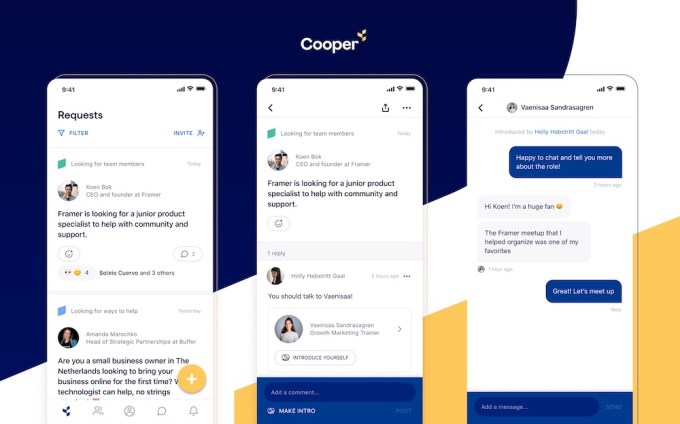
In a period of social distancing, making new professional connections feels harder than ever. So Amsterdam-based Cooper is building a network that’s all about making and receiving introductions.

“Everything that happens in the network is based on on the foundation of introductions,” CEO Robert Gaal told me. “You should never get an unwanted message, and there’s no such thing as a connection request, because it’s not necessary if you have an introduction.”

The startup is launching internationally today and announcing that it has raised $2 million in seed funding.

Gaal (who co-founded the company with CTO Emiel van Liere) described Cooper as “a private professional network that’s not about how many connections do I have, it’s about bringing the people that you already trust into a circle.”

That’s in contrast with existing professional networking sites, which are most useful as “directories” of online résumés, and usually emphasize the quantity of connections, rather than the quality. (I’ll admit that on LinkedIn, I’m connected to a bunch of people who I barely know at all.)

So Cooper tries to take the opposite approach, limiting users’ connections to people they really know. To do this, it can pull data from a user’s online calendar, and it also provides them with a personal invite code that they can share with their professional contacts.

Cooper

Image Credits: Cooper

Users then post requests or opportunities, which are viewable by their connections and by friends of friends, who can offer to make useful introductions via email or in Cooper itself.

In fact, Gaal said that during the initial beta test, multiple people have successfully used Cooper to find new jobs — sometimes after pandemic-related layoffs, which they’re comfortable sharing with their inner circle but don’t want to broadcast to the world at large.

“There’s more discovery, more trust and you can reinvent other things on top of that — what the résumé is, what mentorship is — if you get trust right first,” he said.

Of course, simply sharing a calendar invite with someone doesn’t really mean you trust them or know them well. Cooper could eventually start looking at other measures that indicate your “connectivity” with someone, like how often you email with them, Gaal said — but the first step is simply recreating the professional circle in which you feel comfortable saying, “Oh, you’re looking for a job? My friend is hiring.”

Yes, those kinds of conversations are already happening offline, but he noted that most of us can only remember “a handful of people” at once. Cooper is making that “marketplace” much more visible and easy to track.

The startup doesn’t sell ads or user data. Instead, Gaal hopes to make money by charging membership fees for features like customizing your profile or promoting your request more broadly.

The startup’s seed funding was led by Comcast Ventures, with participation from LocalGlobe and 468 Capital.

“At a time when the ability to connect is limited, Cooper is building a professional network fostering meaningful and substantive connections, “said Daniel Gulati, founding partner at Forecast Fund and former managing director at Comcast Ventures, in a statement. “We are excited to support the team on their journey ahead.”

WordPress Image Lightbox Plugin