Yearly Archives: 2020

News: Trust & Will raises $15M as digital estate planning hits mainstream

Let’s get something morbid out of the way right up front: estate planning is a growth business in 2020. Whether you need to create or update a will, build a family trust, or sign over power of attorney for end-of-life decision-making, it’s been a heck of a year for many families, and even more people

Let’s get something morbid out of the way right up front: estate planning is a growth business in 2020. Whether you need to create or update a will, build a family trust, or sign over power of attorney for end-of-life decision-making, it’s been a heck of a year for many families, and even more people are starting to think about these instruments if anything worse happens this year (and there are still six weeks left!)

In the United States, the vast majority of this paperwork is conducted in-person and on paper, but COVID-19 has made that challenging. Digitally native startups are coming to the forefront in this market, just as the market is getting white hot.

One of the leaders of this pack is Trust & Will, which we first profiled back in early 2019. Two years ago, the startup had just signed the first electronic will in the United States and had raised a $2 million or so seed round led by Rise of the Rest.

Now, the startup is returning to the capital trough, picking up a $15 million Series B led by Jackson Square Ventures and a bunch of other firms listed below. That brings the company’s total funding to date according to founder and CEO Cody Barbo to more than $23 million.

The company disclosed that it has had 160,000 users sign up for the company’s services since its launch in mid-2018. Trust & Will today has three products: a trust-based estate plan, a will-based estate plan, and “Guardian,” which is a sort of simpler setup for parents with kids. Customers pay an upfront setup fee based on which product they choose, and then they pay a smaller recurring annual subscription fee.

The company, which originally only worked in Nevada due to the state laws around digital wills, now has attorneys who can assist clients in multiple states. The company has also since conducted the first electronic will in Florida’s history, which, let’s just say, is an important center in the estate-planning industry.

A couple of other new changes. First, the startup has built up a number of banking and financial planning relationships with institutions such as Fifth Third Bank (which also joined the Series B round as a strategic investor), AARP, and fintech savings startup Acorns.

Second, the company hired former General Assembly CFO John Zdanowski to take on the startups chief financial officer role. The team has grown to 24, and Barbo noted by email that all three co-founders have become dads since the company’s seed round — putting a bit of a poignant note on their mission to make estate planning accessible to everyone.

Trust & Will’s three co-founders with their very-well-estate-planned children. Photo via Trust & Will.

Clearly, the company has a great market tailwind going into 2021, and as more states put in place digital wills and estate planning laws, the market is only set to expand in the coming years. A handful of other startups such as Willful and the brilliantly-named FreeWill are also in this market.

Today, the company’s board consists of Victor Echevarria from Jackson Square Ventures, Rob Chaplinsky of Link Ventures (which led the company’s Series A), Jesse Draper of Halogen Ventures, Barbo, and Daniel Goldstein, who is co-founder and COO.

And now, for the long list of all the other investors who participated. In addition to Jackson Square Ventures, new investors for the Series B included Fifth Third Bank, Northwestern Mutual Future Ventures, AARP, Rosecliff Ventures, Hack VC, Actium Partners, Noah Kerner and Jeff Cruttenden. Returning investors included Link Ventures, Rise of the Rest, WTI, Techstars Ventures, Luma Launch, and Halogen Ventures.

News: The new Mac mini: The revival of the no-compromise low-cost Mac

There’s nothing small about the latest Mac mini. Never mind the Mac mini’s tiny size or low price. This diminutive desktop is a revolution for most users, thanks to Apple’s new chipset. Called the M1, this chip platform replaces the Intel CPU long found at the heart of Apple’s desktop and portable computers, and the

There’s nothing small about the latest Mac mini.

Never mind the Mac mini’s tiny size or low price. This diminutive desktop is a revolution for most users, thanks to Apple’s new chipset. Called the M1, this chip platform replaces the Intel CPU long found at the heart of Apple’s desktop and portable computers, and the results are impressive.

Using the M1 Mac mini feels like using a new iPad or iPhone. Everything satisfyingly snaps into place. I keep waiting for my test machine to start lagging, and nearly a week later, it’s just as fast as the day I started using it. The new Mac mini is surprising, and most users will find it a major upgrade over existing Mac computers. It’s hard to beat regardless of the price.

For casual users, those who live in a web browser or Apple’s apps, the Mac mini is a no-brainer option. This is the desktop I would buy for myself. Even for power users, those who run bespoke applications, the Mac mini should be seriously considered. Most mainstream applications excel on the new Mini — especially apps with a creative tilt toward photography or video.

The Mac mini has long been a forgotten friend among the Mac lineup. Hardly updated and never promoted, it sat on the bench for years, watching as Apple’s portables received updates and refreshes as the world became more mobile. But here we are in the midst of a never-ending pandemic. With coffee shops closed and business travel limited, the COVID-19 crisis could lead to the rediscovery of the desktop computer.

The M1-powered Mac mini is a winner.

Review

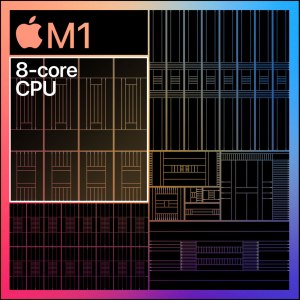
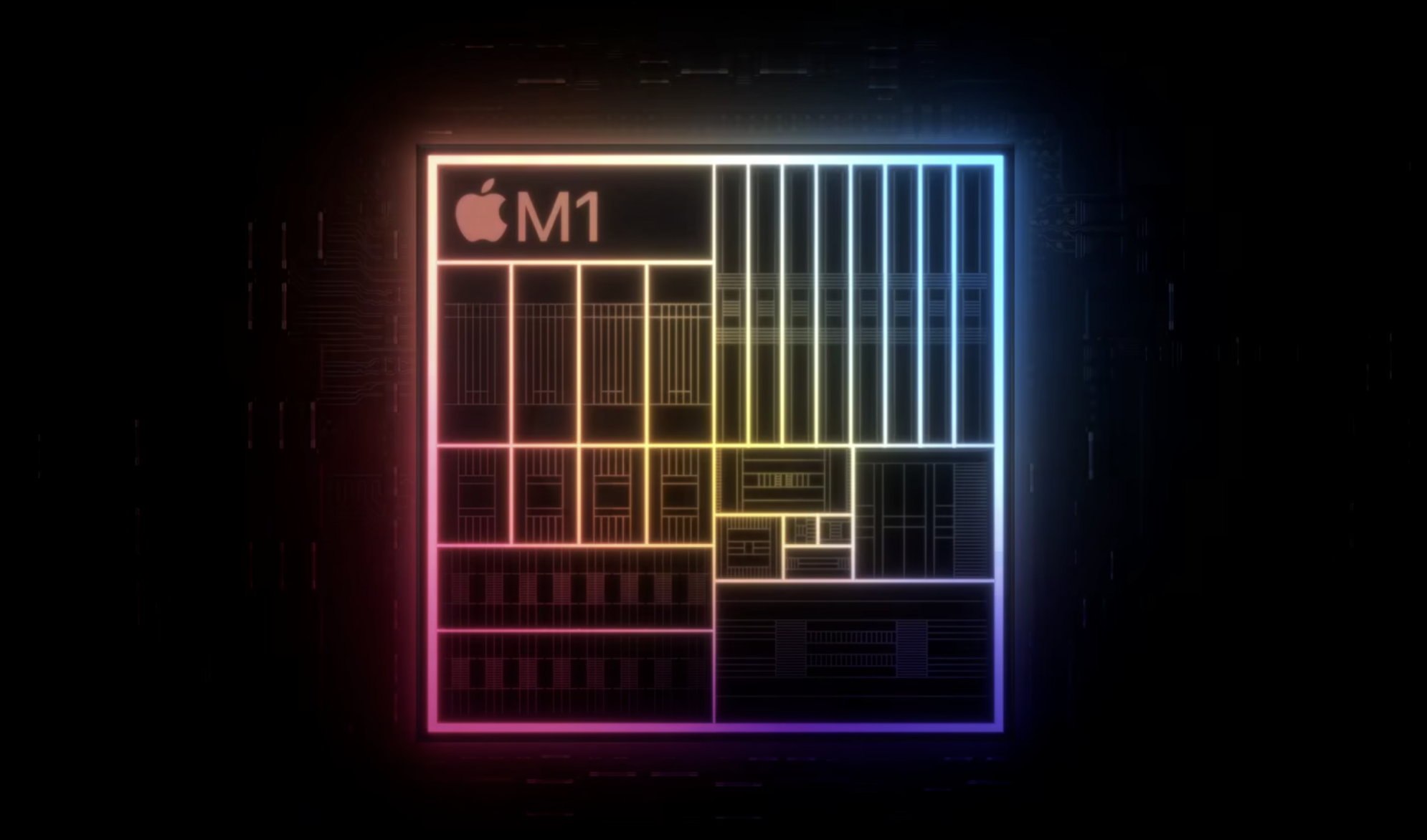
There are several things you should know. One, the new Mac mini runs the M1 SoC, which is fundamentally different from its Intel predecessor. Instead of a CPU, it’s an SoC — System on a Chip, which comes with advantages and concessions. The chipset is built around an ARM design with more integrated components than its CPU counterparts. In many ways, it’s more similar to the system powering phones and tablets than the chips used in traditional computers. Because of this design, components that used to be discrete are now integrated directly into the chip.

Second, Apple provided a 6K 32-inch Pro Display XDR with my test Mac mini (these will be returned to Apple). I’m also running a 24-inch display over HDMI. According to the Mac mini’s product page, the system is limited to two monitors. I was able to hook up a third monitor through 3rd party software but it was unstable and should not be considered a capability.

Lastly, you should know TechCrunch also reviewed the new 13-inch MacBook Air and 13-inch MacBook Pro. We benchmarked these systems with similar conditions to demonstrate the differences between the units. You can find the reviews here for the MacBook Air and MacBook Pro.

In our tests, we found Apple’s M1 system on a chip (SoC) to outperform its rivals, regardless of price. With the M1 at its core, the Mac mini is faster in most regards than every Apple computer available except for the ultra-expensive Mac Pro — and sometimes the Mini is faster than the Mac Pro, too. What’s more, this performance increase is noticeable throughout the system and not just limited to raw computing tasks in purpose-built applications. The system is snappy, responsive and feels like the start of a new era of computing.

MacBook Air M1 review: The right Apple Silicon Mac for most

The new Mac experience

Snappy hardly describes the experience of the new Mac mini. This system flies. Users will instantly notice the increase in speed, too, from startup time to launching apps. In the past, even on powerful machines, macOS has always felt heavy compared to iOS, but not anymore. With the M1 chip, macOS (Big Sur) is light and free and a joy to use.

Even better, the ARM-based M1 chip allows Macs to run iOS applications, and they run as smoothly on the Mac as they do on an iPad.

There’s likely a hesitation around embracing a new Intel-less Mac. Will your legacy applications run on these machines? Will they run well? I can’t answer every variable. I installed and ran dozens of applications during my few days with the system and never experienced a roadblock. Even with older programs, everything ran as advertised, and in most cases, ran better on this M1-powered Mac mini than on my few-months-old 15-inch MacBook Pro. I didn’t find one application unable to run on the new platform.

The largest speed increases are most noticeable when using native apps for the M1 processor. With Apple’s Final Cut Pro, the application loads seemingly instantly — two seconds from button press to it being open and ready to go.

With the M1 chip, it’s less painful to edit 8K footage in the native Final Cut Pro app than it was to edit 4K footage on an Intel Mac. Exporting the files still takes time, though, and this is one of the few tasks where Intel’s platform outperforms the M1.

Even when using legacy software, the system preformed with ease. Edits in Photoshop seemed more fluid. Lightroom loaded photo albums quicker and without hesitation. Editing video in Premiere was easier and less painful as I scrubbed through 6K footage. Even unzipping files was much quicker.

Image Credits: Matt Burns

This is a silly demonstration, but watch the GIF above. Applications open instantly — all of them at the same time. If Apple put a beachball in this system, I haven’t found it yet.

The M1 chip is based on an ARM design, which required Apple to rework macOS to run on this new computing platform. While it looks mostly the same, the macOS is now purpose-built for Apple’s own silicon. To take full advantage of the redesigned chip, applications need to be re-coded into an Arm-friendly design. And yet, we found something surprising: Even the apps that are not re-coded yet are still impressively fast thanks to Apple’s Rosetta 2 that enables software encoded for Intel’s platform to run on the new Apple platform and take advantage of the M1’s power.

For most uses, this holistic approach of building the hardware and software results in major advantages. Common system-level tasks like launching apps, waking from sleep and unzipping files are lightning-fast. Other items like rendering video and editing photos are just as fast, too. Right now, at launch, all of Apple’s apps — from Music to Photos to Safari — are re-encoded for the M1. Like those from Adobe, other apps are not yet native, but the older versions run fine, and in most cases, run better on the M1 than an Intel platform.

The M1 platform lacks a dedicated graphics processing unit. It’s built-into the core of the chip. Thanks to a memory dedicated to machine learning, this lack of a discrete GPU is hardly noticeable for professional users. Still, those who do intensive graphics work (like professional gfx visual artists) should hesitate. Even then, this conclusion could change once the applications become native to the new ARM architecture.

The M1 also lacks the ability to use an eGPU — an external graphics card — but most users should not fret. It could be a problem for pros who found the Intel-based Mac minis paired with a powerful eGPUs as a viable, low-cost alternative to the Mac Pro. However, based on our testing, the GPU performance in these M1 systems are impressive and could be good enough for most, even in creative media editing applications.

In addition to common workflows, I ran through some industry benchmarks to see how the system responds and came away impressed. We took it one step further, too, and charted the performance between Apple’s top-of-the-line systems and the new 13-inch MacBook Air and 13-inch MacBook Pro.

Benchmarks often oversimplify results, but in this case, they seem necessary. This puts systems on common ground. By looking at multiple tests, the results draw a common conclusion. The M1 is really good.

The new Mac lineup

The Mac mini has two siblings. The M1 is also available in Apple’s 13-inch MacBook Air and 13-inch MacBook Pro. The differences are minor. The same computing platform powers all three but feature different cooling schemes in the MacBook Pro and Mac mini. Because of the improved cooling, the MacBook Pro and Mac mini are better suited for sustained performance.

In our testing, all three machines performed similarly. The Air started to fall short in the longer tests, and that’s likely due to its passive cooling that does not feature a fan. In the MacBook Pro and Mini, the SoC is cooled by a fan, while a heatsink is used in the Air.

What does this mean for you? For most users, the Air’s performance is sufficient as it only slows down during long, intensive tasks. For browsing the web, editing photos and watching videos, the Air is perfect.

There’s one downside to the new Mac mini over its Intel sibling. The M1 Mac mini only sports two Thunderbolt 4 inputs — that’s because the M1 chipset has an integrated Thunderbolt controller and it supports up to two of these ports. For some users, this could be a deal-breaker, though it’s not for me. There are countless ways to expand the Thunderbolt capability of the Mac mini, and to me, the performance of the machine outweighs the port limitation.

The M1 Mac mini also lacks a 10GB Ethernet option, limiting its use as a server for some users. This is also likely an M1 limitation, and something I would expect would be addressed in future chipset revisions.

Multiple monitor support is a major downside to the M1 Mac mini. It only supports two monitors: one through Thunderbolt and one over HDMI. I was able to get a third monitor running at low resolution through third-party software, but it was unstable and performed poorly. To some, including me, multiple monitor support is a major issue and two monitors are often not enough.

Benchmarks

Apple, when promoting the M1-powered computers, laid out some wild claims about the chipset. We found most of the claims to be factual. We ran a handful of benchmarks on the M1 systems, comparing them against the most recent Macs, including the Mac Pro.

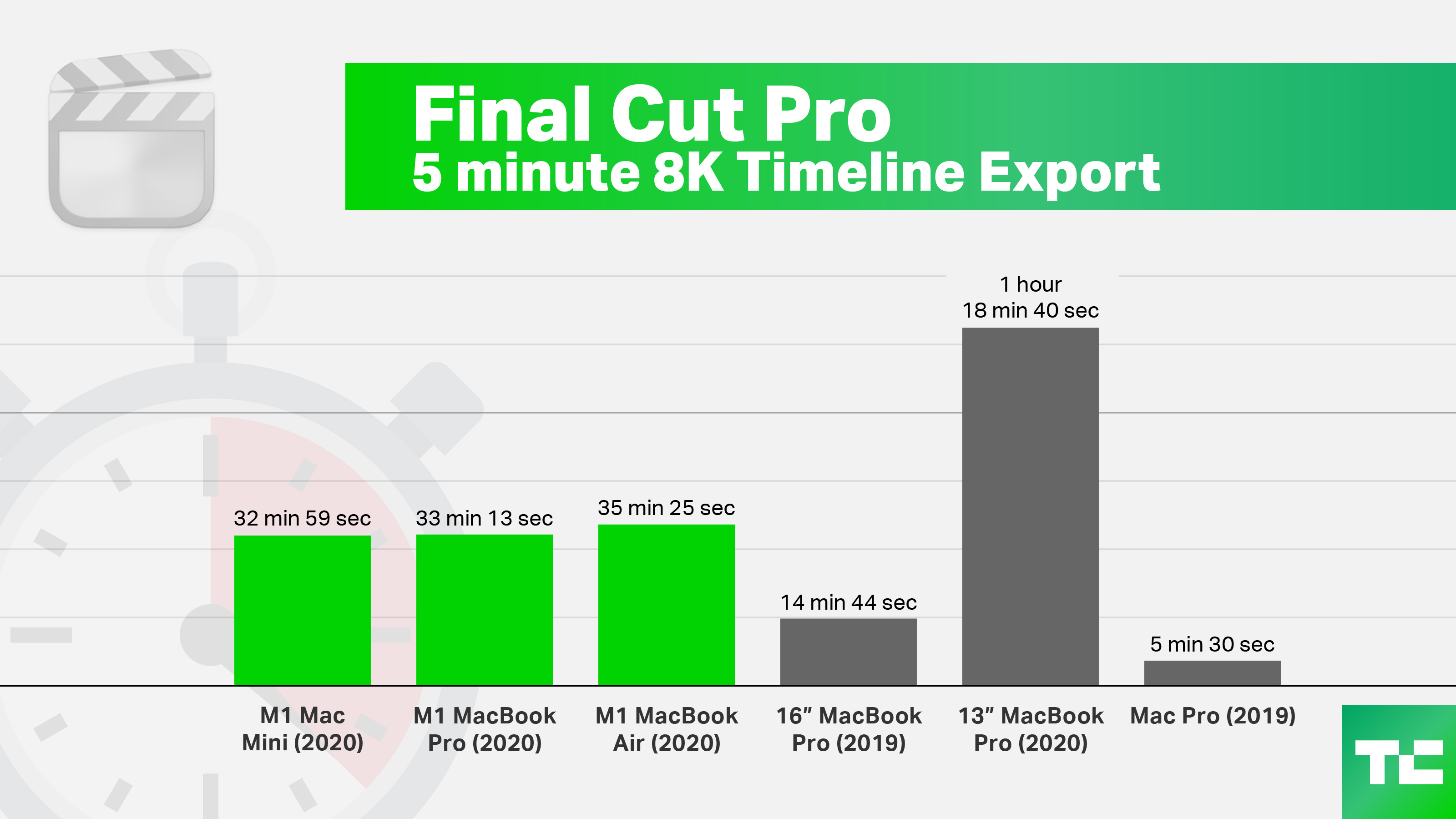
Benchmarks paint with a broad stroke and often miss nuances. That’s the case here. While the first few benchmarks demonstrate the speed of the M1, the final test fails to capture a critical aspect of Final Cut Pro. Sure, it’s slower to export than an Intel-based system, but using the M1-native version of Final Cut Pro is much smoother than what’s available on older systems. I was able to easily manipulate, scrub and edit 8K footage without even a hiccup. Rendering takes longer, but editing is seemingly easier.

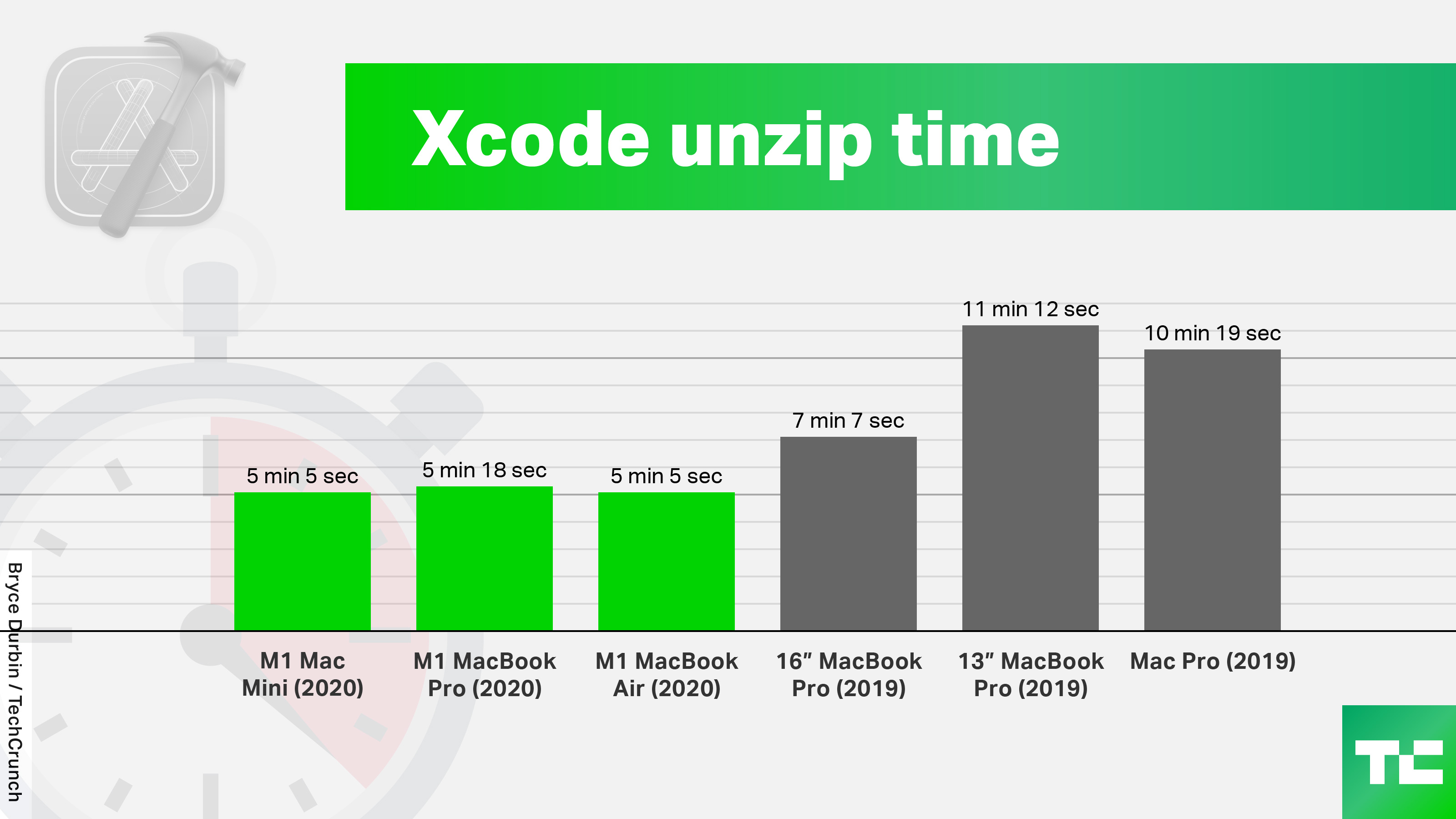
Image Credits: TechCrunch

Here we downloaded the Xcode 12.3 beta. It’s an 11.57GB file that extracts a 28.86GB folder. Lower times are better.

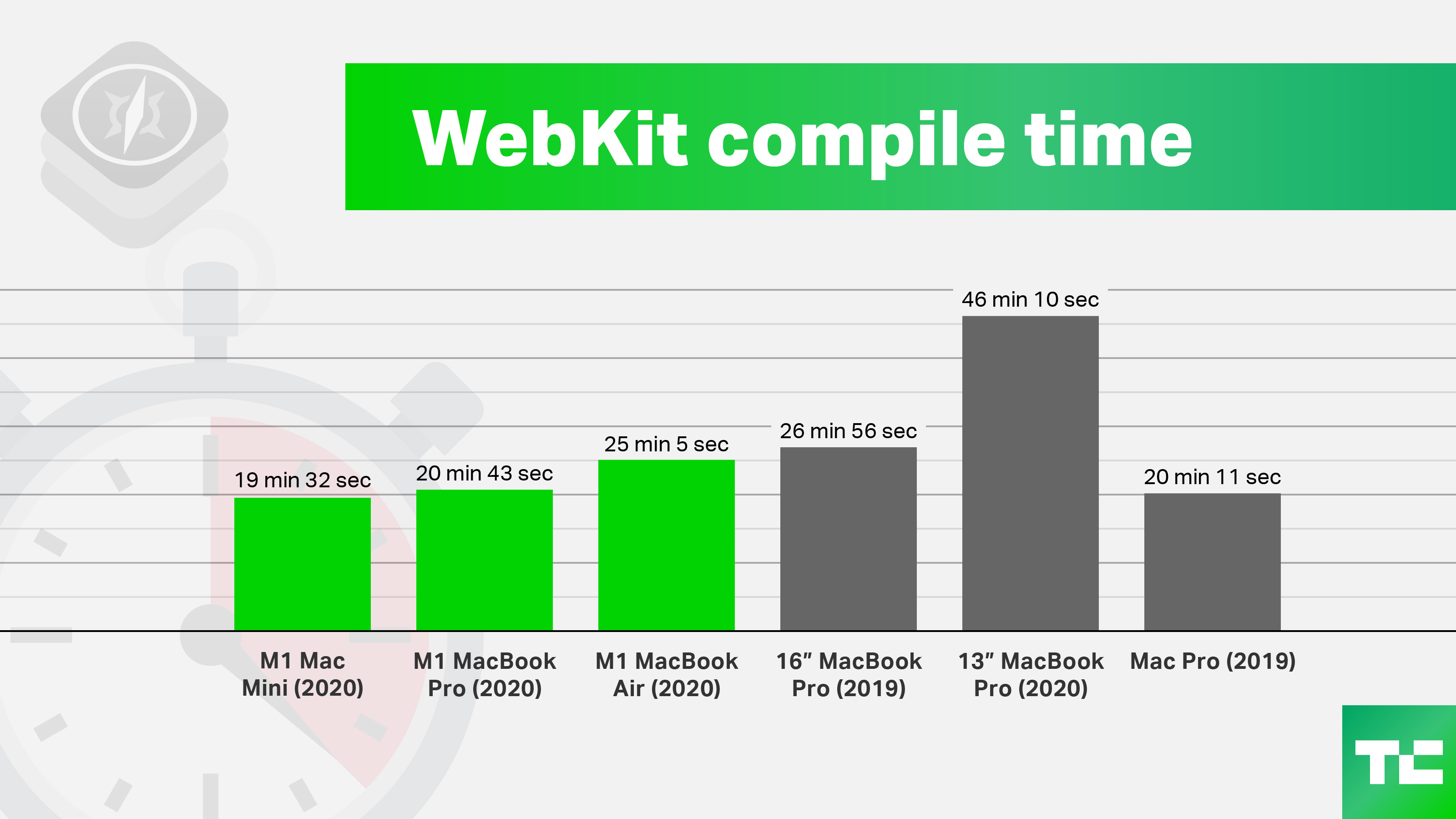
Image Credits: TechCrunch

Here we compile WebKit. Lower times are better.


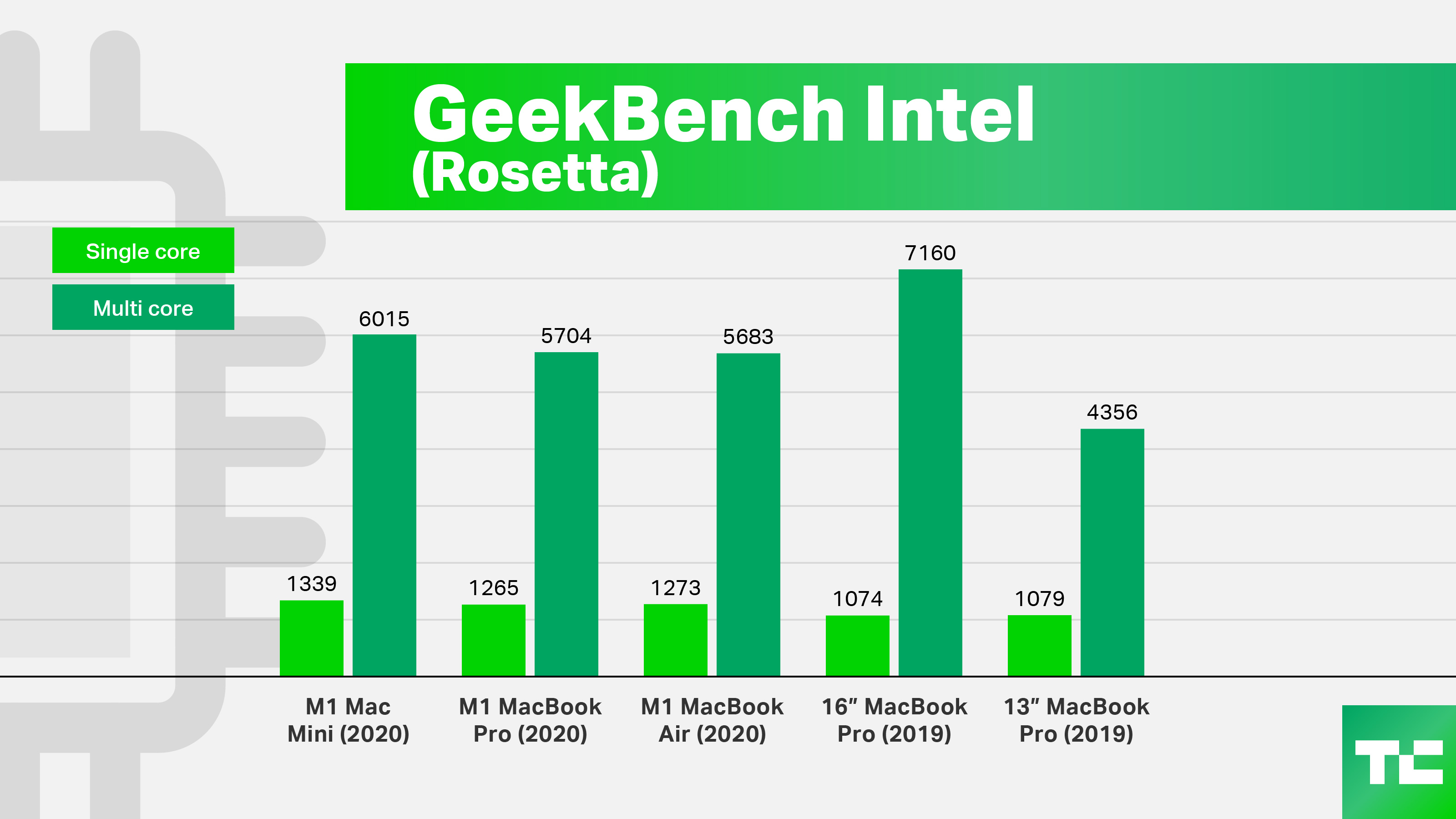
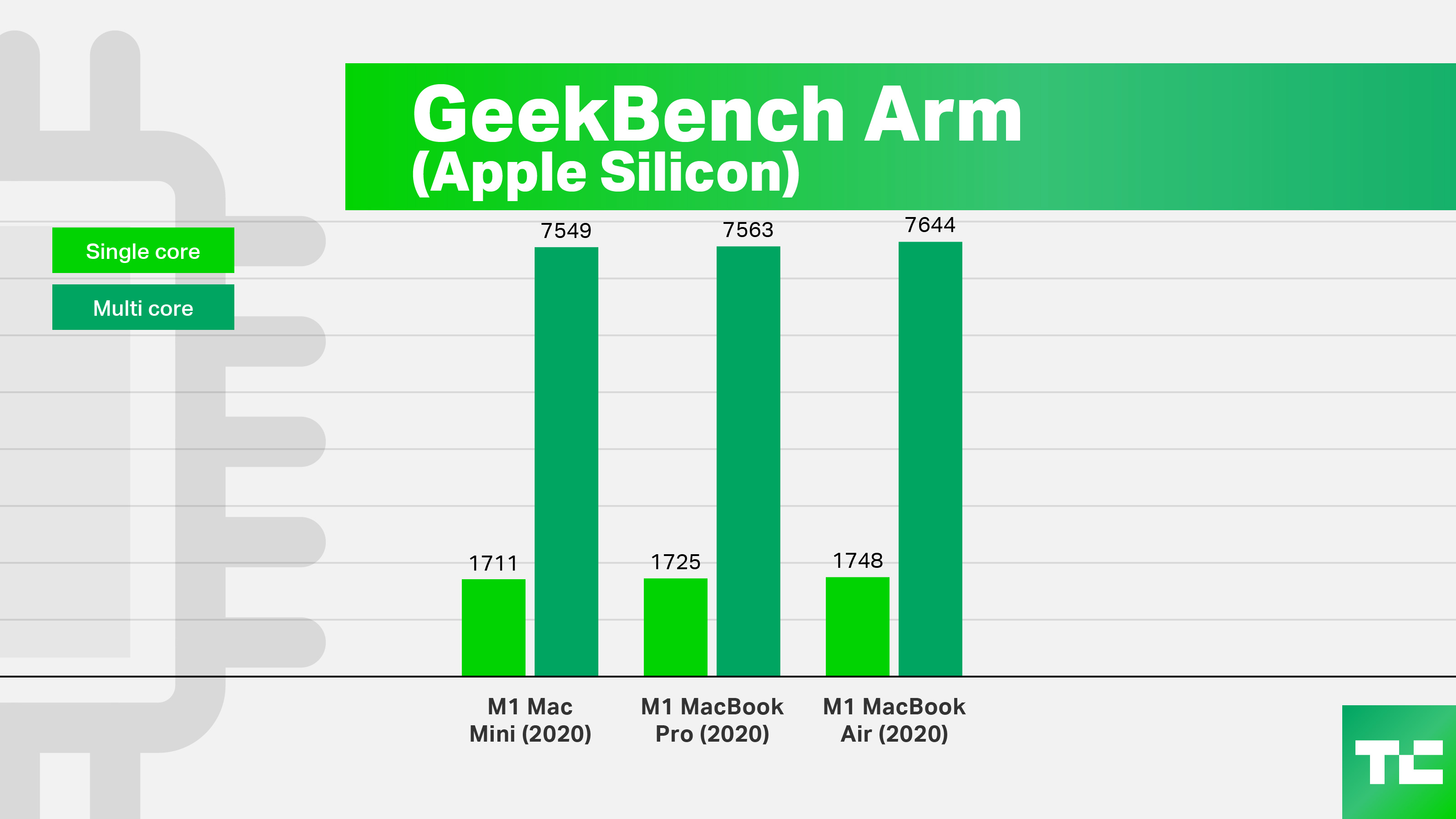
With Geekbench, we ran two tests: One, using Rosetta 2 to demonstrate the system’s power when running legacy applications. Then we ran Geekbench in an M1 native mode to test Apple’s silicon. Higher is better.

Image Credits: TechCrunch

For Final Cut Pro, we timed the rendering of an 8K video (80GB). Lower is better.

Conclusion

Pros

  • Breakthrough performance for the price
  • Easily able to run legacy (Intel) and iOS apps
  • Cool and quiet

Cons

  • Support for only two monitors
  • No eGPU support
  • Only two Thunderbolt 4 ports

Test Mac mini specs

  • Apple M1 chip with 8-core CPU and 8-core GPU
  • 16-core Neural Engine
  • 16GB unified memory
  • 1TB SSD storage
  • Gigabit Ethernet
  • Price as tested: $1,299

The new Mac mini is a fantastic machine and feels like the start of a quiet revival. In another era, Apple was known for its solid, fairly-priced desktops, which is a great description for this Mac mini.

As a longtime fan of the Mac mini, I’m thrilled to see it once again as a great option for those of us who live at a desk .

With the M1 chipset, Apple is moving onto a new chapter in its long history of personal computers. This chip redefines the computing paradigm by offering stellar performance in a small, power-efficient package. In the Mac mini, the M1 shines as a stable workhorse that provides a new experience to Mac desktops. In the new MacBook Air and MacBook Pro, the M1 is just as solid while offering substantially better battery life than previous offerings. Read those reviews here and here.

Should you get the new Mac mini? If you’re stuck at a desk, yes. The new Mac mini is fantastic.

MacBook Air M1 review: The right Apple Silicon Mac for most

News: MacBook Air M1 review: The right Apple Silicon Mac for most

Reviewing hardware is an act of minutia. Occasionally something new or potentially earth-shattering comes along, but on the whole, it’s about chipping away. Documenting small, gradual changes designed to keep product lines fresh and — if you play your cards right — differentiating yourself from the competition. Apple’s as guilty of this as anyone, of

Reviewing hardware is an act of minutia. Occasionally something new or potentially earth-shattering comes along, but on the whole, it’s about chipping away. Documenting small, gradual changes designed to keep product lines fresh and — if you play your cards right — differentiating yourself from the competition.

Apple’s as guilty of this as anyone, of course. That’s just the nature of a 12 to 24-month product cycle. Every refresh can’t be a revolution. Every so often, however, a game-changer comes along — something undeniable that sets the scene for a more profound shift for a product line. The trio of Macs launched at the company’s third major press conference in three months certainly apply.

It’s been 15 years since Apple made the jump to Intel processors from PowerPCs, a chip technology it had relied upon for more than a decade. That move came as the company was butting up against the limitations of its chosen technology. PowerPC took them far at the time, but it couldn’t deliver on the processing power it desired for the next generation of portables.

As with that transition, the move toward Apple silicon has been years in the making. The company has been making a concerted effort to wean itself off of third-party components. Among other things, it’s increasingly difficult to differentiate your product when you’re essentially using the same parts as everyone else on the market. Creating your own processors is, of course, a long and difficult process. Thankfully, however, the company had a head start.

Image Credits: Brian Heater

The Arm-based chips that power the company’s mobile devices are a great starting point. The company can build on several generations of learning, while moving ever closer to that perpetual Holy Grail of Apple software: perfect cross-ecosystem compatibility. Elements of iOS have been trickling down into MacOS for years now (a trend that includes, and arguably accelerates with, Big Sur), while the company eased the transition for Intel Mac owners with the Catalyst.

Image Credits: Brian Heater

After countless rumors and months of wait, the first three Apple Silicon Macs are finally here. And the results are, in a word, impressive. You’ve no doubt seen some of the benchmarks that have popped up over the past several days that have left many in the community taken aback. While it’s true that Apple talked up performance in its own presser, it’s easy enough to discount those numbers without more specific benchmarks. We’ve split our testing of the three systems among three editors — and it’s pretty safe to say we were blown away by what the systems can do.

Okay, so, a brief break down of the M1:

  • Eight-core CPU with a stated 2x performance gain
  • Seven- or eight-core GPU (depending on the Air model you go in for) with up to a 2x graphical upgrade
  • 16-core neural engine
  • Increased power
  • Improved image signal processing

The Air, in particular, presents some truly robust gains of the most recent versions of the system, released back in March. That may feel like forever ago, given everything that has transpired, but that’s a mere eight months. The system excels at two benchmarks in particular: battery life — measures by a simple video playback — and Geekbench, which tests a system’s CPU and GPU performance by simulating real-world situations. Anecdotally, things are just faster all over the place.

Image Credits: Brian Heater

Apps open almost instantly and resource-intensive tasks like editing 4K video are surprisingly zippy. Some of these are changes you’ll likely notice right away, even if you’re not pushing the system to the limit. Take the neat trick of waking up instantly from sleep. It’s something we’ve taken for granted on mobile devices but haven’t seen as much on desktops.

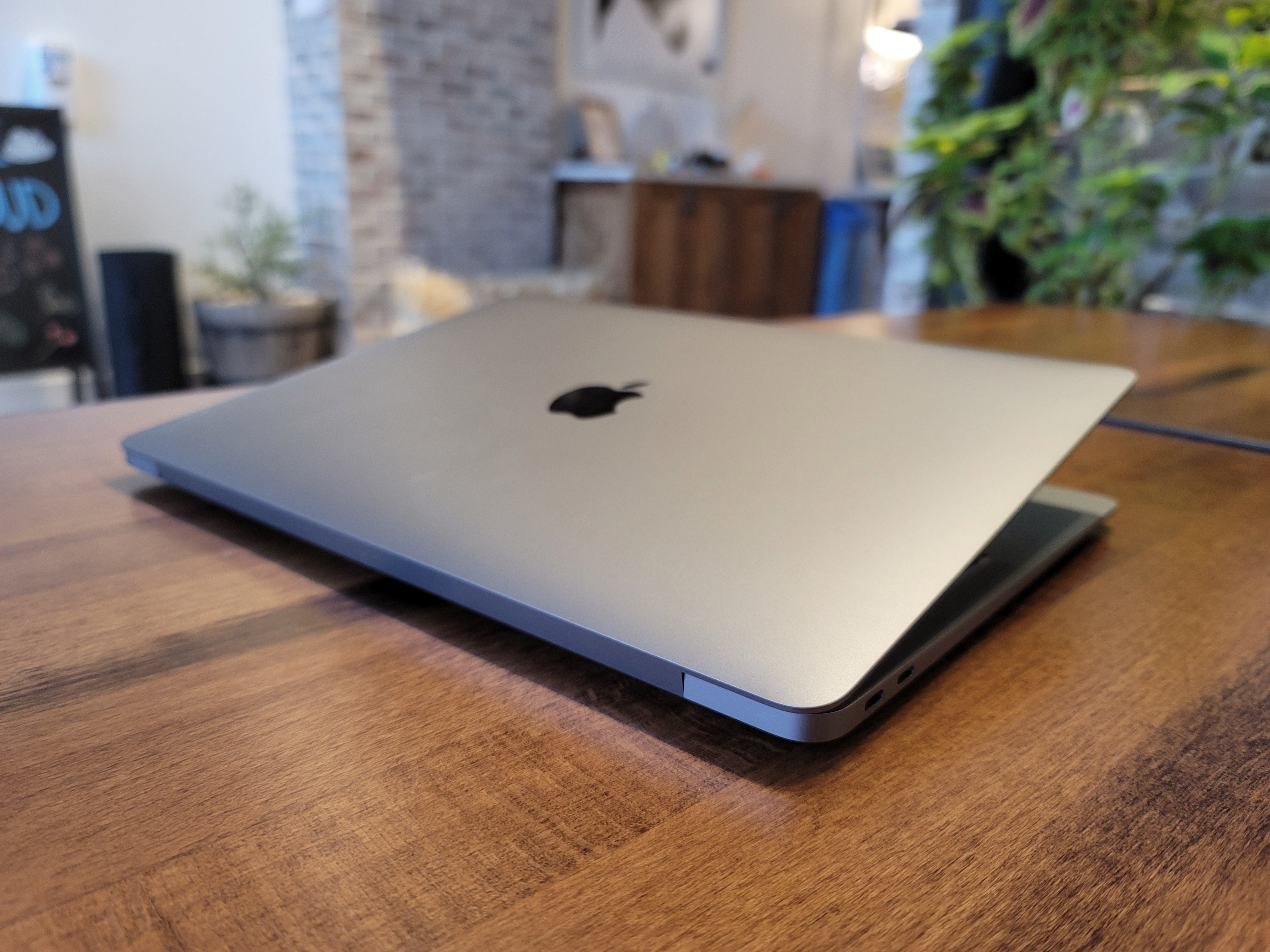
These advances, perhaps unsurprisingly, arrive in the same package. Like the new Mac mini and 13-inch Pro, the Air is identical to the one released early this year. Perhaps the company is seeking to maintain consistency on the outside as the products undergo rather dramatic changes under the hood. Maybe a redesign didn’t line up with the move to Arm. Or, hey, maybe Apple thinks the current design represents some sort of platonic ideal for thin and light laptop.

Whatever the case, you’d be hard-pressed to pick the new Air out of a lineup. I’ve been using the system in public, and no one’s been any the wiser that I got a slight head start on the next generation of Macs. If I’m being honest, I’d have liked it if Apple had ushered the moment in with some befittingly dramatic redesign — but at least no one can accuse Apple of introducing change for the sake of change. And let’s be honest, while the physical design of the Air hasn’t changed much in recent generations, it remains one of the most iconic and better-looking laptops on the market.

That includes the same thin and beveled design that differentiates the product from the rest of the MacBook line, and at 2.8 pounds, it’s 0.2 pounds lighter than the 13-inch MacBook. That’s not a huge spread, but it’s something that will make a difference to your lower back over time — I say that as someone who lugged the system around on a 15-mile walk over the weekend.

Image Credits: Brian Heater

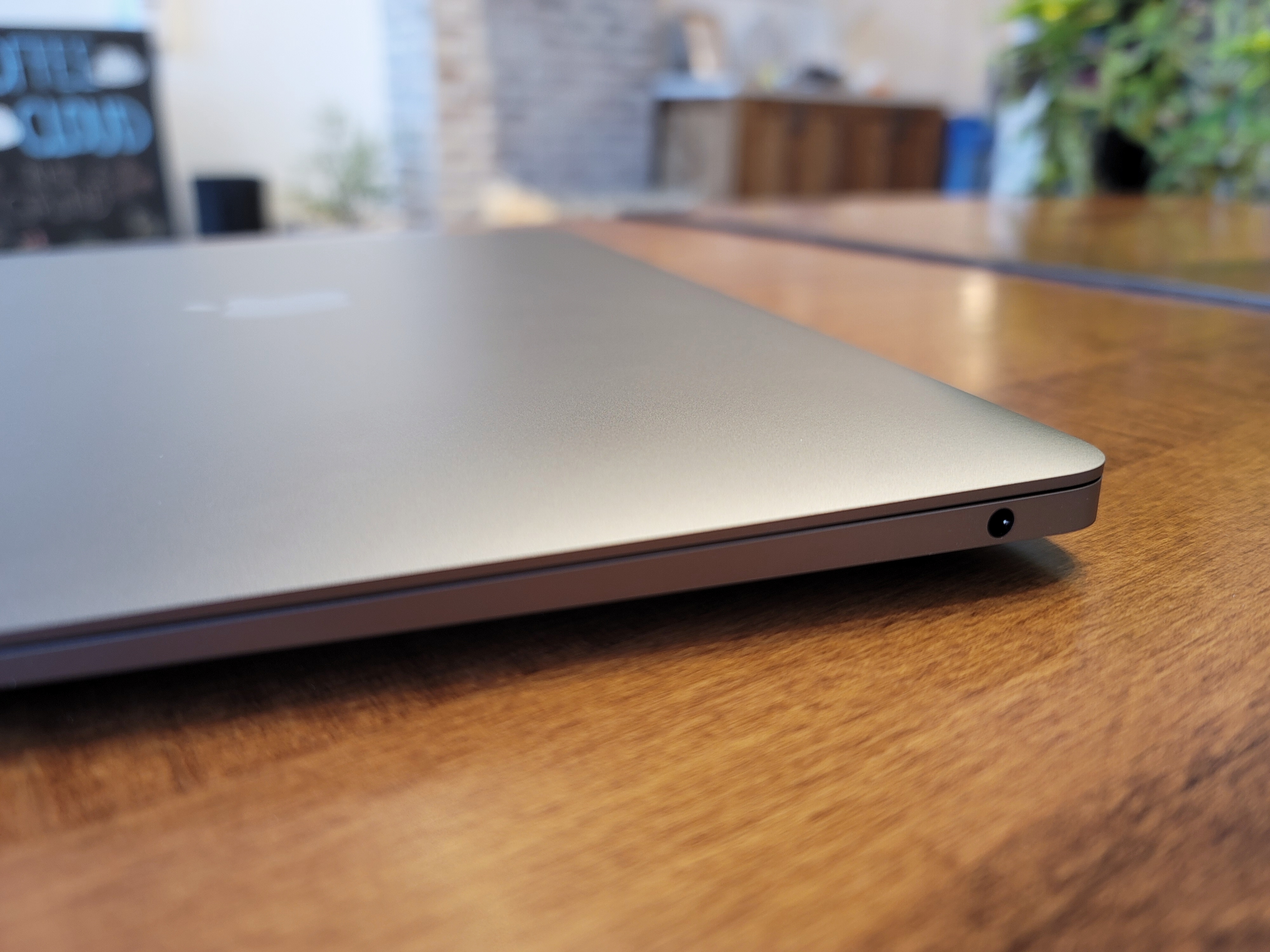
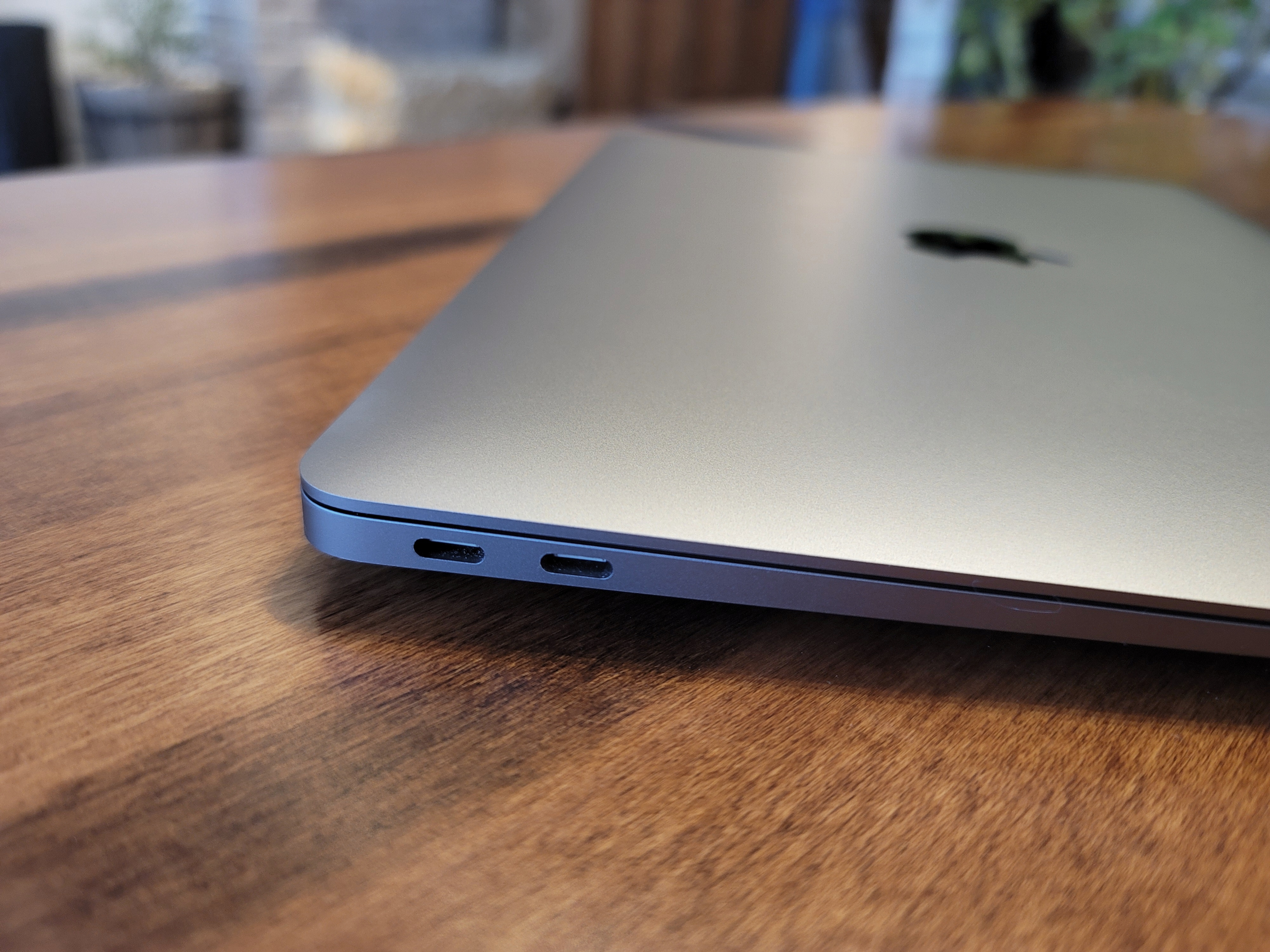
Once again, there are two USB-C ports, both positioned on the same side. I’m always going to argue for more ports, especially given the fact that one will semi-regularly be monopolized by a charging cable. I’m also a fan of spreading them out a bit more — preferably on either side of the machine for those instances when you just can’t get enough slack from the cable or have something a bit wider plugged into the port. Of course, there’s no surprise on that front, unlike the new 13-inch Pro, which lost two ports in the process of upgrading.

That will likely sting for some users attempting to figure out whether to upgrade here. The change appears to be connected to some limitations of the new M1 SOC. If I was a betting man, however, I would suggest that there’s a pretty reasonable possibility that whatever pro-focused version of the chip comes next will support more ports for upcoming devices like the first Apple Silicon 16-inch MacBook Pro.

In fact, the company is likely reserving a number of upgrades to differentiate this round from some new pro-focused devices likely to arrive at some point next year. It’s all part of a kind of configuration of Apple’s Mac strategy that we’re seeing play out in slow motion. The new Air, 13-inch MacBook Pro and Mac mini represent the entry-level tier for the Mac line. It’s a category that’s become an increased focus for the company in recent years — and one we’ve seen play out across the iPhone and Apple Watch lines.

There is, of course, still truth in the longstanding notion of the premium “Apple Tax,” but the company has expended its approach to improve things on the lower end. One of the more surprising aspects of this strategy on the Mac side is just how much the company has closed the gap between the MacBook Air and 13-inch MacBook. There are differences between the two devices, of course. For many or most, the biggest is the $300 price gulf between the $999 starting price for the Air and $1,299 13-inch MacBook Pro.

So, how does Apple justify the price difference? And more to the point, will the upsell make a difference for a vast majority of users? Before we go any further, let’s break down the key differences between the new Air and Pro.

  • Stated Battery – Pro: Up to 20 hours, Air: Up to 18 hours
  • Display – Pro: 500 nits of brightness, Air: 400 nits
  • Microphone Array – Pro: Studio-quality three-mic array, Air: Three-mic array
  • Touch Bar – Pro: Yes, Air: No
  • Speakers – Pro: Stereo speakers with high dynamic range, Air: Stereo speakers
  • Fan – Pro: Yes, Air: No

The last bullet is the most important when it comes to performance. The arrival of the M1 made a fanless MacBook Air a possibility — something that was unheard of in early models. It bodes well for the thinness of future MacBooks, and more immediately, it means extremely silent performance. And, indeed, no matter how much stress testing I’ve managed to do over these past few days, the system has remained eerily silent — though I’d caution you that the passive cooling system can result in a rather toasty Air if you really push things. And, more importantly for a workload standpoint, the system will throttle during resource-intensive tasks — but you’ll have to push it.

Take, for example, the five-minute, 8K clip we exported in Final Cut Pro. At 33:13 minutes on the Pro and 32:59 minutes on the Air, the end result was, honestly fairly negligible (the Mac Pro, meanwhile, blew them both away at a blazing five and a half minutes). Ditto for running a WebKit compile. That took 25 minutes and five seconds on the Air and 20 minutes and 43 seconds. That’s not entirely negligible, but both systems beat out the 2019 16-inch MacBook Pro’s 26 minutes and 56 seconds. And both systems took far less of a battery hit, losing around 9% during the process, versus the 16-inch’s 39%.

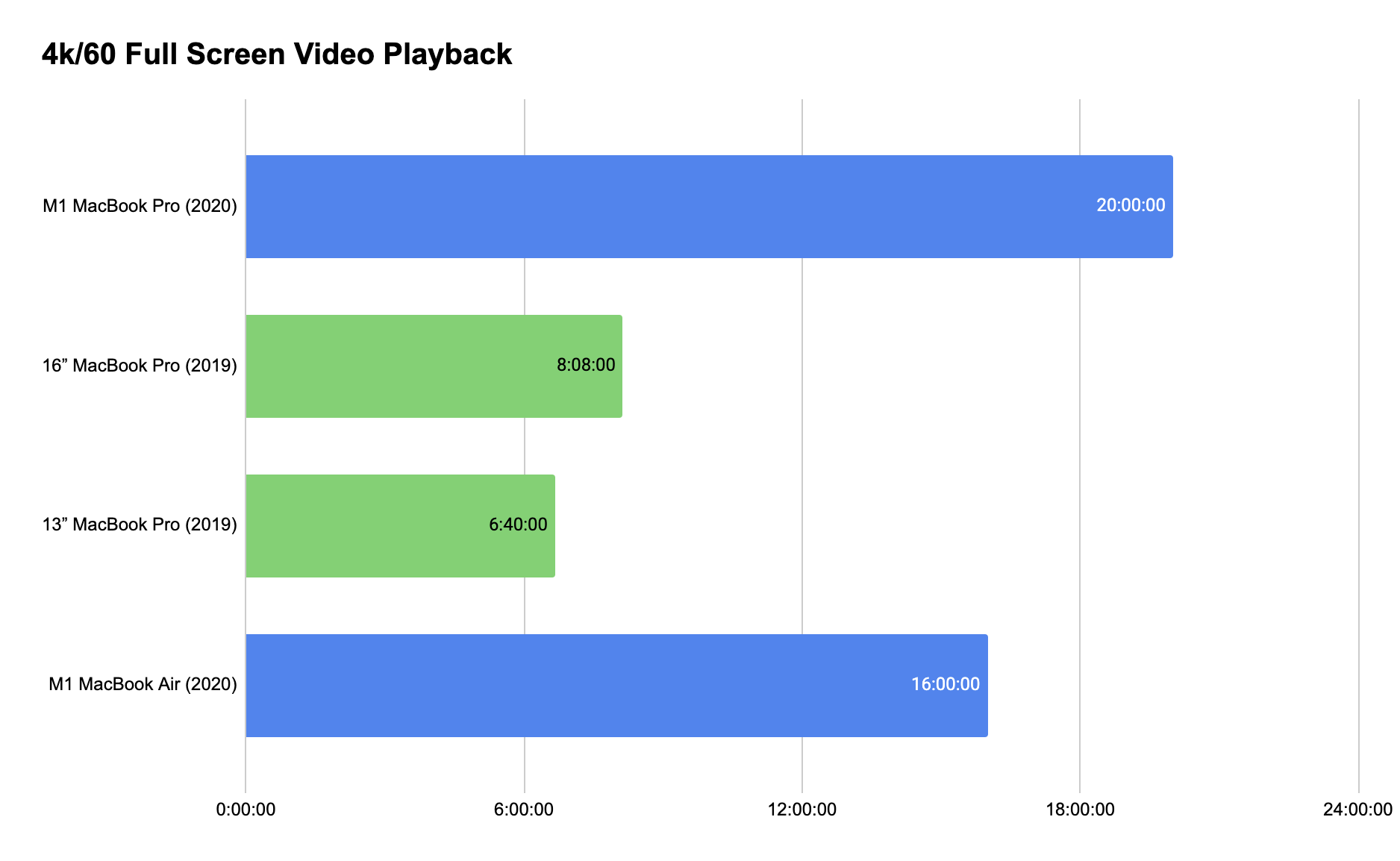
The new M1 chips are remarkably energy efficient, even when performing more resource-intensive tasks. In a video playback test, I got 16 hours of life. That’s less than the maximum 18 hours stated by Apple’s numbers, but it’s an impressive figure, nonetheless. I would certainly feel comfortable leaving the house without a charge.

Per Matthew’s numbers, the Pro fares even better. He was able to get right around the stated 20 hours. That higher figure likely comes due a higher capacity battery courtesy of the thicker laptop footprint. In both cases, however, the systems blew away last year’s 13 and 16-inch Pros, which got eight hours and eight minutes and six hours and 40 minutes, respectively. That’s a tremendous bump in an important metric.

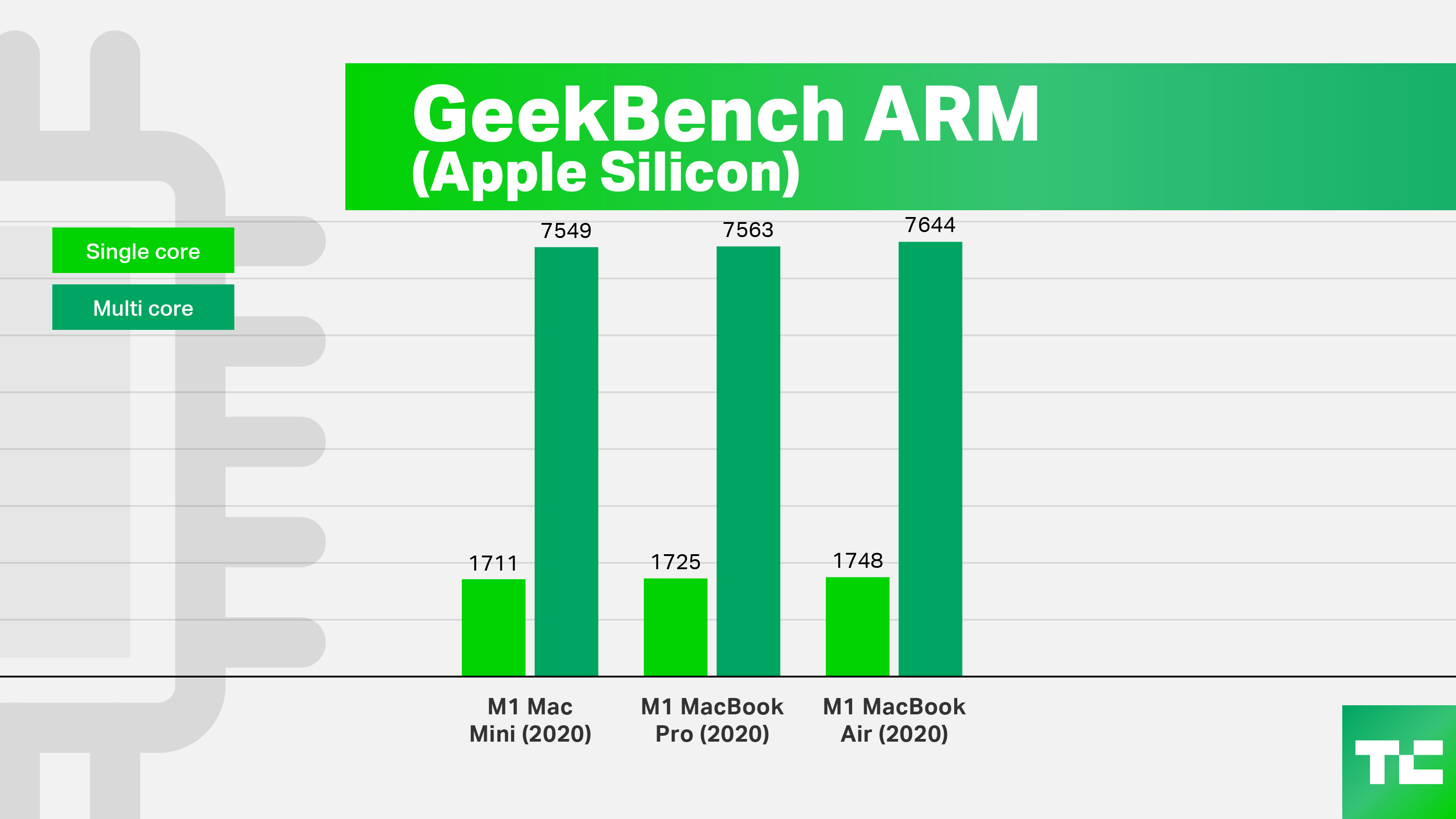
So let’s break down those Geekbench 5 numbers. The new Air and Pro’s numbers are quite similar. That’s to be expected given their respective internals. Again, you’re going to have to really push the system — likely for a prolonged amount of time — before the Air take a noticeable hit due to its fanless design. The Pro scored a 1711 on single core and 7549 on the multi-core. The Air got an average of 1725 and 7563, respectively (for good measure, I’ll add that the the Mini hit a similar 1748 and 7644).

Here’s some more historical context from Geekbench. A few relevant examples: the Core i7 MacBook Air from earlier this year averaged 1136, while the 13-inch Pro hit 1240. Running the Intel version of the benchmark (using the Rosetta 2 emulator), the numbers predictably took a hit, but still best the Intel systems. And, indeed, Intel-designed apps performed quite smoothly.

Image Credits: TechCrunch

Most of the benchmarks we ran found the two systems scoring remarkably close to one another. In other words, I think it’s a safe bet a majority of people searching for systems at this tier won’t be bumping up against those kinds of limits too often. Those who do find themselves frequently performing tasks that challenge those hardware limitations are going to have the difficult choice of buying the new 13-inch Pro now or waiting the see what models like the 16-inch have in store. For more information on that front, spend some time with Matthew’s review of the new 13-inch.

Image Credits: Apple

What I can say with more certainty, however, is that Apple’s got a much stronger case for its rediscovered focus on creative pros. While the category has long been its bread and butter, a case can be made that the company has surrendered some of that market to the likes of Microsoft’s Surface line and others. Apple made the case that the Touch Bar found it rekindling that relationship, but I think there’s a much stronger case to be made for a MacBook Air that can process much heavier workloads than its predecessors.

And, frankly, I haven’t missed the Touch Bar. My primary laptop is a 15-inch Pro with Touch Bar, but it’s a feature that hasn’t really impacted my workflow — and it’s not for a lack of trying. I suspect that for those attempting to distinguish between the Pro and Air the missing feature will barely register. And besides, my favorite part of the Touch Bar addition — TouchID — is here as it was on the last Intel version of the Air. On a whole, I’ve found the ability to log in with a fingerprint more useful than scrolling through photos or emojis on the thin touch strip.

Image Credits: Brian Heater

Speaking of touch — there’s another elephant in the room here. Obviously the touchscreen Macs some predicted didn’t arrive at the event early this month. Even so, it seems reasonable to expect that they will at some point in the not so distant future, with the lines continuing to blur between macOS and iOS. Look no further than Big Sur, which continues the recent trend of adopting key features from the mobile operating system.

Image Credits: Brian Heater

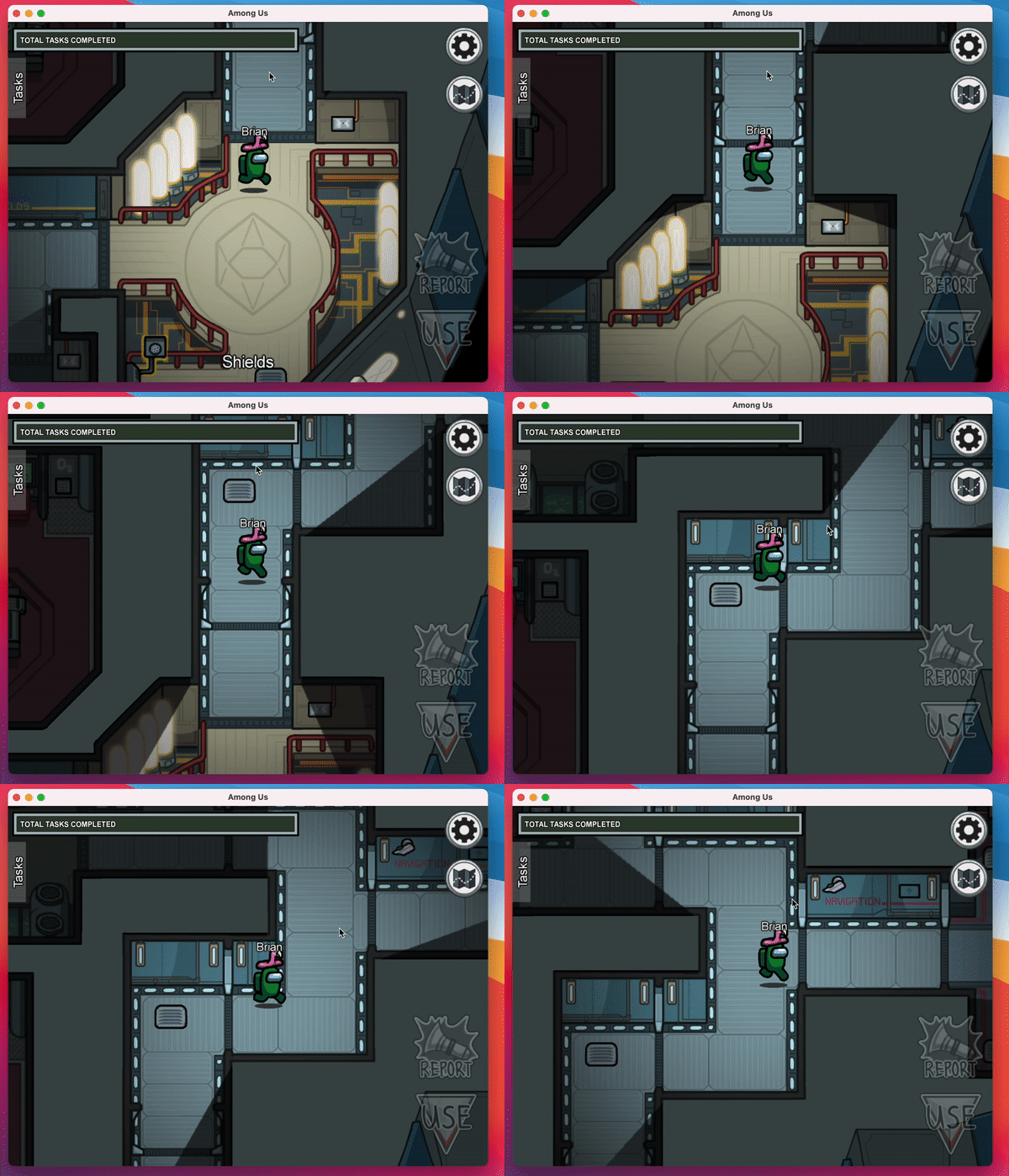
As I noted in my recent writeup of macOS 11.0, a number of features are practically begging for touchscreen interaction. Take the sliders in the newly added Control Center. Sure, the trackpad works fine, but it sure would be satisfying to swipe them over with a finger. This becomes even more pronounced when playing certain iOS optimized games, which now play natively on the M1. Take “Among Us.” I played the wildly popular social game on the new Air — and while the gameplay was predictably smooth, playing with the trackpad feels less natural than touch.

In this implementation, you either have to use the pointer to control an on-screen joypad or simply point the character in the right direction. There’s also the fact that the game occupies a fixed window that you can’t expand to take up the full display. The M1 chip goes a long ways toward opening up the available Mac ecosystem, making porting an iOS app as simple as ticking a box to make it available through the Mac App Store, but in many cases, additional optimization for these systems is warranted particularly for more professionally minded applications.

Image Credits: Brian Heater

As for the other primary input device, the keyboard is pretty much the same as the latest Intel Air — which is to say head and shoulders above early versions. That’s no doubt a dark couple of generations of keyboards Apple would like to forget. They were solid as a rock, and insufferably loud. They also caused a lot of users undue stress by getting jammed. The latest version of the scissor mechanisms are far superior to the early butterflies. I won’t go so far as saying it’s the best laptop typing experience, but it’s like night and day compared to early models.

Another aspect that warrants mention is the webcam. It’s a feature that rarely warrants a sentence in most laptop reviews, but this is 2020. It’s a weird year with weird demands and here we are carrying out the vast majority of our interaction with other human beings over Zoom. It sucks, but it’s life. Many people have no doubt already invested in external webcams as part of the shift toward working from home. For the first time in — well, probably ever — webcams are an important factor in purchasing for many or even most people.

Image Credits: Brian Heater

Apple has, indeed, upgraded the camera for the latest Air — but not entirely. That is to say the sensor is the same, and the camera is still stuck at 720p. But the new image signal processor (ISP) included as part of the M1’s SOC design does result in a better image. You can see the difference above. Frankly, neither is great to be honest, but one is decidedly less bad than the other. On the left you’ll see the Air’s image.

The resolution is still low, but the color — among others — is certainly improved. The white balance is more inline with reality and it handles shades better. I’m going to still defer to my external webcam for things like Extra Crunch panels, but for a quick meeting, sure, I’m fine letting the Air do the job. This would have been a perfect time for Apple to go all-in with a webcam refresh on these systems. Common wisdom says there are limitations on camera hardware give the thickness of the laptop lid, but if I had to venture a guess here, I’d say the company is looking at webcam video as another point of differentiation for Pro models.


The microphone, meanwhile, remains a point of distinction between the Air and Pro. I’ve included voice recordings from the Intel and Arm Airs above. See if you can tell the difference. Honestly, I can’t, really. As with the webcam, they’re fine for a casual chat, but I wouldn’t want to, say, record a podcast on the thing.

These three new systems represent the first step toward Mac’s future. And there’s a lot to be excited about when it comes to the potential of Apple Silicon. The M1 chip already displays some pretty dramatic performance gains for a lot of tasks, coupled with substantial increases in battery life, courtesy of decreased power consumption.

Image Credits: Brian Heater

There are some limitations worth noting on these models. Two USB-C ports appears to be the maximum in the current configuration and all three models currently top out at 16GB of RAM. If either of those are dealbreakers, the company will happily still sell you an Intel model for the foreseeable future.

When Apple Silicon was announced at WWDC back in June, Tim Cook noted that it would take two years to transition the full line. That means we’re very much at the beginning of this journey and there’s a lot left to reveal, including how dramatically different the true Pro tier of MacBooks look.

For most users with most needs, the Air is a fine choice. If I had to buy a new MacBook today I would pull the trigger on Air and upgrade the memory and storage for good measure. It’s a surprisingly powerful machine in a compact package.

News: Levels raises $12M from a16z and others to bring its biowearable to market

Levels today is announcing a large seed round to help bring its biowearable metabolic sensor to market. The innovative platform pairs continuous glucose monitoring (CGM) with an impressive software suite to provide the wearer with deep insights about their health. The company’s founders strongly feel that this approach helps users close the loop between food,

Levels today is announcing a large seed round to help bring its biowearable metabolic sensor to market. The innovative platform pairs continuous glucose monitoring (CGM) with an impressive software suite to provide the wearer with deep insights about their health. The company’s founders strongly feel that this approach helps users close the loop between food, exercise and well-being.

Levels provides actionable health information by constantly monitoring the wearer’s blood sugar using proven technology. This isn’t a wearable worn around the wrist; Levels uses medical hardware that’s attached to the wearer’s arm for two weeks. It sounds scarier than it is. I have one on right now, and it’s painless.

The $12 million seed round was led by Andreessen Horowitz with other notable investors participating, including Marc Randolph (co-founder and first CEO of Netflix), Dick Costolo (former CEO of Twitter), Michael Arrington (founder of TechCrunch), and Matt Dellavedova (NBA, Cleveland Cavaliers).

Levels says there are 45,000 people on its waitlist, and with this funding, the company expects to fulfill all pre-orders and millions more. The company expects customers will be able to purchase Levels starting in early 2021.

“Levels is ultimately a behavior change mechanism,” CEO and co-founder Josh Clemente said. “We will continue to establish product development milestones that are focused on achieving that end state before we fully launch. This funding will allow us to grow the team and perform the research necessary to understand specifically which mechanisms to focus on and translate those into the product. Once we reach that degree of efficacy, we’ll launch.”

The founders of Level are passionate about this cause. Over several phone calls with TechCrunch, Levels’ founders Josh Clemente and Dr. Casey Means explained the company’s targets.

“Optimizing metabolic function can improve energy, endurance, memory, mood, and cognitive performance. Seven of the ten leading causes of death in the US are strongly related to metabolic dysfunction,” said Dr. Casey Means, Co-founder of Levels. “Levels helps you improve metabolic fitness by alerting you to foods that negatively impact glucose levels. Armed with this information, you can take control of your metabolic health and make healthier lifestyle decisions.”

Image Credits: Levels

News: Instagram expands new ‘Guides’ feature to all users

Earlier this year, Instagram launched a new feature called “Guides,” which allowed creators to share tips, resources and other longer-form content in a dedicated tab on their user profiles. Initially, Instagram limited Guides to a select group of creators who were publishing content focused on mental health and well-being. Today, the company says it’s making

Earlier this year, Instagram launched a new feature called “Guides,” which allowed creators to share tips, resources and other longer-form content in a dedicated tab on their user profiles. Initially, Instagram limited Guides to a select group of creators who were publishing content focused on mental health and well-being. Today, the company says it’s making the format available to all users, and expanding Guides to include other types of content, as well — including Products, Places, and Posts.

TechCrunch in August noted an expansion of Instagram Guides appeared to be in development, with a focus on allowing users to create travel guides and product recommendation guides, in addition to a more generic “posts” format.

This “Guides” format was designed to give Instagram creators and marketers a way to share long-form content on a social network that had been, until now, focused more on media — like photos and videos. By comparison, an Instagram Guide could look more like a blog post, as it could include text accompanied by photos, galleries and videos to illustrate the subject matter being discussed.

The feature could help increase users’ time in the app, since users wouldn’t have to click through to external websites and blogs to access these posts — for instance, through a link in the creator’s bio or through a link added to one of the creator’s Stories.

With the expansion to Products, Places and Posts, Instagram’s Guides can now cover more areas. Instagram says it made the feature easier to use, too. It may also feature Product Guides inside its new shopping destination on the platform, Instagram Shop, the company noted.

Visitors to Guides can share the Guides across their own Stories and in Direct Messages, expanding their reach even further.

The expansion to Guides is rolling out now to all users.

News: Google updates Maps with more COVID info and finally launches its Assistant driving mode

Google today announced an update to Google Maps that includes a number of new COVID-related features, as well as the ability to see the live status of your takeout or delivery orders, as well as the launch of the long-expected new Assistant driving mode. In addition, the company shared a few new stats around Google

Google today announced an update to Google Maps that includes a number of new COVID-related features, as well as the ability to see the live status of your takeout or delivery orders, as well as the launch of the long-expected new Assistant driving mode.

In addition, the company shared a few new stats around Google Maps today. The company says that it makes 50 million updates to Maps each day now, for example, though that includes user-generated content like user reviews, photos and ratings. The company also now features “popular times” information for 20 million places around the globe.

Image Credits: Google Maps

As far as COVID is concerned, there are two announcements here. First, Google is updating the COVID layer in Google Maps on Android and iOS with some new information, including the number of all-time detected cases in an area and links to COVID resources from local governments. Second, Google Maps can now tell you, in real time, how busy a given transit line is so you can avoid packed trains or busses, for example. That’s based on real-time feedback from Google Maps users and will feel familiar if you are aware of how Google Maps can already show you how busy a given store or restaurant currently is.

Image Credits: Google Maps

Semi-related — delivery services are booming during the pandemic, after all (even as they continue to struggle to make a profit) — Google Maps on mobile will now be able to show you the live delivery status of your takeout and delivery orders in the U.S., Canada, Germany, Australia, Brazil and India. To do so, you have to book your order from Google Maps on Android or iOS.

For Google Maps users who don’t have an Android Auto-compatible car, the new Google Assistant driving mode in Maps has long been something to look forward to. The company first talked about this set of new features at its I/O developers conference in May 2019, but as is so often the case, features announced at I/O take a while to get to market. Originally, this was supposed to launch last summer.

Image Credits: Google Maps

The idea here is to allow drivers to get alerts about incoming calls, have the Assistant read out text messages and control your music right inside of Google Maps. Using the Assistant ideally reduces driver distractions. For now, this new mode is only coming to Android users in the U.S., though, and the number of features it supports remains limited. Google promises to support more features over time, but it’s not clear which features it plans to add to this mode.

News: Microsoft reveals Pluton, a custom security chip built into Intel, AMD, and Qualcomm processors

For the past two years, some of the world’s biggest chip makers have battled a series of hardware flaws, like Meltdown and Spectre, which made it possible — though not easy — to pluck passwords and other sensitive secrets directly from their processors. The chip makers rolled out patches, but required the companies to rethink

For the past two years, some of the world’s biggest chip makers have battled a series of hardware flaws, like Meltdown and Spectre, which made it possible — though not easy — to pluck passwords and other sensitive secrets directly from their processors. The chip makers rolled out patches, but required the companies to rethink how they approach chip security.

Now, Microsoft thinks it has the answer with its new security chip, which it calls Pluton. The chip, announced today, is the brainchild of a partnership between Microsoft, and chip makers Intel, AMD, and Qualcomm.

Pluton acts as a hardware root-of-trust, which in simple terms protects a device’s hardware from tampering, such as from hardware implants or by hackers exploiting flaws in the device’s low-level firmware. By integrating the chip inside future Intel, AMD, and Qualcomm central processor units, or CPUs, it makes it far more difficult for hackers with physical access to a computer to launch hardware attacks and extract sensitive data, the companies said.

“The Microsoft Pluton design will create a much tighter integration between the hardware and the Windows operating system at the CPU that will reduce the available attack surface,” said David Weston, director of enterprise and operating system security at Microsoft.

Microsoft said Pluton made its first appearance in the Xbox One back in 2013 to make it far more difficult to hack the console or allow gamers to run pirated games. The chip later graduated to Microsoft’s cloud service Azure Sphere, used to secure low-cost Internet of Things devices.

The idea now is to bring that same technology, with some improvements, to new Windows 10 devices.

The chip comes with immediate benefits, like making hardware attacks against Windows devices far more difficult to succeed. But the chip also solves a major security headache by keeping the device’s firmware up-to-date.

Whether or not the Pluton chip can stand the test of time is another matter. Most of the chip vulnerability research has been done by third-party researchers through extensive, and often tedious work. Microsoft’s Weston said the Pluton chip has undergone a security stress-test by its own internal red team and by external vendors. But that could come back to haunt the company if it got something wrong. Case in point: just last month, security researchers found an “unfixable” security flaw in Apple’s T2 security chip — a custom-built chip in most modern Macs that’s analogous to Microsoft’s Pluton — that could open up Macs to the very security threats that the chip is supposed to prevent.

Microsoft declined to say if it planned to offer the Pluton chip designs to other chip makers or if it planned to make the designs open source for anyone to use, but said it plans to share more details in the future, leaving the door open to the possibility.

News: Cato Network snags $100M Series E on $1B valuation as cloud wide area networking thrives

Cato Networks has spent the last five years building a cloud-based wide area network that lets individuals connect to network resources regardless of where they are. When the pandemic hit, and many businesses shifted to work from home, it was the perfect moment for technology like this. Today, the company was rewarded with a $100

Cato Networks has spent the last five years building a cloud-based wide area network that lets individuals connect to network resources regardless of where they are. When the pandemic hit, and many businesses shifted to work from home, it was the perfect moment for technology like this. Today, the company was rewarded with a $100 million Series E investment on $1 billion valuation.

Lightspeed Venture Partners led the round with participation from new investor Coatue and existing investors Greylock, Aspect Ventures/Acrew Capital, Singtel Innov8 and Shlomo Kramer (who is the co-founder and CEO of the company). The company reports it has now raised $332 million since inception.

Kramer is a serial entrepreneur. He co-founded Check Point Software, which went public in 1996 and Imperva, which went public in 2011, and was later acquired by private equity firm Thoma Bravo in 2018. He helped launch Cato in 2015. “In 2015, we identified that the wide area networks (WANs), which is a tens of billions of dollars market, was still built on the same technology stack […] that connects physical locations, and appliances that protect physical locations and was primarily sold by the telcos and MSPs for many years,” Kramer explained.

The idea with Cato was to take that technology and redesign it for a mobile and cloud world, not one that was built for the previous generation of software that lived in private data centers and was mostly accessed from an office. Today they have a cloud-based network of 60 Points of Presence (PoPs) around the world, giving customers access to networking resources and network security no matter where they happen to be

The bet they made was a good one because the world has changed, and that became even more pronounced this year when COVID hit and forced many people to work from home. Now suddenly having the ability to sign in from anywhere became more important than ever, and they have been doing well with 2x growth in ARR this year (although he wouldn’t share specific revenue numbers).

As a company getting Series E funding, Kramer doesn’t shy away from the idea of eventually going public, especially since he’s done it twice before, but neither is he ready to commit any time table. For now, he says the company is growing rapidly, with almost 700 customers — and that’s why it decided to take such a large capital influx right now.

Cato currently has 270 employees with plans to grow to 400 by the end of next year. He says that Cato is a global company with headquarters in Israel where diversity involves religion, but he is trying to build a diverse and inclusive culture regardless of the location.

“My feeling is that inclusion needs to happen in the earlier stages of the funnel. I’m personally involved in these efforts, at the educational sector level, and when students are ready to be recruited by startups, we are already competitive, and if you look at our employee base it’s very diverse,” Kramer said.

With the new funds, he plans to keep building the company and the product. “There’s a huge opportunity and we want to move as fast as possible. We are also going to make very big investments on the engineering side to take the solution and go to the next level,” he said.

News: SpaceX’s Crew Dragon docks with the International Space Station for first operational mission

SpaceX’s astronaut-ferrying Crew Dragon spacecraft is now docked to the International Space Station in Earth’s orbit, marking the successful completion of the first phase of its inaugural operational mission. Dragon was certified for human spaceflight earlier this month by NASA after having completed the development and testing program with a successful human demonstration flight earlier

SpaceX’s astronaut-ferrying Crew Dragon spacecraft is now docked to the International Space Station in Earth’s orbit, marking the successful completion of the first phase of its inaugural operational mission. Dragon was certified for human spaceflight earlier this month by NASA after having completed the development and testing program with a successful human demonstration flight earlier in 2020.

Dragon lifted off from Florida on Sunday evening, carrying four astronauts, including NASA’s Michael Hopkins, Victor Glover and Shannon Walker, and JAXA’s Soichi Noguchi. The spacecraft then spent a little over a day on orbit, moving into position to meet the Space Station and prepare for docking. It completed that late on Monday night, acting completely autonomously using SpaceX’s automated docking software to connect to the Space Station’s new international docking adapter, and then the hatch was opened by the existing ISS crew and the newly arrived team members made their way over.

The successfully docking and hatch opening means that SpaceX and NASA have achieved their goals so far with the Commercial Crew program: Creating a viable and effective means of launching people from the U.S. to space, and to the ISS. This mission’s astronauts will now spend the next six months at the Space Station, with Dragon attached, and then they’ll return likely next June in the second and final phase of this inaugural mission, which will prove that the system also works for coming back to Earth.

News: Surging homegrown talent and VC spark Italy’s tech renaissance

As Italy reinstates many COVID-19 restrictions, the country’s tech ecosystem is watching and waiting to see what the wider effects of the emergency will be. Italy’s ecosystem for tech venture capital and startups has been in development for years and has made decent strides in the last decade. Will the coronavirus stymie their efforts? Put

As Italy reinstates many COVID-19 restrictions, the country’s tech ecosystem is watching and waiting to see what the wider effects of the emergency will be. Italy’s ecosystem for tech venture capital and startups has been in development for years and has made decent strides in the last decade. Will the coronavirus stymie their efforts?

Put off by high taxes and paperwork in their home country, many Italian entrepreneurs moved to places like London in years past to startup. Indeed, the Italian Ministry of Economic Development and the Italian Trade & Investment Agency in London have even been known to fund Italian entrepreneurs abroad to help them gain more experience. There are an estimated 100,000 Italians already living in London, attracting the likes of Riccardo Zacconi, co-founder of King.com (maker of Candy Crush) and Simon Beckerman of social shopping app Depop.

Rome has more than 20 incubators/accelerators and many established VCs; because of its lower costs compared to other European cities, it’s become a major base for startups. However, while many startups exist in cities like Turin, Bologna, Naples and Rome, Milan is generally seen as a bigger ecosystem because of its mercantile culture and a significant share of VC funds.

The good news: VC funding in Italy has grown. In 2019, Italian startups attracted $850 million, compared to just €140 million in 2017, as the VC ecosystem became less insular and more international investors arrived. Milan tends to attract the lion’s share of VC funding — in 2019, startups located there received €311 million, according to NGP Capital. In 2019, about 300 deals were venture-backed.

Even so, Italy is still very much behind its European counterparts, which means founders tend to move their HQ to fundraise elsewhere, while keeping their comparatively cheaper workforce at home. Italy continues to have structural problems for startups: Credit is based on a company’s financial history, so loans are off-limits.

However, in June 2020, the Italian government sponsored a €1 billion investment program aimed at the native startup ecosystem, creating a new venture arm: CDP Venture Capital.

This has seven different funds under management, including a VC fund-of-funds, “Series A/B matching” funds and acceleration funds. It has also launched two different acceleration projects aimed at supporting SMEs and startups with mentoring, networking and support services.

Additionally, the Ministry of Economic Development launched an initiative called The Italian Startup Act that bundled previously passed legislation to incentivize the Italian ecosystem with tools like tax breaks on early-stage investments and R&D credits, plus a startup visa to attract talent.

Entrepreneurs still face plenty of red tape, however, which is tough enough for Italians, let alone outsiders who might consider relocating. And skeptical observers are concerned that some of the government-backed initiatives look like the government is trying to pick winners, which rarely ends well. Plus, there is controversy about how a €209 billion recovery fund from the European Union, earmarked for the country’s 11,000 startups, will be spent.

But the talent pool is increasing, with Italian universities attracting more overseas students with English-language-based courses and big corporates investing. Microsoft has announced a $1.5 billion investment plan, which includes its first cloud data center in the country. NTT data is investing in Calabria. Amazon has invested in new infrastructure. And Apple has sponsored a Naples-based developer academy.

With a population of 60 million (for comparison, U.K.: 66 million, Germany: 83 million, Spain: 46 million), Italy is not lacking in people, but GDP per capita is a low $34,000. It has an estimated 67 VC funds, with 18 of them started since 2015.

Notable startups from Italy include MoneyFarm (which has raised $127 million from United Ventures, Allianz), Prima.it (€100 million, Blackstone, Goldman Sachs), Soldo (€83 million, Accel, Battery Ventures), Casavo (€59 million, Greenoaks, Picus, Project A, 360 Capital), Milkman (€32 million, p101, 360 Capital Partners) and Mosaicoon (€12 million).

Approximately half of seed to Series A funds have raised $100 million+ funds in the last year. However, seed rounds for startups remain low, even for Europe, ranging from anywhere from €300,000 to €1 million.

ScaleIT is a notable tech business event for the country (which clearly took over from the fabulous TechCrunch Italy events of a million years ago).

And finally, WeWork is opening two more buildings in Milan, taking it to five locations in the city, by mid-2021. Milan-born Talent Garden, which has raised €56 million, is still bullish about co-working despite the pandemic. While this was announced before news of a vaccine emerged, it’s clear that major players are still betting on Italy’s emerging tech ecosystem.

These are the investors we interviewed:

Giulia Giovannini, partner, United Ventures

What trends are you most excited about investing in, generally?

We are sector-agnostic in our approach, and we invest both in B2B and B2C tech/digital companies from various industries. We mainly invest in SaaS companies with some proven traction in the market – but overall, we seek the best technology entrepreneurs that want to make an impact. Our focus is on entrepreneurial and technological initiatives aimed at digitalizing and increasing the productivity of traditionally undigitized sectors. Lately, we have been looking into insurtech and medtech.

What’s your latest, most exciting investment?

In October 2020, we led a $7M Series A round in Boom Image Studio, a Milan-based company on a mission to reshuffle the world of commercial photography by transforming the way digital photo content is generated. We believe that Boom will significantly accelerate the photography industry’s digital transformation, dramatically improving the photo production experience for customers and photographers.

Are there startups that you wish you would see in the industry but don’t? What are some overlooked opportunities right now?

The strategy of venture capital is not to capitalize on the continuity of trends already existing on the market or to focus on the hype of the moment, but rather the exercise of imagining the demands of tomorrow, intercepting products and services capable of reinventing entire sectors with a view to a future industrial policy. Startups using tech to foster remote work, education, healthcare are undoubtedly in the spotlight at the moment: the key question is which technologies and platforms can meet current priorities and remain relevant in the post-pandemic future.

What are you looking for in your next investment, in general?

There is no such thing as a “typical United Ventures company,” but there is a paradigm that all our best investments have in common: ambitious founders with strong values and who know how to inspire their team, with an entrepreneurial project focused on a large growing market and the ability to scale internationally.

Which areas are either oversaturated or would be too hard to compete in at this point for a new startup? What other types of products/services are you wary or concerned about?

I have seen too many startups in payment services. I think the wave has passed.

How much are you focused on investing in your local ecosystem versus other startup hubs (or everywhere) in general? More than 50%? Less?

We are a European VC with a strong focus – approximately 50% – on the Italian ecosystem, where we are best placed to support teams in terms of value-add. We are committed to making the most of the Italian market’s peculiarities, connecting Italian entrepreneurs and talents to the global market. On a national level, we are active all around Italy, with startups headquartered in Milan, Rome, Bologna, Pisa.

Which industries in your city and region seem well-positioned to thrive, or not long-term? What are companies you are excited about (your portfolio or not), which founders?

Milan is well positioned on fintech matters, while Italy is home to many exciting initiatives very much oriented towards deep technologies thanks to research centers of excellence such as Milan and Turin Polytechnics and the IIT (Italian Institute of Technology). Concerning our portfolio, I am very excited by Credimi, a digital lending platform offering digital factoring solutions to enterprises experiencing significant growth rates, and I’m looking forward to working with Boom, our latest investment.

How should investors in other cities think about the overall investment climate and opportunities in your city?

The Italian ecosystem is still small compared to other European hubs, but it has been developing rapidly in recent years. Milan has earned a national hub’s status and reached that critical mass — of large companies, multinationals, universities with cosmopolitan vocation, new companies — capable of generating an ecosystem able to attract the best talents and connect them with other continental and global hubs.

Do you expect to see a surge in more founders coming from geographies outside major cities in the years to come, with startup hubs losing people due to the pandemic and lingering concerns, plus the attraction of remote work?

I think startups will continue to gravitate around big cities’ hubs because they bring value in terms of network and contamination. However, the pandemic has allowed an acceleration in the adoption of remote work organization, enabling the search and recruitment of talents from abroad. Many of our portfolio companies opened up fully-remote roles.

Which industry segments that you invest in look weaker or more exposed to potential shifts in consumer and business behavior because of COVID-19? What are the opportunities startups may be able to tap into during these unprecedented times?

B2C startups are certainly favored due to the increased penetration of e-commerce. On the other side, the adoption of new B2B business models may be slowed down by the modus operandi of large companies that are not at their ease signing remote commercial agreements, causing delays.

How has COVID-19 impacted your investment strategy? What are the biggest worries of the founders in your portfolio? What is your advice to startups in your portfolio right now?

Our role, as Venture Capital investors, is to support our portfolio companies at our best capacity. Getting fundraising done and signing customer deals has been challenging in these months, so our advice is, first of all, to control and manage the cash carefully. We highlighted the need to communicate effectively and realistically with their employees, clients, and stakeholders. Concerning our investment strategy, we refocused on the Italian market.

Are you seeing “green shoots” regarding revenue growth, retention or other momentum in your portfolio as they adapt to the pandemic?

Tech startups are facing challenges and opportunities. Our portfolio is navigating the pandemic with determination and creativity. For example, Credimi has put in place several initiatives to aid Italian SMEs to face the COVID-19 emergency. More generally, B2C startups have seen significant growth in revenues, while B2B startups have, in some cases, seen a lengthening in the average time taken to underwrite commercial contracts.

What is a moment that has given you hope in the last month or so? This can be professional, personal or a mix of the two.

Having managed to close the investment in BOOM working remotely with the startup from the first meetings to the closing, I had the confirmation that our job can be easily managed through remote work.

Any other thoughts you want to share with TechCrunch readers?

Technology is driving radical change across all aspects of our life, and the uncertain times we are going through has accelerated the digital transformation in multiple ways. Our job requires a long-term outlook: now more than ever, we are confident in technological innovation’s potential to lay the groundwork for a brighter future.

Anna Tampieri, partner, ENEA Tech

What trends are you most excited about investing in, generally?

Material science and biotech.

What’s your latest, most exciting investment?

Green Bone Ortho.

Are there startups that you wish you would see in the industry but don’t? What are some overlooked opportunities right now?

Startups dealing with new materials.

What are you looking for in your next investment, in general?

Innovative materials and solutions coming from recycling and the circular economy.

What are companies you are excited about (your portfolio or not), which founders?

Food and beverage, biotech, automation and tourism.

How should investors in other cities think about the overall investment climate and opportunities in your city?

Before the pandemic the business climate was positive, even if it was challenging.

Do you expect to see a surge in more founders coming from geographies outside major cities in the years to come, with startup hubs losing people due to the pandemic and lingering concerns, plus the attraction of remote work?
No, I don’t expect that: I think that the pandemic will create a move towards “localism.”

What are the opportunities startups may be able to tap into during these unprecedented times?

Mainly biotech and company involved in developing various anti-COVID solutions.

How has COVID-19 impacted your investment strategy? What are the biggest worries of the founders in your portfolio? What is your advice to startups in your portfolio right now?

Startups dealing with new solutions for personal mobility.

Are you seeing “green shoots” regarding revenue growth, retention or other momentum in your portfolio as they adapt to the pandemic?

Many.

What is a moment that has given you hope in the last month or so? This can be professional, personal or a mix of the two.

The moment that I contacted a newco developing an innovative cure for COVID-19 using monoclonal antibodies.

Any other thoughts you want to share with TechCrunch readers?

I would share an unpopular thought: To focus more on true innovations versus the short-term economic return.

Giuseppe Donvito, partner, P101 Ventures

WordPress Image Lightbox Plugin