Yearly Archives: 2020

News: 5 questions from Airbnb’s IPO filing

Airbnb filed to go public yesterday, offering the world a look into its financial performance over the past several years. The company’s S-1 detailed an expanding travel giant with billions in annual revenue that was severely disrupted by the COVID-19 pandemic. But past our overview of Airbnb’s core financial results and our look into which investors

Airbnb filed to go public yesterday, offering the world a look into its financial performance over the past several years. The company’s S-1 detailed an expanding travel giant with billions in annual revenue that was severely disrupted by the COVID-19 pandemic.

But past our overview of Airbnb’s core financial results and our look into which investors will make the most from its public debut, there are still questions that need answering.


The Exchange explores startups, markets and money. Read it every morning on Extra Crunch, or get The Exchange newsletter every Saturday.


We need to to better understand how far Airbnb’s bookings fell during the end of Q1 and the start of Q2, when travel first collapsed. And, how far those numbers have come back since. We also want to understand what sort of booking activity is driving those gains — is Airbnb really benefiting from a surge of long-term, local stays?

Then, to close, how profitable was Airbnb when times were good, and what sort of cash stockpile does the company have to get back to its former scale?

These five questions should help us better understand how Airbnb managed to survive some tough months and still file to go public before 2020 ran out. Let’s get to work!

We’ll take each question individually, to make our homework today as simple as possible.

How far did Airbnb’s bookings fall during Q1 and Q2?

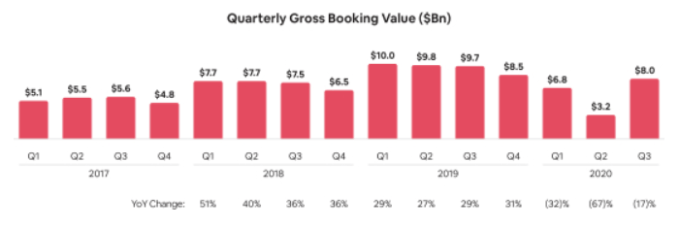
Let’s start by looking at Airbnb’s gross bookings on a quarterly basis. The company defines gross bookings as “net of cancellations and alterations,” so these numbers are not artificially inflated.

Here’s the chart:

Where does the decline begin? Q1, as we’ll see when we dig into monthly data, but the above chart does a good job painting just how bad things got for Airbnb in growth terms as Q1 closed and Q2 kicked off.

As you can see, Airbnb’s second quarter gross bookings were its lowest in recent history; Q2 2020 put up the smallest bookings result since at least the first quarter of 2017. For a company that had done $10.0 billion in gross bookings in a single quarter just over a year before, the declines were catastrophic.

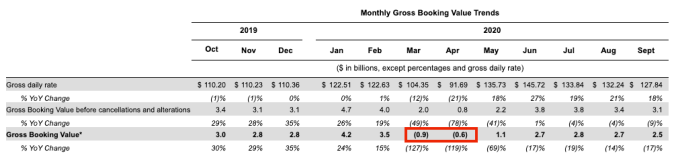
But the results are actually worse than that chart shows; Airbnb actually saw gross bookings go negative for a few months.

How is that possible? Recall that the gross bookings figure discounts cancellations and alterations. So, if Airbnb had a big wave of cancellations, its gross bookings number could fall so sharply it goes negative, even if the company were still seeing some new bookings.

That’s what happened in March and April. Observe:

So how far did Airbnb’s gross bookings fall? They fell to -$900 million in March. More simply, Airbnb saw its expected rental volume fall by nearly $1 billion in a single month. And then in April it fell by another $600 million as more cancellations piled up.

That’s why Airbnb cut staff and took on expensive capital; its business had gone from accreting to bleeding in no time at all.

How far have Airbnb’s bookings come back since?

News: Hey look, glow-in-the-dark PowerBeats

Now that Apple’s getting more serious about its own branded headphones, Beats have, perhaps, lost a little bit of luster within the company. The products are still wildly popular, of course, and the brand offers a lot more options than its parent. Powerbeats are one of the more utilitarian entries among the brand’s wireless offerings

Now that Apple’s getting more serious about its own branded headphones, Beats have, perhaps, lost a little bit of luster within the company. The products are still wildly popular, of course, and the brand offers a lot more options than its parent.

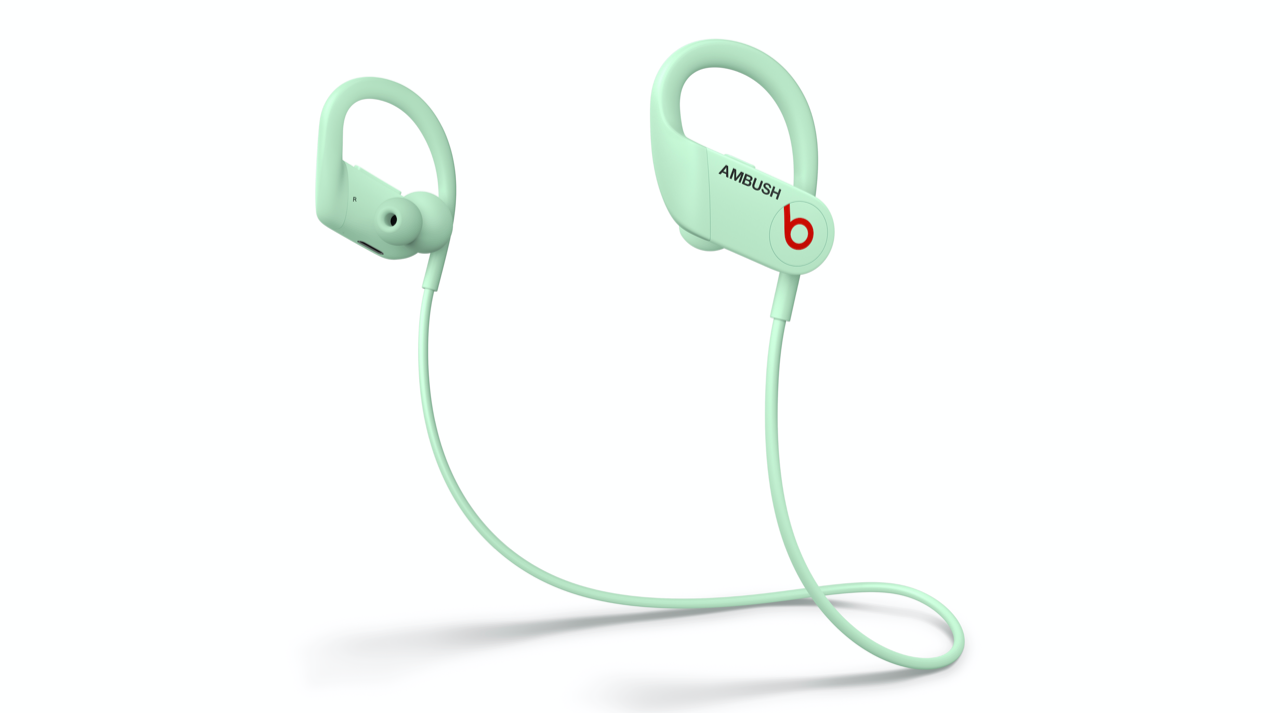
Powerbeats are one of the more utilitarian entries among the brand’s wireless offerings (though not quite to the extent of those new $50 models), trading the fully wireless form factor for a behind-the-neck cable and a lower price. Today Beats is offering a new special edition take on the product, launched a collaboration with the Ambush jewelry line and Nigerian singer, Burna Boy.

You’ve got your usual lineup of specs here: 15 hours of battery, sweat and water resistant design and Apple’s H1 chip, et al. Most importantly, though, they’re the first glow-in-the dark product from Beats. And hey, we could all use a little commoditized magic in this dark and depressing world that too often amounts to a ceaseless and increasingly intense parade of pain and suffering, right?

Image Credits: Apple

Here’s Ambush cofounder Yoon Ahn’s decidedly less defeatist take, ” “I thought it would be really cool to design a product that could capture that same city energy when you’re outside late at night listening to music.”

That way is nicer, I suppose.

Anyway, the limited edition comes at a bit of a premium at $200 (the standard Powerbeats are currently listed at $150). They’re available starting tomorrow.

News: Turo puts $1 million toward helping Black people make money sharing cars

Car sharing marketplace Turo has teamed up with Kiva to offer interest-free loans to Black people and folks from traditionally underserved communities to buy cars and then share them on Turo. The $1 million commitment aims to address the issue of wealth inequality in the United States. Called the Turo Seed Initiative, those who are

Car sharing marketplace Turo has teamed up with Kiva to offer interest-free loans to Black people and folks from traditionally underserved communities to buy cars and then share them on Turo. The $1 million commitment aims to address the issue of wealth inequality in the United States.

Called the Turo Seed Initiative, those who are eligible can raise up to $7,500 via crowdfunding small loans platform. In order to raise money on Kiva, folks must use the funding for business purposes, which includes car-sharing on Turo. Turo will then match whatever the person raises. From there, they can buy a car and list it on Turo.

“This will make it easier for people who don’t have existing assets or the right credit score or doesn’t own a car to be able to get started that way,” Turo CEO Andre Haddad told TechCrunch. “They borrow the money and only reimburse the capital.”

Throughout the program, Turo says it will also work with hosts to ensure they can be effective in sharing their cars on Turo. In terms of repayment, Turo has a one-month grace period before hosts must start repaying the funds over a period of 42 months.

The program is limited to Turo’s top 15 markets, which include San Francisco, Atlanta, Boston and Houston, in order to ensure that there’s enough to demand to make it worthwhile for hosts. On average, hosts earn around $600 per month by sharing their vehicles about 11 days per month. On top of that, hosts can also use their cars to drive for Uber or Lyft, or deliver for companies like DoorDash and GrubHub.

“We’re very confident that there is real profit to be made here,” Haddad said.

Turo has raised $467.4 million to date and competes against the likes of Getaround, Car2Go, ZipCar and others. In September, Turo says it saw 17%% year over year growth in revenue and is on track to deliver 20% year over year growth in October. In October, Getaround raised a $140 million Series E round to bring its total funding to $600 million. At the time, Getaround said its worldwide revenue had mroe than doubled from its pre-COVID baseline.

News: Facebook’s Messenger Kids app redesigned to look more like Messenger

Facebook today is rolling out an updated version of its Messenger Kids app with the goal of making it easier for kids to interact with their friends and family, navigate the app, and personalize their experience with features like custom chat bubble colors. The redesign also gives the kid-friendly app a look-and-feel that’s more like

Facebook today is rolling out an updated version of its Messenger Kids app with the goal of making it easier for kids to interact with their friends and family, navigate the app, and personalize their experience with features like custom chat bubble colors. The redesign also gives the kid-friendly app a look-and-feel that’s more like Messenger itself.

The updated app does away with the larger, colorful blocks that would flash when messages arrive for a more traditional messaging app design where chats are stacked in a vertical list. The child’s unread messages, now at the top of the inbox, are in bold with a blue dot next to them to call the eye’s attention. Media and message previews have also been added, too, allowing kids to more easily see updates for their conversations.

The redesign introduces new navigation with two dedicated “Chat” and “Explore” navigation tabs at the bottom of the screen, allowing for kids to switch between their conversations and the other in-app activities the app provides, like its mini-games

And with a new swipe gesture, kids can start a call from their inbox.

Finally, the update introduces a new option to personalize conversations, including both individual and group chats, with a custom chat bubble color.

Image Credits: Facebook

Facebook refers to the update as a “test,” but the changes here are not small tweaks to the layout, navigation or feature set — they’re a revamp. That makes it less likely that this is just some experiment that will later be rolled back based on user feedback. Instead, by referring to it as a test, Facebook gives itself more time before committing to a global rollout.

The company says the new features will first roll out to kids using iPhones in the U.S. and Canada. The update will later expand to other devices and markets in the months ahead.

The changes arrive shortly after Messenger itself received a significant update of its own, which included a visual makeover and new features, including support for chat themes, custom reactions, selfie stickers and vanish mode, in addition to support for cross-app communication with Instagram users. Those updates could have led to the Messenger Kids makeover as well, given there’s likely some underlying messaging infrastructure that’s shared here.

The Messenger Kids app has been steadily updated in the years since its launch, most recently with a big explainer on what Facebook is doing with all that data it’s collecting.

Image Credits: Facebook

Parents should be aware this app today collects a lot of personal information, including names, profile photos, demographic details (gender and birthday), a child’s connection to parents, contacts’ information (like most frequent contacts), app usage information, device attributes and unique identifiers, data from device settings (like time zones or access to camera and photos), network information and information provided from things like bug reports or feedback/contact forms. While some of this does allow the app to properly function, there’s also concern from some parents about how this data is really being used.

While the app does offer a suite of parental controls that make it easier for parents to monitor and restrict how and when their children chat online, Messenger Kids’ privacy policy still leaves itself a lot of wiggle room about how the data may be used to “evaluate, troubleshoot, improve, create, and develop our products” and be shared with other Facebook Companies. Parents should carefully weigh the risks of allowing their child to use a Facebook product with the conveniences of being able to use an app with a robust set of parental controls.

News: Mati reshapes online trust and reputation with a Plaid-like API

Meet Mati, a startup that recently raised a $13.5 million Series A round to build a digital reputation API that could change the way you interact with online services. Mati uses an API-first approach and lets users seamlessly share pieces of their legal identity. Investors in today’s funding round include Tribe Capital with Arjun Sethi

Meet Mati, a startup that recently raised a $13.5 million Series A round to build a digital reputation API that could change the way you interact with online services. Mati uses an API-first approach and lets users seamlessly share pieces of their legal identity.

Investors in today’s funding round include Tribe Capital with Arjun Sethi joining the board, Jerry Murdock from Insight Partners, Sima Gandhi who is the former head of business development and strategy at Plaid and Will Hockey, the CTO of Plaid.

Mati isn’t just an ID verification company with biometric checks. In many ways, Mati works a bit like Plaid, but not just for other types of data. When a company starts using Mati, they can verify various data points, such as residency, income and taxes.

Instead of taking a photography of important documents, Mati can help you connect to a government database or a utility provider to download and share data from those services directly.

“What we do is a digital reputation API that turns anonymous strangers into trustworthy users,” co-founder and CEO Filip Victor told me. And this kind of verifications are extremely important for fintech startups and companies operating in the so-called sharing economy industry.

Filip Victor himself has suffered in the past from poor reputation processes. As an immigrant in the U.S., he couldn’t verify himself on Airbnb. The issue is that most reputation services aren’t that flexible. You run into edge cases quite quickly when you’re an immigrant or you don’t have the right documents.

Mati has chosen to focus on high-growth regions, such as Latin America and South East Asia because they tend to be underserved when it comes to digital reputation. Clients include Te Creemos, Taptap Send and Tropipay.

“We went region by region, country by country and scraped into different databases. We gained access to things like social security access via the user,” Victor said.

Mati is thinking about other use cases beyond financial services and sharing economy startups. Many online services could benefit from some level of trust. By letting users choose what they want and don’t want to share, the company believes it has found the right balance between privacy and trust.

“Privacy is not about being anonymous or hidden. It’s about controlling your data,” Victor said.

For now, the company has managed to attract 200 customers. In the past year, Mati has tripled the number of customers. The startup now has 50 employees and plans to add another 20 employees with the Series A round.

Image Credits: Mati

News: Dropbox shifts business product focus to remote work with Spaces update

In a September interview at TechCrunch Disrupt, Dropbox co-founder and CEO Drew Houston talked about how the pandemic had forced the company to rethink what work means, and how his company is shifting with the new requirements of a work-from-home world. Today, the company announced broad changes to Dropbox Spaces, the product introduced last year,

In a September interview at TechCrunch Disrupt, Dropbox co-founder and CEO Drew Houston talked about how the pandemic had forced the company to rethink what work means, and how his company is shifting with the new requirements of a work-from-home world. Today, the company announced broad changes to Dropbox Spaces, the product introduced last year, to make it a collaboration and project management tool designed with these new requirements in mind.

Dropbox president Timothy Young says that the company has always been about making it easy to access files wherever you happen to be and whatever device you happen to be on, whether that was in a consumer or business context. As the company has built out its business products over the last several years, that involved sharing content internally or externally. Today’s announcement is about helping teams plan and execute around the content you create with a strong project focus.

“Now what we’re basically trying to do is really help distributed teams stay organized, collaborate together and keep moving along, but also do so in a really secure way and support IT, administrators and companies with some features around that as well, while staying true to Dropbox principles,” Young said.

This involves updating Spaces to be a full-fledged project management tool designed with a distributed workforce in mind. Spaces connects to other tools like your calendar, people directory, project management software — and of course files. You can create a project, add people and files, then set up a timeline and assign and track tasks, In addition, you can access meetings directly from Spaces and communicate with team members, who can be inside or outside the company.

Houston suggested a product like this could be coming in his September interview when he said:

“Back in March we started thinking about this, and how [the rapid shift to distributed work] just kind of happened. It wasn’t really designed. What if you did design it? How would you design this experience to be really great? And so starting in March we reoriented our whole product road map around distributed work,” he said.

Along these same lines, Young says the company itself plans to continue to be a remote first company even after the pandemic ends, and will continue to build tools to make it easier to collaborate and share information with that personal experience in mind.

Today’s announcement is a step in that direction. Dropbox Spaces has been in private beta and should be available at the beginning of next year.

News: GoodRx, Walgreens, CVS shares all down on Amazon’s Pharmacy news

Consumer healthcare stocks are plummeting this morning on news that Amazon has finally launched its integrated pharmacy service. Amazon launches Amazon Pharmacy, a delivery service for prescription medications The news, which could dramatically reshape the healthcare landscape by offering deep discounts on prescription medication and two-day delivery services for Amazon Prime customers, has already taken

Consumer healthcare stocks are plummeting this morning on news that Amazon has finally launched its integrated pharmacy service.

The news, which could dramatically reshape the healthcare landscape by offering deep discounts on prescription medication and two-day delivery services for Amazon Prime customers, has already taken a toll on the share price of companies like GoodRx, Walgreens, and CVS.

GoodRx was hit the hardest, with its shares slumping 19% in pre-market trading. Walgreens Boots Alliance was down nearly 10% before market open and CVS Health slid 7%.

Amazon has been steadily encroaching on pharmacy businesses in the same way the company has moved into grocery delivery and everyday consumer staples.

The convergence of food and pharmacy has been a decades-long evolution for mega-retailers on both sides of the divide — with grocers building out pharmacy services and pharmacies adding food to their shelves.

Since its acquisition of Pillpack in 2018, Amazon has been adding additional pharmaceutical and healthcare services. It launched its own over-the-counter drugs in 2019, and rolled out a healthcare network for its employees — Amazon Care for its workers in Seattle.

In August, Amazon launched its fitness tracker, Halo. The personal health and wellness monitoring and advice service includes a $64.99 wrist tracker and an application suite for monitoring health.

As TechCrunch noted, the service includes more than the standard health tracking gadget/app combo, by taking a comprehensive look at various measures of health, including body fat percentage, as measured at home with just your smartphone’s own camera and the Amazon Halo app.

Taken together, Amazon’s array of hardware, software, pharmacy services and healthcare network represents the most complete package of health services across industries.

It’s a powerful pitch to consumers, and one that could ultimately significantly drive down healthcare costs. And drive down the revenue of other pharmacies, which investors are not stoked to imagine.

News: Hover secures $60M for a 3D imaging platform used to assess and fix properties

The US property market has proven to be more resilient than you might have assumed it would be in the midst of a coronavirus pandemic, and today a startup that’s built a computer vision tool to help owners assess and fix those properties more easily is announcing a significant round of funding as it sees

The US property market has proven to be more resilient than you might have assumed it would be in the midst of a coronavirus pandemic, and today a startup that’s built a computer vision tool to help owners assess and fix those properties more easily is announcing a significant round of funding as it sees a surge of growth in usage.

Hover — which has built a platform that uses eight basic smartphone photos to patch together a 3D image of your home that can then be used by contractors, insurance companies and others to assess a repair, price out the job, and then order the parts to do the work — has raised $60 million in new funding.

The Series D values the company at $490 million post-money, and significantly, it included a number of strategic investors. Three of the biggest insurance companies in the US — Travelers, State Farm Ventures, and Nationwide — led the round, with building materials giant Standard Industries, and other unnamed building tech firms, also participating. Past financial backers Menlo Ventures, GV (formerly Google Ventures), and Alsop Louie Partners as well as new backer Guidewire Software were also in this round.

This funding takes the total raised by Hover to just over $142 million, and for some context on its valuation, it’s a significant jump compared to its last round, a Series C in 2019, when Hover was valued at $280 million (according to PitchBook data).

Today’s funding, that valuation jump, and the interest from insurance firms comes on the heels of huge growth for the company. A.J. Altman, Hover’s founder and CEO, tells me that in 2016 the startup was making some $1 million in revenues. This year, it’s expecting to hit “north of $70 million” in its annual run rate, with insurance companies and other big business partners accounting for the majority of its growth.

Hover was founded in 2011 and it first made its name with homeowners and the sole-trader and small business contractors working on their homes repairing roofs and fixing other parts of their structures. Its unique contribution to the market was a piece of software that bypassed a lot of the fragmented and hardest work involved in doing home repair by tying the whole process to the functions of a smartphone: its camera, and the use of apps.

In essence, it allowed anyone with an ordinary smartphone camera to snap several pictures of a space (up to 8), which could then be used to piece together a “structured” 3D image to better assess a job.

Those 3D images are not ordinary 3D pictures: they are dynamically encoded with information about materials, sizes and dimensions and other data critical to carrying out any work. A contractor using the Hover app could set up a system where these pictures, in turn, could be used to automatically create priced out quotes, with bills of material and timings for work, for their prospective clients. And these days, it also serves as an e-commerce portal for builders to order in the parts to carry out that work. (Hover now has around 35 patents on its tech, Altman said.)

The company has had a lot of traction in the market in part because of how it’s digitized an analogue process that had before it been firmly offline and lacking in transparency, in what is essentially a very fragmented market, with some 100,000 home repair firms in the US today.

“The home improvement segment one of the few that is not online,” Altman said. “For example, if I needed a new roof, it’s not that easy to just tell me what that would cost. The reason is because someone has to pull dozens of measurements off a house before costing that out, estimating the time it would take to fix and so on. Hover built a pipeline that turns photos into all of those answers.” It currently has about 10,000 contractors using its app, Altman said, so there is still a lot of growth in that segment.

Altman said that in its early days, the company had something of a hurdle convincing people of the usefulness of having an app that let even the homeowner take pictures of an issue on a property in order to start the process of finding someone to fix it. That’s because even in an age where DIY is pretty commonplace — and The Home Depot, incidentally, is also a previous backer — many builders see that role as theirs, not their clients.

That has changed a lot, especially in the last year in the age of a global health pandemic that has driven many to reduce social contacts to help contain the spread of the virus.

“Eliminating the need for on-site home visits is a huge deal, but we were spending a lot of time convincing some before Covid that this was a good idea,” he said. “The Covid experience — whether it involved an insurance carrier or contractor — didn’t like the idea of engaging a homeowner, asking them, to do that work.” That has shifted considerably, he said, with many now asking for this option.

Insurance is the fastest-growing segment of its business, Altman said, where insurers are integrating their apps with Hovers, sending out links to customers to snap pictures that then get automatically sent to the insurance app to make customers good on claims.

“It’s important to us that we provide our customers with the best possible experience, and HOVER’s technology helps us to do that by creating a simpler, faster and more transparent claims process,” said Nick Seminara, executive vice president and chief claims officer of Travelers, in a statement. “We see a tremendous opportunity for HOVER in the insurance industry, and we’re pleased to continue our partnership and invest in their future.”

Longer term, there are a number of areas where you could imagine Hover’s technology to apply. The company is already doing a lot of work in commercial buildings, and the next step is likely going to be expanding to more interior work, including home design and decor.

This is a huge market where you could see tech like this linking up with the likes of home sales firms, where companies are able to not just market a home, but potentially fixer-uppers with all the planning work set out for how to fix it up when you buy it; and also of course the extensive landscape of e-commerce businesses selling home furnishings, electronics and more.

Many of these, like Ikea and Houzz, have already put in a lot of investment into leveraging newer tech like Apple’s AR platform to improve their user experience, and so the appetite to take things to the next level is definitely there.

News: Astrobotic teams with Bosch and WiBotic to give its Moon rovers wireless charging and smarts to find power stations

Lunar exploration startup Astrobotic is working on developing ultra-fast wireless charging technology for its CubeRover shoebox-sized lunar robotic explorers. The project, which is funded by NASA’s Tipping Point program with a $5.8 million award, will tap Seattle-based wireless charging startup WiBotic for expertise in high-speed, short-range wireless power, and brings in Bosch to assist with

Lunar exploration startup Astrobotic is working on developing ultra-fast wireless charging technology for its CubeRover shoebox-sized lunar robotic explorers. The project, which is funded by NASA’s Tipping Point program with a $5.8 million award, will tap Seattle-based wireless charging startup WiBotic for expertise in high-speed, short-range wireless power, and brings in Bosch to assist with developing the AI-based data analysis that will help the robots find their way to docking stations for a wireless power-up.

Existing lunar rovers are typically powered by sunlight, but they’re actually very large (roughly car-sized or larger) and they have a lot of surface area to soak up rays via solar panels. Astrobotic’s rovers, which will initially be under five pounds in weight, won’t have much area to collect the sun’s power, and will instead have to rely on secondary power sources to keep enough energy for their exploratory operations.

That’s where WiBotic comes in. Working together with the University of Washington, the startup will be developing a “lightweight, ultra-fast proximity charging solution, compromised of a base station and power receiver” specifically for use in space-based applications. But finding these stations will be its own special challenge – particularly in a lunar context, where things like GPS don’t come into play. Instead, Bosch will leverage data collected from sensors on board the robot to generate a sensor-fusion result that can provide it with autonomous navigation capabilities. That work could be instrumental in helping future rovers navigate not only to power stations, but also to various destinations on the lunar surface as robotic science and exploration missions ramp up.

The goal is to have a demonstration rover charging system ready to show off sometime in 2023, and the partners will be working together with NASA’s Glenn Research Center to test the technology in the facility’s thermal vacuum chamber test lab.

News: Yeah, Apple’s M1 MacBook Pro is powerful, but it’s the battery life that will blow you away

Survival and strategy games are often played in stages. You have the early game where you’re learning the ropes, understanding systems. Then you have mid-game where you’re executing and gathering resources. The most fun part, for me, has always been the late mid-game where you’re in full control of your powers and skills and you’ve

Survival and strategy games are often played in stages. You have the early game where you’re learning the ropes, understanding systems. Then you have mid-game where you’re executing and gathering resources. The most fun part, for me, has always been the late mid-game where you’re in full control of your powers and skills and you’ve got resources to burn — where you execute on your master plan before the endgame gets hairy.

This is where Apple is in the game of power being played by the chip industry. And it’s about to be endgame for Intel. 

Apple has introduced three machines that use its new M1 system on a chip, based on over a decade’s worth of work designing its own processing units based on the ARM instructions set. These machines are capable, assured and powerful, but their greatest advancements come in the performance per watt category.

I personally tested the 13” M1 MacBook Pro and after extensive testing, it’s clear that this machine eclipses some of the most powerful Mac portables ever made in performance while simultaneously delivering 2x-3x the battery life at a minimum. 

These results are astounding, but they’re the product of that long early game that Apple has played with the A-series processors. Beginning in earnest in 2008 with the acquisition of PA Semiconductor, Apple has been working its way towards unraveling the features and capabilities of its devices from the product roadmaps of processor manufacturers.  

The M1 MacBook Pro runs smoothly, launching apps so quickly that they’re often open before your cursor leaves your dock. 

Video editing and rendering is super performant, only falling behind older machines when it leverages the GPU heavily. And even then only with powerful dedicated cards like the 5500M or VEGA II. 

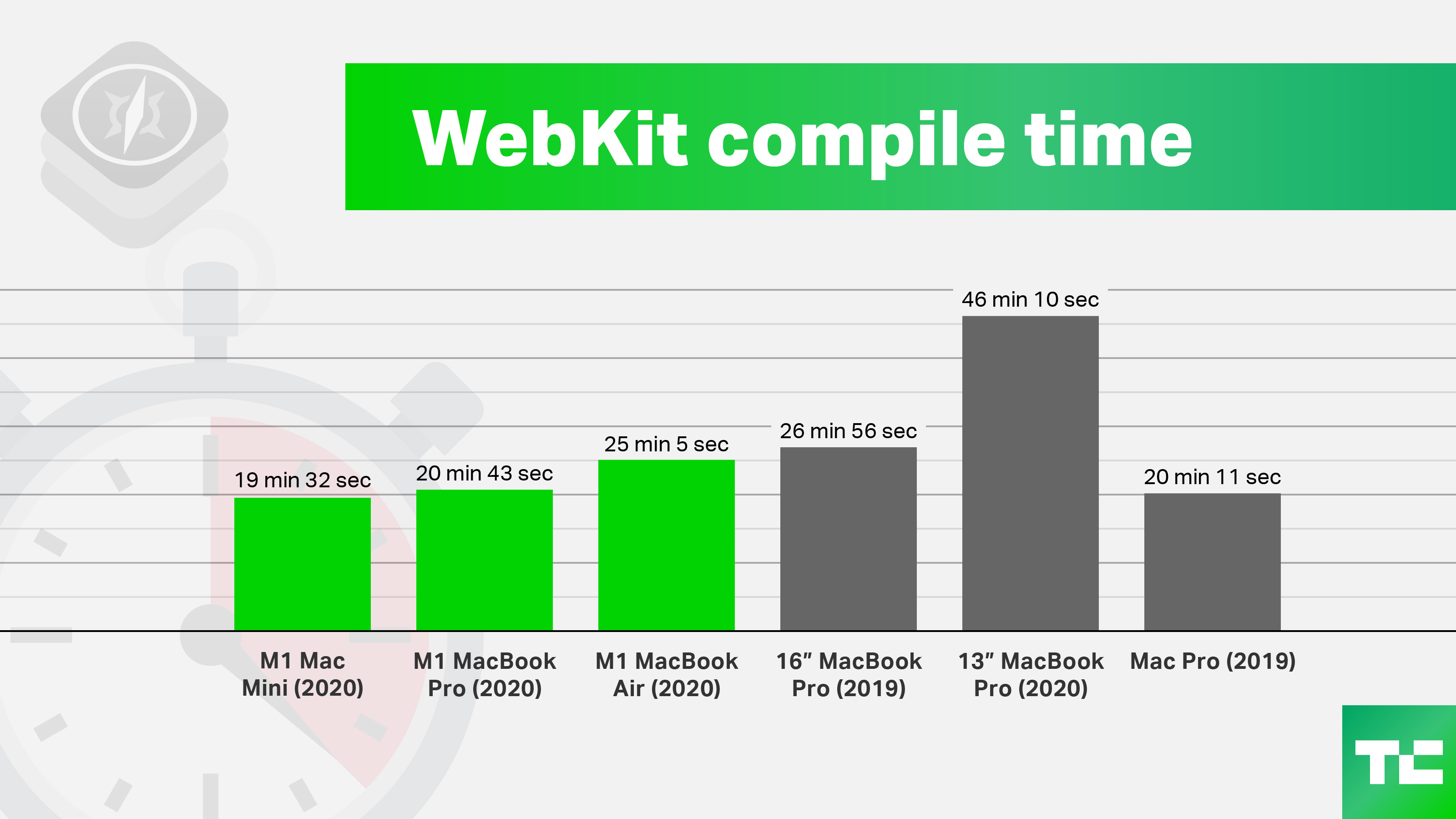
Compiling projects like WebKit produce better build times than nearly any machine (hell the M1 Mac Mini beats the Mac Pro by a few seconds). And it does it while using a fraction of the power. 

This thing works like an iPad. That’s the best way I can describe it succinctly. One illustration I have been using to describe what this will feel like to a user of current MacBooks is that of chronic pain. If you’ve ever dealt with ongoing pain from a condition or injury, and then had it be alleviated by medication, therapy or surgery, you know how the sudden relief feels. You’ve been carrying the load so long you didn’t know how heavy it was. That’s what moving to this M1 MacBook feels like after using other Macs. 

Every click is more responsive. Every interaction is immediate. It feels like an iOS device in all the best ways. 

At the chip level, it also is an iOS device. Which brings us to…

iOS on M1

The iOS experience on the M1 machines is…present. That’s the kindest thing I can say about it. Apps install from the App Store and run smoothly, without incident. Benchmarks run on iOS apps show that they perform natively with no overhead. I even ran an iOS-based graphics benchmark which showed just fine. 
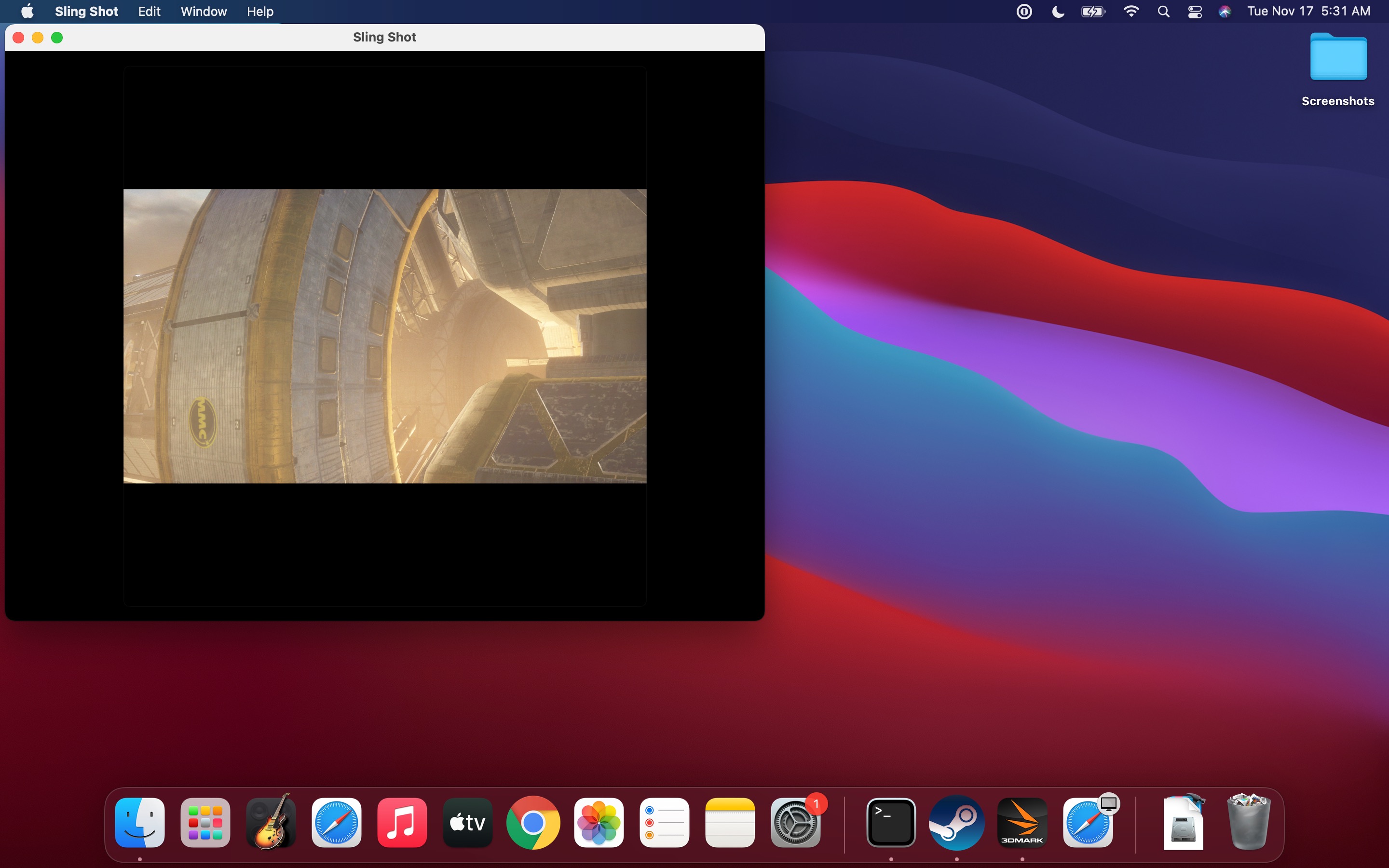
That, however, is where the compliments end. The current iOS app experience on an M1 machine running Big Sur is almost comical; it’s so silly. There is no default tool-tip that explains how to replicate common iOS interactions like swipe-from-edge — instead a badly formatted cheat sheet is buried in a menu. The apps launch and run in windows only. Yes, that’s right, no full-screen iOS apps at all. It’s super cool for a second to have instant native support for iOS on the Mac, but at the end of the day this is a marketing win, not a consumer experience win. 

Apple gets to say that the Mac now supports millions of iOS apps, but the fact is that the experience of using those apps on the M1 is sub-par. It will get better, I have no doubt. But the app experience on the M1 is pretty firmly in this order right now: Native M1 app>Rosetta 2 app>Catalyst app> iOS app. Provided that the Catalyst ports can be bothered to build in Mac-centric behaviors and interactions, of course. But it’s clear that iOS, though present, is clearly not where it needs to be on M1.

Rosetta 2

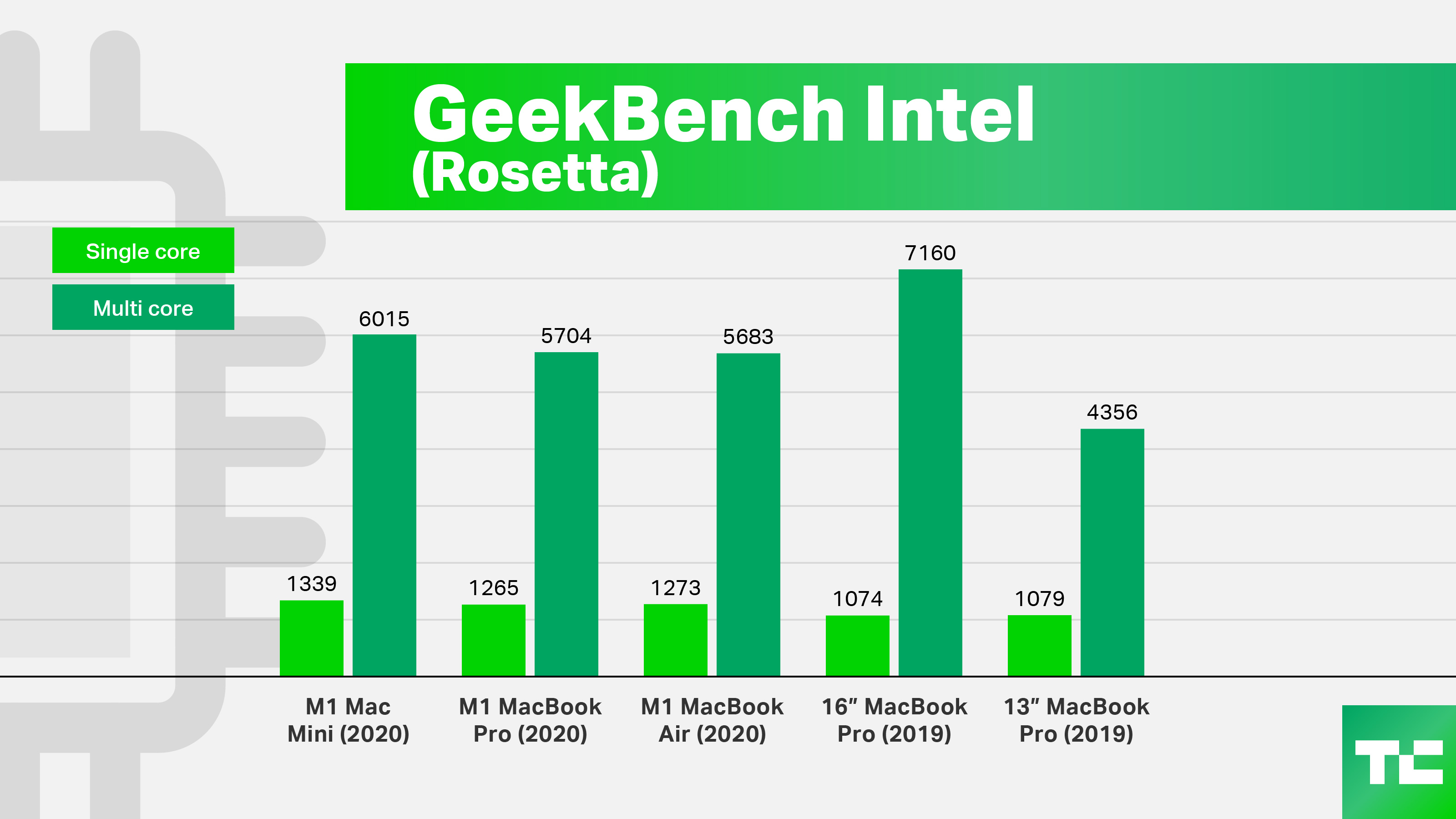
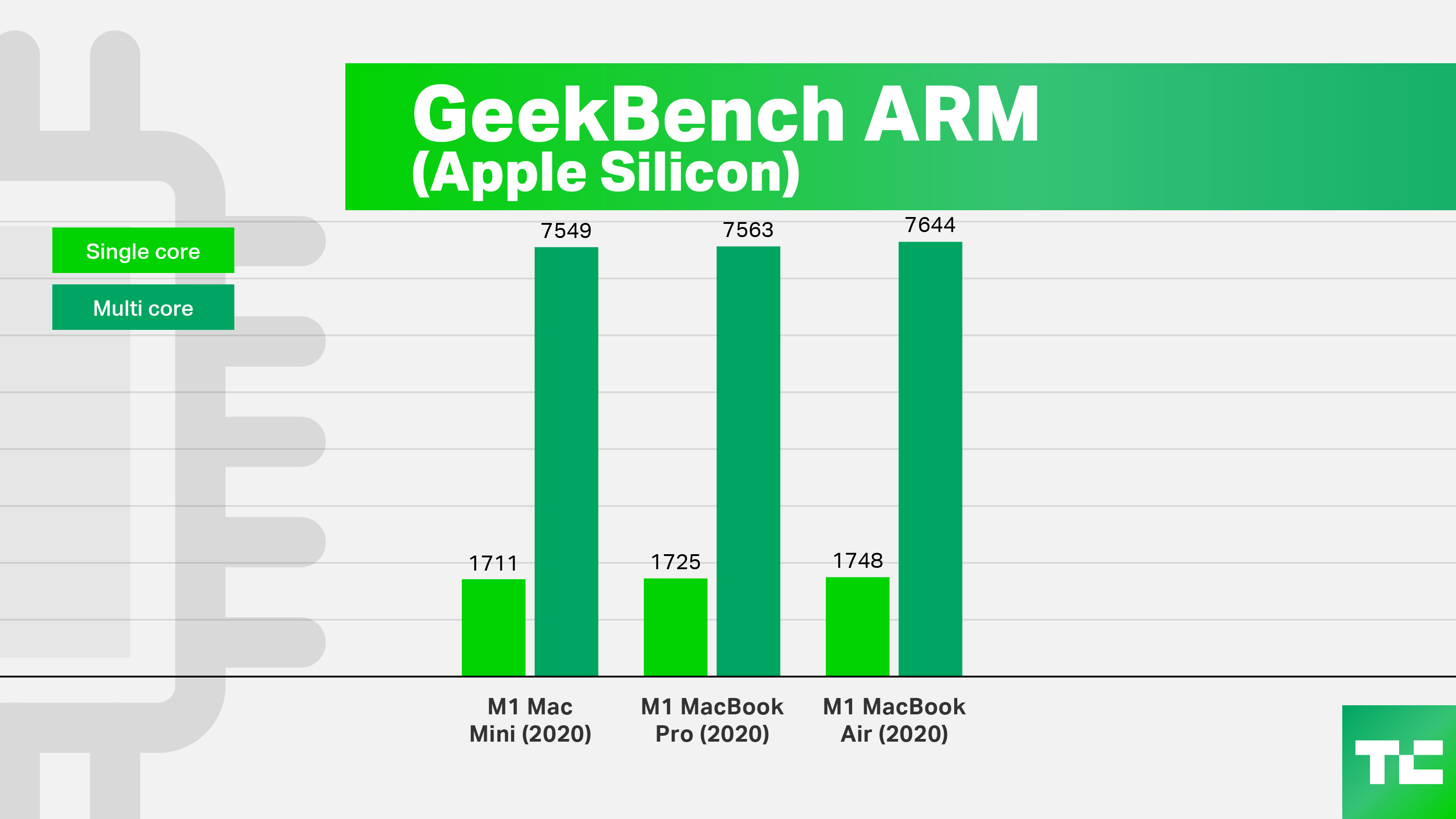
There is both a lot to say and not a lot to say about Rosetta 2. I’m sure we’ll get more detailed breakdowns of how Apple achieved what it has with this new emulation layer that makes x86 applications run fine on the M1 architecture. But the real nut of it is that it has managed to make a chip so powerful that it can take the approximate 26% hit (see the following charts) in raw power to translate apps and still make them run just as fast if not faster than MacBooks with Intel processors. 
It’s pretty astounding. Apple would like us to forget the original Rosetta from the PowerPC transition as much as we would all like to forget it. And I’m happy to say that this is pretty easy to do because I was unable to track any real performance hit when comparing it to older, even ‘more powerful on paper’ Macs like the 16” MacBook Pro. 

It’s just simply not a factor in most instances. And companies like Adobe and Microsoft are already hard at work bringing native M1 apps to the Mac, so the most needed productivity or creativity apps will essentially get a free performance bump of around 30% when they go native. But even now they’re just as fast. It’s a win-win situation. 

Methodology

My methodology  for my testing was pretty straightforward. I ran a battery of tests designed to push these laptops in ways that reflected both real world performance and tasks as well as synthetic benchmarks. I ran the benchmarks with the machines plugged in and then again on battery power to estimate constant performance as well as performance per watt. All tests were run multiple times with cooldown periods in between in order to try to achieve a solid baseline. 

Here are the machines I used for testing:

  • 2020 13” M1 MacBook Pro 8-core 16GB
  • 2019 16” Macbook Pro 8-core 2.4GHz 32GB w/5500M
  • 2019 13” MacBook Pro 4-core 2.8GHz 16GB
  • 2019 Mac Pro 12-Core 3.3GHz 48GB w/AMD Radeon Pro Vega II 32GB

Many of these benchmarks also include numbers from the M1 Mac mini review from Matt Burns and the M1 MacBook Air, tested by Brian Heater which you can check out here.

Compiling WebKit

Right up top I’m going to start off with the real ‘oh shit’ chart of this piece. I checked WebKit out from GitHub and ran a build on all of the machines with no parameters. This is the one deviation from the specs I mentioned above as my 13” had issues that I couldn’t figure out so I had some Internet friends help me

As you can see, the M1 performs admirably well across all models, with the MacBook and Mac Mini edging out the MacBook Air. This is a pretty straightforward way to visualize the difference in performance that can result in heavy tasks that last over 20 minutes, where the MacBook Air’s lack of active fan cooling throttles back the M1 a bit. Even with that throttling, the MacBook Air still beats everything here except for the very beefy MacBook Pro. 
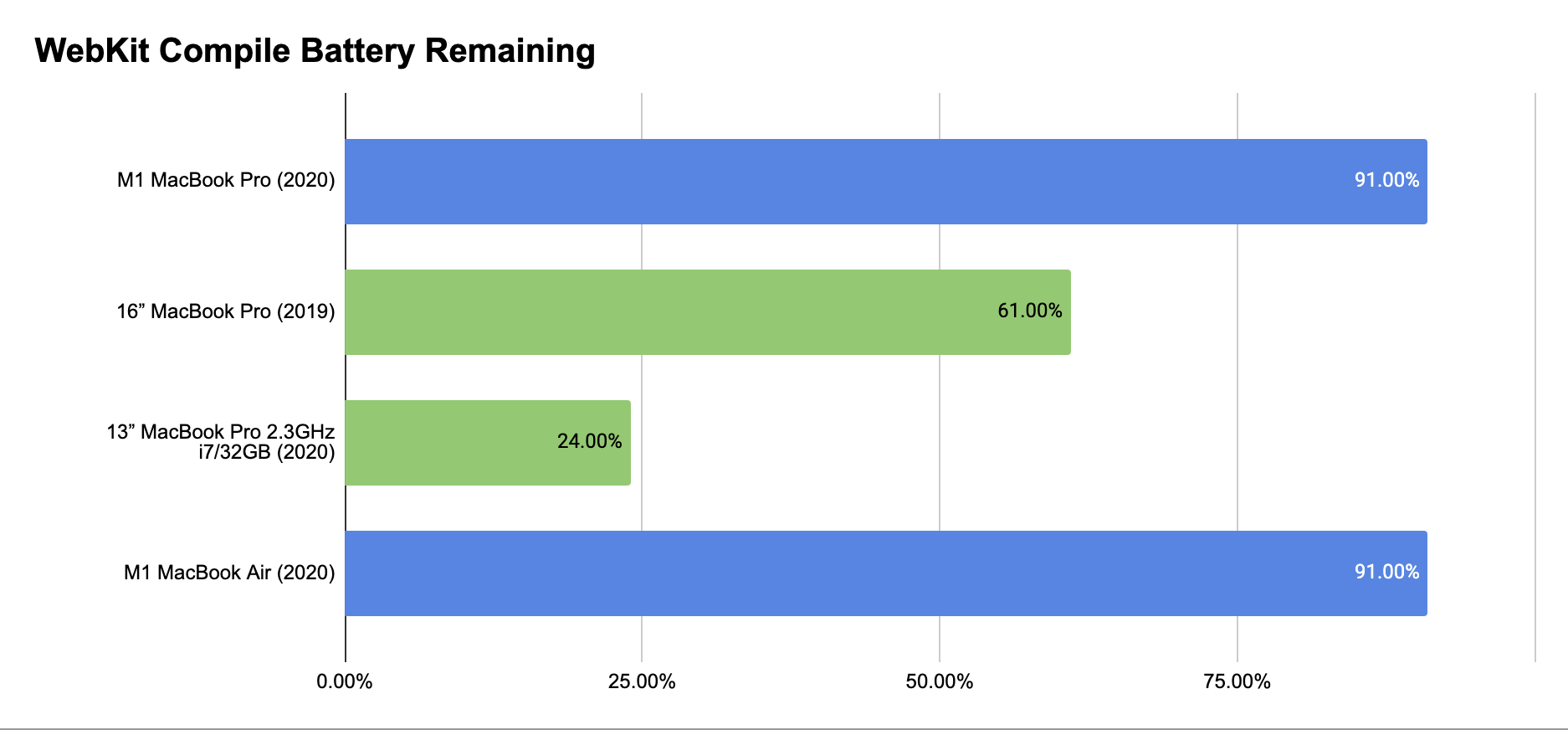
But, the big deal here is really this second chart. After a single build of WebKit, the M1 MacBook Pro had a massive 91% of its battery left. I tried multiple tests here and I could have easily run a full build of WebKit 8-9 times on one charge of the M1 MacBook’s battery. In comparison, I could have gotten through about 3 on the 16” and the 13” 2020 model only had one go in it. 

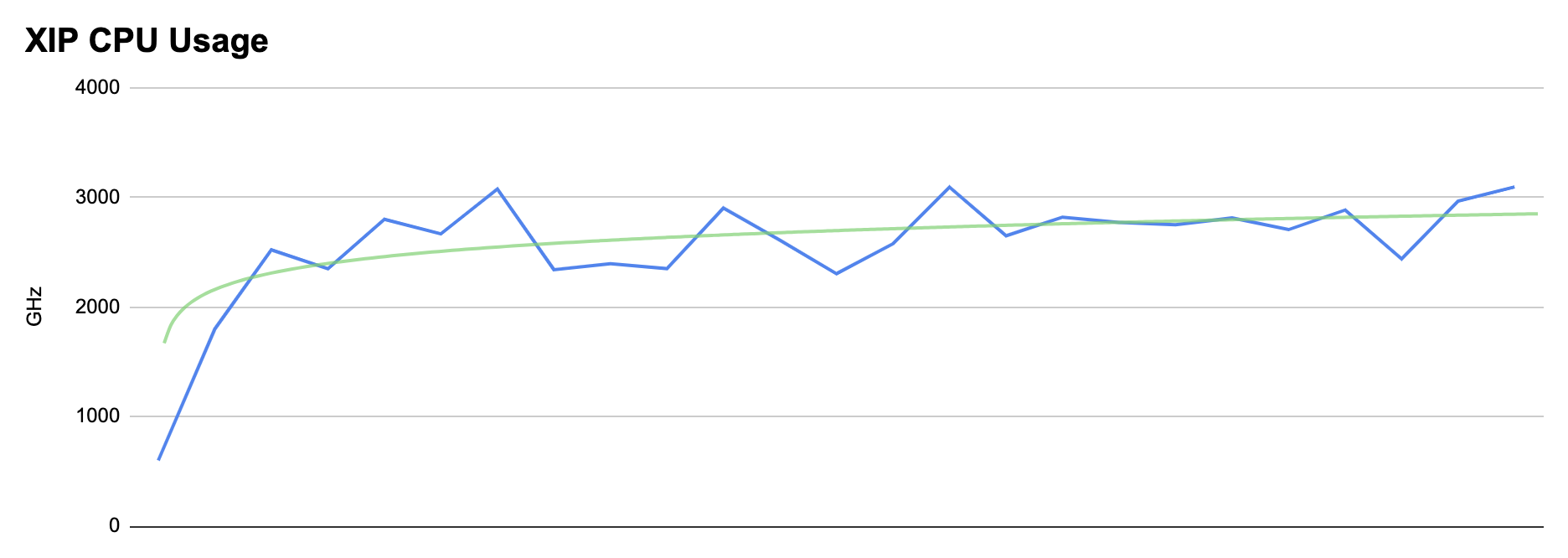
This insane performance per watt of power is the M1’s secret weapon. The battery performance is simply off the chart. Even with processor-bound tasks. To give you an idea, throughout this build of WebKit the P-cluster (the power cores) hit peak pretty much every cycle while the E-cluster (the efficiency cores) maintained a steady 2GHz. These things are going at it, but they’re super power efficient.

Battery Life

In addition to charting battery performance in some real world tests, I also ran a couple of dedicated battery tests. In some cases they ran so long I thought I had left it plugged in by mistake, it’s that good. 

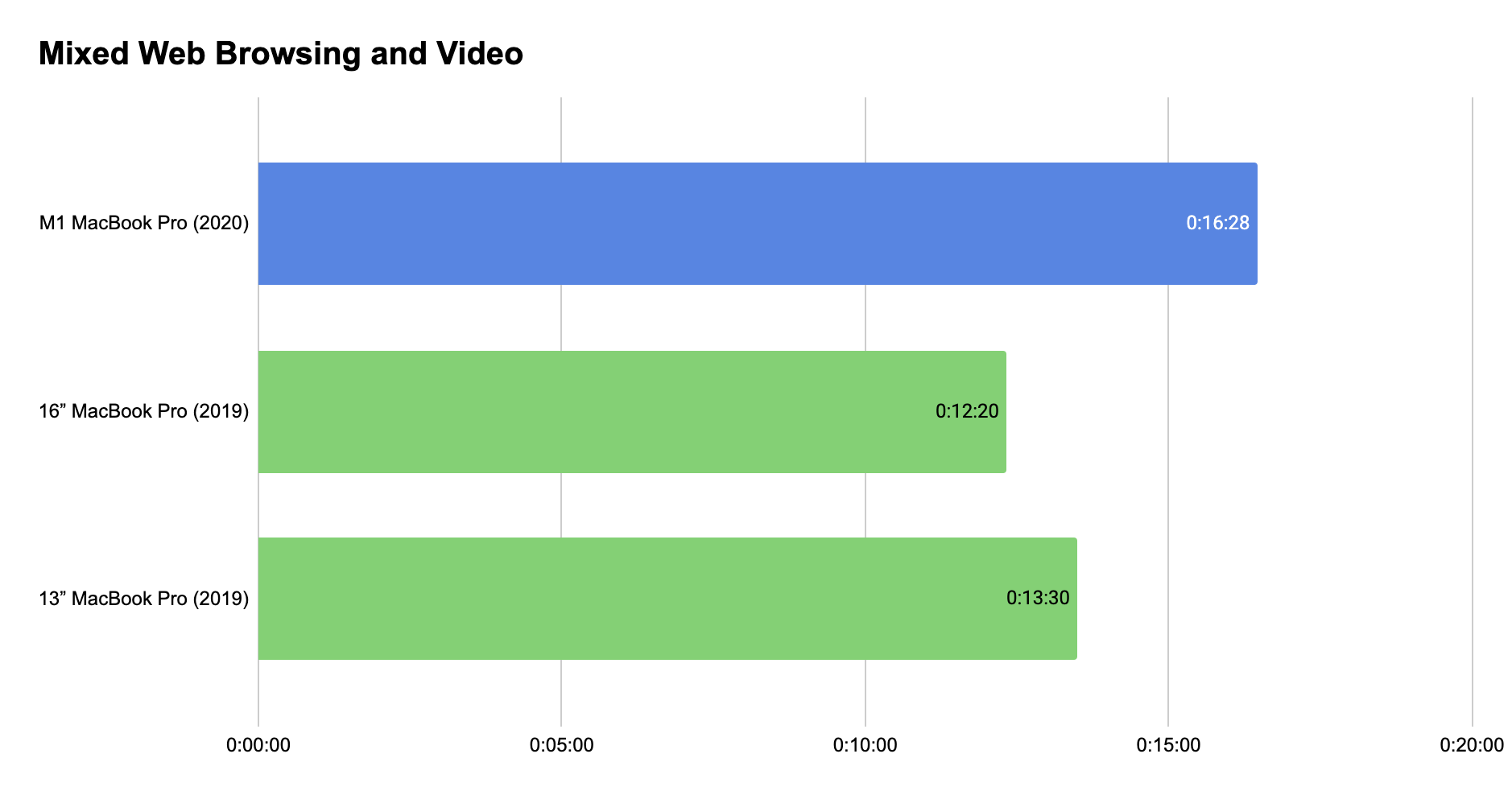
I ran a mixed web browsing and web video playback script that hit a series of pages, waited for 30 seconds and then moved on to simulate browsing. The results return a pretty common sight in our tests, with the M1 outperforming the other MacBooks by just over 25%.
In fullscreen 4k/60 video playback, the M1 fares even better, clocking an easy 20 hours with fixed 50% brightness. On an earlier test, I left the auto-adjust on and it crossed the 24 hour mark easily. Yeah, a full day. That’s an iOS-like milestone.
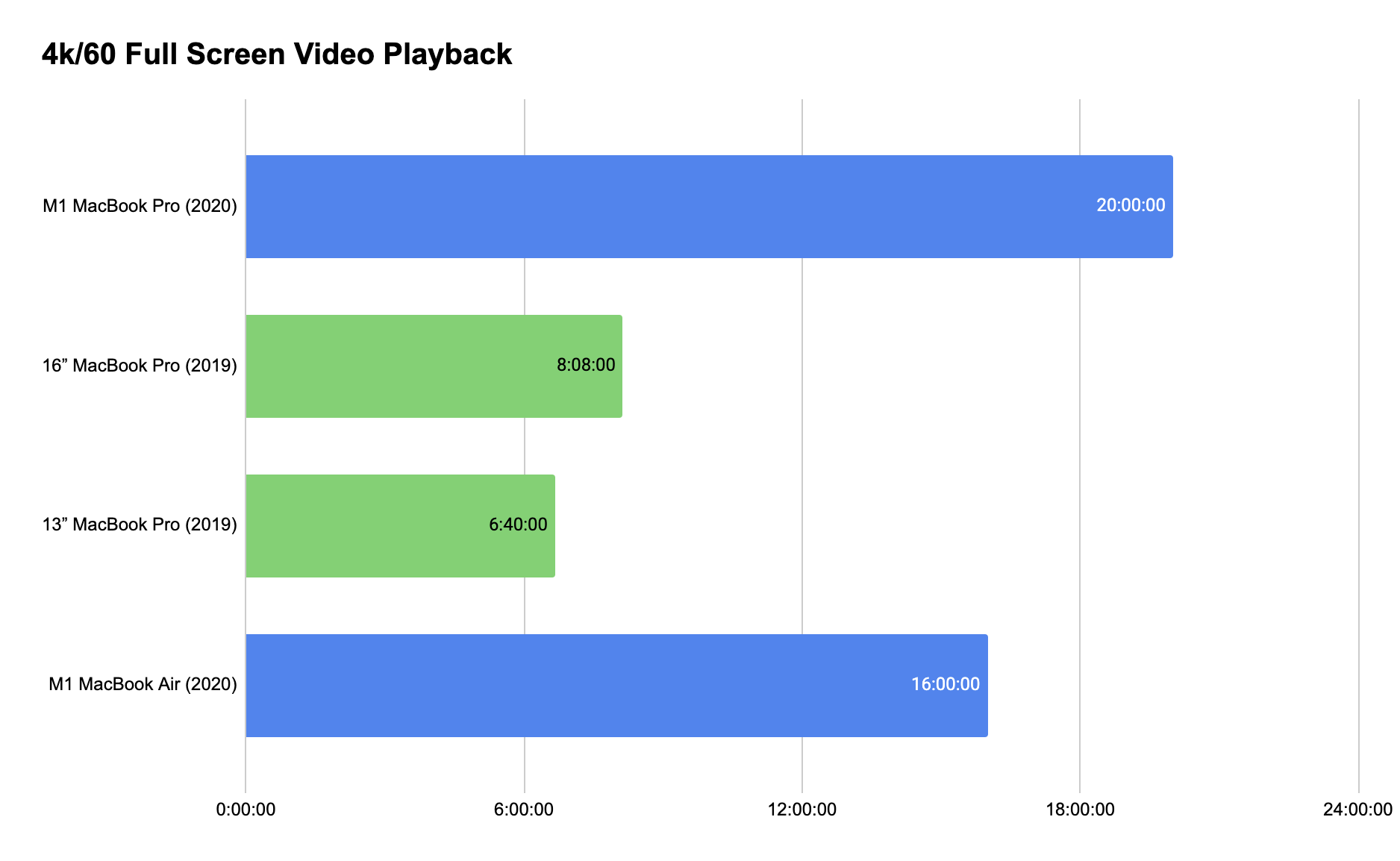
The M1 MacBook Air does very well also, but its smaller battery means a less playback time at 16 hours. Both of them absolutely decimated the earlier models.

Xcode Unzip

This was another developer-centric test that was requested. Once again, CPU bound, and the M1’s blew away any other system in my test group. Faster than the 8-core 16” MacBook Pro, wildly faster than the 13” MacBook Pro and yes, 2x as fast as the 2019 Mac Pro with its 3.3GHz Xeons. 
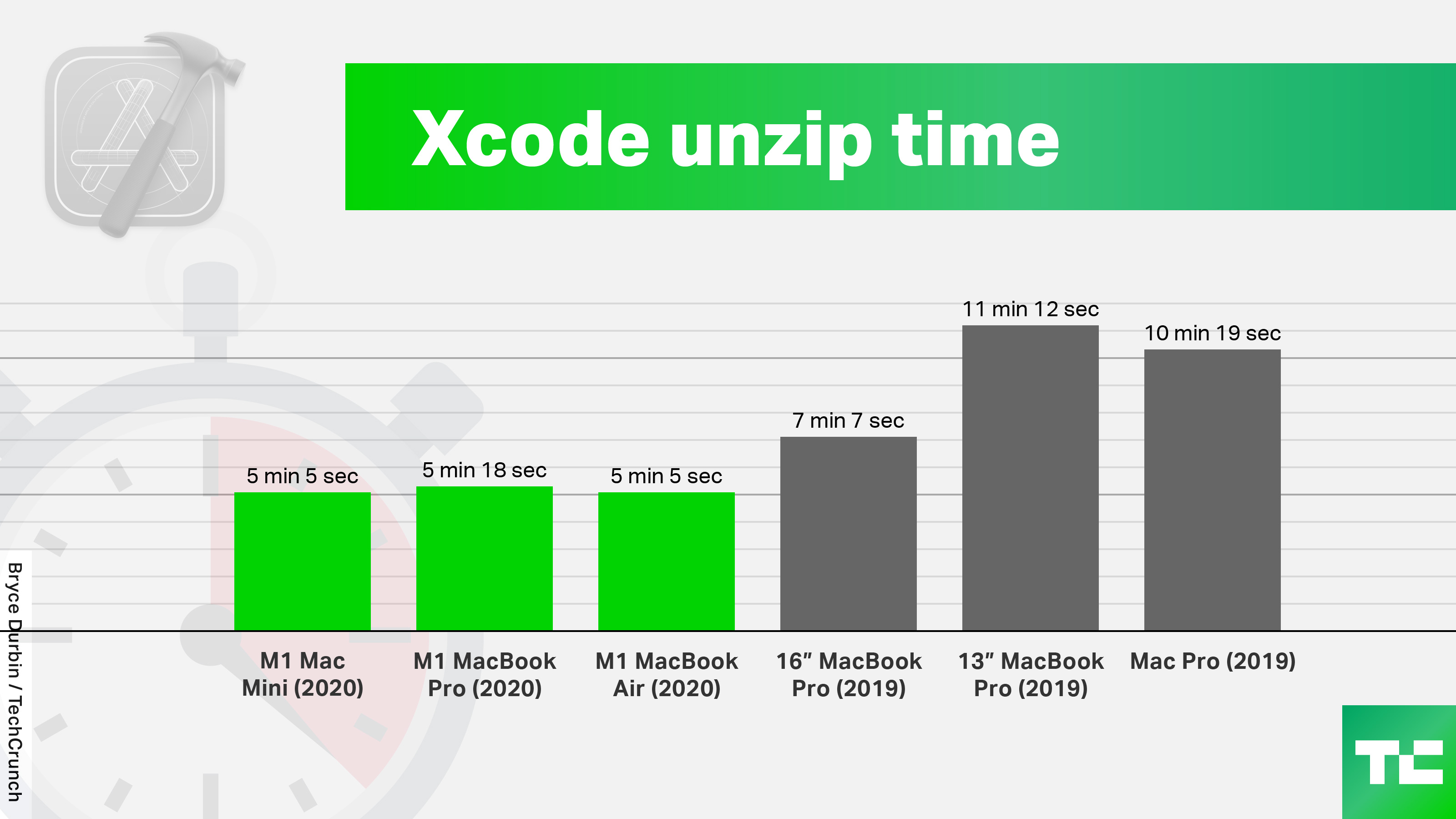
Image Credits: TechCrunch

For a look at the power curve (and to show that there is no throttling of the MacBook Pro over this period (I never found any throttling over longer periods by the way) here’s the usage curve.
Unified Memory and Disk Speed

Much ado has been made of Apple including only 16GB of memory on these first M1 machines. The fact of it, however, is that I have been unable to push them hard enough yet to feel any effect of this due to Apple’s move to unified memory architecture. Moving RAM to the SoC means no upgradeability — you’re stuck on 16GB forever. But it also means massively faster access 

If I was a betting man I’d say that this was an intermediate step to eliminating RAM altogether. It’s possible that a future (far future, this is the play for now) version of Apple’s M-series chips could end up supplying memory to each of the various chips from a vast pool that also serves as permanent storage. For now, though, what you’ve got is a finite, but blazing fast, pool of memory shared between the CPU cores, GPU and other SoC denizens like the Secure Enclave and Neural Engine. 

While running many applications simultaneously, the M1 performed extremely well. Because this new architecture is so close, with memory being a short hop away next door rather than out over a PCIE bus, swapping between applications was zero issue. Even while tasks were run in the background — beefy, data heavy tasks — the rest of the system stayed flowing.

Even when the memory pressure tab of Activity Monitor showed that OS X was using swap space, as it did from time to time, I noticed no slowdown in performance. 

Though I wasn’t able to trip it up I would guess that you would have to throw a single, extremely large file at this thing to get it to show any amount of struggle. 

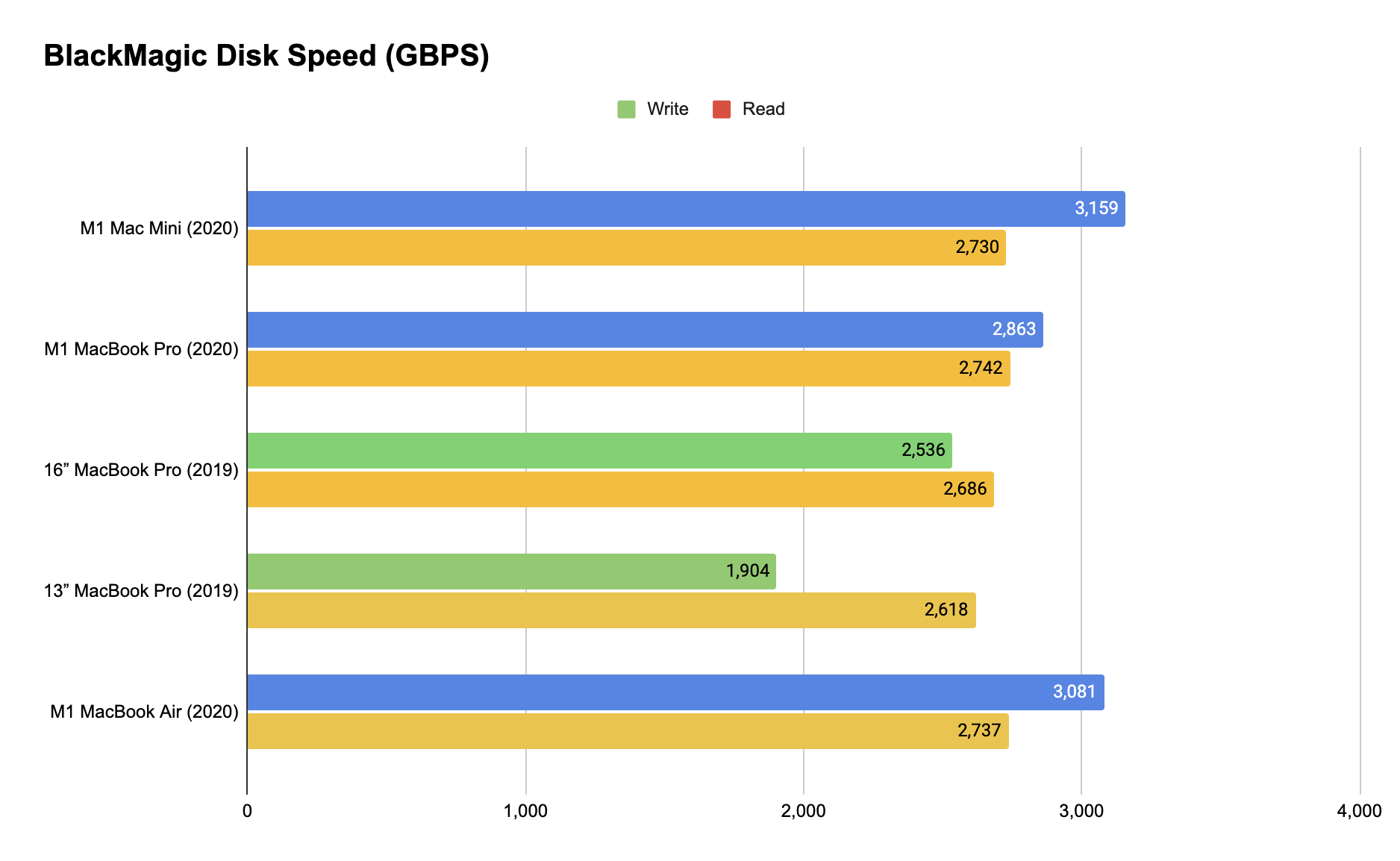
The SSD in the M1 MacBook Pro is running on a PCIE 3.0 bus, and its write and read speeds indicate that. 
 

Thunderbolt

The M1 MacBook Pro has two Thunderbolt controllers, one for each port. This means that you’re going to get full PCIE 4.0 speeds out of each and that it seems very likely that Apple could include up to 4 ports in the future without much change in architecture. 

This configuration also means that you can easily power an Apple Pro Display XDR and another monitor besides. I was unable to test two Apple Pro Display XDR monitors side-by-side.

Cooling and throttling

No matter how long the tests I ran were, I was never able to ascertain any throttling of the CPU on the M1 MacBook Pro. From our testing it was evident that in longer operations (20-40 minutes on up) it was possible to see the MacBook Air pulling back a bit over time. Not so with the Macbook Pro. 

Apple says that it has designed a new ‘cooling system’ in the M1 MacBook Pro, which holds up. There is a single fan but it is noticeably quieter than either of the other fans. In fact, I was never able to get the M1 much hotter than ‘warm’ and the fan ran at speeds that were much more similar to that of a water cooled rig than the turbo engine situation in the other MacBooks. 

Even running a long, intense Cinebench 23 session could not make the M1 MacBook get loud. Over the course of the mark running all high-performance cores regularly hit 3GHz and the efficiency cores hitting 2GHz. Despite that, it continued to run very cool and very quiet in comparison to other MacBooks. It’s the stealth bomber at the Harrier party.

In that Cinebench test you can see that it doubles the multi-core performance of last year’s 13” MacBook and even beats out the single-core performance of the 16” MacBook Pro. 
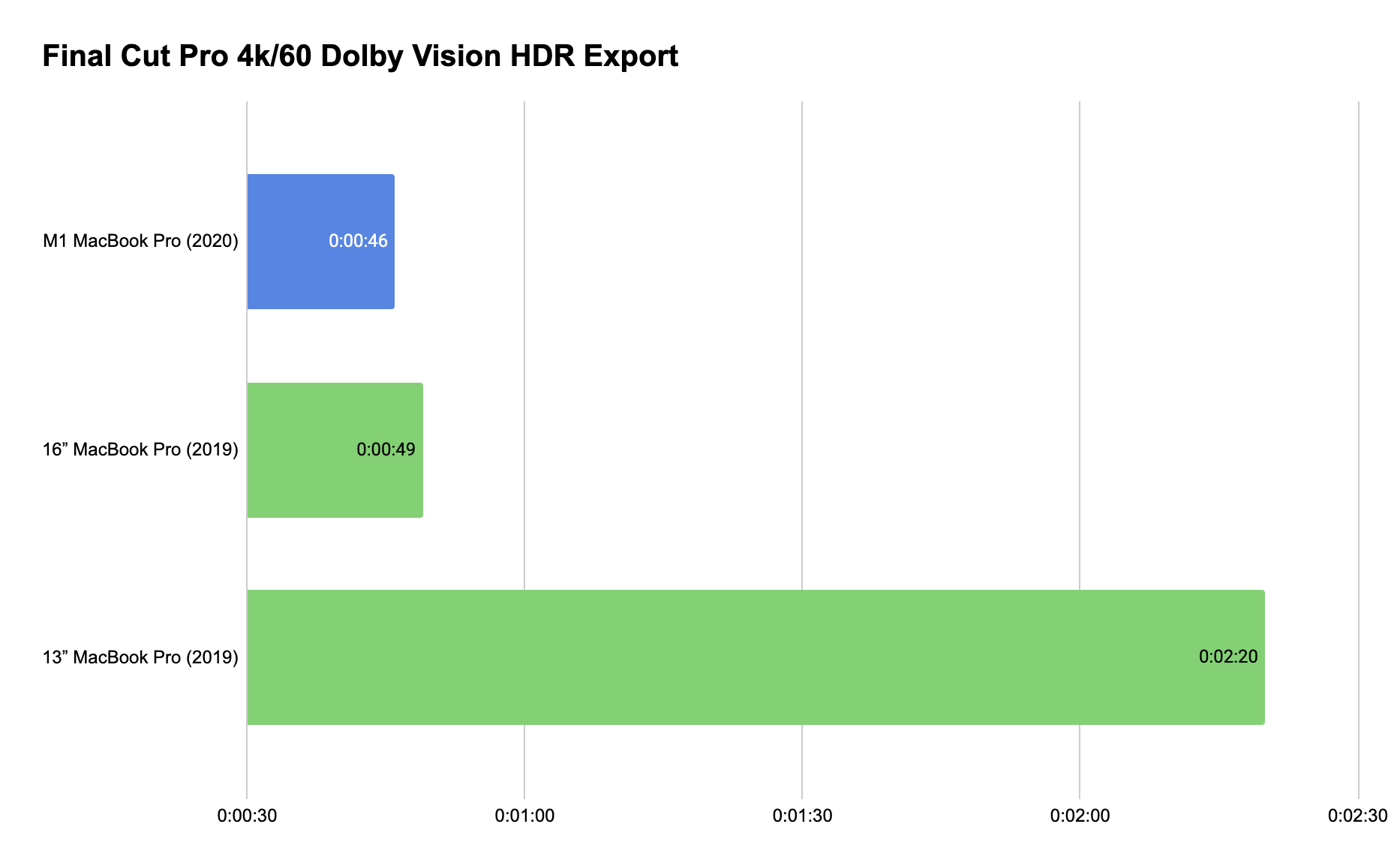
I ran a couple of Final Cut Pro tests with my test suite. First was a 5 minute 4k60 timeline shot with iPhone 12 Pro using audio, transitions, titles and color grading. The M1 Macbook performed fantastic, slightly beating out the 16” MacBook Pro. 


With an 8K timeline of the same duration, the 16” MacBook Pro with its Radeon 5500M was able to really shine with FCP’s GPU acceleration. The M1 held its own though, showing 3x faster speeds than the 13” MacBook Pro with its integrated graphics. 
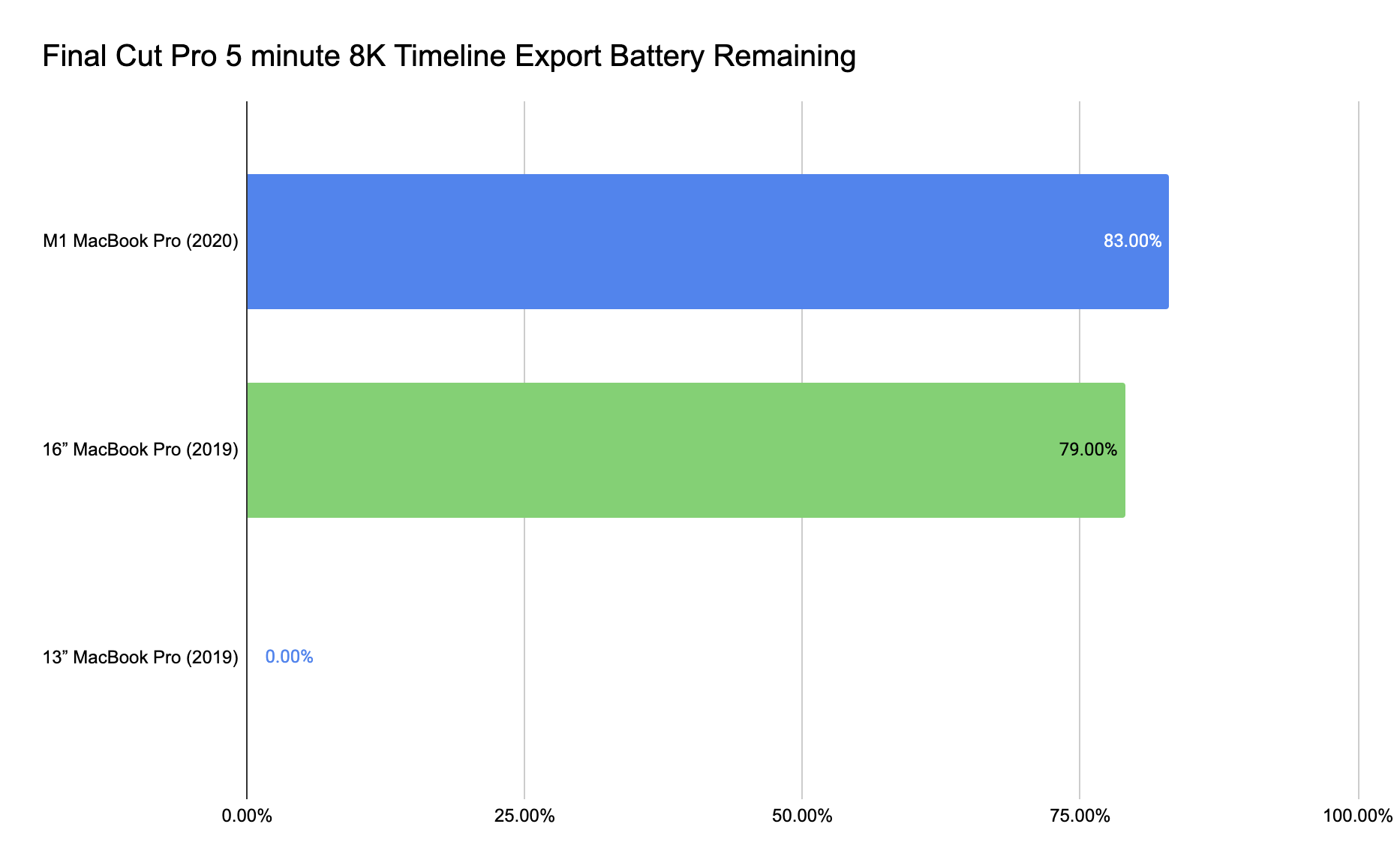
 

And, most impressively, the M1 MacBook Pro used extremely little power to do so. Just 17% of the battery to output an 81GB 8k render. The 13” MacBook Pro could not even finish this render on one battery charge. 

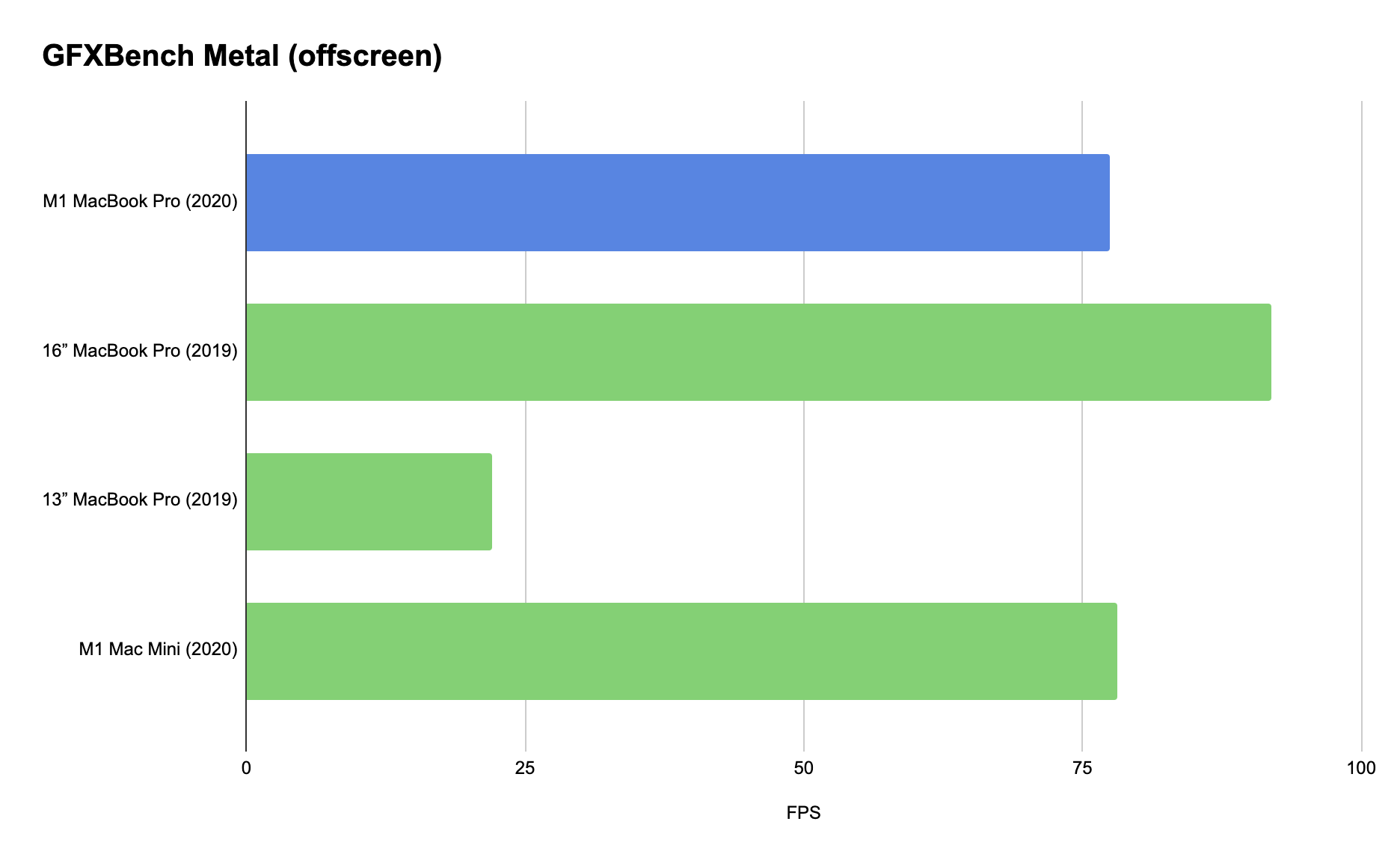
As you can see in these GFXBench charts, while the M1 MacBook Pro isn’t a powerhouse gaming laptop we still got some very surprising and impressive results in tests of the GPU when a rack of Metal tests were run on it. The 16″ MBP still has more raw power, but rendering games at retina is still very possible here.

The M1 is the future of CPU design

All too often over the years we’ve seen Mac releases hamstrung by the capabilities of the chips and chipsets that were being offered by Intel. Even as recently as the 16” MacBook Pro, Apple was stuck a generation or more behind. The writing was basically on the wall once the iPhone became such a massive hit that Apple began producing more chips than the entire rest of the computing industry combined. 

Apple has now shipped over 2 billion chips, a scale that makes Intel’s desktop business look like a luxury manufacturer. I think it was politic of Apple to not mention them by name during last week’s announcement, but it’s also clear that Intel’s days are numbered on the Mac and that their only saving grace for the rest of the industry is that Apple is incredibly unlikely to make chips for anyone else.

Years ago I wrote an article about the iPhone’s biggest flaw being that its performance per watt limited the new experiences that it was capable of delivering. People hated that piece but I was right. Apple has spent the last decade “fixing” its battery problem by continuing to carve out massive performance gains via its A-series chips all while maintaining essentially the same (or slightly better) battery life across the iPhone lineup. No miracle battery technology has appeared, so Apple went in the opposite direction, grinding away at the chip end of the stick.

What we’re seeing today is the result of Apple flipping the switch to bring all of that power efficiency to the Mac, a device with 5x the raw battery to work with. And those results are spectacular.


WordPress Image Lightbox Plugin