Yearly Archives: 2020

News: Bitcoin is rallying

Just in case you hadn’t heard, or are annoyed that folks aren’t writing about it: Bitcoin is rallying, up around 16% in the last week to a value of a little more than $18,000 as of this morning. Here’s a chart of its recent gains, via YCharts (note, it’s a tiny bit behind, so use

Just in case you hadn’t heard, or are annoyed that folks aren’t writing about it: Bitcoin is rallying, up around 16% in the last week to a value of a little more than $18,000 as of this morning.

Here’s a chart of its recent gains, via YCharts (note, it’s a tiny bit behind, so use the chart as a directional instead of absolute tool):

What else is there to say about the rally? We could note that bitcoin miner revenue remains far below its historical peaks, despite some recent gains. We could also point out that the aggregate value of all mined bitcoin in the wild is at an all-time high, per CoinMarketCap data.

The real upshot? Bitcoin is showing it has long-term staying power — even with all its historical volatility.

But not everything is perfect in the world of bitcoin. Looking around the crypto market, the DeFi boom looks mostly based on the ethereum chain, for example, so bitcoin isn’t catching the same developer-and-demand updraft that the rival cryptocurrency is currently enjoying. And I still don’t know what people are using bitcoin for other than hoping to get rich.

And some are, look at those gains! But not that many. The famous cryptocurrency doesn’t appear to be growing much in terms of unique usage.

Anyway, here’s a post about bitcoin being worth a little more than $18,000. That’s a lot! Well done hodlers.

News: Astroscale sets March 2021 for first commercial orbital debris removal demonstration

Japanese startup Astroscale is aiming for March 2021 for a launch of its first-ever active orbital debris removal mission. This demonstration of its technology, which it hopes to use to help ensure that low-Earth orbit becomes a sustainable environment for commercial activity as it becomes increasingly crowded thanks to the rapid pace of new spacecraft

Japanese startup Astroscale is aiming for March 2021 for a launch of its first-ever active orbital debris removal mission. This demonstration of its technology, which it hopes to use to help ensure that low-Earth orbit becomes a sustainable environment for commercial activity as it becomes increasingly crowded thanks to the rapid pace of new spacecraft launches.

This demonstration mission, which is called the “End-of-Life Services by Astroscale-demonstration” (ELSA-d for short) will take off from Kazakhstan, launched via a Russian Soyuz rocket. The actual demonstration itself will see Astroscale’s payload, which includes both a ‘servicer’ (which represents the actual debris removal component) and a ‘client’ (which represents any potential satellite or space junk that Astroscale might eventually be tasked with removing).

The servicer unit will use magnets to ‘capture’ the client, docking with it multiple times to show its efficacy, while the client remains stationary and while it emulates an end-over-end tumbling motion that is common for a lot of defunct orbital debris. The purpose of the mission is to show that Astroscale’s technology for seeking out and finding targets for removal, as well as proper target identity verification and docking/release procedures all work as the startup intended.

Low-Earth orbit space junk removal is half of Astroscale’s approach to making space more sustainable for commercial and research activities – the other is on-orbit servicing of geostationary satellites, which tend to be larger and more expensive and occupy an orbital band deeper out in space. The company recently acquired assets of an Israeli company focused on that endeavor in order to bolster that parallel mission.

News: Arrival becomes latest electric vehicle startup to test the public markets with a SPAC

Arrival has gone from stealthy electric vehicle startup to prospective public company in a span of a year. The UK-based company, which operated in relative secrecy for several years until January when it announced a $110 million investment from Hyundai and Kia, said Wednesday it has agreed to merge with special purpose acquisition company CIIG

Arrival has gone from stealthy electric vehicle startup to prospective public company in a span of a year. The UK-based company, which operated in relative secrecy for several years until January when it announced a $110 million investment from Hyundai and Kia, said Wednesday it has agreed to merge with special purpose acquisition company CIIG Merger Corp.

Arrival was already considered one of the UK’s most valuable startups before Wednesday’s SPAC merger announcement.  This deal, which when completed will make Arrival a publicly traded company listed on the Nasdaq exchange, will push its valuation up to $5.4 billion. Arrival said it raised $400 million in private investment in public equity, or PIPE, from investors that included Fidelity Management & Research Company, Wellington Management, BNP Paribas Asset Management Energy Transition Fund and funds managed by BlackRock. Arrival will have about $660 million in cash proceeds.

Arrival’s aim is to produce electric vehicles that are competitive in price with traditional fossil fuel-powered vehicles and lower than other EVs. Arrival says its modular electric “skateboard” platform, which can be used on a range of different vehicle types, along with its use of microfactories set up near major cities are the key ingredients to its price competitive sauce.

The company already has working prototypes of two major vehicle lines — an electric bus and electric van. The plan is to have four vehicles in the market by 2023, Arrival Automotive CEO Mike Ableson said.

“We are building a strong order book for these products, including 10,000 electric vans from UPS with the additional option to order more thereafter,” Abelson said in an email to TechCrunch. “We are in the process of fitting out microfactories in the UK and the US to fulfill orders, with more in the pipeline.”

Going public via a SPAC will give Arrival the access to capital to achieve its “vision of reimagining the auto industry and accelerating the transition to zero emissions,” he said, noting that the company is now focused on executive and ramping up full production of vehicles with production of its buses starting in the fourth quarter 2021 and its vans in 2022.

“The capital raised from this transaction will go towards delivering on these plans and supercharging the business so we can continue to scale and fulfill the market potential,” Ableson said.

Arrival, which was founded and led by Denis Sverdlov, already has a considerable footprint and order book. Arrival says it has received $1.2 billion in orders. The company employs more than 1,200 people and has five engineering facilities and two microfactories, including its first U.S. location in Rock Hill, South Carolina.

What was the summer of the SPAC — a bevy of companies announcing mergers with publicly traded shell companies between June and mid-September — has extended into the fall. Dozens of companies, including those that have yet to generate revenue or launch a commercial product, have announced SPAC deals in the past few months. A growing number of them are companies in the capitally intensive transportation sector.

EV startups Canoo,  Fisker Inc., Lordstown Motors and Nikola Corp., eschewed the traditional path of becoming a public company.  ChargePoint as well as lidar companies Luminar and Velodyne have also merged, or in the process of merging, with SPACs. Even troubled electric automaker Faraday Future is seeking a SPAC deal.

Arrival, like its EV SPAC brethren, is keen to take advantage of the shift towards electrification. Arrival is homing in on the commercial vehicle market, which is quickening its pace of EV adoption thanks to increasingly strict emissions regulations and other public policy changes.

“Arrival believes that it is well positioned to capitalize on this market opportunity with its technology driven approach to a traditionally underserved market,” Abelson said.

The newly combined company will be listed on the Nasdaq under the new ticker symbol “ARVL.” The combined company will add Peter Cuneo, CIIG’s Chairman and CEO, as the non-executive chairman of Arrival’s board of directors.

News: The crowd goes wild for Yiming

This excerpt follows a high-growth period for Douyin, detailing how it gained around 200 million daily active users within a year via a loyal creator community, viral memes, algorithmic recommendation and aggressive ad spending.

There’s no shortage of TikTok coverage in the news today as the app’s fate in the U.S. hangs in the air.

What the press doesn’t always address is how TikTok gets here — how did a Chinese startup seize the lucrative short-video market in the West before Google and Facebook? What did it do differently from its Chinese predecessors who tried global expansion to little avail? Matthew Brennan’s new book “Attention Factory” set out to answer these questions by tracing ByteDance’s trajectory from an underdog despised by Chinese tech workers and investors to the envy of Silicon Valley and the target of the White House.

Matthew has spent years working closely with China’s tech firms, not only analyzing them but also using their products as a curious local, experiences that informed his meticulously researched and entertaining book. Interwoven with captivating anecdotes of TikTok, rare photos of ByteDance’s original team, incisive analysis and telling infographics, “Attention Factory” is an essential read for those looking to understand how ideas in the American and Chinese internet worlds collided, coincided and converged throughout the 2010s.

TikTok is a rare example of a Chinese internet service that has gained worldwide success. Before expanding overseas, ByteDance had already proven the short-video model in China through Douyin, the homegrown version of TikTok.

The excerpt below follows a high-growth period of Douyin, detailing how it gained around 200 million daily active users within a year: a loyal creator community, viral memes, algorithmic recommendation and aggressive ad spending.

Before long, the Chinese startup would replicate that growth playbook in the rest of the world, tweaking it here and there to make it work.


Hundreds of fashionably dressed young people were arriving at 751 D.PARK, an expanse of industrial plants redeveloped into a hip culture venue in northeast Beijing. They were clad in baseball caps, brightly colored dresses, loose-fitting hip-hop style streetwear and limited-edition sneakers. The site had been transformed into something akin to the stage of the talent competition “American Idol,” spanning two floors filled with strobe lighting, high-volume music and trendy backdrops. This was an exclusive party — three hundred top Douyin creators coming together to celebrate the app’s one-year anniversary.

The online stars, billed as the “new generation of internet celebrities,” weren’t there to just socialize and enjoy themselves. Every influencer was aware of the unspoken competition to derive the best content from that night. They were all fighting to achieve a higher level of superstardom and the medium of battle was short video.

The influencers who knew each other gathered in small groups as their assistants tirelessly captured fifteen-second videos of their carefully crafted skits. Loners roamed around the dance floor, absorbed in finding the ideal lighting for their lip-syncing selfie videos. Lesser-known influencers nervously approached more famous ones, proposing to record a dance together to potentially tap into their peers’ following. Loud hip-hop music kept playing in the background as creators hurried to touch up the videos they had just shot. Once the editing was done, they uploaded their works and anxiously waited for the app’s algorithms to judge who would grab more eyeballs.

Dance teams took to the stage to display their skills. The crowd bopped their heads back and forth as rappers attempted to impress with clever lyrics. Later as the hosts were midway through giving out awards, a wave of noise erupted from the back of the crowd interrupting the proceedings.

It was Yiming. Dressed in a black baseball cap and gray T-shirt and accompanied by Lidong. The audience went wild — the CEO had decided to drop in unannounced! Immediately he was bombarded with requests to take pictures and videos. As those around him whooped and cried out wildly, the entrepreneur simply smiled and kept his hands calmly by his side, an awkward 34-year-old engineer type among the hyper fashionable, mostly teenage hip-hop crowd.

Yiming and Lidong appear at a Douyin promotional event marking the app’s first anniversary in Sept 2017

Yiming and Lidong appear at a Douyin promotional event marking the app’s first anniversary in Sept 2017.

He already knew from looking at the data, but this was confirmation in the flesh — Douyin had built a robust community, with powerful momentum and was on the verge of doing something special.

The breakout

October 1st marks the beginning of “Golden Week,” a seven-day-long official Chinese national holiday. Periods like these are big opportunities for China’s internet industry. People’s behaviors change for a week; many find more time for entertainment and to try new things.

Over October, Douyin’s daily users doubled from seven to 14 million; two months later, they reached 30 million. Over those three months, the 30-day retention rates jumped from eight to over 20%, the average time spent in the app soared from 20 to 40 minutes. It was as if some magic rocket fuel had suddenly been added, boosting every key metric. What had changed?

The answer was Zhu Wenjia. Zhu Wenjia, hired from Baidu in 2015, was widely considered to be one of the top-three best people in the entire company when it came to algorithm technology. He ran one of ByteDance’s most capable engineering teams and had recently been assigned to work on Douyin. The team’s work harnessing the full power of ByteDance’s content recommendation back end led directly to the astounding October results.

The better the metrics, the more resources ByteDance placed behind the app as it now had good retention and was fast-tracked into becoming a strategically important product. Suddenly support was coming in from all over the company — people, money, user traffic, celebrity endorsements, brand collaborations, and most importantly, full integration and optimization of ByteDance’s powerful recommendation engine. Chinese stars with massive fan bases such as Yang Mi, Lu Han, Kris Wu, and Angelababy opened accounts, joining in publicity campaigns, and a nationwide “Douyin Party” event roadshow was planned. Douyin had become the hottest upcoming app in China.

ByteDance ramped up the investment in all three short-video products, including Douyin. People, resources and advertising budget were all raised, leading an industry insider to comment later: “The sudden rise of Douyin wasn’t without good cause. Yiming threw more money at this than anyone and dared to hunt down and grab the best people.”

Commercialization began with the first three brand ad campaigns paid for by Airbnb, Harbin Beer and Chevrolet. Douyin’s advertising business would soon make rapid progress. ByteDance already had hundreds of sales and marketing staff who would shortly be able to add Douyin’s advertisement inventory to their sales targets.

Yiming revealed in a later interview that the company had made it compulsory for everyone on the management team to make their own Douyin videos with goals to gain a certain number of likes or suffer forfeits such as doing push-ups. It wasn’t good enough to just look at charts and data; management needed to understand short videos from a creator’s perspective also. Yiming had watched Douyin videos for a long time but creating his own was “a big step for me,” he admitted.

Yiming’s personal Douyin account (3277469). Seventeen videos at the time of writing, including clips from his global travels

Yiming’s personal Douyin account (3277469). Seventeen videos at the time of writing, including clips from his global travels.

‘Oh well … karma’s a bitch’

The video opened to a young woman yawning, dressed in pajamas with messy morning hair. Wearing glasses and with no signs of makeup, she casually lip-syncs the line, “Oh well … karma’s a bitch” and throws a silk scarf into the air. Suddenly loud background music explosively begins. In an instant, she transforms into a glamorous fashion model, almost unrecognizable from a second before. A new meme had taken hold of Douyin.

“Karma’s a bitch” was a new version of the original “Don’t judge me” challenge that had propelled Musical.ly to top the U.S. app store three years earlier. The meme was another breakthrough for Douyin; People loved watching the shocking transformations. Compilations of the meme’s videos started popping up online. In particular, the makeup skills of some women left many men in disbelief. “Karma’s a bitch” left an impact on mainstream culture and gained widespread recognition and publicity, even making waves out into English language global media.

Douyin was also increasingly hypercharging the popularity of catchy pop songs with strong hooks. In late 2017, a track known as the “Ci-li-ci-li song” exploded on Douyin. The song’s catchy energy was undeniably infectious. Yet, it was the novel set of dance moves that had become associated with the track’s hook that turned the music into a meme and dramatically amplified its success.

The track had actually been released back in 2013 by Romanian reggae and dancehall artist Matteo, under the name “Panama.” Four years after its debut, the song’s unexpected and explosive spike in popularity led the singer to hastily organize an Asia tour to capitalize on his track’s sudden fame. A YouTube video shows him meeting Chinese fans at the Hangzhou airport who demonstrate their moves to him in the arrivals hall. With the dance having been created entirely in China, the bewildered artist finds himself in the awkward situation of not knowing how to follow the moves to the song for which he is famous.

Perhaps the most reliable indicator of the platform’s increasing influence on society was how the name, Douyin, had started to enter everyday colloquial vernacular, becoming synonymous with short video. The meaning of “Let’s shoot a Douyin!” needed no explanation.

Make it rain

ByteDance knew they now had a winning formula. Retention was good, word of mouth was excellent, a large, vibrant community of video creators had been fostered. The recommendation engine was doing its job of surfacing the best content. Douyin’s fire was already burning bright; now, it was time to pour gasoline on things and spend, spend, spend.

The holiday week of Chinese New Year is another unique annual opportunity for app promotions. Hundreds of millions travel home to be reunited with their families and find themselves with free time to relax. An entertainment app like Douyin was the perfect way to pass the time; word of mouth spread naturally between family members.

To step up its efforts further, Douyin directly gave out money to users by running a Chinese New Year “lucky money” campaign. Users could collect small cash amounts in special videos by tapping on the “red packet” icons — a digital manifestation of cash-filled envelopes people give to each other during the holiday. ByteDance also went all out, spending wildly, buying adverts and promotions across major online channels to acquire users, spending about 4 million yuan a day (over half a million dollars). The combination of all these effects sent Douyin to the top of the Chinese app store charts. Various reports stated Douyin’s daily users jumped from around 40 to 70 million over the February to March period covering Chinese New Year, with some of the top accounts seeing their follower numbers quadruple.
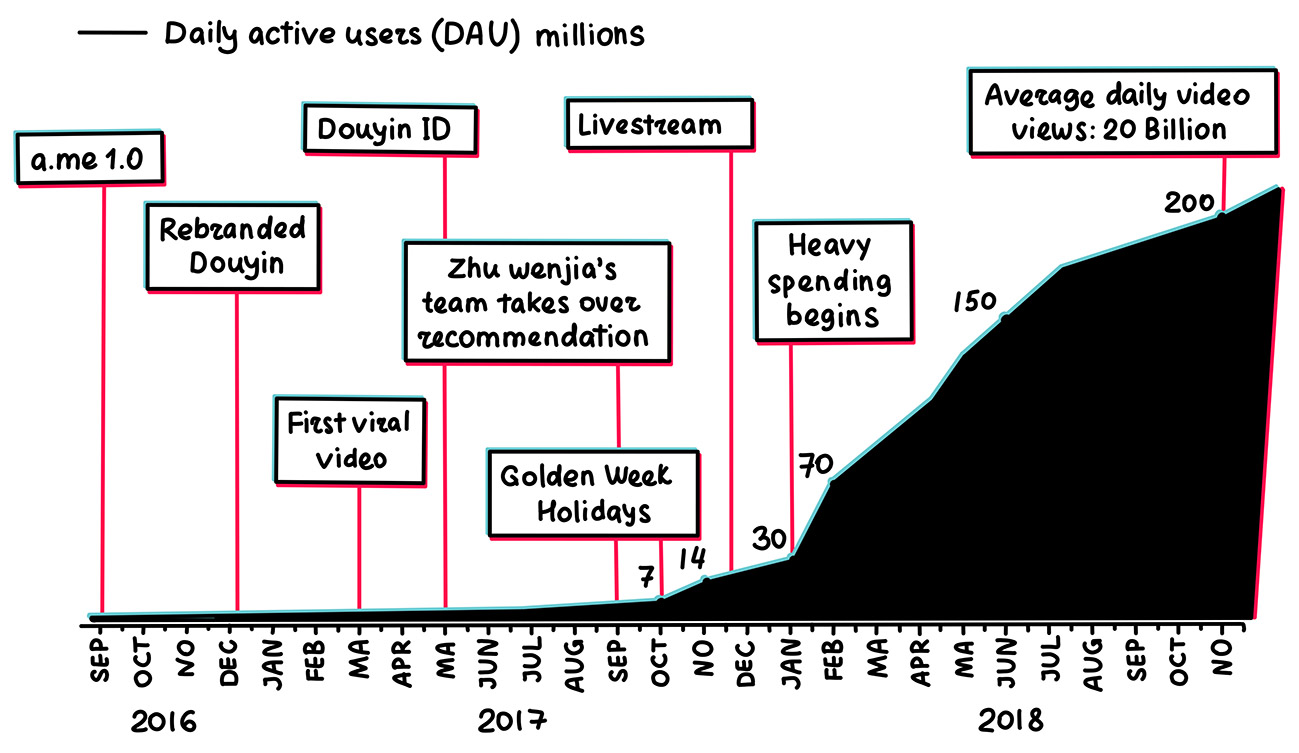
A chart mapping the progress of Douyin, from zero to 200 million daily active users, during the first two years of operation.

A chart mapping the progress of Douyin, from zero to 200 million daily active users, during the first two years of operation.


This article is an excerpt from “Attention Factory: The Story of TikTok and China’s ByteDance,” which was written by Matthew Brennan and edited by TechCrunch reporter Rita Liao, who wrote the introduction to this post.


News: Tapping into digital nomadism and ‘deep work’ trends, Skimlinks founder raises $1.5M for Flown

We already knew there was a big trend towards remote working, and this has only been drastically accelerated by the COVID-19 pandemic. At the same time, the distractions of daily life can easily impinge on the ‘deep work’ many need to get done when working on something important, like writing a book, or launching a

We already knew there was a big trend towards remote working, and this has only been drastically accelerated by the COVID-19 pandemic. At the same time, the distractions of daily life can easily impinge on the ‘deep work’ many need to get done when working on something important, like writing a book, or launching a company for instance. For many individuals and teams looking to get real, focused work done, the solution is often to book an Airbnb somewhere for several days. At the same time, they might look for a space that can also inspire their work and mindset.

This is in the ideal world of course. In practice, you will find the Airbnb’s wifi is terrible and it’s outside a building site. So today’s deep-workers and global digital nomads would probably be interested in a solution.

Into this scenario arrives Flown, an online platform that will match knowledge workers with inspiring properties already setup for productive and ergonomic remote work, as well as providing an array of online tools and resources to help them.

Flown is essentially wrapping up the knowledge workers’ wish-list into one package. Think “Airbnb-meets-Calm as a service”.

The venture is being launched by serial entrepreneur Alicia Navarro, who has emerged from a hiatus following the acquisition of Skimlinks in May this year.

Flown has now closed a $1.5 million pre-seed investment round from several noted and prolific angels and entrepreneurs including Taavet Hinrikus (Transferwise), Greg Marsh (OneFineStay), James Meekings (Funding Circle) and Pete Cashmore (Mashable) – with a third of the fundraise also coming from female investors.

The funding will be used to build out the Flown platform ahead of its formal launch in the UK and Portugal, onboarding new properties and hiring a team, which already includes hires drawn from hotel group Mr & Mrs Smith, Ometria, Quill, McKinsey’s Generation, and Resi.

Navarro says she was inspired to create Flown after stepping back from Skimlinks in 2018, following 11 years at the helm.

Navarro said: “After leaving Skimlinks, I thought I’d have tons of time to write, think and ideate. Unfortunately, it was impossible to find spaces to do this: co-working spaces were too distracting, cafes weren’t ergonomic, and I needed a break from working from home. Plus, not being part of a team any longer meant I was often lonely, and struggled to get into the right mental space for thinking creatively or productively.”

After traveling around Europe to find places to work she became frustrated at how difficult it was to find workable remote working locations.

She may well be pushing at an open door. There are now estimated to be over one billion knowledge workers globally, and it’s the fastest-growing sector of the global economy.

Flown will consist of two products:

Flown Away: A highly curated list of homes, hotels and retreat spaces that are fully equipped for distraction-free, ergonomic and productive remote working. From a ‘cabin in the woods’ to a countryside cottage equipped with whiteboard and display screen. It will also include inspiring locations such as those where famous writers have worked.

Flown Here: An online platform of resources and interactive tools to help workers establish more effective ‘deep work’ rituals – from virtual accountability groups to ‘perception-shifting creative challenges’. (“Deep work” is a concept popularized in Cal Newport’s book of the same name. It describes a state of focused, distraction-free concentration, where people do their most creative and productive thinking and working).

The attraction to property owners is being able to rent locations midweek and off-season, offering hosts demand on their traditionally lower occupancy periods. This will also allow hosts to diversify their revenues away from the leisure market, and access a more resilient source of demand.

Taavet Hinrikus from Transferwise commented: “I recognized that Flown has the potential to be a real driving force for the way we work, and for how the hospitality industry can adapt to become more resilient and diversified by accommodating knowledge workers, not just holiday-makers.”

Ahead of its launch in early 2021, Flown is offering £200 of credit to anyone who visits and joins the member waitlist or nominates a property.

News: Pfizer says its COVID-19 vaccine is 95% effective in final clinical trial results analysis

Drugmaker Pfizer has provided updated analysis around its COVID-19 vaccine Phase 3 clinical trial data, saying that in the final result of its analysis of the 44,000-participant trial, its COVID-19 vaccine candidate proved 95% percent effective. This is a better efficacy rate than Pfizer reported previously, when it announced a 90% effectiveness metric based on

Drugmaker Pfizer has provided updated analysis around its COVID-19 vaccine Phase 3 clinical trial data, saying that in the final result of its analysis of the 44,000-participant trial, its COVID-19 vaccine candidate proved 95% percent effective. This is a better efficacy rate than Pfizer reported previously, when it announced a 90% effectiveness metric based on preliminary analysis of the Phase 3 trial data.

This result also follows a preliminary data report from Moderna about their own Phase 3 trial of their vaccine candidate, which they reported showed 94.5% effectiveness. Pfizer and partner BioNTech’s vaccine is an mRNA-based preventative treatment, similar to the Moderna one, and now it looks like they should be roughly similar in efficacy – at least in the early offing, based on a limited sample of total cases and prior to peer review by the scientific community, which is yet to come.

The Pfizer data in its final analysis shows that among a total of 170 confirmed COVID-19 cases so far among the 44,000 people who took part in the study, 162 cases came from the placebo group while only eight were from the group of those who received the actual vaccine candidate. The company also reported that 9 out of 10 of the severe cases among those who were infected occurred in the placebo group, suggesting that even in the rare occasion that the vaccine didn’t prevent contraction of COVID-19, it helped reduce its severity.

This should help Pfizer make its case that it be granted an Emergency Use Authorization (EUA) from the U.S. Food and Drug Administration (FDA) to be able to provide the vaccine early pending full and final approval as an emergency measure. Earlier this week, the company reported that it has already collected two months’ worth of follow-up data about participants in its trial, which is a required component for said approval, and it’s pursuing it with hopes of achieving that EUA before year’s end. The company intends to ramp production of its vaccine beginning later this year, and achieving a run rate of up to 1.3 billion doses by next year.

News: Headway raises $26M to help people find therapists, and therapists to accept insurance

Mental health has taken a nosedive for many people this year — spurred by economic and political uncertainty, a Covid-19-fueled public health crisis, and being cooped up, among other things. In the U.S., a startup is today announcing some funding to make it easier for those who need it to find help. Headway, which helps

Mental health has taken a nosedive for many people this year — spurred by economic and political uncertainty, a Covid-19-fueled public health crisis, and being cooped up, among other things. In the U.S., a startup is today announcing some funding to make it easier for those who need it to find help.

Headway, which helps people search for and engage therapists who accept insurance for payments, is today announcing that it has raised $26 million, a Series A that it plans to use to expand the service to more cities and to widen the pool of therapists that it works with, as well as to invest in building out more technology to improve how its search and recommendation works.

The startup currently has some 1,800 therapists on its books in the New York area and says that tens of thousands of patients have used its service to find them and book appointments.

The funding is being co-led by Thrive and GV (formerly known as Google Ventures), and also includes participation from past investors Accel (which led its seed round), GFC and IA Ventures. The startup has now raised $33 million, and other previous investors include the founders of One Medical, Flatiron Health, and Clover Health. It’s not disclosing valuation with this round.

Headway has built a two-sided marketplace of sorts that taps into one of the biggest hurdles around how medical care works in the US: it favors big business over smaller operations.

People who are seeking out a therapist usually are looking for someone who they can trust and connect with to constructively and reassuringly work through problems they are facing. That can be a big challenge in itself — and Headway addresses that with a kind of “Yelp” style directory covering them. To note, the Yelp comparison only goes so far: there is no paid placement, just listings. That could be one reason why it caught the eye of a VC connected to the world’s biggest online search company.

But this isn’t the only issue patients face.

In many cases, therapists are sole traders, people who work for themselves, and they typically do not take insurance as payment.

The reason may have been originally partly traditional. Specifically, mental health therapy would not have been covered by insurance in the old days, and employees would not want to disclose issues to employers, who typically provide health insurance in the US, to push that paradigm. (This is rapidly changing, and in some industries it’s been turned into a deal sweetener, with extensive policies covering many other kind of therapies also included).

But the reason for lack of insurance coverage is also operational: the health insurance industry is geared around working with large hospitals and health organizations that have large teams of people on staff specifically to handle claims, process payments, and generally interface with the different parties.

Andrew Adams, the co-founder and CEO of Headway, said he came up against this very issue himself when moving to New York from California several years ago to take a job. He was looking for a therapist, but he found most unwilling to accept his insurance as payment, making getting therapy unaffordable.

“This is the defining problem in the space,” he in an interview. “Health insurance is built around a medical world dominated by billers and admins, but therapists are small practitioners and don’t have the bandwidth to handle that, so they don’t. So we thought if we could make it easier for them to, they would, and they have.”

Headway’s approach has been to build relationships with insurers and act as a kind of middleman/broker between them and a wide pool of therapists. It’s built software that helps those therapists — whose skills and expertise are in working with people and helping them manage their issues, not office and business admin — manage not just appointment booking but, critically, billing and all of the work that comes with that.

The business model is interesting here. Headway doesn’t charge patients for its search service, nor does it charge therapists. It takes a commission from the insurance providers, which pay it essentially for enabling wider access to more therapists (and billable work) for their policies.

Today, Headway’s focus is squarely on mental health, with “therapists” mostly being in categories like psychotherapy or psychiatry. But you could imagine how that might over time widen out to the multitude of other professional categories that also reach into complementary or completely different categories of therapies and are connected to a person’s well-being and mental health.

So, too, are there more opportunities for what Headway provides in the process.

Adams said that before the coronavirus pandemic, some 90% of meetings between patients and therapists were in-person. Now, “90% are virtual.”

While Headway is not providing the platform for those meetings to take place, it seems like an obvious step to provide therapists with the tools to do their customer-facing work alongside the tools it’s already providing to handle those relationships in the back office.

Similarly, while the search engine today can help people look for therapists based on some parameters like location, gender and age, you can imagine more being brought into that recommendation mix, where a person without a clear idea of what he or she wants can perhaps walk through a more detailed list to identify what to look for next.

Interestingly, Headway’s role may be no less important in environments where there may be multiple systems at work, for example in countries where the government provides some healthcare coverage, or all of it, or none at all.

“The complexity of dealing with insurance doesn’t get any harder or easier,” Adams said. “In fact, I’d say there is even more needed to deal with the complexity.”

News: Houseparty adds ‘Fortnite Mode,’ bringing video chat to the popular game

Epic acquired Houseparty way back in June of last year, following an absolutely massive $1.25 billion raise. It was clear why the Fortnite publisher would be interested in the social video app. After all, Fortnite is one of the most social games around. Now, after several months of global quarantining, the deal is finally bearing

Epic acquired Houseparty way back in June of last year, following an absolutely massive $1.25 billion raise. It was clear why the Fortnite publisher would be interested in the social video app. After all, Fortnite is one of the most social games around.

Now, after several months of global quarantining, the deal is finally bearing some fruit. Today Epic announced that the title is getting video chat via Houseparty integration. Starting today, the feature is available on a handful of platforms: PC and PlayStation 4 and 5.

Image Credits: Epic

Users will need to install Houseparty on an Android or iOS device and connect the app with their Epic Games account. From there, the video chat will be integrated into the game. Images are cropped tight on the player’s face and a virtual background is added, à la Zoom. Given the all-ages nature of the game, there are some additional safety features on board, including the ability for parents to toggle off the feature in Fortnite’s settings.

News: Apple to reduce App Store fees for small businesses with under $1 million in revenues

Amid increased regulatory scrutiny over how it runs its App Store, Apple today announced it will reduce the App Store commissions for smaller businesses. Under the new guidelines of the “App Store Small Business Program,” as it’s called, developers earning up to $1 million per year will only have to pay a 15% commission on

Amid increased regulatory scrutiny over how it runs its App Store, Apple today announced it will reduce the App Store commissions for smaller businesses. Under the new guidelines of the “App Store Small Business Program,” as it’s called, developers earning up to $1 million per year will only have to pay a 15% commission on in-app purchases, rather than the standard 30% commission.

The new program will launch on Jan. 1, 2021, and will be based on the business’s revenues in the previous calendar year — meaning 2020. This $1 million threshold will be based on how much existing developers made across all their applications on a post-commission basis, Apple notes. That means the businesses could actually earn up to $1.3 million in gross revenues. The reduced fee will also apply to new developers launching their apps for the first time.

If, during the course of the year, the developer’s apps surpass the $1 million threshold, they’ll be moved to the standard commission rate, generally 30%, for the remainder of the year. They’ll also then enter the following year at that standard rate, as well. Depending on the developers’ business, however, the “standard” rate may not always be 30%. For developers running an auto-renewing subscription business, for example, the standard commission drops to 15% in year two on a per-user basis, based on Apple’s existing guidelines. This will not change.

Developers can have their eligibility for the App Store Small Business Program reassessed on an annual basis going forward, Apple says.

Despite the lowered commissions, there are no planned changes to the services offered by the Apple Developer program as a whole. Smaller businesses will continue to have access to Apple’s development applications, like Xcode, its programming languages, like Swift, its secure payments interface, over 250,000 APIs, as well as new technologies like HealthKit, ARKit, CoreML and others.

Apple today has 1.8 million apps on its App Store, which reaches over 1.5 billion Apple devices across 175 countries worldwide. In 2019, the App Store facilitated $519 billion in commerce worldwide, with over 85% of that total accruing solely to third-party developers. Apple only commissions the smaller 15% of apps that sell digital goods and services through either in-app purchases or through paid application downloads.

While Apple didn’t provide an exact number of how many apps will be impacted by the new program, it did say that it believes the “vast majority” will qualify.

The company plans to announce further details about the eligibility process in December.

Given that a large number of developers could potentially qualify for the new reduced commissions, Apple’s bottom line within its growing Services business may be impacted.

In addition to the App Store, Apple’s Services business includes other subscription offerings, including AppleCare, Apple Music, Apple Pay, Apple TV+, Apple Music, Apple News+, and more. This business hit an all-time high of $14.5 billion in Apple’s fiscal Q4 2020. While the Services business has heavily leaned on the App Store in years past, Apple has more recently found ways to reduce its reliance on App Store fees. For example, the company recently launched Apple One, a family of subscription bundles that make it easier and more affordable for consumers to pay for Apple’s subscription services.

The changes to the commission structure follow a year that’s been particularly tough on small businesses due to the coronavirus pandemic and the resulting hit to the global economy. Meanwhile, Apple cracked down harder than ever in 2020 on developers skirting its rules over in-app purchases.

Apple’s demands for a 30% cut — which the company recently argued is comparable to other marketplaces of this nature — led it to do battle with its own developers over the course of 2020.

It rejected apps like Basecamp’s Hey from the the App Store for failing to offer support for in-app purchases, and it rejected apps that directed users to other ways to pay outside the App Store, like WordPress for iOS. It’s also now battling in court with Epic Games over the latter’s refusal to pay App Store commissions for its game Fortnite, which Apple yanked from the App Store. The growing chorus of discontent from the developer community, led to the creation of the Coalition for App Fairness, an advocacy group comprised of developers large and small fighting against what they perceive to be anti-competitive behavior from Apple and Google.

Apple’s battle with developers wasn’t limited to the fee structure itself. This year, the company oddly to burn developer goodwill in other ways, too, like when it announced iOS 14 would launch in less 24 hours, leaving developers unable to have their apps iOS 14-ready on day one.

And as the battles over App Store played out, Apple rolled out an increasingly complex set of rules around how apps can operate and when fees are assessed, under the guise of being developer-friendly. What’s actually developer-friendly, however, is what Apple is doing now: simply dropping the commission rate for smaller businesses.

“Small businesses are the backbone of our global economy and the beating heart of innovation and opportunity in communities around the world. We’re launching this program to help small business owners write the next chapter of creativity and prosperity on the App Store, and to build the kind of quality apps our customers love,” said Apple CEO Tim Cook, in a statement about the new program. “The App Store has been an engine of economic growth like none other, creating millions of new jobs and a pathway to entrepreneurship accessible to anyone with a great idea. Our new program carries that progress forward — helping developers fund their small businesses, take risks on new ideas, expand their teams, and continue to make apps that enrich people’s lives,” he said.

News: Tourlane adds another $20M at a $242M valuation to help it weather the Covid storm

The tourism and travel industry has been one of the hardest hit by the global Covid-19 health pandemic, and today a promising startup in the space announced some funding to help it weather the storm. Berlin-based Tourlane, which has built a platform that mimics the role of an in-person travel agent to plan and book

The tourism and travel industry has been one of the hardest hit by the global Covid-19 health pandemic, and today a promising startup in the space announced some funding to help it weather the storm. Berlin-based Tourlane, which has built a platform that mimics the role of an in-person travel agent to plan and book all aspects of multi-day trips for individuals and small groups, has raised $20 million, in what it describes as an extension to its 2019 Series C.

The money will be used to give Tourlane, in its own words, “financial stability; allowing the company to pursue its customer-centric vision of creating an end-to-end experience for booking unique individual trips based on advanced technology and travel expertise.”

From what we understand, the company has had a big drop in bookings as a result of the many bans on travel, reduced flight schedules and stay-at-home orders issued across different countries as they try to grapple with the coroanvirus outbreak: it’s currently at 20% the rate of bookings versus the same time last year.

The Series C had been $47 million originally — bringing the total now to $67 million — and was co-led by Sequoia Capital — itself making a bigger push into Europe at the moment — and Spark Capital. Those two VCs, along with other existing investors DN Capital, and HV Capital, and both founders, all participated in the extension. Tourlane has now raised over $100 million.

From what I understand the extension is happening at the same valuation — which according to PitchBook (and my sources) is around $242 million.

A press release announcing the extension did not include any metrics, but in addition to the allusion to financial stability, the undercurrent of the notice is one of just making sure the company has the resources to get through this, and potentially turn the situation into a positive for the company (however that may be possible).

“We deeply believe that this pandemic is an opportunity to rethink travel, and will be a catalyst for the Tourlane business model,” said Julian Stiefel, co-CEO & co-founder of Tourlane (the other co-founder and co-CEO is another Julian, Julian Weselek). “With this latest funding round, we are continuing to invest in our technology and product experience, while at the same time ensuring maximum flexibility for our customers.”

This is not too far outside of the bigger trend among other startups in the industry, and compared to some is a relatively good outcome. Indeed, Tourlane’s funding comes on the heels of a number of twists and turns in the wider category of startups focused on travel and tourism. Just this week, Airbnb filed its long-awaited IPO prospectus, which — while still a big deal — revealed huge drops in the company’s revenues in the wake of many people cancelling travel plans.

Others have not fared so well. Domio (another player in the accommodation space) is reportedly in the process of shutting down its business after raising well over $100 million. Trip Actions, Zeus Living and Sonder have all seen big layoffs. GetYourGuide, another Berlin-based travel startup, raised $133 million in the form of a convertible note as it looks to raise more money to get itself through the crisis.

At Tourlane specifically, in addition to the drop in the number of bookings currently, the startup has also been having a rocky year since the outbreak of the pandemic.

In March, the company saw a 30% higher surge of inbound customer service queries as people got in touch to cancel or rebook their trips. That meant not just a potential loss of revenue — Tourlane was issuing refunds even in cases where it had not been able to secure the refunds from suppliers yet itself — but a big operational cost to the company.

Before the pandemic the company had some 290 employees and had been on a growth tear. While it has made some layoffs — it has around 250-ish now — about half of the remaining employees are on a partial furlough scheme, where they are working only part time (part of a German government scheme, where it provides assistance to make up the difference).

There have been some brighter spots, too. In the summer, when there was a small amount of recovery in many places — so much so that we even started to see stories about group getaways amongst nomads who just couldn’t cool their itchy feet — companies like GetYourGuide, Airbnb and Tourlane saw an increase in activity.

Tourlane offers curated trip itineraries and bookings to some 50 destinations, and it said that in some places like Iceland — which found itself one of the few destination spots that didn’t see big outbreaks in Covid-19 cases — it was even seeing record bookings. Unfortunately, all that evaporates like so much geothermal steam when cases start to tick up again.

The hope now is that vaccines and their rollout will give people more confidence to travel again, and governments and other organizations the ability to reduce some of the strong restrictions that have been put in place that make quick getaways completely impossible.

“When the crisis hit us earlier this year, our team made an incredible effort to adjust strategy, adapt to a new reality, and get ready for the new demand when the market bounces back,” Weselek said in a statement. “In these unprecedented times, the commitment from our investors is a strong signal of confidence in our strategy, the Tourlane business model, and what’s to come in the future.”

“Tourlane has the tremendous opportunity to redefine the way people experience travel,” added Andrew Reed, partner at Sequoia Capital, in a statement. “We are excited to continue our partnership in this next chapter supporting Tourlane’s technological innovation and growth in the years to come.”

“We were impressed by Tourlane’s ability to quickly and consistently adapt their strategy during such a turbulent year,” said Christian Saller, chairman of Tourlane and general partner at HV Capital, said in his own statement. “The new investment will help to quickly transition into growth mode when the market recovers. We are more convinced than ever that Tourlane is perfectly positioned to create the best experience in travel.”


WordPress Image Lightbox Plugin