Yearly Archives: 2020

News: Loadsmart raises $90 million to further consolidate its one-stop freight and logistics platform

Leading on-demand digital freight platform Loadsmart has raised a $90 million Series C funding round, led by funds under management by BlackRock, and co-led by Chromo Invest. The funding will be used to continue to build out its platform to offer even more end-to-end logistics services to its freight customers, and the company says that

Leading on-demand digital freight platform Loadsmart has raised a $90 million Series C funding round, led by funds under management by BlackRock, and co-led by Chromo Invest. The funding will be used to continue to build out its platform to offer even more end-to-end logistics services to its freight customers, and the company says that it will be doing that in part through new collaboration with strategic investor TFI International, a leader in the logistics space, which also participated in this round.

In addition to TFI, the round also saw renewed investment from Maersk, a global oceanic shipping leader and one of Loadsmart’s strategic backers since its Series A round. The company says it has increased its revenues by 250% across 2020, while at the same time managing to keep its operating expenses flat. In a press release announcing the news, the company seemed to take indirect shots at competitors including Uber Freight and Convoy by noting that it has achieved its growth through “organic” means, rather than “by subsidizing its customers’ freight spend” through aggressive pricing.

Loadsmart offers booking for freight transportation across land, rail and through ports, all from a single online portal. It recently added the ability to ship partial truckloads, and it’s consistency brought in new strategic investors deeply involved in all aspects of the industry, including port management and overland shipping, which is likely contributing to its growth through ever-deeper industry insight.

News: Xesto is a foot scanning app that simplifies shoe gifting

You wait ages for foot scanning startups to help with the tricky fit issue that troubles online shoe shopping and then two come along at once: Launching today in time for Black Friday sprees is Xesto — which like Neatsy, which we wrote about earlier today, also makes use of the iPhone’s TrueDepth camera to

You wait ages for foot scanning startups to help with the tricky fit issue that troubles online shoe shopping and then two come along at once: Launching today in time for Black Friday sprees is Xesto — which like Neatsy, which we wrote about earlier today, also makes use of the iPhone’s TrueDepth camera to generate individual 3D foot models for shoe size recommendations.

The Canadian startup hasn’t always been focused on feet. It has a long-standing research collaboration with the University of Toronto, alma mater of its CEO and co-founder Sophie Howe (its other co-founder and chief scientist, Afiny Akdemir, is also pursuing a Math PhD there) — and was actually founded back in 2015 to explore business ideas in human computer interaction.

But Howe tells us it moved into mobile sizing shortly after the 2017 launch of the iPhone X — which added a 3D depth camera to Apple’s smartphone. Since then Apple has added the sensor to additional iPhone models, pushing it within reach of a larger swathe of iOS users. So you can see why startups are spying a virtual fit opportunity here.

“This summer I had an aha! moment when my boyfriend saw a pair of fancy shoes on a deep discount online and thought they would be a great gift. He couldn’t remember my foot length at the time, and knew I didn’t own that brand so he couldn’t have gone through my closet to find my size,” says Howe. “I realized in that moment shoes as gifts are uncommon because they’re so hard to get correct because of size, and no one likes returning and exchanging gifts. When I’ve bought shoes for him in the past, I’ve had to ruin the surprise by calling him – and I’m not the only one. I realized in talking with friends this was a feature they all wanted without even knowing it… Shoes have such a cult status in wardrobes and it is time to unlock their gifting potential!”

Howe slid into this TechCrunch writer’s DMs with the eye-catching claim that Xesto’s foot-scanning technology is more accurate than Neatsy’s — sending a Xesto scan of her foot compared to Neatsy’s measure of it to back up the boast. (Aka: “We are under 1.5 mm accuracy. We compared against Neatsy right now and they are about 1.5 cm off of the true size of the app,” as she put it.)

Another big difference is Xesto isn’t selling any shoes itself. Nor is it interested in just sneakers; its shoe-type agnostic. If you can put it on your feet it wants to help you find the right fit, is the idea.

Right now the app is focused on the foot scanning process and the resulting 3D foot models — showing shoppers their feet in a 3D point cloud view, another photorealistic view as well as providing granular foot measurements.

There’s also a neat feature that lets you share your foot scans so, for example, a person who doesn’t have their own depth sensing iPhone could ask to borrow a friend’s to capture and takeaway scans of their own feet.

Helping people who want to be bought (correctly fitting) shoes as gifts is the main reason they’ve added foot scan sharing, per Howe — who notes shoppers can create and store multiple foot profiles on an account “for ease of group shopping”.

“Xesto is solving two problems: Buying shoes [online] for yourself, and buying shoes for someone else,” she tells TechCrunch. “Problem 1: When you buy shoes online, you might be unfamiliar with your size in the brand or model. If you’ve never bought from a brand before, it is very risky to make a purchase because there is very limited context in selecting your size. With many brands you translate your size yourself.

“Problem 2: People don’t only buy shoes for themselves. We enable gift and family purchasing (within a household or remote!) by sharing profiles.”

Xesto is doing its size predictions based on comparing a user’s (<1.5mm accurate) foot measurements to brands’ official sizing guidelines — with more than 150 shoe brands currently supported.

Howe says it plans to incorporate customer feedback into these predictions — including by analyzing online reviews where people tend to specify if a particular shoe sizes larger or smaller than expected. So it’s hoping to be able to keep honing the model’s accuracy.

“What we do is remove the uncertainty of finding your size by taking your 3D foot dimensions and correlate that to the brands sizes (or shoe model, if we have them),” she says. “We use the brands size guides and customer feedback to make the size recommendations. We have over 150 brands currently supported and are continuously adding more brands and models. We also recommend if you have extra wide feet you read reviews to see if you need to size up (until we have all that data robustly gathered).”

Asked about the competitive landscape, given all this foot scanning action, Howe admits there’s a number of approaches trying to help with virtual shoe fit — such as comparative brand sizing recommendations or even foot scanning with pieces of paper. But she argues Xesto has an edge because of the high level of detail of its 3D scans — and on account of its social sharing feature. Aka this is an app to make foot scans you can send your bestie for shopping keepsies.

“What we do that is unique is only use 3D depth data and computer vision to create a 3D scan of the foot with under 1.5mm accuracy (unmatched as far as we’ve seen) in only a few minutes,” she argues. “We don’t ask you any information about your feet, or to use a reference object. We make size recommendations based on your feet alone, then let you share them seamlessly with loved ones. Size sharing is a unique feature we haven’t seen in the sizing space that we’re incredibly excited about (not only because we will get more shoes as gifts :D).”

Xesto’s iOS app is free for shoppers to download. It’s also entirely free to create and share your foot scan in glorious 3D point cloud — and will remain so according to Howe. The team’s monetization plan is focused on building out partnerships with retailers, which is on the slate for 2021.

“Right now we’re not taking any revenue but next year we will be announcing partnerships where we work directly within brands ecosystems,” she says, adding: “[We wanted to offer] the app to customers in time for Black Friday and the holiday shopping season. In 2021, we are launching some exciting initiatives in partnership with brands. But the app will always be free for shoppers!”

Since being founded around five years ago, Howe says Xesto has raised a pre-seed round from angel investors and secured national advanced research grants, as well as taking in some revenue over its lifetime. The team has one patent granted and one pending for their technologies, she adds.

News: Google, Facebook and Twitter threaten to leave Pakistan over censorship law

Global internet companies Facebook, Google and Twitter and others have banded together and threatened to leave Pakistan after the South Asian nation granted blanket powers to local regulators to censor digital content. Earlier this week, Pakistan Prime Minister Imran Khan granted the Pakistan Telecommunication Authority the power to remove and block digital content that pose

Global internet companies Facebook, Google and Twitter and others have banded together and threatened to leave Pakistan after the South Asian nation granted blanket powers to local regulators to censor digital content.

Earlier this week, Pakistan Prime Minister Imran Khan granted the Pakistan Telecommunication Authority the power to remove and block digital content that pose “harms, intimidates or excites disaffection” toward the government or in other ways hurt the “integrity, security, and defence of Pakistan.”

Through a group called the Asia Internet Coalition Asia (AIC), the tech firms said that they were “alarmed” by the scope of Pakistan’s new law targeting internet firms.” In addition to Facebook, Google, and Twitter, AIC represents Apple, Amazon, LinkedIn, SAP, Expedia Group, Yahoo, Airbnb, Grab, Rakuten, Booking.com, Line, and Cloudflare.

If the message sounds familiar, it’s because this is not the first time these tech giants have publicly expressed their concerns over the new law, which was proposed by Khan’s ministry in February this year.

After the Pakistani government made the proposal earlier this year, the group had threatened to leave, a move that made the nation retreat and promise an extensive and broad-based consultation process with civil society and tech companies.

That consultation never happened, AIC said in a statement on Thursday, reiterating that its members will be unable to operate in the country with this law in place.

“The draconian data localization requirements will damage the ability of people to access a free and open internet and shut Pakistan’s digital economy off from the rest of the world. It’s chilling to see the PTA’s powers expanded, allowing them to force social media companies to violate established human rights norms on privacy and freedom of expression,” the group said in a statement.

“The Rules would make it extremely difficult for AIC Members to make their services available to Pakistani users and businesses. If Pakistan wants to be an attractive destination for technology investment and realise its goal of digital transformation, we urge the Government to work with industry on practical, clear rules that protect the benefits of the internet and keep people safe from harm.”

Under the new law, tech companies that fail to remove or block the unlawful content from their platforms within 24 hours of notice from Pakistan authorities also face a fine of up to $3.14 million. And like its neighboring nation, India, — which has also proposed a similar regulation with little to no backlash — Pakistan now also requires these companies to have local offices in the country.

The new rules comes as Pakistan has cracked down on what it deems to be inappropriate content on the internet in recent months. Earlier this year, it banned popular mobile game PUBG Mobile and last month it temporarily blocked TikTok.

Countries like Pakistan and India contribute little to the bottomline for tech companies. But India, which has proposed several protectionist laws in recent years, has largely escaped any major protest from global tech companies because of its size. Pakistan has about 75 million internet users.

By contrast, India is the biggest market for Google and Facebook by users. “Silicon Valley companies love to come to India because it’s an MAU (monthly active users) farm,” Kunal Shah, a veteran entrepreneur, said in a conference in 2018.

News: What is Roblox worth?

With Roblox joining the end-of-year unicorn stampede toward the public markets, we’re set for a contentedly busy second half of November and early December. I hope you didn’t have vacation planned in the next few weeks. This morning we need to get deeper into the Roblox S-1 so we can better understand the nature of

With Roblox joining the end-of-year unicorn stampede toward the public markets, we’re set for a contentedly busy second half of November and early December. I hope you didn’t have vacation planned in the next few weeks.

This morning we need to get deeper into the Roblox S-1 so we can better understand the nature of its revenue generation. Why? Because we want to start working on what the gaming company is worth; some comparisons are being made to Unity, another unicorn that went public earlier this year with a gaming focus.


The Exchange explores startups, markets and money. Read it every morning on Extra Crunch, or get The Exchange newsletter every Saturday.


Should we apply Unity’s revenue multiple to Roblox? Or does the company deserve a slimmer multiple based on the substance of its revenue?

We’ll also have to remind ourselves how much capital Roblox last raised while private, and at what price. Given our historical knowledge of its financial results, we might be able to nail some valuations to revenue figures, helping us understand, roughly, how the venture capital community was valuing Roblox while it was private.

If you want an overview of just the numbers, Natasha and I wrote a digest here.

Now, let’s get to work.

What’s Roblox worth as a public company?

To get a foundation, let’s recall how Roblox was valued during its last private round. According to Crunchbase data, Roblox’s $150 million Series G was raised at a $3.9 billion pre-money valuation. So, Roblox was worth $4.05 billion after the February 2020 funding event.

Naturally there is a lag between when a deal is struck and when it is announced. So, let’s rewind the clock to Q4 2019 and ask ourselves what Roblox looked like at the time. From its S-1, here are the Q4 2019 numbers:

  • Revenue of $138.3 million, +44.2% compared to the year-ago quarter
  • A net loss of $39.6 million, +197.1% compared to the year-ago quarter

Annualizing that revenue figure, Roblox was on a $553.3 million run rate at around the time it raised that Series G. In revenue-multiple terms, Roblox was valued at 7.3x its top line on an annualized basis.

If you are a SaaS fan you are probably pretty shocked right now. Why the hell was Roblox, a software company, worth so little? Well let’s remind ourselves how it makes money:

We generate substantially all of our revenue through the sales of Robux to users. Users can spend Robux to purchase access to experiences, enhancements in experiences, and items in the Avatar Marketplace. Robux are available as one-time purchases or monthly subscriptions. We recognize revenue ratably over the estimated average lifetime of a paying user. […]

Other revenue streams include a minimal amount of revenue from advertising, licenses, and royalties.

News: Prices increase tonight for our space focused event, TC Sessions: Space

“Space, the final frontier…” You can probably recite the “Star Trek” opening monologue in your sleep. But we’re talking science fact, not fiction, and TC Sessions: Space 2020 provides real opportunity to connect with the people, information and funding you need to boldly build the future of space technology. Go boldly, yes. But why pay

“Space, the final frontier…” You can probably recite the “Star Trek” opening monologue in your sleep. But we’re talking science fact, not fiction, and TC Sessions: Space 2020 provides real opportunity to connect with the people, information and funding you need to boldly build the future of space technology.

Go boldly, yes. But why pay full price? Early bird pricing ends — in Gene Roddenberry’s parlance — on Stardate 98489.04. (a.k.a. today, November 20 at 11:59 p.m. PST). Boldly buy your pass before the deadline and save $100.

Tune in to hear from leading space industry founders, investors and technologists from across the public, private and defense industries. When it comes to experts, TechCrunch delivers. People like Rocket Lab CEO Peter Beck, U.S. Space Force Chief of Space Operations General Jay Raymond, Lockheed Martin VP and head of civil space programs Lisa Callahan.

On the investment front we have VCs like Chris Boshuizen (Data Collective DCVC), Mike Collett (Promus Ventures) and Tess Hatch (Bessemer Venture Partners). And don’t miss out on the Fast Money breakout sessions to learn about space accelerator programs and how to access grant money.

Topics span a galaxy’s worth of technology, including 3D-printed rockets, earth observation data, orbital operations, ground station networks, launch services, broadband communications, defense operations and manufacturing in space.

Here’s a classic “but wait, there’s more” moment, because we’re not done adding opportunity. And this one’s a doozy!

Starburst x TechCrunch: Pitch Me to the Moon — Starburst Aerospace and TechCrunch are teaming up to launch a pitch competition called Pitch Me to the Moon. Think the Startup Battlefield, but for space. Ten promising early-stage space startups, selected by Starburst, will have an opportunity to present their innovations live to a panel of high-profile judges from across the industry.

Find this and all the panel discussions, interviews, fireside chats and interactive Q&As listed in the event agenda. Don’t worry about time conflicts — all sessions are available live and on-demand. Feel free to network with attendees, take care of client business or catch sessions live knowing that you can watch anything you missed later as your schedule permits.

Up your exposure game with a Space Startup Exhibitor Package ($360). It includes digital exhibition space, lead-generation capabilities and three conference passes. Bonus exposure: all exhibiting space startups get pitch live to attendees during the event.

Go boldly for $100 less. Buy your pass to TC Sessions: Space 2020 before the early bird deal ends tonight, November 20 at 11:59 p.m. PST.

Is your company interested in sponsoring TC Sessions: Space 2020? Click here to talk with us about available opportunities.

News: Snap acquired Voisey, an app to create music tracks overlaying your own vocals

Snapchat helped pioneer the use of lenses on faces in photos and videos to turn ordinary picture messages into fantastical creations where humans can look like, say, cats, and even cats can wear festival-chic flower crowns. Now it sounds like the company might be turning its attention… to sound. The company appears to have acquired

Snapchat helped pioneer the use of lenses on faces in photos and videos to turn ordinary picture messages into fantastical creations where humans can look like, say, cats, and even cats can wear festival-chic flower crowns. Now it sounds like the company might be turning its attention… to sound.

The company appears to have acquired Voisey, a UK startup that features instrumentals that you overlay with your own voice to create short music tracks (and videos), and also lets musicians upload instrumentals that become the basis for those tracks. Users can apply audio filters (like auto-tune, automated harmonies, and some funny twists like a Billie-Eilish-ish effect) to their voices; and they can also browse and view other people’s Voicey tracks.

The results look something like this or this.

The deal was first reported by Business Insider, which noted Voisey had changed its company address in London to that of Snap’s. In addition to that, we have seen that filings in Companies House indicate that the the four people who co-founded the startup — Dag Langfoss-Håland, Pal Wagtskjold-Myran, Erlend Drevdal Hausken and Oliver Barnes — as well as the startup’s first two investors — Terry Steven Fisher and Jason Lee Brook — all resigned as directors of the company on October 21. At the same time, two employees at Snap — Atul Manilal Porwal on the legal team and international controller Amanda Louise Reid — were assigned directorship roles.

Snap’s London spokesperson Tanya Ridd said Snap declined to comment for this story. Voisey did not respond to our email.

Voicey had raised only $1.88 million to date (per PitchBook data), and it’s ranked at 143 in iOS in Music in the US currently, according to AppAnnie stats. It’s not clear how much Snap would have paid for the startup but the news comes on the heels of a Snap filing earlier this month that indicated that the UK entity, which is still loss-making, is poised to borrow up to $500 million, so there is possibly come cash for acquisitions reserved as part of that.

Voicey has been described in the past as a “TikTok for music creation”. And it does look a little like the popular video app, which like Voicey is also focused around user-generated content. Voicey has a distinctly stronger creator feel to it, and there has even been at least one singer discovered on the platform. The Billie Eilish-esque Olivia Knight, who goes by “poutyface,” signed with Island Records/Warner Chappell earlier this year.

On the other hand, TikTok — at least for now — is less about music creation, and more about people creating other kinds of content — dancing, written messages, chitchat — set to music. We write “for now” because TikTok’s parent Bytedance has also quietly acquired assets for music creation, so maybe we should watch this space.

It’s not clear whether Snap would look to integrate some or all of Voicey’s features into its flagship app Snapchat to create new music services, or run Voicey as a separate app (with easy hooks into Snapchat), or a combination of the two. Based on past experience it could be any of these.

Snap has been slowly building up its music cred but up to now that has felt more like work to clone TikTok: last month, it launched Sounds on Snapchat, a feature to let people add tunes to their Stories, to make them, well, more like TikTok videos. That has come with a growing trove of licensing deals with big publishers.

Even before it launched that, Snap hadn’t ignored the power of sound completely. It has been offering voice filters, to give your videos a more comedic twist, for years already. But with music being one of the most engaging of formats on social media, Voicey could potentially give Snap, and Snapchat, a leg up in the feature race with a platform to build original content.

What’s interesting is the timing of this deal.

It was just last week that we revealed another voice-focused acquisition of Snap’s, the Israeli startup Voca.ai, which it acquired for $70 million (although a close source disputed that and said it’s $120 million…).

As with Voicey, no word on where Voca.ai tech will be used, but Voca.ai is an AI-based startup that lets companies create interactive voice-based chatbots for customer service interactions. That could see Snap expanding the kinds of services it provides to businesses, or expanding how people can interact using voice on its existing services, specifically its Spectacles, or both (or, again, something completely different).

Put together with the Voicey deal, it’s a sign of the company doing a lot more than just snapping pictures.

News: Index ventures into Latin America to back Sofia, a Mexico City-based telemedicine and health insurer

Arturo Sanchez and his co-founders have spent the past two years developing the telemedicine and insurance platform, Sofia, as a way to give customers across Mexico better access to quality healthcare through their insurance plan. Along with his co-founders, Sebastian Jimenez, a former Google employee who serves as the company’s chief product officer, and Manuel

Arturo Sanchez and his co-founders have spent the past two years developing the telemedicine and insurance platform, Sofia, as a way to give customers across Mexico better access to quality healthcare through their insurance plan.

Along with his co-founders, Sebastian Jimenez, a former Google employee who serves as the company’s chief product officer, and Manuel Andere an ex-Patreon employee who’s now Sofia’s chief technology officer, Sanchez  (a former Index Ventures employee) is on a path to provide low-cost insurance for middle class consumers across Latin America, starting in Mexico City.

Backing that vision are a clutch of regional and international investors including Kaszek Ventures, Ribbit Capital, and Index Ventures. When Index Ventures came in to lead the company’s $19 million round earlier this year, it was the first commitment that the venture firm had made in Latin America, but given the strength of the market, it likely won’t be their last.

In Sofia, Index has found a good foothold from which to expand its activity. The company which initially started as a telemedicine platform recently received approvals to operate as an insurer as well — part of a long-term vision for growth where it provides a full service health platform for customers.

Founded by three college friends who graduated from the Instituto Tecnológico Autónomo de México (Mexico’s version of MIT), the company initially launched with COVID-19 related telemedicine service as the pandemic took hold in Mexico.

That service was a placeholder for what Sanchez said was the broader company vision. And while that product alone had 10,000 users signed up for it, the new vision is broader.

“We registered as an insurance company because we want to go deeper into people’s health. We have built a telemedicine solution, which is a core component of the product. The goal is to be an integrated provider that provide primary care and handles more significant types of illnesses,” said Sanchez.

The company already has a core group of 100 physicians in Mexico City and initially will be serving the city with 70 different specialist areas.

All the virtual consultations are covered without an additional payment and in-person or specialty consultations come at a 30% reduced rate to an out-of-pocket payment, according to Sanchez.

Fees depend on age and gender, but Sanchez said a customer would typically pay around $500 per-year or roughly between $40 and $50 per-month.

The company covers 70% of the cost of most treatments that’s capped at $2,000 per-year and coverage maxes out at $75,000. “In Mexico that covers north of 98% of all illnesses or treatment episodes,” said Sanchez.

In Mexico, insurance is even less common than in the US.

90% of private health spend happens out of pocket. The problem that we’re trying to solve is for these people that are already spending money on healthcare but doing it in an unpredictable and risky way,” said Sanchez. “They buy [our service] and they have access to great quality healthcare that they buy it and it’s a significant step up from what they’ve been living with.”


News: Can artificial intelligence give elephants a winning edge?

With great technology, collaboration and a commitment to stop the Ivory trade that leads to most elephant deaths, there’s a real chance to save these singular creatures.

Adam Benzion
Contributor

Adam Benzion is a serial entrepreneur, writer, tech investor, co-founder of Hackster.io and the CXO of Edge Impulse.
More posts by this contributor

Images of elephants roaming the African plains are imprinted on all of our minds and something easily recognized as a symbol of Africa. But the future of elephants today is uncertain. An elephant is currently being killed by poachers every 15 minutes, and humans, who love watching them so much, have declared war on their species. Most people are not poachers, ivory collectors or intentionally harming wildlife, but silence or indifference to the battle at hand is as deadly.

You can choose to read this article, feel bad for a moment and then move on to your next email and start your day.

Or, perhaps you will pause and think: Our opportunities to help save wildlife, especially elephants, are right in front of us and grow every day. And some of these opportunities are rooted in machine learning (ML) and the magical outcome we fondly call AI.

Open-source developers are giving elephants a neural edge

Six months ago, amid a COVID-infused world, Hackster.io, a large open-source community owned by Avnet, and Smart Parks, a Dutch-based organization focused on wildlife conservation, reached out to tech industry leaders, including Microsoft, u-blox and Taoglas, Nordic Semiconductors, Western Digital and Edge Impulse with an idea to fund the R&D, manufacturing and shipping of 10 of the most advanced elephant tracking collars ever built.

These modern tracking collars are designed to deploy advanced machine-learning (ML) algorithms with the most extended battery life ever delivered for similar devices and a networking range more expansive than ever seen before. To make this vision even more audacious, they called to fully open-source and freely share the outcome of this effort via OpenCollar.io, a conservation organization championing open-source tracking collar hardware and software for environmental and wildlife monitoring projects.

Our opportunities to help save wildlife — especially elephants — are right in front of us and grow every day.

The tracker, ElephantEdge, would be built by specialist engineering firm Irnas, with the Hackster community coming together to make fully deployable ML models by Edge Impulse and telemetry dashboards by Avnet that will run the newly built hardware. Such an ambitious project was never attempted before, and many doubted that such a collaborative and innovative project could be pulled off.

Creating the world’s best elephant-tracking device

Only they pulled it off. Brilliantly. The new ElephantEdge tracker is considered the most advanced of its kind, with eight years of battery life and hundreds of miles worth of LoRaWAN networking repeaters range, running TinyML models that will provide park rangers with a better understanding of elephant acoustics, motion, location, environmental anomalies and more. The tracker can communicate with an array of sensors, connected by LoRaWAN technology to park rangers’ phones and laptops.

This gives rangers a more accurate image and location to track than earlier systems that captured and reported on pictures of all wildlife, which ran down the trackers’ battery life. The advanced ML software that runs on these trackers is built explicitly for elephants and developed by the Hackster.io community in a public design challenge.

“Elephants are the gardeners of the ecosystems as their roaming in itself creates space for other species to thrive. Our ElephantEdge project brings in people from all over the world to create the best technology vital for the survival of these gentle giants. Every day they are threatened by habitat destruction and poaching. This innovation and partnerships allow us to gain more insight into their behavior so we can improve protection,” said Smart Parks co-founder Tim van Dam.

Open-source, community-powered, conservation-AI at work

With hardware built by Irnas and Smart Parks, the community was busy building the algorithms to make it sing. Software developer and data scientist Swapnil Verma and Mausam Jain in the U.K. and Japan created Elephant AI. Using Edge Impulse, the team developed two ML models that will tap the tracker’s onboard sensors and provide critical information for park rangers.

The first community-led project, called Human Presence Detection, will alert park rangers of poaching risk using audio sampling to detect human presence in areas where humans are not supposed to be. This algorithm uses audio sensors to record sound and sight while sending it over the LoRaWAN network directly to a ranger’s phone to create an immediate alert.

The second model they named “Elephant Activity Monitoring.” It detects general elephant activity, taking time-series input from the tracker’s accelerometer to spot and make sense of running, sleeping and grazing to provide conservation specialists with the critical information they need to protect the elephants.

Another brilliant community development came from the other side of the world. Sara Olsson, a Swedish software engineer who has a passion for the national world, created a TinyML and IoT monitoring dashboard to help park rangers with conservation efforts.

With little resources and support, Sara built a full telemetry dashboard combined with ML algorithms to monitor camera traps and watering holes, while reducing network traffic by processing data on the collar and considerably saving battery life. To validate her hypothesis, she used 1,155 data models and 311 tests!
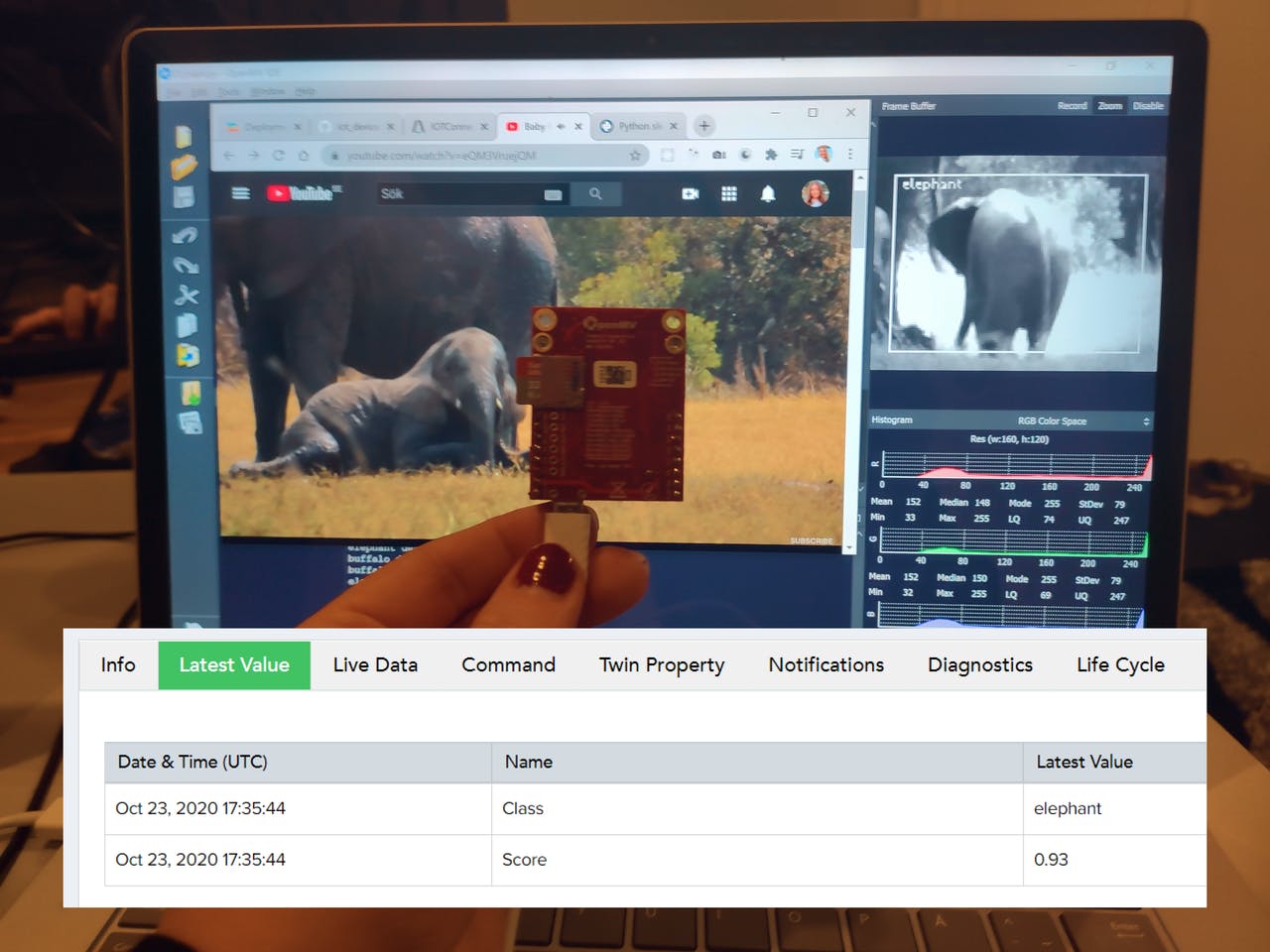
Sara Olsson's TinyML and IoT monitoring dashboard

Sara Olsson’s TinyML and IoT monitoring dashboard. Image Credits: Sara Olsson

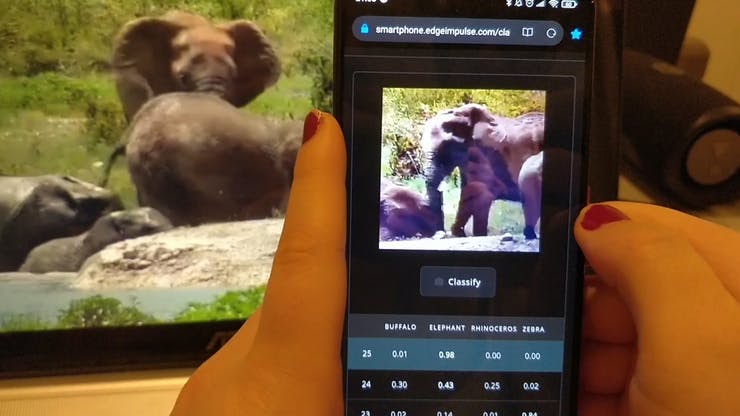
She completed her work in the Edge Impulse studio, creating the models and testing them with camera traps streams from Africam using an OpenMV camera from her home’s comfort.

Technology for good works, but human behavior must change

Project ElephantEdge is an example of how commercial and public interest can converge and result in a collaborative sustainability effort to advance wildlife conservation efforts. The new collar can generate critical data and equip park rangers with better data to make urgent life-saving decisions about protecting their territories. By the end of 2021, at least ten elephants will be sporting the new collars in selected parks across Africa, in partnership with the World Wildlife Fund and Vulcan’s EarthRanger, unleashing a new wave of conservation, learning and defending.

Naturally, this is great, the technology works, and it’s helping elephants like never before. But in reality, the root cause of the problem runs much more profound. Humans must change their relationship to the natural world for proper elephant habitat and population revival to occur.

“The threat to elephants is greater than it’s ever been,” said Richard Leakey, a leading palaeoanthropologist and conservationist scholar. The main argument for allowing trophy or ivory hunting is that it raises money for conservation and local communities. However, a recent report revealed that only 3% of Africa’s hunting revenue trickles down to communities in hunting areas. Animals don’t need to die to make money for the communities you live around.

With great technology, collaboration and a commitment to address the underlying cultural conditions and the ivory trade that leads to most elephant deaths, there’s a real chance to save these singular creatures.


News: If you didn’t make $1B this week, you are not doing VC right

The only thing more rare than a unicorn is an exited unicorn. At TechCrunch, we cover a lot of startup financings, but we rarely get the opportunity to cover exits. This week was an exception though, as it was exitpalooza as Affirm, Roblox, Airbnb, and Wish all filed to go public. With DoorDash’s IPO filing

The only thing more rare than a unicorn is an exited unicorn.

At TechCrunch, we cover a lot of startup financings, but we rarely get the opportunity to cover exits. This week was an exception though, as it was exitpalooza as Affirm, Roblox, Airbnb, and Wish all filed to go public. With DoorDash’s IPO filing last week, this is upwards of $100 billion in potential float heading to the public markets as we make our way to the end of a tumultuous 2020.

All those exits raise a simple question – who made the money? Which VCs got in early on some of the biggest startups of the decade? Who is going to be buying a new yacht for the family for the holidays (or, like, a fancy yurt for when Burning Man restarts)? The good news is that the wealth is being spread around at least a couple of VC firms, although there are definitely a handful of partners who are looking at a very, very nice check in the mail compared to others.

So let’s dive in.

News: Why is GoCardless COO Carlos Gonzalez-Cadenas pivoting to become a full-time VC?

Index Ventures, a London- and San Francisco-headquartered venture capital firm that primarily invests in Europe and the U.S., recently announced its latest partner. Carlos Gonzalez-Cadenas, currently COO of London-based fintech GoCardless and previously the chief product officer of Skyscanner, will join Index in January. Gonzalez-Cadenas is a seasoned entrepreneur and operator, but has also become

Index Ventures, a London- and San Francisco-headquartered venture capital firm that primarily invests in Europe and the U.S., recently announced its latest partner. Carlos Gonzalez-Cadenas, currently COO of London-based fintech GoCardless and previously the chief product officer of Skyscanner, will join Index in January.

Gonzalez-Cadenas is a seasoned entrepreneur and operator, but has also become a prolific angel investor in the U.K. and Europe over the last three years, making more than 50 angel investments in total. Well-regarded by founders and co-investors, his transition to a full-time role in venture capital feels like quite a natural one.

Earlier this week, TechCrunch caught up with Gonzalez-Cadenas over Zoom to learn more about his new role at Index and how he intends to source deals and support founders. Index’s latest hire also shared his insights on Europe’s venture market, describing this era as the “best moment in entrepreneurship in Europe.”

TechCrunch: Let me start by asking, why do you want to become a VC? You’re obviously a well-established entrepreneur and operator, are you sure venture capital is the career for you?

Carlos Gonzalez-Cadenas: I’ve been an angel investor for the last three years and this is something that has basically grown for me quite organically. I started doing just a handful and seeing if this is something I like and over time it has grown quite a lot and so has the number of entrepreneurs I’m partnered with. And this is something I’ve been increasingly more excited to do. So it has grown organically and something that emotionally has been getting closer and closer as time has passed.

And the things I like more specifically are: One, I’m quite a curious person, and for me, investing gives you the possibility of learning a lot about different sectors, about different entrepreneurs, different ways of building businesses, and that is something that I enjoy a lot.

The second bit is that I care a lot about helping entrepreneurs, especially the next generation of entrepreneurs, build great businesses in Europe. I’ve been very lucky, in the past, to learn from great people, like Gareth [Williams, Skyscanner co-founder] and Hiroki [Takeuchi. CEO at GoCardless], in my journey. I feel a duty of helping the next generation of entrepreneurs and sharing all the things that I’ve learnt. I care a lot about setting up founders as much as possible for success and sharing all those experiences I’ve learned [from].

These are the key two motivations that have led me to decide that it would be a great time now to move to the investing side.

How have you managed your deal flow while having a full-time job and where is that deal flow coming from?

It is typically coming in three buckets. A part of it is coming from my entrepreneur and operator network. So there are entrepreneurs and operators I know that are referring other entrepreneurs to me. Another bucket is other investors that I typically co-invest with. Another bucket is venture capitalists. I basically tend to invest quite a lot with VCs and in some cases they are referring deals to me.

In terms of managing it alongside GoCardless, it takes quite a lot of effort. It requires a lot of dedication and time invested during evenings and weekends.

The good thing is that my network typically tends to send me quite highly curated deals so essentially the deal flow I have luckily tends to be quite high quality, which makes things a bit more manageable. But don’t get me wrong, it still takes quite a lot of effort even if the deal flow is relatively high quality.

Presumably you haven’t been able to be all that hands-on as an angel investor, so how are you going to make that transition and what is it that you think you bring with the operational side to venture?

The way I think about this is, the entrepreneurs I typically invest in and their companies tend to be quite capable in their day-to-day perspective. Where they tend to find more value in interactions with me is what I call the “moments of truth.” Those key decisions, those key points in the journey where essentially it can influence the trajectory of the business in a fundamental way. It could be things like, I am fundraising and I don’t know how to position the business. Or I’m thinking about my strategy for the next 18 months and I will basically welcome an experienced person giving me a qualified opinion.

Or I have a big people problem and I don’t know how to solve that problem and I need that third person who has been in my shoes before. Or it could be that I’m thinking about how to organize my team as I move from startup to scale-up and I need help from someone who has scaled teams before. Or could be that I’m hiring three executives and I don’t know what a great CMO looks like. It’s those high-impact, high-leverage questions that the entrepreneurs tend to find helpful engaging with me, as opposed to very detailed day-to-day things that most of the entrepreneurs I work with tend to be quite capable of doing. And so far that model is working. The other thing is that the model is quite scalable because you are engaging 2-3 times per year but those times are high quality and highly impactful for the entrepreneur.

I typically also tend to have pretty regular and frequent communication with entrepreneurs on Slack. It’s more like quick questions that can be solved, and I tend to get quite a lot of that. So I think it’s that bimodel approach of high-frequency questions that we can solve by asynchronous means or high-impact moments a few times per year where, essentially, we need to sit down and we need to think together deeply about the problem.

And I tend to do nothing in the middle, where essentially, it’s stuff that is not so impactful but takes a huge amount of time for everyone, that doesn’t tend to be the most effective way of helping entrepreneurs. Obviously, I’m guided by what entrepreneurs want from perspective, so I’m always training the models in response to what they need.

WordPress Image Lightbox Plugin