Yearly Archives: 2020

News: Serenade snags $2.1M seed round to turn speech into code

Several years ago Serenade co-founder Matt Wiethoff was a developer at Quora when he was diagnosed with a severe repetitive stress injury to his hand and couldn’t code. He and co-founder Tommy MacWilliam decided to use AI to create a tool that let him speak the code instead and Serenade was born. Today, the company

Several years ago Serenade co-founder Matt Wiethoff was a developer at Quora when he was diagnosed with a severe repetitive stress injury to his hand and couldn’t code. He and co-founder Tommy MacWilliam decided to use AI to create a tool that let him speak the code instead and Serenade was born.

Today, the company announced a $2.1 million seed investment led by Amplify Partners and Neo. While it was at it, the startup also announced the first commercial version of the product, Serenade Pro.

“Serenade is an app that you’ll download onto your computer. It will plug into your existing editors like Visual Studio Code or IntelliJ, and then allows you to speak your code,” co-founder MacWilliam told me. At that point the startup’s AI engine takes over and translates what you say into syntactically correct code.

He says that while there are a bunch of generalized speech-to-text engines out there, they hadn’t been able to find anything that was tuned specifically for the requirements of someone entering code. While it may seem that this would have a pretty narrow market focus, the co-founders see this use case as simply a starting point with developers using this kind of technology even when not injured.

“Our vision is that this is just the future of programming. With machine learning, coding becomes faster and easier than ever before, and our AI eliminates a lot of the rote mechanical parts of programming. So rather than needing to remember keyboard shortcuts or syntax details of a language, you can just focus on expressing your idea naturally, and then our machine learning takes care of translating that into actual code for you,” MacWilliam explained.

The startup has five employees today, but has plans to build the company to 15-20 in the next year fueled by the introduction of the commercial product and the new funding. As they build the company, MacWilliam says being diverse is a big part of that.

“Our diversity strategy ranges throughout the process. I think it starts at the top of the funnel. We need to make sure that we’re going out and reaching great people — there are great people everywhere and it’s on us to find them and convince them why working at Serenade would be great,” he said. They are working with a variety of sources to find a diverse group of candidates that stretches beyond their own personal network, then looking at how they interview and judge candidates’ skill sets with the goal of building a more diverse employee base.

The company sees itself as a way to move beyond the keyboard to speaking your code, and it intends to use this money to continue building the product, while building a community of dedicated users. “We’ll be thinking about how we can showcase the value of coding by voice, how we can put together demos and build a community of product champions showing that [it’s faster to code using your voice],” he said.

News: Friday app, a remote work tool, raises $2.1 million led by Bessemer

Friday, an app looking to make remote work more efficient, has announced the close of a $2.1 million seed round led by Bessemer Venture Partners. Active Capital, Underscore, El Cap Holdings, TLC Collective, and New York Venture Partners also participated in the round, among others. Founded by Luke Thomas, Friday sits on top of the

Friday, an app looking to make remote work more efficient, has announced the close of a $2.1 million seed round led by Bessemer Venture Partners. Active Capital, Underscore, El Cap Holdings, TLC Collective, and New York Venture Partners also participated in the round, among others.

Founded by Luke Thomas, Friday sits on top of the tools that teams already use — Github, Trello, Asana, Slack, etc. — to surface information that workers need when they need it and keep them on top of what others in the organization are doing.

The platform offers a Daily Planner feature, so users can roadmap their day and share it with others, as well as a Work Routines feature, giving users the ability to customize and even automate routine updates. For example, weekly updates or daily standups done via Slack or Google Hangouts can be done via Friday app, eliminating the time spent by managers, or others, jotting down these updates or copying that info over from Slack.

Friday also lets users set goals across the organization or team so that users’ daily and weekly work aligns with the broader OKRs of the company.

Plus, Friday users can track their time spent in meetings, as well as team morale and productivity, using the Analytics dashboard of the platform.

Friday has a free forever model, which allows individual users or even organizations to use the app for free for as long as they want. More advanced features like Goals, Analytics and the ability to see past three weeks of history within the app, are paywalled for a price of $6/seat/month.

Thomas says that one of the biggest challenges for Friday is that people automatically assume it’s competing with an Asana or Trello, as opposed to being a layer on top of these products that brings all that information into one place.

“The number one problem is that we’re in a noisy space,” said Thomas. “There are a lot of tools that are saying they’re a remote work tool when they’re really just a layer on top of Zoom or a video conferencing tool. There is certainly increased amount of interest in the space in a good and positive way, but it also means that we have to work harder to cut through the noise.”

The Friday team is small for now — four full-time staff members — and Thomas says that he plans to double the size of the team following the seed round. Thomas declined to share any information around the diversity breakdown of the team.

Following a beta launch at the beginning of 2020, Friday says it is used by employees at organizations such as Twitter, LinkedIn, Quizlet, Red Hat, and EA, among others.

This latest round brings the company’s total funding to $2.5 million.

News: Corporate services platform Sleek lands $4 million in new funding

Sleek, the corporate services platform that helps entrepreneurs launch and run new companies in Singapore and Hong Kong, has raised $4 million. The new funding was led by SEEDS Capital, the investment arm of government agency Enterprise Singapore. Returning investors MI8 Limited and Pierre Lorinet also participated, along with Singapore Fintech Association co-founder Varun Mittal

Sleek, the corporate services platform that helps entrepreneurs launch and run new companies in Singapore and Hong Kong, has raised $4 million.

The new funding was led by SEEDS Capital, the investment arm of government agency Enterprise Singapore. Returning investors MI8 Limited and Pierre Lorinet also participated, along with Singapore Fintech Association co-founder Varun Mittal as part of Sequoia Capital’s scout program.

Sleek co-founder and chief growth officer Adrien Barthel told TechCrunch that the funding is part of Sleek’s seed round and brings the startup’s total raised so far to $7 million. It will start raising a Series A next year.

Founded three years ago by Barthel and Julien Labruyere, Sleek first began offering online corporate services, including company incorporation, compliance, digital accounting and tax filing, in Singapore before expanding into Hong Kong. Sleek now serves more than 3,000 companies, ranging from individual consultants to SMEs, startups and investment vehicles for funds, Barthel said.

Sleek is one of several cloud-based corporate services platforms focused on Singapore and/or Hong Kong, where regulations make it easier to incorporate companies and file taxes online, that have recently raised new venture capital funding. Others include Lanturn, Osome and Bluemeg. These startups were originally launched to reduce the amount of time and money spent on performing operational tasks, but the COVID-19 pandemic has increased demand for their services.

“We are happy to see other digital initiatives coming up around us,” Barthel told TechCrunch. “The market is wide enough for us to evolve on different positioning, and we’re only starting to see traditional firms looking at embracing the use of technology.”

While Sleek’s peers also offer secretarial, accounting and tax services, Barthel said his company’s vision “is to become the entrepreneur’s operating system, by going beyond that common service ground and building a range of services that are here to fit all entrepreneurs’ needs.”

For example, it recently released an electronic signature app called SleekSign that has digitized 145,000 signatures so far, added payroll services and launched a corporate insurance desk. Barthel said more product releases are planned for the end of this year and the first quarter of 2021.

In addition to growing its roster of services for entrepreneurs, Sleek also plans to expand into new markets where regulations also mesh well with its digital services.

“Our platform being common law friendly, we’re looking at such jurisdictions with attention, such as Australia, the United Kingdom and North America,’ said Barthel. “We are also closely looking at a few regional markets in Southeast Asia where regulatory frameworks are evolving and accepting progressively the use of technology for governance management and accounting.”

News: Metigy gets $20 million AUD to making online marketing easier for SMEs

Metigy, a marketing platform created to help small businesses automate more of the decision making in their online ad campaigns, has raised a Series B of $20 million AUD (about $14.6 million USD). The new funding, led by returning investor Cygnet Capital, will be used to grow the Sydney, Australia-based startup’s international customer base, especially

Metigy, a marketing platform created to help small businesses automate more of the decision making in their online ad campaigns, has raised a Series B of $20 million AUD (about $14.6 million USD). The new funding, led by returning investor Cygnet Capital, will be used to grow the Sydney, Australia-based startup’s international customer base, especially in the United States and Southeast Asia. Other participants in the round included Regal Funds Management, OC Funds, Five V Venture Capital and Thorney, plus returning

Founded in 2015, Metigy is currently used by about 26,000 businesses and has channel partnerships with Google and Optus. About 44% of its customers are in Australia and New Zealand, while 26% are in Southeast Asia, and 22% are in the United States. The startup has raised AUD $27.1 million (about USD $19.9 million) in total.

Co-founder and chief executive officer David Fairfull told TechCrunch Metigy was created because “half of SMEs fail in the first two years and marketing is one of the top two reasons for this. It’s a global issue and a paradigm that can be changed by harnessing technology.”

Fairfull and other members of Metigy’s founding team previously worked at We Are Social, a global creative agency. While there, they “spotted an opportunity to give small businesses access to the same data and strategic insights” as larger marketing teams.

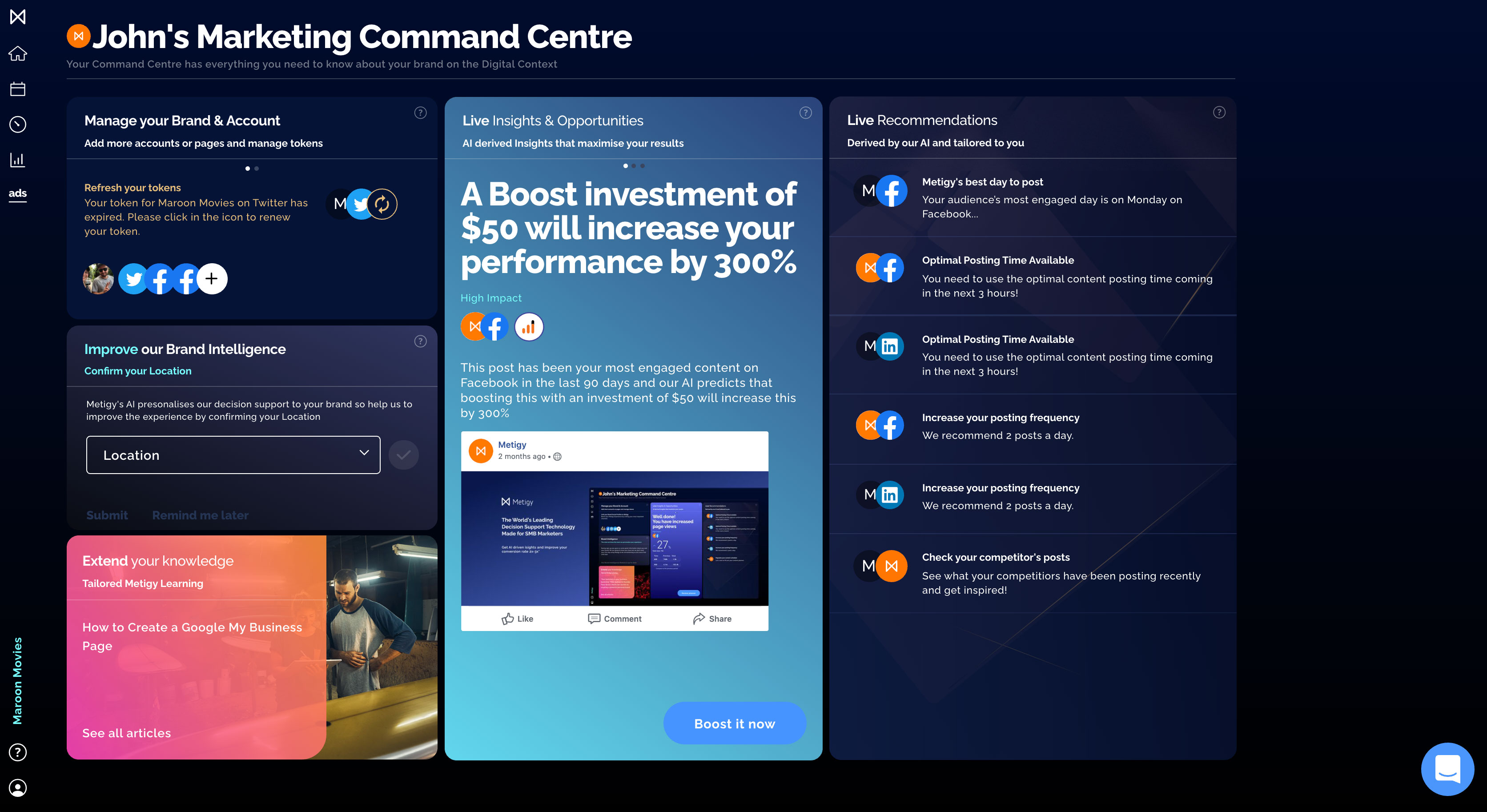
Marketing platform Metigy's Command Center

Marketing platform Metigy’s Command Center

Metigy’s platform gives more support to small or inexperienced marketing teams by using real-time data from their online advertising channels to create a livestream of recommendations. For example, it will tell marketing teams if they should start posting more content right away, use more hashtags or schedule more posts. The platforms also predicts what posts will result in the most conversions, helping companies decide how to spend their advertising budget.

For example, one of Metigy’s customers, parking app Share with Oscar, used Metigy to analyze what was trending on social media when members of the Royal Family visited Sydney. As a result, Fairfull said they were able to generate 2,700 customer engagements by spending about AUD $10 (about USD $7).

Other social marketing platforms like Hootsuite and Sprout Social are “essentially process solutions that help make the marketer more efficient,” said Fairfull. “However, if you don’t understand marketing, then all this process efficiency won’t help you gain results.”

Metigy is focusing on the United States and Southeast Asia because of the large number of SMEs there. By 2022, there is expected to be 30 million SMEs in the U.S. “On top of this, success in marketing technology is often benchmarked by success in the U.S., so expanding in this region adds credibility,” Fairfull added.

But in terms of volume, Southeast Asia offers a more promising market. “The real growth opportunity for us though is in Southeast Asia, where there is expected to be 150 million SMEs across the 11 markets by 2022,” Fairfull said. But the majority of them don’t have large marketing teams or access to the kind of ad technology that larger companies do. Companies in the region also tend to be more price sensitive, Fairfull added, so artificial intelligence and machine learning-based technology helps lower the cost of software like Metigy to an attractive price.

News: Snapchat launches a TikTok-like feed called Spotlight, kick-started by paying creators

After taking on TikTok with music-powered features last month, Snapchat this morning is officially launching a dedicated place within its app where users can watch short, entertaining videos in a vertically scrollable, TikTok-like feed. This new feature, called Spotlight, will showcase the community’s creative efforts, including the videos now backed by music, as well as

After taking on TikTok with music-powered features last month, Snapchat this morning is officially launching a dedicated place within its app where users can watch short, entertaining videos in a vertically scrollable, TikTok-like feed. This new feature, called Spotlight, will showcase the community’s creative efforts, including the videos now backed by music, as well as other Snaps users may find interesting.

Snapchat says its algorithms will work to surface the most engaging Snaps to display to each user on a personalized basis.

To do so, it will rank the Snaps in the new feed using a combination of factors, like how many other people found a particular Snap interesting, how long people spent watching it, if it was favorited or shared with friends, and more. The algorithms will also consider negative factors, like if a viewer skipped watching the Snap quickly, for example. Over time, the feed will become tailored to the individual user based on their own interactions, preferences, and favorites. This is a similar system to what TikTok uses for its “For You” feed.

Image Credits: Snap

However, on TikTok, only users with public profiles can have their videos hit the “For You” feed. Spotlight, meanwhile, can feature Snaps from users with both private or public accounts. These Snaps can be sent to Spotlight directly or posted to Our Story. The company says the Snaps from the private accounts will be featured in an unattributed fashion — that is, no name will be attached to the content. There will also be no way to comment on these Snaps or message the creator, Snapchat explains.

Users who are over 18 can opt in to public profiles in order to have their names displayed, which allows them to build a following. But while this allows users to private and directly reply to the creators, there are no public comment mechanisms on Spotlight.

That’s a different setup than on TikTok and gives Snapchat a way to avoid the much larger hassle of handling comment moderation.

The Spotlight feed itself, though, is moderated. The company says all Snaps that appear on the new feed will have to adhere to Snapchat’s Community Guidelines, which prohibit the spread of false information (including conspiracy theories), misleading content, hate speech, explicit or profane content, bullying, harassment, violence, and other toxic content. The Snaps must also adhere to Snapchat’s new Spotlight Guidelines, Terms of Service, and Spotlight Terms.

Image Credits: Snap

The Spotlight Guidelines specify what sort of content Snapchat wants, the format for the Snaps, and other rules. For example, they state the Snaps should be vertical videos with sound up to 60 seconds in length. They should also include a #topic hashtag and should make use of Snapchat’s Creative Tools like Captions, Sounds, Lenses or GIFs, if possible, The Snaps have to be appropriate for a 13+ audience, as well.

Captions are a new feature, designed for use in Spotlight. Also new is a continuous shooting mode for longer Snaps and the ability to trim singular Snaps.

The Snaps can also only use the licensed music from Snapchat’s own Sounds library and must feature original content, not content repurposed from somewhere else on the internet . That could limit accounts that repost internet memes, which tend draw large subscriber bases on rival platforms, like Instagram and TikTok.

In addition, Snaps in Spotlight won’t disappear from being surfaced in the feed unless the creator chooses to delete them.

Users will be alerted to the new Spotlight feature when they return to Snapchat following Monday’s launch. Afterward, they’ll be able to take Snaps as usual then choose whether they want to send them to their friends, to their Story, to Snap Map, or now to Spotlight.

Image Credits: Snap

The feed itself will be accessible through a prominent new fifth tab on the Snapchat home screen’s main navigation, and is designated with a Play icon.

To encourage users to publish to Spotlight, the company will distribute over $1 million USD every day to Snapchat users (16 and up) who create the top Snaps on Spotlight. This will continue through the end of 2020. The earnings will be determined by Snapchat’s proprietary algorithm that rewards users based on the total number of unique views a Snap gets per day (calculated using Pacific Time), as compared with others on the platform.

The company says it expects many users to earn money from this fund each day, but those with the most views will earn more than others. It will also monitor this feed for fraud, it warns.

With the music licensing aspects already ironed out, Snapchat is now looking to leverage the over 4 billion Snaps created by its users every day to power the new Spotlight feed. This move represents Snapchat’s biggest attempt at taking on TikTok to date — and one that it’s willing to kickstart with direct payments, too. That will likely encourage plenty of participation among Snapchat’s young user base, given they’re already using the app on a regular basis. And once posting to Spotlight becomes a habit, Snapchat could have a viable competitor on its hands, at least among the younger demographic that favors its app.

Its biggest disadvantage, of course, is that it has struggled to reach beyond its young user base. That’s something TikTok has done better with, by comparison. The Wall St. Journal last week noted that TikTok teens were often following accounts from senior citizens, for instance, and the AARP had earlier reported TikTok had attracted a middle-aged crowd, as well.

Snapchat says Spotlight is live today on both iOS and Android in the U.S., Canada, Australia, New Zealand, the U.K., Ireland, Norway, Sweden, Denmark, Germany, and France, with more countries to come soon.

News: Digital marketing firms file UK competition complaint against Google’s Privacy Sandbox

Google’s push to phase out third party tracking cookies — aka its ‘Privacy Sandbox’ initiative — is facing a competition challenge in Europe. A coalition of digital marketing companies announced today that it’s filed a complaint with the UK’s Competition and Markets Authority (CMA), calling for the regulator to block implementation of the Sandbox. The

Google’s push to phase out third party tracking cookies — aka its ‘Privacy Sandbox’ initiative — is facing a competition challenge in Europe. A coalition of digital marketing companies announced today that it’s filed a complaint with the UK’s Competition and Markets Authority (CMA), calling for the regulator to block implementation of the Sandbox.

The coalition wants Google’s phasing out of third party tracking cookies to be put on ice to prevent the Sandbox launching in early 2021 to give regulators time to devise or propose what it dubs “long term competitive remedies to mitigate [Google’s dominance]”.

“[Our] letter is asking for the introduction of Privacy Sandbox to be delayed until such measures are put in place,” they write in a press release.

The group, which is badging itself as Marketers for an Open Web (MOW), says it’s comprised of “businesses in the online ecosystem who share a concern that Google is threatening the open web model that is vital to the functioning of a free and competitive media and online economy”.

A link on MOW’s website to a list of “members” was not functioning at the time of writing. But, per Companies House, the entity was incorporated on September 18, 2020 — listing James Roswell, CEO and co-founder of UK mobile marketing company, 51 Degrees, as its sole director.

The CMA confirmed to us that it’s received MOW’s complaint, adding that some of the coalition’s concerns reflect issues identified in a detailed review of the online ad market it published this summer.

However it has not yet taken a decision on whether or not to investigate.

“We can confirm we have received a complaint regarding Google raising certain concerns, some of which relate to those we identified in our online platforms and digital advertising market study,” said the CMA spokesperson. “We take the matters raised in the complaint very seriously, and will assess them carefully with a view to deciding whether to open a formal investigation under the Competition Act.

“If the urgency of the concerns requires us to intervene swiftly, we will also assess whether to impose interim measures to order the suspension of any suspected anti-competitive conduct pending the outcome of a full investigation.”

In its final report of the online ad market, the CMA concluded that the market power of Google and Facebook is now so great that a new regulatory approach — and a dedicated oversight body — is needed to address what it summarized as “wide ranging and self reinforcing” concerns.

Although the regulator chose not to take any enforcement action at that point — preferring to wait for the UK government to come forward with pro-competition legislation.

In its statement today, the CMA makes it clear it could still choose to act on related competition concerns if it feels an imperative to do so — including potentially blocking the launch of Privacy Sandbox to allow time for a full investigation — while it waits for legislators to come up with a regulatory framework. Though, again, it has not made any decisions yet.

Reached for a response to the MOW complaint, Google sent us this statement — attributed to a spokesperson:

The ad-supported web is at risk if digital advertising practices don’t evolve to reflect people’s changing expectations around how data is collected and used. That’s why Google introduced the Privacy Sandbox, an open initiative built in collaboration with the industry, to provide strong privacy for users while also supporting publishers.

Also commenting in a statement, MOW’s director Roswell said: “The concept of the open web is based on a decentralised, standards-based environment that is not under the control of any single commercial organisation.  This model is vital to the health of a free and independent media, to a competitive digital business environment and to the freedom and choice of all web users.  Privacy Sandbox creates new, Google-owned standards and is an irreversible step towards a Google-owned ‘walled garden’ web where they control how businesses and users interact online.”

The group’s complaint follows a similar one filed in France last month (via Reuters) — albeit, in that case targeting privacy changes incoming to Apple’s smartphone platform that are also set to limit advertisers access to an iPhone-specific tracking ID that’s generated for that purpose (IDFA).

Apple has said the incoming changes — which it recently delayed until early next year — will give users “greater control over whether or not they want to allow apps to track them by linking their information with data from third parties for the purpose of advertising, or sharing their information with data brokers”. But four online ad associations — IAB France, MMAF, SRI and UDECAM — bringing the complaint to France’s competition regulator argue Apple is abusing its market power to distort competition.

The move by the online ad industry to get European competition regulators to delay Apple’s and Google’s privacy squeeze on third party ad tracking is taking place at the same time as industry players band together to try to accelerate development of their own replacement for tracking cookies — announcing a joint effort called PRAM (Partnership for Responsible Addressable Media) this summer to “advance and protect critical functionalities like customization and analytics for digital media and advertising, while safeguarding privacy and improving consumer experience”, as they put it.

The adtech industry now appears to be coalescing behind a cookie replacement proposal called UnifiedOpen ID 2.0 (UID2).

A document detailing the proposal which had been posted to the public Internet — but was taken down after a privacy researcher drew attention to it — suggests they want to put in place a centralized system for tracking Internet users that’s based on personal data such as an email address or phone number.

“UID2 is based on authenticated PII (e.g. email, phone) that can be created and managed by constituents across advertising ecosystem, including Advertisers, Publishers, DSPs, SSPs,” runs a short outline of the proposal in the paper, which is authored by two people from a Demand Side Platform called The Trade Desk that’s proposing to build the tech but then hand it off to an “independent and non-partial entity” to manage.

One component of the UID2 proposal consists of a “Unified ID Service” that it says would apply a salt and hash process to the PII to generate UID2 and encrypting that to create a UID2 Token, as well as provision login requests from publishers to access the token.

The other component is a user facing website that’s described as a “transparency & consent service” — to handle user requests for data or UID2 logouts etc.

However the proposal by the online ad industry to centralize Internet users’ identity by attaching it to hashed pieces of actual personal data — and with a self-regulating “Trusted Ads Ecosystem” slated to be controlling the mapping of PII to UID2 — seems unlikely to assuage the self-same privacy concerns fuelling the demise of tracking cookies in the first place (to put it mildly).

Trusting the mass surveillance industry to self regulate a centralized ID system for Internet users is for the birds.

But adtech players are clearly hoping they can buy themselves enough time to cobble together a self-serving cookie alternative — and sell it to regulators as a competition remedy. (Their parallel bet is they can buy off inactive privacy regulators with dubious claims of ‘transparency and consent’.)

So it will certainly be interesting to see whether the adtech industry succeeds in forcing competition regulators to stand in the way of platform-level privacy reforms, while pulling off a major reorg and rebranding exercise of privacy-hostile tracking operations.

In a counter move this month, European privacy campaign group, noyb, filed two complaints against Apple for not obtaining consent from users to create and store the IDFA on their devices.

So that’s one bit of strategic pushback.

Real-time bidding, meanwhile, remains under regulatory scrutiny in Europe — with huge questions over the lawfulness of its processing of Internet users’ personal data. Privacy campaigners are also now challenging data protection regulators over their failure to act on those long-standing complaints.

A flagship online ad industry tool for gathering web users’ consent to tracking is also under attack and looks to be facing imminent action under the bloc’s General Data Protection Regulation (GDPR) .

Last month an investigation by Belgium’s data protection agency found the IAB Europe’s so-called Transparency and Consent Framework (TCF) didn’t offer either — failing to meet the GDPR standard for transparency, fairness and accountability, and the lawfulness of data processing. Enforcement action is expected in early 2021.


News: Resilience raises over $800 million to transform pharmaceutical manufacturing in response to COVID-19

Resilience, a new biopharmaceutical company backed by $800 million in financing from investors including ARCH Venture Partners and 8VC, has emerged from stealth to transform the way that drugs and therapies are manufactured in the U.S. Founded by ARCH Venture Partners investor Robert Nelsen, National Resilience Inc., which does business as Resilience was born out

Resilience, a new biopharmaceutical company backed by $800 million in financing from investors including ARCH Venture Partners and 8VC, has emerged from stealth to transform the way that drugs and therapies are manufactured in the U.S.

Founded by ARCH Venture Partners investor Robert Nelsen, National Resilience Inc., which does business as Resilience was born out of Nelsen’s frustrations with the inept American response to the COVID-19 pandemic.

According to a statement the company will invest heavily in developing new manufacturing technologies across cell and gene therapies, viral vectors, vaccines and proteins.

Resilience’s founders identified problems in the therapeutic manufacturing process as one of the key problems that the industry faces in bringing new treatments to market — and that hurdle is exactly what the company was founded to overcome.

“COVID-19 has exposed critical vulnerabilities in medical supply chains, and today’s manufacturing can’t keep up with scientific innovation, medical discovery, and the need to rapidly produce and distribute critically important drugs at scale. We are committed to tackling these huge problems with a whole new business model,” said Nelsen in a statement.

The company brings together some of the leading investment firms in healthcare and biosciences including operating partners from Flagship Pioneering like Rahul Singhvi, who will serve as the company’s chief executive’ former Food and Drug Administration commissioner Scott Gottlieb, a partner at New Enterprise Associates and director on the Resilience board; and Patrick Yang, the former executive vice president and global head of technical operations at Roche/Genentech .

“It is critical that we adopt solutions that will protect the manufacturing supply chain, and provide more certainty around drug development and the ability to scale up the manufacturing of safe, effective but also more complex products that science is making possible,” said Dr. Gottlieb, in a statement. “RESILIENCE will enable these solutions by combining cutting edge technology, an unrivaled pool of talent, and the industry’s first shared service business model. Similar to Amazon Web Services, RESILIENCE will empower drug developers with the tools to more fully align discovery, development, and manufacturing; while offering new opportunities to invest in downstream innovations in formulation and manufacturing earlier, while products are still being conceived and developed.”

Other heavy hitters in the world of medicine and biotechnology who are working with the company include Frances Arnold, the Nobel Prize-winning professor from the California Institute of Technology; George Barrett, the former chief executive of Cardinal Health; Susan Desmond-Hellmann, the former president of product development at Genentech; Kaye Foster, the former vice president of human resources at Johnson and Johnson; and Denice Torres, the former President of Johnson & Johnson Pharmaceutical and Consumer Companies.

News: Oxford University’s COVID-19 vaccine shows high efficacy, and is cheaper to make and easier to store

Oxford University’s COVID-19 vaccine, being developed in partnership with drugmaker AstraZeneca, has shown to be 70.4% effective in preliminary results from its Phase 3 clinical trial. That rate actually includes data from two different approaches to dosing, including one where two full strength does were applied, which was 62% effective, and a much more promising

Oxford University’s COVID-19 vaccine, being developed in partnership with drugmaker AstraZeneca, has shown to be 70.4% effective in preliminary results from its Phase 3 clinical trial. That rate actually includes data from two different approaches to dosing, including one where two full strength does were applied, which was 62% effective, and a much more promising dosage trial which used one half-dose and one full strength dose to follow – that one was 90% effective.

Oxford’s results may not have the eye-catching high efficacy headline totals of the recent announcements from Pfizer and Moderna, but they could actually represent some of the most promising yet for a few different reasons. First, if that second dosage strategy holds true across later results and further analysis, it means that the Oxford vaccine can be administered in lower amounts and provide stronger efficacy (there’s no reason to use the full two-dose method if it’s that much less effective).

Second, the Oxford vaccine can be stored and transported at standard refrigerator temperatures – between 35° and 45°F – whereas the other two vaccine candidates require storage at lower temperatures. That helps obviate the need for more specialized equipment during transportation and on-site at clinics and hospitals where it will be administered.

Oxford’s COVID-19 vaccine also uses a different approach to either Moderna’s or Pfizer’s, which are both mRNA vaccines. That’s a relatively unproven technology when it comes to human therapeutics, which involves using messenger RNA to provide blueprints to a person’s body to build proteins effective at blocking a virus, without any virus present. The Oxford University candidate is an adenovirus vaccine, which is a much more established technology that’s already been in use for decades, and which involves genetically altering a weekend common cold virus and using that to trigger a person’s own natural immune response.

Finally, it’s also cheaper – in part because it uses tried and tested technology for which there’s already a robust and mature supply chain, and in part because it’s easier to transport and store.

The Phase 3 trial for the Oxford vaccine included 24,000 participants, and it’s expected to grow to 60,000 by the end of the year. Safety data so far shows no significant risks, and among the 131 confirmed cases in the interim analysis that produced these results, none of those who received either vaccine dosage developed a severe case, or one requiring hospitalization.

This is great news for potential vaccination programs, since it introduces variety of supply chain into an apparently effective vaccine treatment for COVID-19. We’re much better off if we have not only multiple effective vaccines, but multiple different types of effective vaccines, in terms of being able to inoculate widely as quickly as possible.

News: Gartner: Q3 smartphone sales down 5.7% to 366M, stemming Covid-19 declines earlier this year

As we head into the all-important holiday sales period, new numbers from Gartner point to some recovery for the smartphone market as vendors roll out a raft of new 5G handsets. Q3 smartphone figures published today showed that smartphone unit sales declined 5.7% globally over the same period last year to 366 million units. Yes,

As we head into the all-important holiday sales period, new numbers from Gartner point to some recovery for the smartphone market as vendors roll out a raft of new 5G handsets. Q3 smartphone figures published today showed that smartphone unit sales declined 5.7% globally over the same period last year to 366 million units. Yes, it’s a drop, but it is still a clear improvement on the first half of this year, when sales slumped by 20% in each quarter, due largely to the effects of Covid-19 on spending and consumer confidence overall.

In terms of brands, Samsung continued to lead the pack in terms of overall units, with 80.8 million units, and a 22% market share. In fact, the Korean handset maker and China’s Xiaomi were the only two in the top five to see growth in their sales in the quarter, respectively at 2.2% and 34.9%. Xiaomi’s numbers were strong enough to see it overtake Apple for the quarter to become the number-three slot in terms of overall sales rankings. Huawei just about held on to number two. See the full chart further down in this story with more detail.

Also worth noting: overall mobile sales — a figure that includes both smartphones and feature phones — were down 8.7% 401 million units. That underscores not just how few feature phones are selling at the moment (smartphones can often even be cheaper to buy, depending on the brands involved or the carrier bundles), but also that those less sophisticated devices are seeing even more sales pressure than more advanced models.

Smartphone slump: it’s not just Covid-19

It’s worth remembering that even before the global health pandemic, smartphone sales were facing slowing growth. The reasons: after a period of huge enthusiasm from consumers to pick up devices, many countries reached market penetration. And then, the latest features were too incremental to spur people to sell up and pay a premium on newer models.

In that context, the big hope from the industry has been 5G, which has been marketed by both carriers and handset makers as having more data efficiency and speed than older technologies. Yet when you look at the wider roadmap for 5G, rollout has remained patchy, and consumers by and large are still not fully convinced they need it.

Notably, in this past quarter, there is still some evidence that emerging/developing markets continue to have an impact on growth — in contrast to new features being drivers in penetrated markets.

“Early signs of recovery can be seen in a few markets, including parts of mature Asia/Pacific and Latin America. Near normal conditions in China improved smartphone production to fill in the supply gap in the third quarter which benefited sales to some extent,” said Anshul Gupta, senior research director at Gartner, in a statement. “For the first time this year, smartphone sales to end users in three of the top five markets i.e., India, Indonesia and Brazil increased, growing 9.3%, 8.5% and 3.3%, respectively.”

The more positive Q3 figures coincide with a period this summer that saw new Covid-19 cases slowing down in many places and the relaxation of many restrictions, so now all eyes are on this coming holiday period, at a time when Covid-19 cases have picked up with a vengeance, and with no rollout (yet) of large-scale vaccination or therapeutic programs. That is having an inevitable drag on the economy.

“Consumers are limiting their discretionary spend even as some lockdown conditions have started to improve,” said Gupta of the Q3 numbers. “Global smartphone sales experienced moderate growth from the second quarter of 2020 to the third quarter. This was due to pent-up demand from previous quarters.”

Digging into the numbers, Samsung has held on to its top spot, although its growth was significantly less strong in the quarter. “Fortunately” for Samsung, it’s still a long way ahead. That is in part because number-two Huawei, with 51.8 million units sold, was down by more than 21% since last year, in the wake of a public relations crisis after being banned in the US and phased out in the UK, due to the accusations that its equipment is used by China for spying.

It will be interesting to see how Apple’s small decline of 0.6% to 40.6 million units to Xiaomi’s 44.4 million, will shift in the next quarter, on the back of the company launching a new raft of iPhone 12 devices.

“Apple sold 40.5 million units in the third quarter of 2020, a decline of 0.6% as compared to 2019,” said Annette Zimmermann, research vice president at Gartner, in a statement. “The slight decrease was mainly due to Apple’s delayed shipment start of its new 2020 iPhone generation, which in previous years would always start mid/end September. This year, the launch event and shipment start began 4 weeks later than usual.”

Oppo, which is still not available through carriers or retail partners in the US, rounded out the top five sellers with just under 30 million phones sold. The fact that it and Xiaomi do so well despite not really having a phone presence in the US is an interesting testament to what kind of role the US plays in the global smartphone market: huge in terms of perception, but perhaps less so when the chips are down.

“Others” — that category that can take in the long tail of players who make phones, continues to be a huge force, accounting for more sales than any one of the top five. That underscores the fragmentation in the Android-based smartphone industry, but all the same, its collective numbers were in decline, a sign that consumers are indeed slowly continuing to consolidate around a smaller group of trusted brands.


Vendor 3Q20

Units

3Q20 Market Share (%) 3Q19

Units

3Q19 Market Share (%) 3Q20-3Q19 Growth (%)
Samsung 80,816.0 22.0 79,056.7 20.3 2.2
Huawei 51,830.9 14.1 65,822.0 16.9 -21.3
Xiaomi 44,405.4 12.1 32,927.9 8.5 34.9
Apple 40,598.4 11.1 40,833.0 10.5 -0.6
OPPO 29,890.4 8.2 30,581.4 7.9 -2.3
Others 119,117.4 32.5 139,586.7 35.9 -14.7
Total 366,658.6 100.0 388,807.7 100.0 -5.7

Source: Gartner (November 2020)


News: The promise and challenge of Roblox’s future in China

In a much-anticipated move, California-based gaming firm Roblox filed to go public last week. One aspect driving the future growth of the children- and community-focused gaming platform is its China entry, which it fleshes out in detail for the first time in its IPO prospectus. Like all gaming companies entering China, Roblox must work with

In a much-anticipated move, California-based gaming firm Roblox filed to go public last week. One aspect driving the future growth of the children- and community-focused gaming platform is its China entry, which it fleshes out in detail for the first time in its IPO prospectus.

Like all gaming companies entering China, Roblox must work with a local publishing and operations partner. And like Riot Games, Supercell, Epic Games, Activision Blizzard, Ubisoft, Nintendo and many more, Roblox chose Tencent, the world’s largest gaming firm by revenue, according to Newzoo.

The partnership, which began in 2019, revolves around a joint venture in which Roblox holds a 51% controlling stake and a Tencent affiliate called Songhua owns a 49% interest. The prospectus notes that Tencent currently intends to publish and operate a localized version of the Roblox Platform (罗布乐思), which allows people to create games and play those programmed by others.

User-generated content is in part what makes Roblox popular amongst young gamers, but that social aspect almost certainly makes its China entry trickier. It’s widely understood that the Chinese government is asserting more control over what gets published on the internet, and in recent times its scrutiny over gaming content has heightened. Industry veteran Wenfeng Yang went as far as speculating that games with user-generated content will “never made [their] path to China,” citing the example of Animal Crossing.

Roblox says it believes it’s “uniquely positioned” to grow its penetration in China but its “performance will be dependent on” Tencent’s ability to clear regulatory hurdles. It’s unclear what measures Roblox will take to prevent its user-generated content from running afoul of the Chinese authorities, whose appetite for what is permitted can be volatile. Tencent itself has been in the crosshairs of regulators over allegedly “addictive” and “harmful” gaming content. It also remains to be seen how Roblox ensures its user experience won’t be compromised by whatever censorship system that gets implemented.

Roblox chose Tencent as its Chinese partner. / Image: Roblox

At the most basic level, Roblox claims it works to ensure user safety through measures designed “to enforce real-world laws,” including text-filtering, content moderation, automated systems to identify behaviors in violation of platform policies, and a review team. The company expresses in its filing optimism about getting China’s regulatory greenlight:

While Tencent is still working to obtain the required regulatory license to publish and operate Luobulesi [Roblox’s local name] in China, we believe the regulatory requirements specific to China will be met. In the meantime, Luobu is working towards creating a robust developer community in China.”

The company is rightfully optimistic. China is the world’s largest gaming market and Tencent has a proven history of converting its social network users into gamers. Roblox’s marketing focus on encouraging “creativity” might also sit well with Beijing’s call for tech companies to “do good,” an order Tencent has answered. Roblox’s Chinese website suggests it’s touting part of its business as a learning and STEM tool and shows it’s seeking collaborations with local schools and educators.

Nonetheless, the involvement of Tencent is the elephant in the room in times of uncertain U.S.-China relations. The Committee on Foreign Investment in the U.S. or CFIUS, which is chaired by the Treasury Department, was inquiring about data practices by Tencent-backed gaming studios in the U.S. including Epic and Riot, Bloomberg reported in September.

Roblox isn’t exempt. It notes in the prospectus that CFIUS has “made inquiries to us with respect to Tencent’s equity investment in us and involvement in the China JV.” It further warns that it “cannot predict what effect any further inquiry by the Committee on Foreign Investment in the U.S. into our relationship with Tencent or changes in China-U.S. relations overall may have on our ability to effectively support the China JV or on the operations or success of the China JV.”

The other obstacle faced by all foreign companies entering China is local clones. Reworld, backed by prominent Chinese venture firms such as Northern Light Venture Capital and Joy Capital, is one. The game is unabashed about its origin. In a Reddit post responding to the accusation of it being “a ripoff of Roblox,” Reworld pays its tribute to Roblox and admits its product is “built on the shoulders of Roblox,” while claiming “it did not take any code from Roblox Studio.”

The Beijing-based startup behind Reworld has so far raised more than $50 million and had about 100 developers working on Reworld’s editing tool and 50 other operational staff, its co-founder said in a June interview. In comparison, Roblox had 38 employees in China by September, 38 of whom were in product and engineering functions. It’s actively hiring in China.

Roblox cannot comment for the story as it’s in the IPO quiet period.

WordPress Image Lightbox Plugin