Yearly Archives: 2020

News: Vettery acquires Hired to create a ‘unified’ job search platform

Two large job search and recruiting platforms are coming together, with Vettery acquiring Hired. The news follows a report last week in The Information claiming that Hired had begun to sell off its assets and wind down the company. The report also stated that Hired CEO Mehul Patel “abruptly resigned” via Zoom in early October.

Two large job search and recruiting platforms are coming together, with Vettery acquiring Hired.

The news follows a report last week in The Information claiming that Hired had begun to sell off its assets and wind down the company. The report also stated that Hired CEO Mehul Patel “abruptly resigned” via Zoom in early October.

Today’s announcement simply says that Patel is moving on “to pursue new opportunities,” with Vettery CEO Josh Brenner becoming chief executive of the combined companies.

Brenner told me that the two platforms are largely complementary, with only a 5% overlap in their respective customer bases. Hired, he said, has built AI job-matching tools (as well as talent assessment and bias reduction features) that are particularly well-suited for software and engineering positions, while Vettery offers “a little bit more breadth in the verticals that we support.”

“The key is bringing scale to these marketplaces,” Brenner said. “We see this as a formidable competitor to any of the legacy hiring solutions.”

Hired and Vettery logos

Image Credits: Vettery

The plan, he added, is to create a single “unified solution” that brings together the best of both platforms. Vettery says this soluton will offer job-matching AI that draws on combined data from 1.5 million interviews and over 21,000 job placements.

Asked whether the combined site would operate under the Hired or Vettery brand name, Brenner said, “We believe there will be one brand in the future. Right now, we’re continuing to keep both brands while we do the research figure to out what the best approach is.”

Hired was founded in 2012 and raised more than $130 million in funding, according to Crunchbase. Vettery, meanwhile, launched in 2014 and was itself acquired two years ago by HR services firm Adecco Group.

The financial terms of the acquisition were not disclosed.

Asked how many Hired employees would be joining Vettery, Brenner said it was too early in the transition to specify, but he added, “Not only does Hired have a great client base, they’ve also got an amazing team that we’ve admired as well and gotten to know over the last period of time … so we’re extremely hopeful that we can bring together as many of those talented people as possible.”

News: GM dumps Trump to side with California in emissions rules fight

General Motors is changing sides in a battle over whether states — and specifically California — can set tailpipe emissions regulations and other rules meant to mitigate climate change that are stricter than the federal government. The automaker said Monday it will no longer back the Trump Administration’s lawsuit to prevent California from setting its

General Motors is changing sides in a battle over whether states — and specifically California — can set tailpipe emissions regulations and other rules meant to mitigate climate change that are stricter than the federal government.

The automaker said Monday it will no longer back the Trump Administration’s lawsuit to prevent California from setting its own rules, Reuters reported. CEO Mary Barra reportedly sent a letter to several environmental groups stating that the automaker was “immediately withdrawing from the preemption litigation” and is inviting other automakers to join it.

The decision is a reversal for the automaker, which along with competitors Fiat Chrysler and Toyota sided with the Trump Administration last year over the issue.  With President-elect Joe Biden just weeks away from taking office, this reversal falls into the strategic category. It also follows GM’s decision to spend $27 billion over the next five years on the development of electric vehicles and automated technology in an effort to bring products to market faster.

The issue of “states rights” are at the center of the legal standoff between Trump and California. Under the Clean Air Act, California does have the authority to set its own clean air regulations. The state’s Air Resources Board called for a 2.7% year-over-year fuel efficiency increase through 2026 even as the Trump Administration set out to rollback Obama-era rules on fuel economy standards.

The automotive industry was split on the issue. BMW, Ford, Honda and Volkswagen of America reached a deal with California regulators to adhere to stricter emissions rules, while GM, FCA and Toyota joined the industry group Association of Global Automakers.

Automakers that sided with Trump have been criticized, and not just by the usual climate and environmental advocates. Ford joined in as well, going as far as airing an ad campaign in September called “California Innovation” that trolled GM brand Chevy, FCA’s Jeep and Toyota for not agreeing to the stricter emissions framework.

News: Approaching commercialization for its autonomous radar nav system, Lunewave raises $7 million

Lunewave, the Arizona-based startup developing a novel technology for radars for autonomous vehicles, has raised $7 million in financing as it gets ready for the commercial rollout of its systems. The company’s latest financing came from Proeza entures, Blue 9 Capital, Tsingyuan Ventures and Intact Ventures, the company said. With the latest funding Lunewave will

Lunewave, the Arizona-based startup developing a novel technology for radars for autonomous vehicles, has raised $7 million in financing as it gets ready for the commercial rollout of its systems.

The company’s latest financing came from Proeza entures, Blue 9 Capital, Tsingyuan Ventures and Intact Ventures, the company said.

With the latest funding Lunewave will continue to work with Tier 1 suppliers to establish strategic partnerships and jointly manufacture the company’s radar sensor, according to chief executive and co-founder John Xin.

The 3D printed Luneburg lens pitches features like broad bandwidth, high gain, and a capacity for forming multiple high-quality beams in all directions. The company said two of its sensors could replace 20 radar sensros used today.

The Lunewave radar has already gone through several pre-development projects with original equipment manufacturers and with ride hailing companies. “We’re very close to establishing a formal contractual partnership to commercialize our product,” said Xin. “By the end of the first quarter we will be able to announce a strategic partnership with a global tier 1 supplier.”

For Xin, the big pillars within sensors are cameras, lidar and radar, and he says that radar is the only one that works well in inclement weather conditions. “In the industry these days it’s becoming a philosophical discussion,” said Xin. “But we believe in sensor fusion. The more safety the better. Our job is to be the vendor choice for radar solutions.”

Xin said the new financing would go to staff up the company’s product development and sales teams as it looks to continue to refine its technology. The company’s product development currently operates on two tracks. One is a pure “a-dash” system and the other is geared toward level three, four, and five autonomy in vehicles.

The company is also hoping to continue its penetration of the industrial vehicle market — another area where Xin says the Lunewave is beginning to see real traction.

“We believe that ADAS and AV systems will continue to make their way into vehicles, leading to a strong growth in radars as they are a core component of both systems,” said Rodolfo Elias Dieck, managing director, Proeza Ventures. 

The company boasts that its technology offers 180-degree field of view in the horizontal plane and can detect objects surrounding a car with 6 times the resolution available today — even at long range and in poor weather.

As part of the funding, former BMW director Peter Schwarzenbacher and former Delphi executive James Zizelman will be taking seats on the company’s board of directors. Zizelman, who currently serves as the president of Stoneridge Contro Devices, was previous the vice president of engineering for Aptiv and an exec at Delphi Automotive.

“The technology that Lunewave is bringing to market provides the ultimate in value proposition,” said Zizelman. “Not only does this innovation bring truly superior technical capability in field of view, resolution, and other attributes, it also offers the opportunity to replace multiple radar units with a single Lunewave device—better and more cost effective.”


News: Amazon’s Echo Buds get new fitness tracking features

I wasn’t super impressed when I reviewed the Echo Buds around this time last year, but Amazon’s first shot at Alexa-powered fully wireless earbuds was passable. And while they’ve already been on the market for a while now, the company’s continuing to deliver some key updates, including today’s addition of new fitness features. Say “Alexa,

I wasn’t super impressed when I reviewed the Echo Buds around this time last year, but Amazon’s first shot at Alexa-powered fully wireless earbuds was passable. And while they’ve already been on the market for a while now, the company’s continuing to deliver some key updates, including today’s addition of new fitness features.

Say “Alexa, start my workout” with the buds in, and they’ll begin logging steps, calories, distance, pace and duration of runs. Like many new software additions, this one will take a few days to roll out for everyone. This one also requires users to enable the new tracking feature using the Alexa app.

Once enabled, you can state/ask follow-ups, like:

  • “Alexa, start my run”
  • “Alexa, pause my walk”
  • “Alexa, end my workout”
  • “Alexa, how far have I run?”
  • “Alexa, what’s my pace?”
  • “Alexa, how was my workout?”

Asking, “Alexa, how was my workout?” After the fact will pull up your historical running stats.

As I noted previously, the Echo Buds didn’t really do much to set themselves apart from myriad other earbuds, though there certainly was a lot to be said for the price — then $130. At the moment, they’re discounted much further, now running $80 — which makes them a solidly competitive deal.

News: The downfall of adtech means the trust economy is here

Richard Jones Contributor Share on Twitter Richard is CMO of Cheetah Digital, a cross-channel customer engagement solution provider. As an expert in zero-party data, he is committed to helping brands provide a value exchange with consumers through the lifecycle in return for consumer attention, engagement and loyalty. 2020 has brought about much-needed social movements. In

Richard Jones
Contributor

Richard is CMO of Cheetah Digital, a cross-channel customer engagement solution provider. As an expert in zero-party data, he is committed to helping brands provide a value exchange with consumers through the lifecycle in return for consumer attention, engagement and loyalty.

2020 has brought about much-needed social movements. In June, activists launched the Stop Hate for Profit campaign, a call to hold social media companies like Facebook accountable for the hate happening on their platforms.

The idea was to pull advertising spending to wake these social platforms up. More than 1,200 businesses and nonprofits joined the movement, including brands such as The North Face, Patagonia and Verizon. I led my company, Cheetah Digital, to join alongside some of our clients like Starbucks and VF Corp.

Stop Hate for Profit highlighted social media hitting its tipping point. Twitter and Snapchat chose to stand up against hate speech, banning political ads and taking action to flag misinformation. Facebook, unfortunately, has not yet been as proactive, or at best it’s been sporadic in its response.

While many thought the movement would come and go, the reality is it has only just begun. With America conducting arguably its most divisive election in history, these problems won’t just go away. For marketers, Stop Hate for Profit is more than a social movement — it is pointing to an issue with ad tech as a whole.

I believe we are seeing the downfall of ad tech as we know it with social media boycotts and data privacy leading the charge.

The social media quagmire

In May, Forrester released a report titled “It’s OK to Break Up with Social Media” that contained statistics indicating that consumers are fed up with social media: 70% of respondents said they don’t trust social media platforms with their data. Only 14% of consumers believe the information they read on social media is trustworthy. 37% of online adults in the U.S. believe social media does more harm than good.

Here is the reality we need to get back to: Social media isn’t built for marketers to reach consumers. In the beginning of the social media craze, brands rushed to get on board and join the conversations. What many brands discovered is these channels became a platform for customer complaints not for building positive brand perception. Furthermore, the social platforms marketers flocked to as an avenue to reach customers began charging marketers just to get to the customers.

The algorithms that define what content you see unfortunately make it harder for people to see opposing views, and this more than anything else polarizes society further. If you start looking at QAnon content, very soon that’s all the algorithms feed you. You might spend more time on social platforms fueling their ad dollars, but you have also lost a grip on reality. Marketers must admit things have gone too far on social media and it is okay to move on.

Privacy matters

Imagine you are in need of a minor surgery. Perhaps you take an Uber ride to the specialist for a consultation. Next, you go get the surgery and it is successful. Soon you find yourself at home recovering and all is well. That is, until you start scrolling Facebook. Suddenly advertisements pop up for medical malpractice lawyers, but you haven’t told anyone about the surgery and you certainly didn’t post about it on social media.

Here you are, just wanting to rest and recover at home, but instead you are being bombarded by advertisements. So how did those ads get there? You left a digital footprint, your data was sold and now you’re being hit with intrusive ads. To me, this story crystallizes the abuse ad tech has been fostering in the world around us. There’s an utter invasion of privacy and consumers aren’t blind to it.

Data privacy has been a focus of conversation for marketers for several years now. Just this year, America saw the California Consumer Privacy Act (CCPA) go into effect and become enforceable. This legislation gives back control of data to the consumer. In June, Apple announced updates to make it harder for apps and publishers to track location data and use it for ad targeting. At the beginning of August, Meredith and Kroger announced a partnership to provide first-party sales data for advertising efforts in an attempt to move off of cookies. It is clear data privacy is not a fad going away anytime soon.

Where do marketers go from here?

I believe the future of marketing is the trust economy. The Stop Hate for Profit campaign, the invasion of privacy and shifting attitudes and behaviors of consumers point to the end of an era where marketers relied upon third-party data. Trust is now the most impactful economic power, not data. We conducted research earlier this year with eConsultancy, and our findings revealed that 39% of U.S. consumers don’t like personal ads driven from cookie data. People don’t want to be tracked and targeted as they click around the web. Ad tech’s roof is caving in and marketers must adjust.

The old methods of marketing won’t carry you through into the era of the trust economy. It is time to look to new channels and revisit old channels. We have to shift back to the channels where we own what is being said. Advertising on social platforms should be focused on driving consumers to owned channels where you can capture their permissions and data to connect with them directly. Consider email as a channel to focus on.

Don’t worry — it works. That same eConsultancy report found nearly three out of four consumers made a purchase in the last 12 months from an email sent by a brand or retailer and massively outperformed social ads when it came to driving sales. Similarly nine times as many U.S. consumers want to increase their participation in loyalty programs in 2020 than those that want to reduce their involvement. You have to ensure you are owning your data and loyalty programs are a treasure trove of consumer data you own. Emily Collins from Forrester does a good job of explaining why you can achieve this with a true loyalty strategy, not just a rewards program.

Your goal should be to build direct connections to consumers. Building trust means offering a value exchange for data and engagement, not going and buying it from a third-party. Fatemah Khatibloo, a principal analyst for Forrester wrote, “Zero-party data is that which a customer intentionally and proactively shares with a brand. It can include purchase intentions, personal context, and how the individual wants the brand to recognize her.” This zero-party data is foundational for the trust economy and you should check out her advice on how it helps you navigate privacy and personalization.

Take responsibility

The trust economy is really about asking yourself, as a marketer, what you stand for. How do you view your relationship with consumers? Do you care? What kind of relationship do you want? Privacy has to be part of this. Accountability is crucial. We must be accountable to where we are putting our money. It’s time to stop supporting hate, propping up the worst of society and fueling division. Start taking responsibility, caring about social issues and building meaningful relationships with consumers built on trust.


News: 7 things we just learned about Sequoia’s European expansion plans

Sequoia Capital, the renowned Silicon Valley venture capital firm that has backed companies like Apple, Google, Dropbox, Airbnb and Stripe, recently disclosed that it had opened its first office in Europe. To staff up, it hired partner Luciana Lixandru away from rival Accel Partners. Even without an official European presence, Sequoia has quietly operated in

Sequoia Capital, the renowned Silicon Valley venture capital firm that has backed companies like Apple, Google, Dropbox, Airbnb and Stripe, recently disclosed that it had opened its first office in Europe. To staff up, it hired partner Luciana Lixandru away from rival Accel Partners.

Even without an official European presence, Sequoia has quietly operated in the region for more than a decade, first investing in Klarna in 2010. Other Europe-founded companies in its portfolio include Baaima, CEGX, Charlotte Tilbury, Dashlane, Evervault, FON Wireless, Front, Graphcore, Mapillary, Metaswitch Networks, n8n, Remote, Skyscanner, Songkick, Tessian, Tourlane, UiPath, Unity and 6Winderkinder (Wunderlist).

Yet, it is only now that the VC firm is putting people on the ground here in Europe, starting with an office in London that has a remit to invest across the continent.

Working alongside Lixandru is junior investor George Robson, who joined from Revolut. Most recently, Sequoia recruited Zoe Jervier Hewitt from EQT as head of talent in Europe. And finally, Matt Miller, a Sequoia U.S. veteran, is also part of the European efforts and plans to relocate next year, while I also understand that Sequoia’s Doug Leone will be spending a lot of his time in Europe.

Last week at the virtual “Node by Slush” event, I interviewed Lixandru and Miller and teased out some important details about Sequoia’s plans.

1. Sequoia now believes Europe is producing market leaders ahead of Silicon Valley

“There has been this evolution and maturity of the tech ecosystem that has been really meaningful, that has attracted us to want to put down boots on the ground and be more invested in Europe than ever before,” said Sequoia partner Matt Miller.

“One change is in the attitudes of young people. Europe has always been this place where there’s been incredible talent coming out of the computer science programs, across the universities across the continent and the U.K., and these young people previously, were going into careers in investment banking and consulting are bigger conglomerates. And now that those young people are interested in startups and technology careers, that’s fueling a lot of great ideas and a lot of great talent.

“There was a long time this question of, when will there be a $10 billion plus startup, and now there’s multiple of them across the continent. And now the question has really changed: When will there be the next hundred billion dollar startup in Europe, and I think it’s just an evolution over time.

“We find ourselves getting pulled more and more. So when … we want to invest in the best AI semiconductor company in the world, we looked at them in China, Israel and Europe. And the one we wanted to invest in was Graphcore, in Bristol [in the U.K.]. And when we looked … [to] invest in the best process automation company in the world, we looked at automation anywhere in California … and we looked at companies all over the world, and the one we wanted to invest in was UiPath in Romania. And that is increasingly becoming the case.”

“To some extent, success breeds success, too,” said Lixandru. “I think role models are really powerful. And the fact that there have been these category-leading companies created out of Europe, but that are winning on a global scale, like Spotify, Adyen and UiPath … I think that’s really inspirational to the next generation of founders. And I think that has helped a lot.”

2. The firm will make investments out of the same fund as the U.S. and Canada

“We work as one partnership across two geographies, and we invest from the same pool of capital across both geographies,” explained Lixandru. “And the rationale behind that is exactly what Max talked about. We want to be able to partner with category leading companies, and if they start in Paris, or in Stockholm, or in San Francisco, for us, it does not make a difference. We want to partner with them early. And we want to be able to help them on the ground early … whether they start here in Europe or in the U.S.”

Related to this, Sequoia will share carry — the fund’s profits — with partners across the U.S. and Europe, regardless of where partners reside or where the deal was sourced.

“One of the things that I love the most about Sequoia having been here close to nine years now is the way that we operate is very, very team centric, and that everybody is compensated the same amount in a fund, whether or not it is the investment that they lead or the investment that their partner led,” said Miller. “So when we make an investment, we lock arms together as a team, and we work collectively to help that company be successful.”

Miller said portfolio companies in Europe also get to work with Sequoia’s operational supporting partners in the U.S., too. “And the economic model is one that supports that,” he said.

3. Sequoia will continue building out a team on the ground in Europe

News: Gift Guide: Which next-gen console is the one your kid wants?

This holiday season the next generation of gamers, bless their hearts, will be hoping to receive the next generation of gaming consoles. But confusing branding by the console makers — not to mention a major shortage of consoles — could lead to disappointment during the unwrapping process. Before making any big promises this year, you’ll

This holiday season the next generation of gamers, bless their hearts, will be hoping to receive the next generation of gaming consoles. But confusing branding by the console makers — not to mention a major shortage of consoles — could lead to disappointment during the unwrapping process. Before making any big promises this year, you’ll want to be completely clear on two things: which console you’re actually trying to get, and how much of a challenge it might be to get one.

By the way, it’s totally understandable if you’re a little lost — particularly on Microsoft’s end, the branding is a little weird this time around. Even the lifelong gamers on our staff have mixed up the various Xbox names a few times.

If you’re not 100% sure which brand of console your kid (or partner or whoever) has, go take a look right now. An Xbox will have a big X somewhere on a side without cables coming out of it, and a PS4 will have a subtler “PS” symbol embossed on it. The “Pro” has three “layers” and the regular one has two.

Okay, now that you know what you’ve got, here are the new versions that they want:

Sony PlayStation 5

The PlayStation 5, or PS5 for short, is the newest gaming console from Sony. It’s the one your kids want if they already have a PlayStation 4 or even a PlayStation 4 Pro, which they might have gotten a year or two back.

The PS5 is more powerful than the PS4, but it also plays most PS4 games, so you don’t need to worry about a game you just bought for a birthday or whatever. It has some fancy new features for fancy new TVs, but you don’t need to worry about that — the improved performance is the main draw.

There are two versions of the PS5, and the only real difference between them is that one has a disc drive for playing disc-based games; they both come with a controller and are about the same size. The one with the drive costs $500, and is the one you should choose if you’re not completely certain the recipient would prefer the driveless “Digital Edition.” Saving $100 up front is enticing, but consider that some titles for this generation will cost $70, so the capability to buy used games at half price might pay for itself pretty quickly.

The PS5 doesn’t come with any “real” next-generation games, and the selection this season is going to be pretty slim. But your best bet for pretty much any gamer is Spider-Man: Miles Morales. I’ve played it and its predecessor — which Miles Morales comes with — and it’s going to be the one everyone wants right off the bat. (Its violence is pretty PG, like the movies.)

The PS4’s controllers sadly won’t work on PS5 games. But don’t worry about getting any extra ones or charging stands or whatnot right now, unless your gamer plays a lot of games with other people on the couch already.

Microsoft Xbox Series X
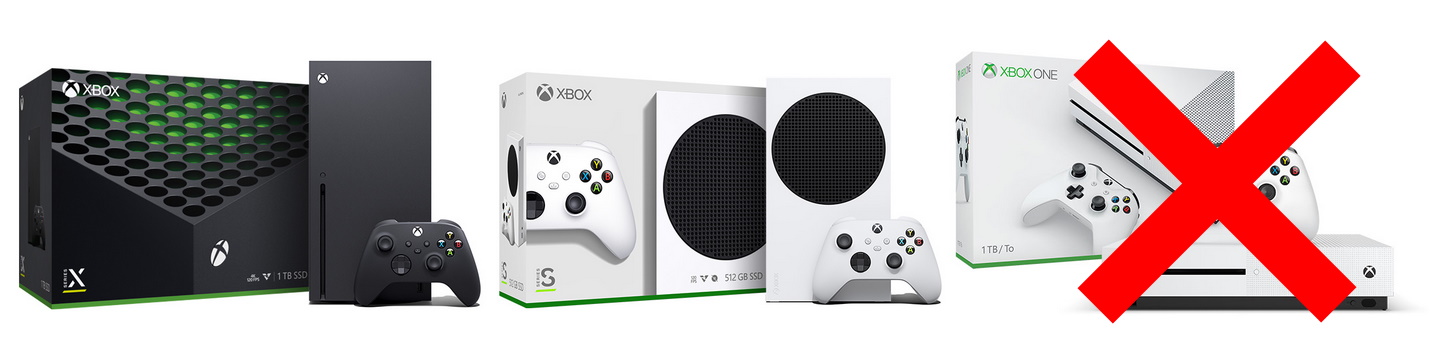
The Xbox Series X is the latest gaming console from Microsoft, replacing the Xbox One X and One S. Yes, the practice of changing the middle word instead of the last initial is difficult to understand, and it will be the reason lots of kids unwrap last year’s new console instead of this year’s.

The Xbox Series X is more powerful than the Xbox One X, but should also play almost all the old games, so if you bought something recently, don’t worry that it won’t be compatible. There are lots of fancy-sounding new features, but you don’t need to worry about those or buy them separately — stuff like HDR and 4K all depend on your TV, but any TV from the last few years will look great.

There are two versions of the next Xbox, and they have significant differences. The $500 Xbox Series X is the “real” version, with a disc drive for old and used games, and all the power-ups Microsoft has advertised. This one is almost certainly the one any gamer will be expecting and hoping to get.

Like Sony, Microsoft has a version of the Xbox that has no disc drive: the $300 Xbox Series S. Confusingly, this is the same price, same color, and nearly the same name and type of console as last generation’s Xbox One S, so first of all be sure you’re not buying the One. The Xbox Series S is definitely “next-gen,” but has a bit less power than the Series X, and so will have a few compromises in addition to the lack of a drive. It’s not recommended you get this one unless you know what you’re doing or really need that $200 (understandable).

For a day-one game, there isn’t really a big must-have exclusive. Assassin’s Creed: Valhalla is probably a good bet, though, if bloody violence is okay. If not, honestly a gift certificate or subscription to the “Game Pass” service that provides free games is fine.

No need for extra controllers — the Xbox Series X supports the last-gen’s controllers. Genuine thanks to Microsoft for that one.

Difficulty level: Holiday 2020

A PS5 and controller.

Image Credits: Devin Coldewey / TechCrunch

Now that you know which console to get (again… a PlayStation 5 or an Xbox Series X), I’ve got some bad news and some good news.

The bad news is they’re probably (read: definitely) going to be sold out. Microsoft and Sony are pumping these things out as fast as they can, but the truth is they really rushed this launch to make it in time for the holidays and won’t have enough to go around.

Resist the urge to buy the “next best” in last year’s model — the new ones are a major change and are replacements, not just upgrades, for the old ones. It would literally be better for a kid to receive a pre-order receipt for a new console than a brand new old one. And don’t go wild trying to find one on eBay or whatever — this is going to be a very scammy season and it’s better to avoid that scene entirely.

The pandemic also means you probably can’t or won’t want to wait in line all night to grab a unit in person. Getting a console will almost certainly involve spending a good amount of time on the websites of the major retailers… and a good bit of luck.  Follow electronics and gaming shops on Twitter and bookmark the consoles’ pages to check for availability regularly, but expect each shipment to be sold out within a minute or two and for the retailer’s website to crash every single time.

Don’t buy them a Nintendo Switch, either, unless they’ve asked for one of course. The Switch is fantastic, but it’s completely different from the consoles above.

The good news is they won’t be missing out on much right now. Almost every game worth having for the next year will be available on the new and old consoles, and in some cases players may be able to start their game on one and continue it on the next. Good luck figuring out exactly which games will be enhanced, upgraded, or otherwise carried between generations (it’s a patchwork mess), but any of the hot new games is a good bet.

Good luck!


News: Despite pandemic, forecasts predict U.S. online holiday sales increase of 20%-30% or more

Strong e-commerce sales are predicted to help lift overall holiday retail spending in the U.S., according to forecasts released today by the National Retail Federation (NRF) and eMarketer. Both firms expect to see overall retail sales growth during November and December, though the market may be impacted by slowing brick-and-mortar sales. Of the two, NRF

Strong e-commerce sales are predicted to help lift overall holiday retail spending in the U.S., according to forecasts released today by the National Retail Federation (NRF) and eMarketer. Both firms expect to see overall retail sales growth during November and December, though the market may be impacted by slowing brick-and-mortar sales.

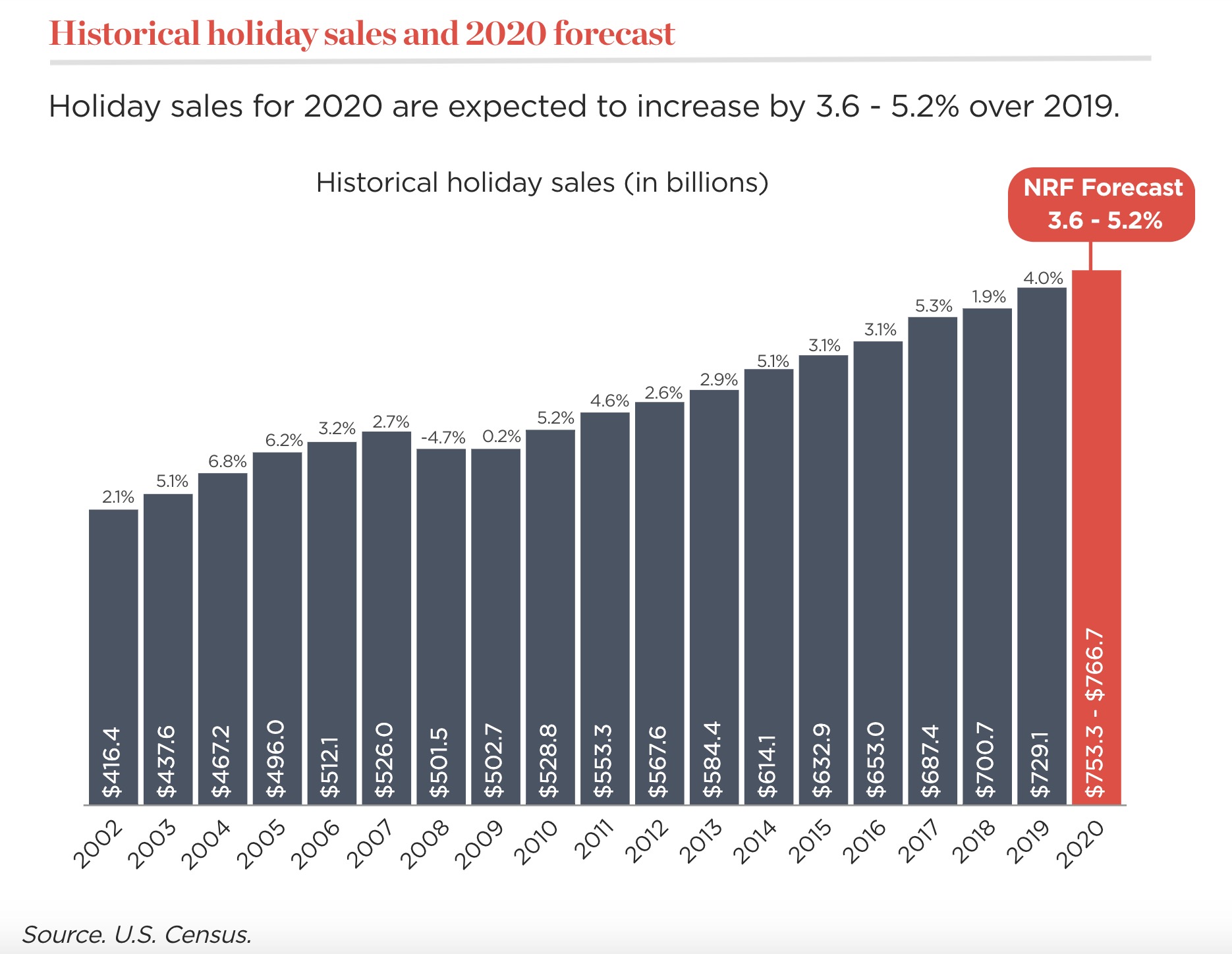
Of the two, NRF had the more optimistic forecast. It estimates U.S. holiday sales during November and December will increase between 3.6% and 5.2% year-over-year, for a total between $755.3 billion and $766.7 billion. That’s compared with a 4% increase in 2019 to $729.1 billion, and an average of a 3.5% increase over the past five years.

Image Credits: NRF

Growth will come from online and other non-store sales, which are included in the total, which will increase between 20% and 30% to reach between $202.5 billion and $218.4 billion. That’s up from $168.7 billion last year.

NRF’s takeaway is that consumers are willing to spend — perhaps because of the challenging year that 2020 has been, rather than despite it.

“After all they’ve been through, we think there’s going to be a psychological factor that they owe it to themselves and their families to have a better-than-normal holiday,” noted NRF Chief Economist Jack Kleinhenz. “There are risks to the economy if the virus continues to spread, but as long as consumers remain confident and upbeat, they will spend for the holiday season,” he added.

The firm also noted Americans may have reduced their spending in other categories, like personal services, travel and entertainment due to the pandemic, which could increase the money they have for retail spending.

eMarketer, on the other hand, paints a less rosy picture when it comes to overall sales.

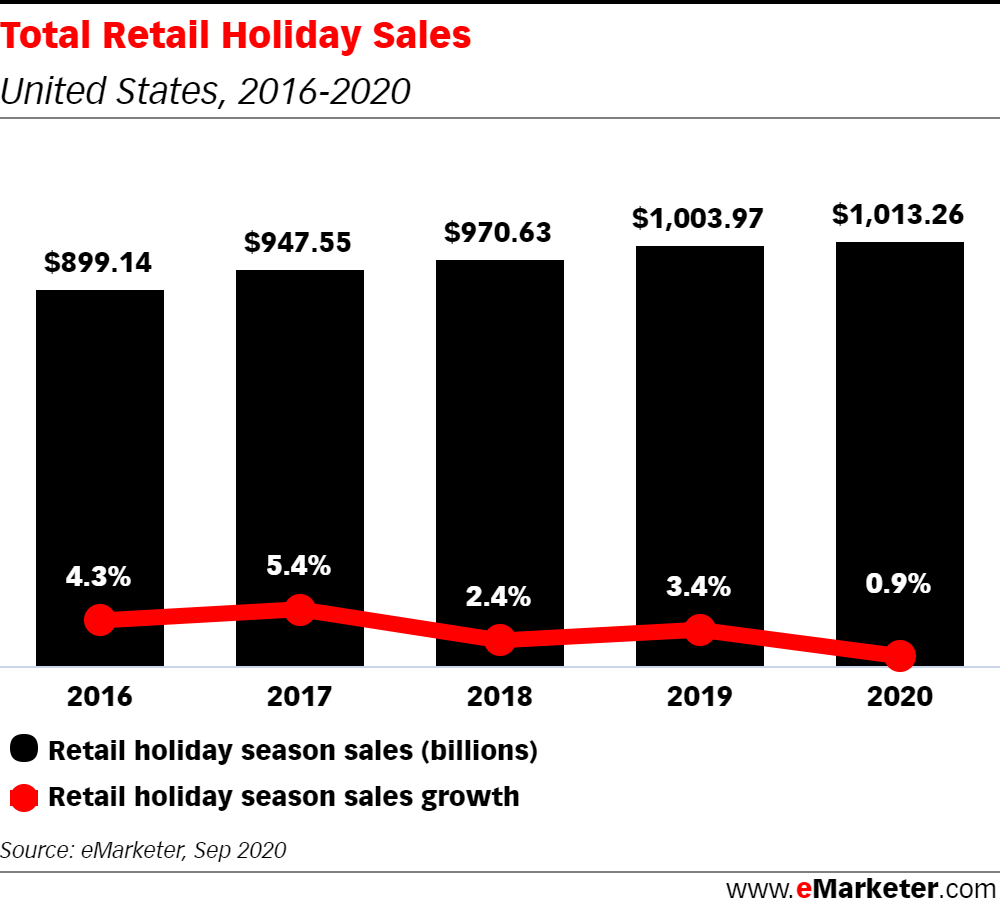
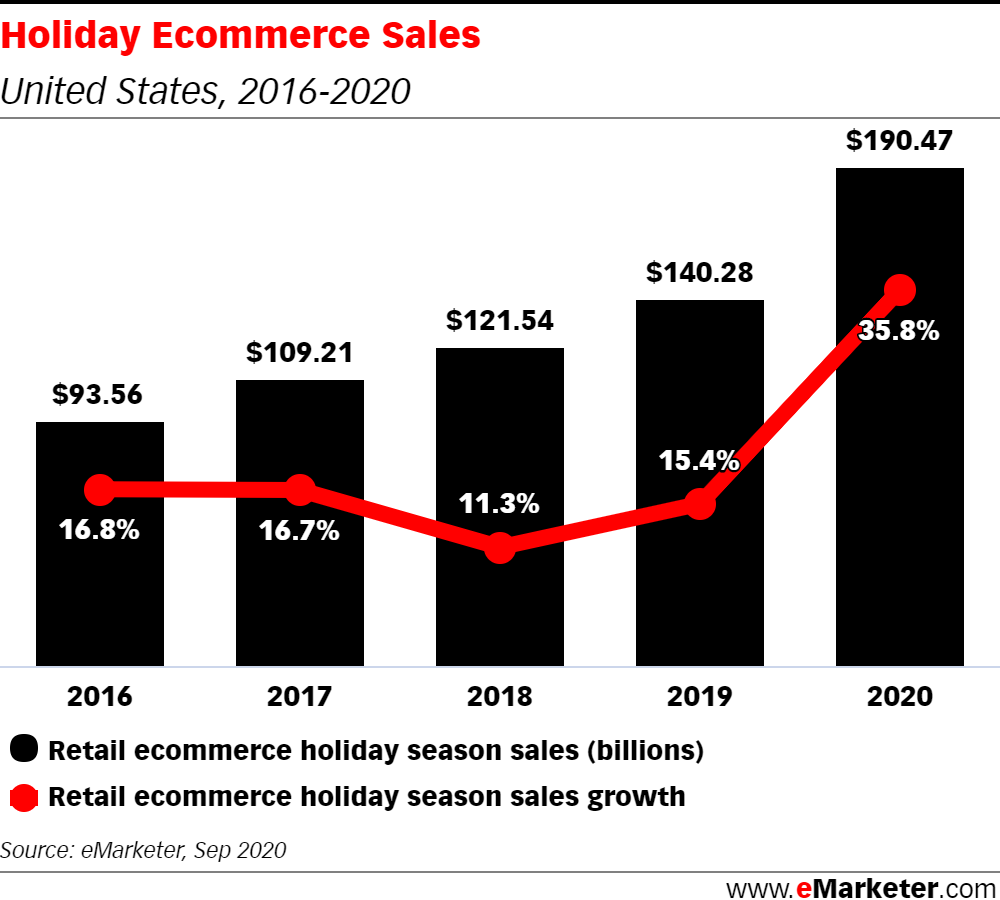
The firm predicts that total holiday season retail sales will see the lowest growth rate at just 0.9% year-over-year. This growth will come from the e-commerce sector, which will see its highest growth rate — 35.8% — since the firm began tracking retail sales in 2008. Brick-and-mortar sales, on the other hand, will decline 4.7%.

The discrepancy between these two firms’ estimates have to do with how they calculate “retail sales.”

eMarketer’s estimates include auto and gasoline sales, but exclude restaurants, travel, and event sales. NRF’s figures, on the other hand, exclude auto, gasoline and restaurants.

However, both agree on an e-commerce surge. NRF notes online sales were already up 36.7% year-over-year in the third quarter — in part, due to early holiday shopping. This year, some 42% of consumers had started shopping earlier than usual, it recently found. Plus, retail sales were up 10.6% in October 2020 versus October 2019, in aggregate, its forecast noted.

But whether it’s 20% to 30% growth or 35.8%, depending on the firm, it’s clear e-commerce is saving the day here.

NRF also expects seasonal hiring to be in line with recent years, as retailers hire between 475,000 and 575,000 seasonal workers compared with 562,000 in 2019. Some of that hiring may have already taken place in October, due to early shopping, it said.

Though Black Friday may not see the same levels of in-person shopping as in years past, brick-and-mortar retailers have made it easier to shop digitally, then either have items shipped home, picked up in-store, or even curbside. Outside of Amazon, Walmart and Target have particularly benefited from investments in e-commerce, as both retailers easily beat Wall St. expectations in their latest earnings reports, released just ahead of the holiday quarter.

Online, however, Cyber Monday will continue to rule, however, eMarketer says.

Image Credits: eMarketer

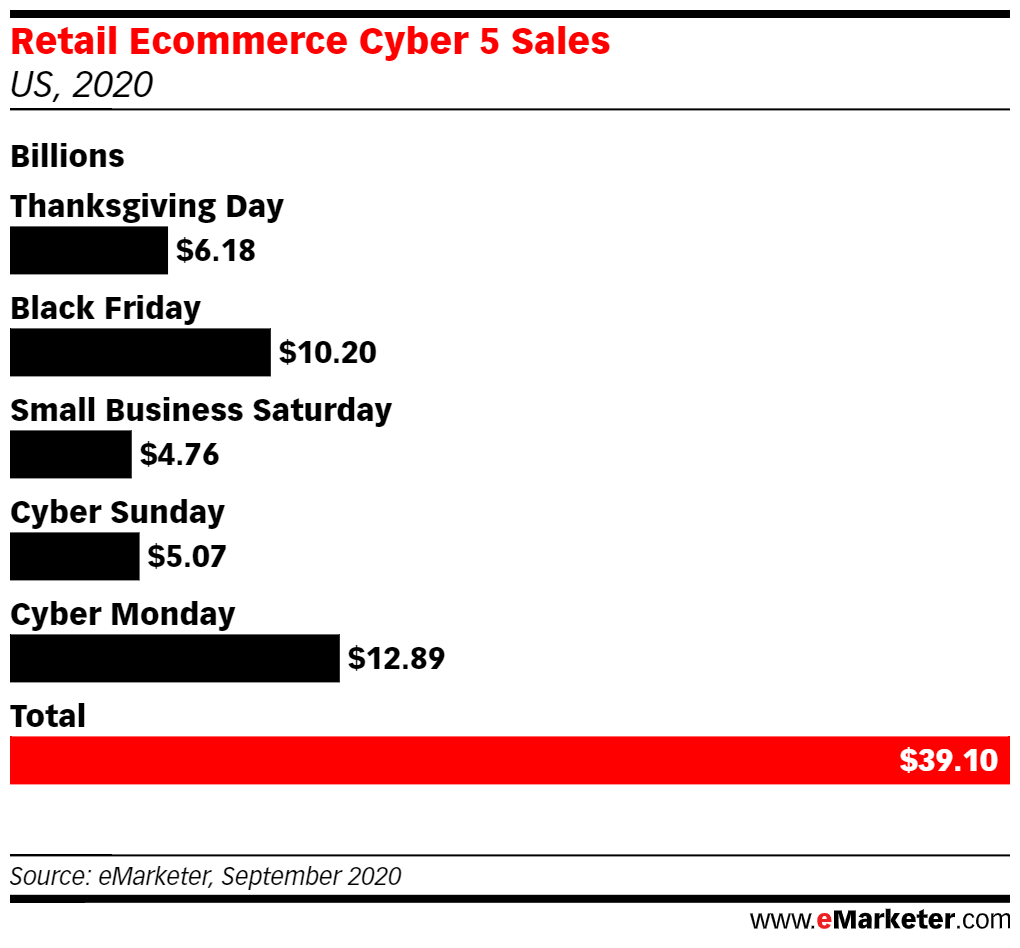
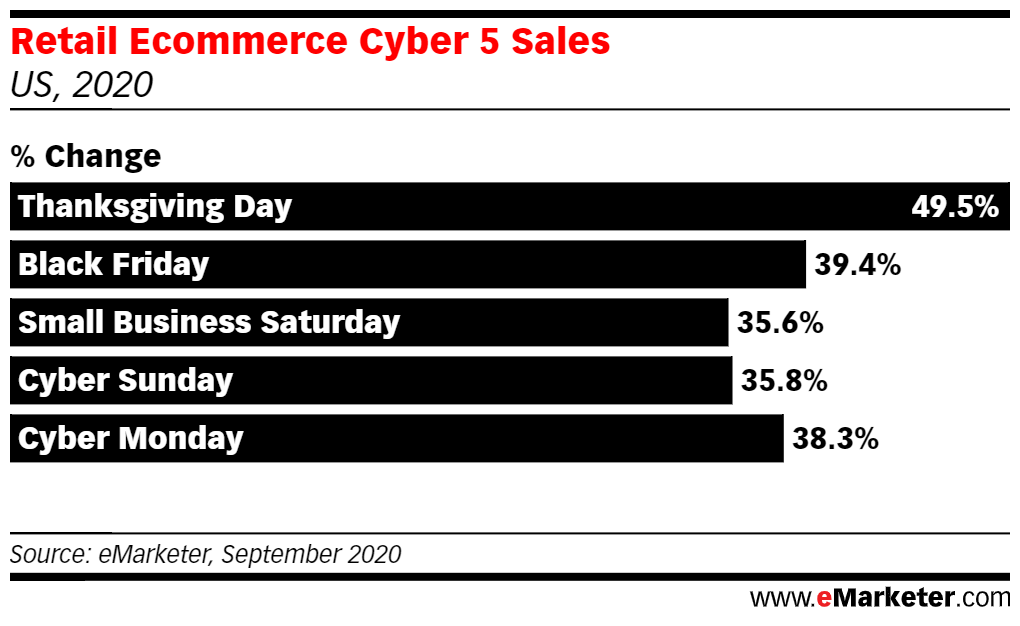
Of the five big online shopping days in 2020, eMarketer says Cyber Monday will again beat out Black Friday in terms of overall e-commerce sales, at $12.89 billion compared with Black Friday’s $10.20 billion. But Thanksgiving Day will see the most year-over-year growth in e-commerce sales, at 49.5%, followed by Black Friday, Small Business Saturday, Cyber Sunday and Cyber Monday.

Image Credits: eMarketer

In a mobile forecast, analytics firm App Annie predicted Americans would spend over 110 million hours in shopping apps on Android devices during the two-week period consisting of Black Friday and Cyber Monday weeks. It noted the pandemic had already accelerated mobile device usage to 4 hours, 20 minutes per day, and Americans spent over 61 million hours shopping during the week of Prime Day.

News: Netflix says ‘The Queen’s Gambit’ is setting viewership records

“The Queen’s Gambit” is setting viewership records at Netflix, the streaming service said today. Like all the viewership data that Netflix has released this year, these new numbers reflect how many people “chose to watch” — in other words, how many people watched at least two minutes of a given show or movie. In the case

“The Queen’s Gambit” is setting viewership records at Netflix, the streaming service said today.

Like all the viewership data that Netflix has released this year, these new numbers reflect how many people “chose to watch” — in other words, how many people watched at least two minutes of a given show or movie. In the case of “The Queen’s Gambit,” the number is 62 million households for the first 28 days of release, making it Netflix’s most popular scripted limited series ever.

You may have noticed some qualifiers there. “The Queen’s Gambit” beat out other limited series, like co-creator Scott Frank’s previous show “Godless,” but not Netflix’s biggest ongoing hits, such as “The Witcher” (76 million households watching season one). It also fell just a bit short of the limited-but-unscripted documentary series “Tiger King,” which reached 64 million households during its first four weeks.

The numbers are still pretty impressive for a series with what seems like a decidedly uncommercial premise — following a troubled young woman as she rises through the ranks of competitive chess, eventually challenging the Soviet Union’s world champion. But the series has benefited from excellent reviews (100% on Rotten Tomatoes) and the fact that it’s very, very good.

Indeed, its impact can be seen outside Netflix’s viewing numbers. The 37-year-old Walter Tevis novel on which it’s based has become a New York Times bestseller, while sales of chess sets have increased dramatically.

“Three years ago when Scott Frank … first approached us about adapting ‘The Queen’s Gambit’ — Walter Tevis’ 1983 book about a young chess prodigy — we felt it was a compelling tale,” Netflix’s vice president for original series Peter Friedlander wrote in a blog post. “Beth is an underdog who faces addiction, loss and abandonment. Her success — against the odds — speaks to the importance of perseverance, family, and finding, and staying true to yourself.”


News: Founders seeking their first check need a fundraising sales funnel

CEO and co-founder of music tech startup Stem Milana Lewis explains how she landed several superstar investors and raised a little under $22 million.

Nathan Beckord
Contributor

Nathan Beckord is CEO of Foundersuite.com, a software platform for raising capital and managing investors that has helped entrepreneurs raise over $2 billion since 2016. He is also the host of Foundersuite’s How I Raised It podcast.

Milana Lewis, CEO and co-founder of music tech startup Stem, started the fundraising process long before she actually asked any investors for money (dig the well before you’re thirsty — it’s the best way). She recommends that other founders do the same.

Ten years ago, Milana started working at United Talent Agency (UTA), one of the world’s leading talent agencies. When tasked with finding the best tools and technologies that UTA’s clients could use to self-distribute their work, she discovered a glaring gap.

“There were all these tools built for the distribution of content, monetization of content and audience development,” she says. “The last piece missing was the financial aspect.” The entertainment industry desperately needed a platform that would help artists manage the financial side of their business — and that’s how the idea for Stem was born.

Because UTA had its own investment branch, called UTA Ventures, Milana’s job also introduced her to some brilliant investors. Years later, when it was time to fundraise for Stem, those connections played a pretty big role.

In an episode of How I Raised It, Milana shared how Stem has landed some superstar investors and raised a little under $22 million.

1. Bring investors along for the ride — from the very start

Milana’s involvement with UTA Ventures exposed her to the investor experience and put her in the same room as people like Gary Vaynerchuk, Jonathon Triest from Ludlow Ventures, Anthony Saleh from Wndrco and Scooter Braun.

After meeting them the first time, she made sure to nurture those relationships, and she was “honest and vulnerable” about the fact that she wanted to be an entrepreneur one day.

“It’s amazing how much people will help and support you along in that journey,” Milana says. Investors “get excited about making early-stage investments because they want to identify that person before anyone else does.”

As her idea for Stem came together, she shared that with them, too. Over the course of a year, she provided regular updates on her vision, like how she was building out her team, and she also called them for occasional advice.

By the time she approached some of them for funding, she didn’t even need to present a full pitch. By then, they already knew enough about Stem, and about Milana as a businesswoman. Her pitch meeting with Gary Vaynerchuk — the first person to invest — ended up being just 15 minutes long.

“I brought people on my entrepreneurial journey in the beginning,” Milana says. “The biggest piece of advice I could give is to start raising a year before you start raising. Start building relationships and data points.”

2. Become best friends with systems and deadlines

For each round, Milana put together a lead list — a list of potential investors who she either met socially or through business. Each time, she wanted to have at least 100 names on this list.

WordPress Image Lightbox Plugin